
BuddhistCatholicContemplativeEvangelicalGeneral ChristianHinduJewishLatter-day SaintMuslimNew VisionsProgressive Christian
Beliefs
- Buddhist
- Catholic
- Contemplative
- Evangelical
- General Christian
- Hindu
- Jewish
- Latter-day Saint
- More Voices
- Muslim
- New Visions
- Pagan
- Progressive Christian
Topics
- Religion News
- Food and Religion
- Sports and Religion
- Religious Art
- Religious Music and Entertainment
- Religious Events
- History and Religion
- Style and Religion
- Politics and Religion
- Women in Religion
- Recreation Outdoors and Religion
- Business Finance and Religion
- Careers Workplace and Religion
- Education and Religion
- Family Parenting and Religion
- Health Fitness and Religion
- Home and Religion
- Relationships and Religion
- Technology and Religion
- Travel and Religion
Columnists
- Buddhist Columnists
- Business Finance and Religion Columnists
- Careers Workplace and Religion Columnists
- Catholic Columnists
- Contemplative Columnists
- Education and Religion Columnists
- Evangelists Columnists
- Family Parenting and Religion Columnists
- General Christian Columnists
- Health Fitness and Religion Columnists
- Hindu Columnists
- History and Religion Columnists
- Home and Religion Columnists
- Jewish Columnists
- More Voices Columnists
- Latter Day Columnists
- Muslim Columnists
- New Visions Columnists
- Nonreligious Columnists
- Pagan Columnists
- Politics and Religion Columnists
- Progressive Columnists
- Recreation Outdoors and Religion Columnists
- Relationships and Religion Columnists
- Religion News Columnists
- Religious Art Columnists
- Religious Events Columnists
- Religious Music and Entertainment Columnists
- Sports and Religion Columnists
- Style and Religion Columnists
- Technology and Religion Columnists
- Travel and Religion Columnists
- Women in Religion Columnists
Resource Library
- 2026 Calendar
- Library of World Religions
- The 100 Most Holy Places on Earth
- Patheos Answers
- Podcasts
- Videos
- Faith Leaders Database
- Anglican Episcopalian
- Bahai
- Baptist
- Buddhism
- Christianity
- Confucianism
- Eastern Orthodoxy
- Hinduism
- Holiness and Pentecostal
- ISKCON
- Islam
- Judaism
- Lutheran
- Methodist
- The Church of Jesus Christ of Latter-day Saints
- New Age
- Paganism
- Presbytarian and Reformed
- Protestantism
- Religion Behind the Scenes
- Roman Catholic
- Scientology
- Shia Islam
- Sikhism
- Sufism
- Sunni Islam
- Taoism
- Zen
- See all religions
Research Tools
 Ad-Free & Subscriber Log-In Subscription Support
Ad-Free & Subscriber Log-In Subscription Support
Follow Patheos 

- Trending:
- Forgiveness
- |
- Marriage
- |
- Consciousness
- |
- Death Penalty
- |
- Election
- |
- Halloween
 Ellen Painter Dollar
- Home
- Progressive Christian
- “We can just love them”: Adoptive Parents on Their Kids with Special Needs
“We can just love them”: Adoptive Parents on Their Kids with Special Needs
Last updated on: November 19, 2013 at 1:33 pm by Ellen Painter Dollar
“We can just love them”: Adoptive Parents on Their Kids with Special Needs 2013-11-19T13:33:27-05:00 Ellen Painter Dollar
Patheos Explore the world's faith through different perspectives on religion and spirituality! Patheos has the views of the prevalent religions and spiritualities of the world.
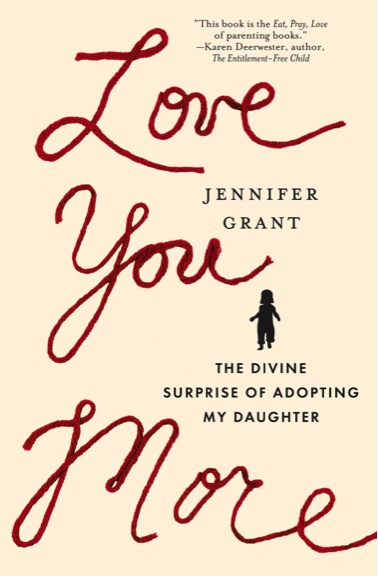 In honor of National Adoption Month, I’m featuring below an excerpt from Love You More: The Divine Surprise of Adopting My Daughter by Jennifer Grant. Love You More tells the story of how Jen and her husband David adopted their fourth child, Mia, from Guatemala. The book also does an excellent job of addressing questions, concerns, and myths about adoption. I was especially impressed with Jen’s discussion of some of adoption’s ethical quandaries, such as the fact that grinding poverty, not lack of parental desire, motivates some birth parents to relinquish their children. I have recommended Love You More to several friends who have adopted children, and they all found it honest and true to their own experiences.
In the excerpt below, Jen talks to two mothers whose children have medical or genetic conditions. If you like what you read here and want more, head on over to Amazon, where you can get the Kindle version of Love You More for only $1.99, in honor of National Adoption Month.
*********
I recently met Pam Blackburn, a mother and social worker who, like me, has a blended family or children both by birth and by adoption. Two of Pam’s children by adoption are daughters in their mid-twenties. One of them, Melissa, has cerebral palsy and is paralyzed. The other, Hannah, has Down syndrome and autism. Both sisters are nonverbal; Pam knows that no one will ever be able to grasp completely what they are truly thinking about or feeling. But she watches them closely, interprets what she believes they are trying to communicate, talks to them and cares for their needs.
Pam is a “saint,” right?
I double-dog dare you to say that to her.
“If there is anything I would love people to know about people who have adopted kids with special needs it is that we are not saints,” Pam said. “We aren’t perfect. We make mistakes. We get angry and frustrated. We laugh and cry. We have joys and challenges – just like all parents.”
Sometimes people remark that her girls are fortunate that she chose them. “I get fired up about this because, first and foremost, all children are chosen,” Pam said. “Abortion and birth control are our rights; people can choose them. I’m not saying I advocate abortion, but it is a choice. Placing a child for adoption is also a choice. So, in my mind, if you are raising a child, whether she came to you through adoption or birth, that child was chosen.”
Pam also bristles when people say how lucky her children are that she adopted them. Strangers don’t seem to believe her when Pam says that she is the lucky one. She considers herself blessed to be their mother and said that Melissa has taught her “how to love, laugh and appreciate life.”
She does not feel sorry for her daughters; she delights in them.
And what about HIV-infected children? Isn’t adopting a child with HIV tantamount to choosing the grief of burying your own child? Nope, not anymore. I spoke to Margaret Fleming about a year ago after three of her children, all of whom were adopted, had just started kindergarten. While mothers of typical kindergartners fret over whether their kids can count by twos or color within the lines, Margaret had an additional set of concerns. More crucial than her kids being able to tie their shoelaces or hold a pencil properly to Margaret are the results of regular blood draws that track CD4 counts and viral loads. Margaret’s kids are HIV positive.
Margaret is the founder of Adoption-Link, Inc., an agency in Oak Park, Illinois, through which she had placed hundreds of children, many who have special needs. It was in 2002, on a visit to meet her now nine-year-old daughter, when her eyes were opened to the crisis of children and HIV. On a visit to Vietnam, Margaret encountered a hospital ward full of children who had tested positive for HIV at birth. “The HIV ward was the hottest and most inaccessible floor of the hospital,” Margaret said. “There was an old fan turning, covered in cobwebs. The babies rocked back and forth all day long. They just sat there, never cried, never fussed. There was no music, no sound, and only a few broken plastic rattles.”
She said the caregivers held the babies at arm’s length, seemingly afraid to bring them close for fear of becoming infected with HIV themselves. On the back of the infants’ shirts, written in indelible black marker, was “HIV.”
“It was like The Scarlet Letter,” Margaret said.
According to a UNICEF report, globally about 370,000 children younger than 15 years old became infected with HIV in 2007. Most infections occur during birth or through breastfeeding. Many of these children are orphaned when their parents die of AIDS. Margaret said that a high percentage of the children languishing on the HIV ward on that day were not, in fact, HIV positive. “They probably just had the antibodies,” she said. Because infants keep their mothers’ antibodies in their bodies for more than a year, standard HIV tests given to newborns yield positive results, even when children are not infected. HIV positive babies are said to “serorevert” if subsequent HIV tests are negative; this occurs most of the time.
On returning to the U.S. from Vietnam, Margaret created an adoption program for children with HIV. “I vowed I would do something to make a dent in this AIDS pandemic,” she said. Already the mother of five children by adoption and in process to adopt one of the children on the ward, Margaret established “Chances by Choice,” a program at Adoption-Link which facilitates the adoption of children who are born with HIV. It was the first program of its kind, but now many agencies offer HIV programs.
To date, Chances by Choice has placed close to 60 children with HIV with adoptive families. Prospective parents who want to adopt a child with HIV are usually directed to Adoption-Link’s international program; it is very rare that a child in the U.S. is infected with HIV. Margaret said Chances by Choice’s Haiti program is “going great guns.” The agency works with an orphanage outside of Port-au-Prince where many HIV-affected children live.
Adopting a baby who is HIV-infected is not equivalent to adopting a child with a death sentence. With proper nutrition, medication and love, the child thrives. Some families, such as Margaret’s, are very open about the children’s HIV status. Others alert teachers or caregivers, but do not make it generally known. Children on strong antiretroviral medications have such low viral loads that although parents should take precautions like wearing rubber gloves when cleaning a cut, the fragile virus is very, very unlikely to infect anyone else.
Margaret’s children with HIV are responding well to a regimen of anti-retroviral medications. “They take their medications twice a day. I say, ‘Who wants to go first?’” Margaret said. She said that one of the medications tastes like gasoline, but following it with a spoonful of something sweet, such as chocolate pudding, eases the aftertaste. “We grind up the pills and call it the magic dust.” To manage their HIV, the children also have blood draws every three months to determine their viral load and to get a CD4 count to discern the strength of their immune systems.
The children are living normal, healthy lives, zipping around their house with doll strollers and making Batman toys fly through the air. Their mother is concerned about the long-term toxic effects of strong medications on her children’s livers, but said that “many people don’t understand that there are all kinds of medicines now and if people adhere to the regime, they’ll be fine.” She admits that she doesn’t know what course her HIV infected children’s health will take. “We do a lot outside, have a lot of fun. We can’t know what’s going to happen. We can just love them.”
To live in the moment, to celebrate my children in all of their complexity and to live by faith are all goals of mine. And I learn something about what it looks like to accomplish them when I look at people like Pam and Margaret, women who delight in their kids with “special needs.” While sometimes those of us whose children are “typically-developing” hang expectations on them the way some people put great clumps of tinsel on a Christmas tree, obscuring its real beauty, parents of kids with special needs seem more ready to stop and look at their kids and appreciate their unique gifts.
Jennifer Grant is the author of Love You More: The Divine Surprise of Adopting My Daughter, MOMumental: Adventures in the Messy Art of Raising a Family, Disquiet Time: Rants and Reflections on the Good Book by Skeptics, the Faithful, and a Few Scoundrels (co-editor, forthcoming, 2014), and 12: A Daybook for a Wholehearted Year (forthcoming, 2014). She is a grateful believer, a reader, a sometime poet, a dog lover, and, with her husband of 25 years, mother to four wonderfully creative and quirky tween and teenaged children. Learn more at jennifergrant.com.
Previous Post

November 14, 2013
The Mass Shooting You Probably Don't Know About
Next Post
November 21, 2013 Should Able-Bodied People Ever Use a Handicapped Bathroom Stall?
Browse Our Archives
Select a Category disability ethics parenthood Uncategorized
Select a Month September 2016 June 2016 May 2016 April 2016 March 2016 February 2016 January 2016 December 2015 November 2015 October 2015 September 2015 August 2015 July 2015 June 2015 May 2015 April 2015 March 2015 February 2015 January 2015 December 2014 November 2014 October 2014 September 2014 August 2014 July 2014 June 2014 May 2014 April 2014 March 2014 February 2014 January 2014 December 2013 November 2013 October 2013 September 2013 August 2013 July 2013 June 2013 May 2013 April 2013 March 2013 February 2013 January 2013 December 2012 November 2012 October 2012 September 2012 August 2012 July 2012 June 2012 May 2012 April 2012 March 2012 February 2012 January 2012 December 2011
Follow Us!
TAKE THE
Religious Wisdom Quiz
To whom did Jesus say, "Today you will be with me in paradise"?
Select your answer to see how you score.
The repentant thief Pilate Nicodemus Peter
Related posts from Ellen Painter Dollar

Disability as the Last Acceptable Prejudice: A Farewell...

The Three Worst Stories That "Me Before You"...

Consider the Birds: What happens to a writer...

A Mother's Call to Care for Other People's...
TRENDING AT PATHEOS Progressive Christian

Why Christians Have a Sacred Duty to Vote:...
The Bible offers strong support for the sacred duty to vote. Here...

What Being a Modern-Day Apostle Means to Me
In my last column, I discussed the ins and outs of modern-day...

Did Ancient China Once Worship the God of...
Across human history, a common thread weaves through the origins of the...

Love Your Neighbor – Including Earth-Kin: Lev. 19,...
God’s command to love your neighbor means acting in an ethical and...

Lead a Church Study of “Jesus and Lao...
Guest writer Jack Thomas (The Irreverent Reverend) reflects on leading his church...

Principles for Understanding the Apostolic Ministry Today
Whenever people discover that my formal ministry title is "apostle," as in...
view all Progressive Christian blogs
Ad-Free & Subscriber Log-In Subscription Support
- About Us
- 2026 Calendar
- Videos
- Podcasts
- Library of World Religions
- Faith In Media Tracker
- Advertise With Us
- Write for Us
- Privacy Policy
- Terms of Service
- Do Not Sell My Data
- Contact Us
- Radiant Digital
- Manage Newsletter Subscriptions
- Unsubscribe From Notifications
- Sitemap
Copyright 2008-2026, Patheos. All rights reserved.
Subscription Support Ad-Free & Subscriber Log-In
Follow Patheos