
BuddhistCatholicContemplativeEvangelicalGeneral ChristianHinduJewishLatter-day SaintMuslimNew VisionsProgressive Christian
Beliefs
- Buddhist
- Catholic
- Contemplative
- Evangelical
- General Christian
- Hindu
- Jewish
- Latter-day Saint
- More Voices
- Muslim
- New Visions
- Pagan
- Progressive Christian
Topics
- Religion News
- Food and Religion
- Sports and Religion
- Religious Art
- Religious Music and Entertainment
- Religious Events
- History and Religion
- Style and Religion
- Politics and Religion
- Women in Religion
- Recreation Outdoors and Religion
- Business Finance and Religion
- Careers Workplace and Religion
- Education and Religion
- Family Parenting and Religion
- Health Fitness and Religion
- Home and Religion
- Relationships and Religion
- Technology and Religion
- Travel and Religion
Columnists
- Buddhist Columnists
- Business Finance and Religion Columnists
- Careers Workplace and Religion Columnists
- Catholic Columnists
- Contemplative Columnists
- Education and Religion Columnists
- Evangelists Columnists
- Family Parenting and Religion Columnists
- General Christian Columnists
- Health Fitness and Religion Columnists
- Hindu Columnists
- History and Religion Columnists
- Home and Religion Columnists
- Jewish Columnists
- More Voices Columnists
- Latter Day Columnists
- Muslim Columnists
- New Visions Columnists
- Nonreligious Columnists
- Pagan Columnists
- Politics and Religion Columnists
- Progressive Columnists
- Recreation Outdoors and Religion Columnists
- Relationships and Religion Columnists
- Religion News Columnists
- Religious Art Columnists
- Religious Events Columnists
- Religious Music and Entertainment Columnists
- Sports and Religion Columnists
- Style and Religion Columnists
- Technology and Religion Columnists
- Travel and Religion Columnists
- Women in Religion Columnists
Resource Library
- 2026 Calendar
- Library of World Religions
- The 100 Most Holy Places on Earth
- Patheos Answers
- Podcasts
- Videos
- Faith Leaders Database
- Anglican Episcopalian
- Bahai
- Baptist
- Buddhism
- Christianity
- Confucianism
- Eastern Orthodoxy
- Hinduism
- Holiness and Pentecostal
- ISKCON
- Islam
- Judaism
- Lutheran
- Methodist
- The Church of Jesus Christ of Latter-day Saints
- New Age
- Paganism
- Presbytarian and Reformed
- Protestantism
- Religion Behind the Scenes
- Roman Catholic
- Scientology
- Shia Islam
- Sikhism
- Sufism
- Sunni Islam
- Taoism
- Zen
- See all religions
Research Tools
 Ad-Free & Subscriber Log-In Subscription Support
Ad-Free & Subscriber Log-In Subscription Support
Follow Patheos 

- Trending:
- Forgiveness
- |
- Marriage
- |
- Consciousness
- |
- Death Penalty
- |
- Election
- |
- Halloween
 Ellen Painter Dollar
- Home
- Progressive Christian
- Redeeming My Grocery Routine to Feed Those Who Are Hungry
Redeeming My Grocery Routine to Feed Those Who Are Hungry
Last updated on: November 11, 2013 at 12:49 pm by Ellen Painter Dollar
Redeeming My Grocery Routine to Feed Those Who Are Hungry 2013-11-11T12:49:57-05:00 Ellen Painter Dollar
Patheos Explore the world's faith through different perspectives on religion and spirituality! Patheos has the views of the prevalent religions and spiritualities of the world.
Of all the chores, I loathe grocery shopping the most. There are just so many steps involved—making a list (which involves a check of the fridge, the cabinets, and the calendar), pushing a heavy cart up and down aisles (and inevitably, all the way back to the produce section from the freezer aisle when I realize I forgot onions), then coming home and putting everything away (including washing the grapes and taking various snack foods out of their boxes to go into the plastic bins in our cabinets). It’s sad how often I come home from grocery shopping late in the afternoon, and end up ordering pizza for dinner—despite the full refrigerator—because I’m so wiped out from getting the groceries that I no longer have energy to cook any of them. And of course, every shopping trip ends with the realization, as I unpack the last bag, that I forgot something vital.
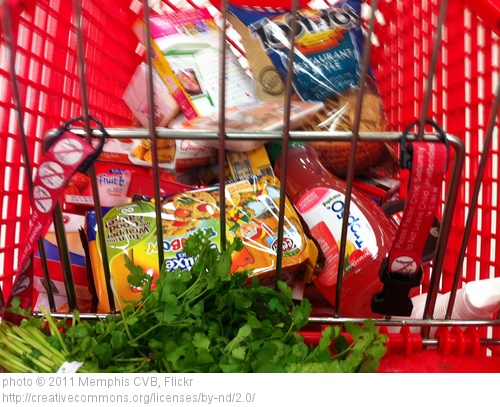 Preoccupied with how much I hate grocery shopping and the frustrations of feeding three kids who each have their own strong and frequently voiced opinions on what foods they do and don’t like, I can forget what a profound luxury it is to have enough food to feed my family, all the time.
A New York Times article on the people affected by cuts to the federal food stamps program left me convicted—that’s the only word that feels right—of my responsibility to help those who loathe grocery shopping not merely because it’s time-consuming and tiring, but because they cannot afford enough food to feed themselves or their children.
The budget cuts mean that individuals and families receiving food stamps are getting $10, $20, $30 less per month. Such amounts seem modest when I compare them with my monthly grocery expenses, but given that many food stamp recipients are already on fixed incomes from Social Security or disability payments, or work for low hourly wages, those amounts equal a significant percentage of families’ monthly food bills. The Times interviewed one man who, as of last week, only had $5 worth of food stamps left for the month, and a mother who buys her daughter’s favorite foods and forgoes her own because, she said, as an adult she can handle hunger better than her daughter can.
My Episcopal church has made feeding programs a cornerstone of our outreach efforts, and for good reason. The consequences of never having enough to eat, or never having enough healthy food to eat, go beyond hunger pangs to affect mood, energy, and long-term physical and mental health. Preparing and sharing meals are also fundamental activities that bind people together in families and communities. No wonder so many Biblical stories have food at their center—God giving the Israelites manna in the wilderness, the loaves and fishes, the last supper, and Jesus eating a breakfast of fish on the beach with his friends after his resurrection.
I began writing and fleshing out this post before hearing my rector’s sermon on Sunday, in which he focused on our feeding ministries and how we might expand and deepen them. He asked us to consider how much we could do in our local community if everyone who worships at St. James’s brought a few cans or boxes of food with us every Sunday to donate to our local food pantry. (For a couple of years, we have stationed a red wagon in the church entrance where parishioners can leave nonperishable food to be delivered to the pantry.) That Bob preached that sermon the same weekend I planned to write this post (originally published on my church blog) encouraging a deeper commitment to those who are hungry, particularly those for whom federal food stamp cuts are a huge and daily concern, makes me think that our message is ultimately coming from someone other than me and him.
After reading the Times article, I made a decision. I may loathe grocery shopping, but I must do it. And as long as I’m doing it, I will commit to buying at least one thing for the food pantry every time I buy food for my own family. If I pick up a box of Honey Nut Cheerios for my family, I’ll pick up a second for the food pantry. If pasta sauce is on sale this week but I don’t need any, I’ll buy a few jars for someone else. Until now, I’ve been haphazard in my food donations. I walk into the church cloister, see the wagon waiting to receive food donations, and think, “Oh yeah, I need to do that.” Now, I’m going to actually do it. Every time I shop.
Besides giving to a food pantry, we can help feed our neighbors by donating food to local charities with feeding programs (including those offering Thanksgiving fixings to people who can’t afford to buy it all), or giving money to food banks where nonprofits can buy donated food dirt cheap. Whatever we do, I think it’s important that our efforts be consistent and regular. Years ago, I worked for an Episcopal social service agency in D.C. with a food pantry. We got plenty of food during the food-focused holiday season. But come March, and especially come July, our shelves were far emptier. Seasonal dishes may be lighter and healthier in the summer compared with the holidays, but empty bellies are just as painful.
The miracle of the loaves and fishes is sometimes interpreted as a parable about sharing. Jesus didn’t perform a miracle—some kind of magic trick— to allow two fish and five loaves to feed thousands. The miracle was that, when the gathered multitudes saw a boy offer his meager provisions willingly to Jesus and his friends, others opened their sacks and pouches to see what bits of sustenance they too might share. When everyone gave something, even just a little, the crowd had enough to feed everyone, with leftovers.
If we all committed to remembering hungry people every time we buy groceries for our families, write our monthly checks to charities, or tell our elected representatives what we see as budgetary priorities, how might we see the miracle of the loaves and fishes embodied right in our local communities? How might we ease the burden of those trying to feed themselves and their families on dwindling food stamps? On Sunday, as we listened to Bob preach, my husband Daniel leaned over and said, “I wonder what would happen if we put larger food collection bins in the cloister. Would people fill them?” I think the answer could be yes.
Next Post

November 12, 2013 God is a Trick of the Light
Browse Our Archives
Select a Category disability ethics parenthood Uncategorized
Select a Month September 2016 June 2016 May 2016 April 2016 March 2016 February 2016 January 2016 December 2015 November 2015 October 2015 September 2015 August 2015 July 2015 June 2015 May 2015 April 2015 March 2015 February 2015 January 2015 December 2014 November 2014 October 2014 September 2014 August 2014 July 2014 June 2014 May 2014 April 2014 March 2014 February 2014 January 2014 December 2013 November 2013 October 2013 September 2013 August 2013 July 2013 June 2013 May 2013 April 2013 March 2013 February 2013 January 2013 December 2012 November 2012 October 2012 September 2012 August 2012 July 2012 June 2012 May 2012 April 2012 March 2012 February 2012 January 2012 December 2011
Follow Us!
TAKE THE
Religious Wisdom Quiz
According to Jesus, what should you do when you pray?
Select your answer to see how you score.
Pray loudly for show Only pray at church Pray in secret Pray once a year
Related posts from Ellen Painter Dollar




Hope is the Hard and Necessary Work of...
TRENDING AT PATHEOS Progressive Christian

Why Christians Have a Sacred Duty to Vote:...
The Bible offers strong support for the sacred duty to vote. Here...

What Being a Modern-Day Apostle Means to Me
In my last column, I discussed the ins and outs of modern-day...

Did Ancient China Once Worship the God of...
Across human history, a common thread weaves through the origins of the...

Love Your Neighbor – Including Earth-Kin: Lev. 19,...
God’s command to love your neighbor means acting in an ethical and...

Lead a Church Study of “Jesus and Lao...
Guest writer Jack Thomas (The Irreverent Reverend) reflects on leading his church...

Principles for Understanding the Apostolic Ministry Today
Whenever people discover that my formal ministry title is "apostle," as in...
view all Progressive Christian blogs
Ad-Free & Subscriber Log-In Subscription Support
- About Us
- 2026 Calendar
- Videos
- Podcasts
- Library of World Religions
- Faith In Media Tracker
- Advertise With Us
- Write for Us
- Privacy Policy
- Terms of Service
- Do Not Sell My Data
- Contact Us
- Radiant Digital
- Manage Newsletter Subscriptions
- Unsubscribe From Notifications
- Sitemap
Copyright 2008-2026, Patheos. All rights reserved.
Subscription Support Ad-Free & Subscriber Log-In
Follow Patheos