
BuddhistCatholicContemplativeEvangelicalGeneral ChristianHinduJewishLatter-day SaintMuslimNew VisionsProgressive Christian
Beliefs
- Buddhist
- Catholic
- Contemplative
- Evangelical
- General Christian
- Hindu
- Jewish
- Latter-day Saint
- More Voices
- Muslim
- New Visions
- Pagan
- Progressive Christian
Topics
- Religion News
- Food and Religion
- Sports and Religion
- Religious Art
- Religious Music and Entertainment
- Religious Events
- History and Religion
- Style and Religion
- Politics and Religion
- Women in Religion
- Recreation Outdoors and Religion
- Business Finance and Religion
- Careers Workplace and Religion
- Education and Religion
- Family Parenting and Religion
- Health Fitness and Religion
- Home and Religion
- Relationships and Religion
- Technology and Religion
- Travel and Religion
Columnists
- Buddhist Columnists
- Business Finance and Religion Columnists
- Careers Workplace and Religion Columnists
- Catholic Columnists
- Contemplative Columnists
- Education and Religion Columnists
- Evangelists Columnists
- Family Parenting and Religion Columnists
- General Christian Columnists
- Health Fitness and Religion Columnists
- Hindu Columnists
- History and Religion Columnists
- Home and Religion Columnists
- Jewish Columnists
- More Voices Columnists
- Latter Day Columnists
- Muslim Columnists
- New Visions Columnists
- Nonreligious Columnists
- Pagan Columnists
- Politics and Religion Columnists
- Progressive Columnists
- Recreation Outdoors and Religion Columnists
- Relationships and Religion Columnists
- Religion News Columnists
- Religious Art Columnists
- Religious Events Columnists
- Religious Music and Entertainment Columnists
- Sports and Religion Columnists
- Style and Religion Columnists
- Technology and Religion Columnists
- Travel and Religion Columnists
- Women in Religion Columnists
Resource Library
- 2026 Calendar
- Library of World Religions
- The 100 Most Holy Places on Earth
- Patheos Answers
- Podcasts
- Videos
- Faith Leaders Database
- Anglican Episcopalian
- Bahai
- Baptist
- Buddhism
- Christianity
- Confucianism
- Eastern Orthodoxy
- Hinduism
- Holiness and Pentecostal
- ISKCON
- Islam
- Judaism
- Lutheran
- Methodist
- The Church of Jesus Christ of Latter-day Saints
- New Age
- Paganism
- Presbytarian and Reformed
- Protestantism
- Religion Behind the Scenes
- Roman Catholic
- Scientology
- Shia Islam
- Sikhism
- Sufism
- Sunni Islam
- Taoism
- Zen
- See all religions
Research Tools
 Ad-Free & Subscriber Log-In Subscription Support
Ad-Free & Subscriber Log-In Subscription Support
Follow Patheos 

- Trending:
- Forgiveness
- |
- Marriage
- |
- Consciousness
- |
- Death Penalty
- |
- Election
- |
- Halloween
 Ellen Painter Dollar
- Home
- Progressive Christian
- The Radical Hospitality of Learning to Live with All My Kids’ Stuff
The Radical Hospitality of Learning to Live with All My Kids’ Stuff
Last updated on: September 30, 2013 at 8:43 am by Ellen Painter Dollar
The Radical Hospitality of Learning to Live with All My Kids’ Stuff 2013-09-30T08:43:29-04:00 Ellen Painter Dollar
Patheos Explore the world's faith through different perspectives on religion and spirituality! Patheos has the views of the prevalent religions and spiritualities of the world.
I am taking the week off from producing any new writing. Instead, I am doing a top-to-bottom clean up and clean out of our house. As we move into the season of colder weather and lots and lots of celebrations (all three kids have birthdays between now and January), I’m pining for a little more space, a little less clutter. In honor of my week of dealing with the stuff that comes along with living with three non-adults, I am re-posting this piece, originally published last March. The NYT op ed to which it responds is out of date, but the ideas aren’t.
******
Graham Hill’s op ed about living well with less in last Sunday’s New York Times started like this:
I LIVE in a 420-square-foot studio. I sleep in a bed that folds down from the wall. I have six dress shirts. I have 10 shallow bowls that I use for salads and main dishes. When people come over for dinner, I pull out my extendable dining room table. I don’t have a single CD or DVD and I have 10 percent of the books I once did.
Good for you. Let me hazard a guess: You don’t have any kids, do you?
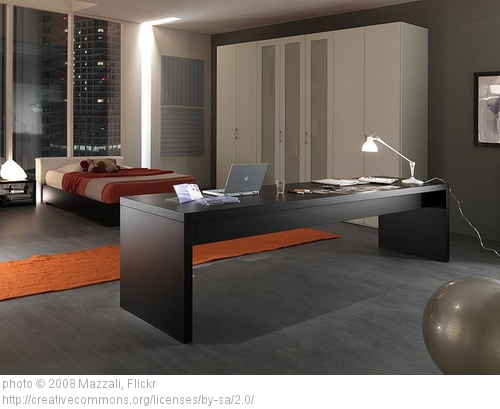
This is not Graham Hill’s home. Or mine. I have no idea whose home it is. But it seems to embody the clutter-free, streamlined aesthetic that we’re supposed to have these days. I wonder where the trash can is. And the tangle of various device chargers piled next to an outlet. And the dog’s chew toys. And the pile of overdue library books, bills to mail, and shirts to drop off at the cleaners. I also wonder what that sphere is in the foreground. You don’t have a trash can, but you have a random decorative sphere?
I regularly devour the New York Times real estate section, shelter magazines, and HGTV remodeling shows. I can just imagine Hill’s studio apartment, with its clean lines, multipurpose furniture that folds neatly out of the way, open shelving where his 10 bowls and sleek iPod dock take on the aesthetic of sculpture. As a homebody and introvert, I am drawn to the notion of sitting down to read or work in a visually quiet space, free of clutter. As someone who spent my formative 20s in a church that preached, in word and action, the art of simple living (I was one of the most impressively dressed church members merely because I was one of the only people who actually bought new clothes, ever), I am sympathetic to the environmental and psychological arguments for owning less stuff.
As a mother of three, however, I have had to learn to thrive in a visually noisy space, full of color and mess and lots and lots of stuff.
Living with less stuff requires control, which is the first thing parents give up when we have children. One of the many things over which we lose control is our home, which is now inhabited by human beings whose notions of what is pretty and what is necessary are radically different than ours.
It’s not that I don’t think children need to learn that more stuff doesn’t equal happiness. My kids are very familiar with both handed-down clothes and the word “no” in response to their many requests for new toys and clothes and iPod songs.
But in our culture, the battle for less stuff is an uphill one, and it is one I have largely stopped fighting. I have stopped standing in the doors of my children’s rooms, feeling guilty and disgusted by the piles of stuffed animals and trinkets. I have stopped winding myself up into a tizzy of cleaning and decluttering, in which I stomp around, muttering nastily about all the junk we own in a way that does not endear me to my family. Monday morning, I looked around at the clutter in the kids’ bedrooms and our living room and shrugged, having decided that I would focus my time this week on finishing up a few vital writing projects rather than cleaning and straightening. So far, it has been a good week anyway; we and the clutter are abiding together quite nicely.
In all that clutter, I also saw evidence of creativity. While it is true that kids can have more fun with a cardboard box than with the fancy toy it contains, it is also true that children are rarely content with only the box and a trio of primary-colored markers. They decide they also need tape and ribbon and paper. As I write, our basement has been transformed into a restaurant, with dozens of signs taped on the walls and myriad household objects pressed into duty as props and decor. A corner of our living room is a school for dolls, with a letter chart lining the wall and cardboard folded into books. The untrained eye would see a cluttered mess of unnecessary objects. Frankly, my eye sees a cluttered mess of unnecessary objects. How I long for a living room designed for reading by the fire and a basement playroom with a few carefully selected toys piled into color-coordinated labeled baskets and a designated office area where I pen uncluttered thoughts using a laptop that doesn’t have sticky fingerprints on it.
But wishing for such things is essentially wishing that my children, attached as they are to all of their inconvenient, messy things and rituals, did not exist.
The promise of a small home in which every object is useful and chosen is a lovely one. But it is neither easily obtainable nor unequivocally preferable. Before we moved into our current home (just under 2,000 square feet), we lived in a 1,000 square foot ranch house. I spent far more time preoccupied with our stuff, and accumulated far more stress, living in that smaller home, where every object required thought about its use, size, and storage; where every toy, down to every last Lego brick, had to be cleaned up at the end of every day because the playroom was also the living room and the home office; where even our decision to have a third child was preceded by many nights in which I nursed my second daughter while mentally rearranging the furniture in her tiny room, trying to figure out if we could potentially have two babies sleeping in there.
No doubt about it: We Americans have and want too much stuff. Our desires and our consuming have serious ramifications for our mental, familial, and planetary health. But the measure of how much is too much has less to do with absolute quantity and more to do with relationship. Does what we own control us, or vice versa? Does it interfere with or enhance how we relate to other people and our environment? Graham Hill’s vision of a one-room home with just a few carefully selected possessions is appealing, but it’s not for me. For Hill, freedom from the tyranny of stuff required opening his arms to let go of the many possessions that came along with financial success, from the 3,000 square foot home to all the latest technogadgets. For me, freedom from that same tyranny requires opening my arms to receive the mess of clutter and treasures that has come along with my three children.
Hill’s possessions made his life “unnecessarily complicated.” My children and all of their stuff make my life necessarily complicated. Children bring with them more and more and more, of everything, from small plastic objects and reams of artwork to emotional intensity, germs, and joy. I have heard more than one grandparent say that they hesitate to wipe the sticky fingerprints off their windows or clean up the glitter- and glue-based art installations left behind by their grandchildren, because they love the reminders of their homes being filled by these loud, messy, unpredictable little people. I am trying to embrace that gratitude and acceptance now, when the loud, messy, unpredictable little people are permanent residents rather than temporary visitors.
For another take on the redemption of clutter, read my post from several years ago on the “Daily Episcopalian” blog, Lessons from a Cluttered Life.
Next Post

October 16, 2013 Did the Resurrection Happen? And Does It Matter?
Browse Our Archives
Select a Category disability ethics parenthood Uncategorized
Select a Month September 2016 June 2016 May 2016 April 2016 March 2016 February 2016 January 2016 December 2015 November 2015 October 2015 September 2015 August 2015 July 2015 June 2015 May 2015 April 2015 March 2015 February 2015 January 2015 December 2014 November 2014 October 2014 September 2014 August 2014 July 2014 June 2014 May 2014 April 2014 March 2014 February 2014 January 2014 December 2013 November 2013 October 2013 September 2013 August 2013 July 2013 June 2013 May 2013 April 2013 March 2013 February 2013 January 2013 December 2012 November 2012 October 2012 September 2012 August 2012 July 2012 June 2012 May 2012 April 2012 March 2012 February 2012 January 2012 December 2011
Follow Us!
TAKE THE
Religious Wisdom Quiz
Who was Jude?
Select your answer to see how you score.
Brother of Jesus The apostle who replaced Judas Brother of Peter The first martyred apostle
Related posts from Ellen Painter Dollar

A Mother's Call to Care for Other People's...

Lenten Compline for the Weary Parent

Please Don't Post a Photo of Your Kid's...

TRENDING AT PATHEOS Progressive Christian

Why Christians Have a Sacred Duty to Vote:...
The Bible offers strong support for the sacred duty to vote. Here...

What Being a Modern-Day Apostle Means to Me
In my last column, I discussed the ins and outs of modern-day...

Did Ancient China Once Worship the God of...
Across human history, a common thread weaves through the origins of the...

Love Your Neighbor – Including Earth-Kin: Lev. 19,...
God’s command to love your neighbor means acting in an ethical and...

Lead a Church Study of “Jesus and Lao...
Guest writer Jack Thomas (The Irreverent Reverend) reflects on leading his church...

Principles for Understanding the Apostolic Ministry Today
Whenever people discover that my formal ministry title is "apostle," as in...
view all Progressive Christian blogs
Ad-Free & Subscriber Log-In Subscription Support
- About Us
- 2026 Calendar
- Videos
- Podcasts
- Library of World Religions
- Faith In Media Tracker
- Advertise With Us
- Write for Us
- Privacy Policy
- Terms of Service
- Do Not Sell My Data
- Contact Us
- Radiant Digital
- Manage Newsletter Subscriptions
- Unsubscribe From Notifications
- Sitemap
Copyright 2008-2026, Patheos. All rights reserved.
Subscription Support Ad-Free & Subscriber Log-In
Follow Patheos