
BuddhistCatholicContemplativeEvangelicalGeneral ChristianHinduJewishLatter-day SaintMuslimNew VisionsProgressive Christian
Beliefs
- Buddhist
- Catholic
- Contemplative
- Evangelical
- General Christian
- Hindu
- Jewish
- Latter-day Saint
- More Voices
- Muslim
- New Visions
- Pagan
- Progressive Christian
Topics
- Religion News
- Food and Religion
- Sports and Religion
- Religious Art
- Religious Music and Entertainment
- Religious Events
- History and Religion
- Style and Religion
- Politics and Religion
- Women in Religion
- Recreation Outdoors and Religion
- Business Finance and Religion
- Careers Workplace and Religion
- Education and Religion
- Family Parenting and Religion
- Health Fitness and Religion
- Home and Religion
- Relationships and Religion
- Technology and Religion
- Travel and Religion
Columnists
- Buddhist Columnists
- Business Finance and Religion Columnists
- Careers Workplace and Religion Columnists
- Catholic Columnists
- Contemplative Columnists
- Education and Religion Columnists
- Evangelists Columnists
- Family Parenting and Religion Columnists
- General Christian Columnists
- Health Fitness and Religion Columnists
- Hindu Columnists
- History and Religion Columnists
- Home and Religion Columnists
- Jewish Columnists
- More Voices Columnists
- Latter Day Columnists
- Muslim Columnists
- New Visions Columnists
- Nonreligious Columnists
- Pagan Columnists
- Politics and Religion Columnists
- Progressive Columnists
- Recreation Outdoors and Religion Columnists
- Relationships and Religion Columnists
- Religion News Columnists
- Religious Art Columnists
- Religious Events Columnists
- Religious Music and Entertainment Columnists
- Sports and Religion Columnists
- Style and Religion Columnists
- Technology and Religion Columnists
- Travel and Religion Columnists
- Women in Religion Columnists
Resource Library
- 2026 Calendar
- Library of World Religions
- The 100 Most Holy Places on Earth
- Patheos Answers
- Podcasts
- Videos
- Faith Leaders Database
- Anglican Episcopalian
- Bahai
- Baptist
- Buddhism
- Christianity
- Confucianism
- Eastern Orthodoxy
- Hinduism
- Holiness and Pentecostal
- ISKCON
- Islam
- Judaism
- Lutheran
- Methodist
- The Church of Jesus Christ of Latter-day Saints
- New Age
- Paganism
- Presbytarian and Reformed
- Protestantism
- Religion Behind the Scenes
- Roman Catholic
- Scientology
- Shia Islam
- Sikhism
- Sufism
- Sunni Islam
- Taoism
- Zen
- See all religions
Research Tools
 Ad-Free & Subscriber Log-In Subscription Support
Ad-Free & Subscriber Log-In Subscription Support
Follow Patheos 

- Trending:
- Forgiveness
- |
- Marriage
- |
- Consciousness
- |
- Death Penalty
- |
- Election
- |
- Halloween
 Ellen Painter Dollar
- Home
- Progressive Christian
- A Story About the Abundance, and Absence, of Memory and Faith
A Story About the Abundance, and Absence, of Memory and Faith
Last updated on: September 24, 2013 at 7:39 am by Ellen Painter Dollar
A Story About the Abundance, and Absence, of Memory and Faith 2013-09-24T07:39:20-04:00 Ellen Painter Dollar
Patheos Explore the world's faith through different perspectives on religion and spirituality! Patheos has the views of the prevalent religions and spiritualities of the world.
Alzheimer’s disease is one of the most frightening diagnoses to many of us. A decline in which we lose not only our memories, but our ability to recognize our own loved ones or care for our most basic bodily functions is assumed to be a fate worse than death. As poet and author Jeanne Murray Walker said in an interview here on Patheos:
By 2050 the incidence of Alzheimer’s is expected to quadruple worldwide. As a recent op-ed in the New York Times argued, fear of the disease causes children to abandon their parents, and parents to consider suicide, rather than live through dementia.
But Walker goes on to say more, and what she adds is vital:
What a parent has to gain from being cared for by her children may be obvious; it’s less clear what the child has to gain. But listen: taking care of my mother during her Alzheimer’s years left me with gifts that surely would not have come to me any other way.
“Listen!” says Walker in her rich, beautiful memoir of witnessing her mother’s final years, The Geography of Memory. “Listen!” says my friend David, who is blogging about his experience living with an Alzheimer’s diagnosis, and the surprising discovery that he is happier, and more emotionally open, than he ever has been. Neither writer denies the potential for Alzheimer’s to cause suffering. But they want us to know that life with Alzheimer’s, like life with many varieties of illness and misfortune, can nurture joy, connection, and a deeper awareness even as it brings heartache and pain.
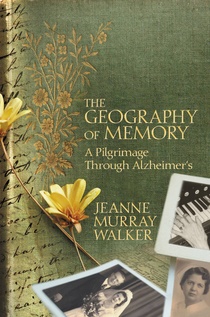 The subtitle of Walker’s book is A Pilgrimage Through Alzheimer’s. But truth be told, there is very little about Alzheimer’s itself in this book. The central subject is not a disease but a person—Walker’s strong-willed mother who hated to read but loved the Bible, whose impeccable dress gave way to a haphazard but vibrant mixing of patterns and colors in her final years, whose fundamentalist faith caused a clear but not insurmountable rift with her daughter. Walker writes of mundane struggles and griefs that will be familiar to anyone who has cared for an ailing and aging parent or in-law—the exhausting grind of caring for a parent along with children, spouse, home, and job; the circular, infuriating conversations about using a walker or moving up to the next level of assisted-living care; the fraught disagreements with siblings and the parent herself about what should be done as physical and cognitive capacities decline. Walker’s writing is anything but mundane, and her account of her mother’s final years is peppered with Walker’s childhood memories, particularly those in which she worked to separate herself from the mother whose unwavering love and personality carried her children through terribly hard times (including the death of their father), but could also feel stifling.
Walker struggled in particular to free herself from her mother’s “literal way of reading” and fundamentalist “feedback loop” of “absolute, unambiguous, dead certainty.” Her different take on faith becomes symbolized by a fluorescent green plastic cross for sale at Walker’s Christian summer camp. Her mother shunned all outward symbols of faith, crosses included. Walker writes:
My odd and secret love for the green fluorescent cross…was my earliest inkling that some life force might be stronger than the need for certainty. Following it, I discovered the shining ambiguity of this world, the endless unfolding of it, the mystery of how a tree can be both a tree and a symbol, standing for something besides itself. I found the possibility of paradox, and also the ongoing chance that I might be wrong.
It will be no surprise to my regular readers I loved all that stuff about paradox and ambiguity, nor that my favorite passages from The Geography of Memory have to do with suffering, and what the Christian faith does or doesn’t say about it. Of the cross, Walker writes:
As I sit here watching Mother, the genius of Christianity occurs to me. The story is, God entered human history and suffered. If God is eternal, then maybe that suffering is always in the “now.” I wonder what that means. I think it means God has a good memory. Two thousand years later, he still recalls what it’s like to feel confused, abandoned, hurt.
And of the possibility of heaven:
Maybe faith gives a person the ability to see whatever joy and beauty and wit flickers in the disorienting darkness. Or maybe it is the result of paying attention more to those flickers than to the darkness itself. I don’t know. How can we know for sure that the flickers are clues to how the story will end? We can’t, not for sure. Nevertheless, most mornings I wake up believing that we are perennials, not annuals. That feeling, itself, is a gift. Surely what dies will spring back to life. I suspect it was my mother who taught me that faith—good and true flower show judge that she was.
Walker writes, “it [is] our stories—our own images and emotions—that give us a way of talking to one another.” The Geography of Memory is fundamentally a good story, one that will resonate with many readers regardless of the exact form their faith takes, or whether caring for an aging and ailing parent is in their past or their future. Walker has written a story about Alzheimer’s, yes, and about her mother, and about her. But fundamentally, it is a story about memory and faith—about times when they surround and buoy us, and times when they evade our reach.
I am participating in a Patheos Book Club discussion on “The Geography of Memory.” Author Jeanne Murray Walker will be participating in a live chat with interested readers TODAY (September 24( at 12:30 p.m. Eastern. Access the chat and find more information and reviews on the Book Club page.
Christian responses to suffering
Previous Post

September 23, 2013
Why I Love Pope Francis's Radical (Not Really) Take on the Gospel
Next Post
September 27, 2013 [Snapshots from Oak Ridge] What My Kids and My Garden Have in Common
Browse Our Archives
Select a Category disability ethics parenthood Uncategorized
Select a Month September 2016 June 2016 May 2016 April 2016 March 2016 February 2016 January 2016 December 2015 November 2015 October 2015 September 2015 August 2015 July 2015 June 2015 May 2015 April 2015 March 2015 February 2015 January 2015 December 2014 November 2014 October 2014 September 2014 August 2014 July 2014 June 2014 May 2014 April 2014 March 2014 February 2014 January 2014 December 2013 November 2013 October 2013 September 2013 August 2013 July 2013 June 2013 May 2013 April 2013 March 2013 February 2013 January 2013 December 2012 November 2012 October 2012 September 2012 August 2012 July 2012 June 2012 May 2012 April 2012 March 2012 February 2012 January 2012 December 2011
Follow Us!
TAKE THE
Religious Wisdom Quiz
Who was Jude?
Select your answer to see how you score.
Brother of Jesus The apostle who replaced Judas Brother of Peter The first martyred apostle
Related posts from Ellen Painter Dollar

Disability as the Last Acceptable Prejudice: A Farewell...

The Three Worst Stories That "Me Before You"...

Prince, Chronic Pain, Opioids & Why Dependence is...

TRENDING AT PATHEOS Progressive Christian

Why Christians Have a Sacred Duty to Vote:...
The Bible offers strong support for the sacred duty to vote. Here...

What Being a Modern-Day Apostle Means to Me
In my last column, I discussed the ins and outs of modern-day...

Did Ancient China Once Worship the God of...
Across human history, a common thread weaves through the origins of the...

Love Your Neighbor – Including Earth-Kin: Lev. 19,...
God’s command to love your neighbor means acting in an ethical and...

Lead a Church Study of “Jesus and Lao...
Guest writer Jack Thomas (The Irreverent Reverend) reflects on leading his church...

Principles for Understanding the Apostolic Ministry Today
Whenever people discover that my formal ministry title is "apostle," as in...
view all Progressive Christian blogs
Ad-Free & Subscriber Log-In Subscription Support
- About Us
- 2026 Calendar
- Videos
- Podcasts
- Library of World Religions
- Faith In Media Tracker
- Advertise With Us
- Write for Us
- Privacy Policy
- Terms of Service
- Do Not Sell My Data
- Contact Us
- Radiant Digital
- Manage Newsletter Subscriptions
- Unsubscribe From Notifications
- Sitemap
Copyright 2008-2026, Patheos. All rights reserved.
Subscription Support Ad-Free & Subscriber Log-In
Follow Patheos