
BuddhistCatholicContemplativeEvangelicalGeneral ChristianHinduJewishLatter-day SaintMuslimNew VisionsProgressive Christian
Beliefs
- Buddhist
- Catholic
- Contemplative
- Evangelical
- General Christian
- Hindu
- Jewish
- Latter-day Saint
- More Voices
- Muslim
- New Visions
- Pagan
- Progressive Christian
Topics
- Religion News
- Food and Religion
- Sports and Religion
- Religious Art
- Religious Music and Entertainment
- Religious Events
- History and Religion
- Style and Religion
- Politics and Religion
- Women in Religion
- Recreation Outdoors and Religion
- Business Finance and Religion
- Careers Workplace and Religion
- Education and Religion
- Family Parenting and Religion
- Health Fitness and Religion
- Home and Religion
- Relationships and Religion
- Technology and Religion
- Travel and Religion
Columnists
- Buddhist Columnists
- Business Finance and Religion Columnists
- Careers Workplace and Religion Columnists
- Catholic Columnists
- Contemplative Columnists
- Education and Religion Columnists
- Evangelists Columnists
- Family Parenting and Religion Columnists
- General Christian Columnists
- Health Fitness and Religion Columnists
- Hindu Columnists
- History and Religion Columnists
- Home and Religion Columnists
- Jewish Columnists
- More Voices Columnists
- Latter Day Columnists
- Muslim Columnists
- New Visions Columnists
- Nonreligious Columnists
- Pagan Columnists
- Politics and Religion Columnists
- Progressive Columnists
- Recreation Outdoors and Religion Columnists
- Relationships and Religion Columnists
- Religion News Columnists
- Religious Art Columnists
- Religious Events Columnists
- Religious Music and Entertainment Columnists
- Sports and Religion Columnists
- Style and Religion Columnists
- Technology and Religion Columnists
- Travel and Religion Columnists
- Women in Religion Columnists
Resource Library
- 2026 Calendar
- Library of World Religions
- The 100 Most Holy Places on Earth
- Patheos Answers
- Podcasts
- Videos
- Faith Leaders Database
- Anglican Episcopalian
- Bahai
- Baptist
- Buddhism
- Christianity
- Confucianism
- Eastern Orthodoxy
- Hinduism
- Holiness and Pentecostal
- ISKCON
- Islam
- Judaism
- Lutheran
- Methodist
- The Church of Jesus Christ of Latter-day Saints
- New Age
- Paganism
- Presbytarian and Reformed
- Protestantism
- Religion Behind the Scenes
- Roman Catholic
- Scientology
- Shia Islam
- Sikhism
- Sufism
- Sunni Islam
- Taoism
- Zen
- See all religions
Research Tools
 Ad-Free & Subscriber Log-In Subscription Support
Ad-Free & Subscriber Log-In Subscription Support
Follow Patheos 

- Trending:
- Forgiveness
- |
- Marriage
- |
- Consciousness
- |
- Death Penalty
- |
- Election
- |
- Halloween
 Ellen Painter Dollar
- Home
- Progressive Christian
- Articulating the Mystery of Faith: Christian Wiman’s “My Bright Abyss”
Articulating the Mystery of Faith: Christian Wiman’s “My Bright Abyss”
Last updated on: May 8, 2013 at 4:00 am by Ellen Painter Dollar
Articulating the Mystery of Faith: Christian Wiman’s “My Bright Abyss” 2013-05-07T12:36:37-04:00 Ellen Painter Dollar
Patheos Explore the world's faith through different perspectives on religion and spirituality! Patheos has the views of the prevalent religions and spiritualities of the world.
We Christians are sometimes taken to task for the way that we, when embroiled in difficult conversations about whether or not God exists, chalk things up to “mystery.” Our atheist/agnostic conversation partners see this (rightly, in some cases) as a cop out, as a way of saying, “I don’t really understand why I believe, but I do believe, so I’ll just say it’s a mystery, which will end the argument because what makes a mystery mysterious is that it remains unknown and unknowable, unexplained and inexplicable.”
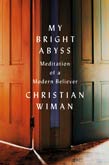 Poet Christian Wiman’s new memoir, My Bright Abyss: Meditation of a Modern Believer tells the story of Wiman’s ambivalent embracing of Christian faith, in the context of a cancer diagnosis. The events of Wiman’s life, however, take a back seat to his contemplation of God. Using poetic language, as well as actual poems (his and others’), Wiman articulates the mysteries that abide in the heart of faith—to the extent that such mysteries can be articulated at all, which is imperfectly.
Wiman explains why a living faith requires both articulated beliefs (dogma) and a mysticism that transcends language:
[M]ystical experience needs some form of dogma in order not to dissipate into moments of spiritual intensity that are merely personal, and dogma needs regular infusions of unknowingness to keep from calcifying into the predictable, pontificating, and anti-intellectual services so common in mainstream American churches. So what does all this mean practically? It means that congregations must be conscious of the persistent and ineradicable loneliness that makes a person seek communion, with other people and with God, in the first place. It means that conservative churches that are infused with the bouncy brand of American optimism one finds in sales pitches are selling shit. It means that liberal churches that go months without mentioning the name of Jesus, much less the dying Christ, have no more spiritual purpose or significance than a local union hall.
And if we claim to understand everything about our faith, if we claim a comfortable certainty with what we believe, our faith is suspect:
There is no clean intellectual coherence, no abstract ultimate meaning to be found, and if this is not recognized, then the compulsion to find such certainty becomes its own punishment. This realization is not the end of theology, but the beginning of it: trust no theory, no religious history or creed, in which the author’s personal faith is not actively at risk.
Writing about faith feels risky to me. My shortcomings become painfully obvious. For the past week or so, an atheist commenter (going by the screen name “ngotts”) has argued with many things that I and other readers have said on the blog and in the comments. I have not responded, in part for the purely practical reason that I have been focusing my limited writing time on penning future posts as well as some work I have promised to editors. But I also haven’t responded because I have been unable to find the words with which to respond. I know the essential outlines of what I believe, but I don’t know how to explain it. I know that I see the world through a very different lens than ngotts does, but I have trouble saying why or clearly explaining how that lens alters my perceptions. I wasn’t ignoring ngotts’s questions because they were bad or silly or uninteresting. I was ignoring them because they were good questions, to which I felt unable to respond in a way that would be of value.
Sometimes I wonder what the heck I’m doing, passing myself off as a Christian writer when I don’t know how to articulate why I am a Christian.
Reading Wiman’s book has given me some new perspectives on all of this—ngotts’s (and others’) questions, my difficulty in figuring out what to say in response.
Falling back on “mystery” to explain (or not really explain) faith is not necessarily a cop out. If there really is a God who created the universe and all that is in it, including intangibles like love and beauty, isn’t some allusion to mystery necessary? If God could be entirely summed up with concrete language and tidy explanations, wouldn’t we be worshiping a tiny, limited God—one not worthy of our worship?
Only the poets among us are able to access language with which to begin to kind of sort of articulate the mysteries of God. Only poetic language can begin to articulate the mysteries abiding at faith’s core.
I am not a poet. Words will continue to elude me as I try to explain why I believe as I do. But my inability to articulate the mystical core of my faith doesn’t mean that such a core exists only in my imagination. That I am utterly unable to write a decent love poem, after all, doesn’t mean that my love for my husband is superficial and questionable. It just means I’m not a poet.
Christian Wiman is a poet—a poet with feet planted (or stuck) firmly in the muck and horror and mundanity of the world, even as he seeks something beyond it (or actually, deep within it, as Wiman argues that the reality of God is tied intimately to suffering). He writes,
If God is a salve applied to unbearable psychic wounds, or a dream figure conjured out of memory and mortal terror, or an escape from a life that has become either too appalling or too banal to bear, then I have to admit: it is not working for me.
That sort of God doesn’t work for most of us. Wiman points us to a different sort of God, one we meet in humility and suffering and art and, yes, mystery. This Bright Abyss doesn’t set out to prove anything about God, which is possibly why I found it a far more convincing defense of faith than the most thorough attempt at apologetics. “What I crave now is that integration,” Wiman writes, “some speech that is true to the transcendent nature of grace yet adequate to the hard reality, in which daily faith operates. I crave, I suppose, the poetry and the prose of knowing.” Wiman’s speech points us toward that which is unspeakable, which is probably as close to articulating the mystery of God that any of us can get.
(ngotts — I hope you’ll consider reading Wiman’s book, if only to understand why we Christian non-poets so frequently give incomplete, frustrating answers to your questions.)
Next Post

May 9, 2013 The Summer When I Didn't Cherish Time with My Kids
Browse Our Archives
Select a Category disability ethics parenthood Uncategorized
Select a Month September 2016 June 2016 May 2016 April 2016 March 2016 February 2016 January 2016 December 2015 November 2015 October 2015 September 2015 August 2015 July 2015 June 2015 May 2015 April 2015 March 2015 February 2015 January 2015 December 2014 November 2014 October 2014 September 2014 August 2014 July 2014 June 2014 May 2014 April 2014 March 2014 February 2014 January 2014 December 2013 November 2013 October 2013 September 2013 August 2013 July 2013 June 2013 May 2013 April 2013 March 2013 February 2013 January 2013 December 2012 November 2012 October 2012 September 2012 August 2012 July 2012 June 2012 May 2012 April 2012 March 2012 February 2012 January 2012 December 2011
Follow Us!
TAKE THE
Religious Wisdom Quiz
What does "Peter" mean?
Select your answer to see how you score.
Light Rock Mercy Faithful
Related posts from Ellen Painter Dollar

The Three Worst Stories That "Me Before You"...



TRENDING AT PATHEOS Progressive Christian

What Being a Modern-Day Apostle Means to Me
In my last column, I discussed the ins and outs of modern-day...

Did Ancient China Once Worship the God of...
Across human history, a common thread weaves through the origins of the...

Love Your Neighbor – Including Earth-Kin: Lev. 19,...
God’s command to love your neighbor means acting in an ethical and...

Lead a Church Study of “Jesus and Lao...
Guest writer Jack Thomas (The Irreverent Reverend) reflects on leading his church...

Pastoral Wisdom for Responding to Sermon Pushback
Getting sermon pushback on your social justice sermon? Learn practical, Proverbs-based strategies...

Principles for Understanding the Apostolic Ministry Today
Whenever people discover that my formal ministry title is "apostle," as in...
view all Progressive Christian blogs
Ad-Free & Subscriber Log-In Subscription Support
- About Us
- 2026 Calendar
- Videos
- Podcasts
- Library of World Religions
- Faith In Media Tracker
- Advertise With Us
- Write for Us
- Privacy Policy
- Terms of Service
- Do Not Sell My Data
- Contact Us
- Radiant Digital
- Manage Newsletter Subscriptions
- Unsubscribe From Notifications
- Sitemap
Copyright 2008-2026, Patheos. All rights reserved.
Subscription Support Ad-Free & Subscriber Log-In
Follow Patheos