
BuddhistCatholicContemplativeEvangelicalGeneral ChristianHinduJewishLatter-day SaintMuslimNew VisionsProgressive Christian
Beliefs
- Buddhist
- Catholic
- Contemplative
- Evangelical
- General Christian
- Hindu
- Jewish
- Latter-day Saint
- More Voices
- Muslim
- New Visions
- Pagan
- Progressive Christian
Topics
- Religion News
- Food and Religion
- Sports and Religion
- Religious Art
- Religious Music and Entertainment
- Religious Events
- History and Religion
- Style and Religion
- Politics and Religion
- Women in Religion
- Recreation Outdoors and Religion
- Business Finance and Religion
- Careers Workplace and Religion
- Education and Religion
- Family Parenting and Religion
- Health Fitness and Religion
- Home and Religion
- Relationships and Religion
- Technology and Religion
- Travel and Religion
Columnists
- Buddhist Columnists
- Business Finance and Religion Columnists
- Careers Workplace and Religion Columnists
- Catholic Columnists
- Contemplative Columnists
- Education and Religion Columnists
- Evangelists Columnists
- Family Parenting and Religion Columnists
- General Christian Columnists
- Health Fitness and Religion Columnists
- Hindu Columnists
- History and Religion Columnists
- Home and Religion Columnists
- Jewish Columnists
- More Voices Columnists
- Latter Day Columnists
- Muslim Columnists
- New Visions Columnists
- Nonreligious Columnists
- Pagan Columnists
- Politics and Religion Columnists
- Progressive Columnists
- Recreation Outdoors and Religion Columnists
- Relationships and Religion Columnists
- Religion News Columnists
- Religious Art Columnists
- Religious Events Columnists
- Religious Music and Entertainment Columnists
- Sports and Religion Columnists
- Style and Religion Columnists
- Technology and Religion Columnists
- Travel and Religion Columnists
- Women in Religion Columnists
Resource Library
- 2026 Calendar
- Library of World Religions
- The 100 Most Holy Places on Earth
- Patheos Answers
- Podcasts
- Videos
- Faith Leaders Database
- Anglican Episcopalian
- Bahai
- Baptist
- Buddhism
- Christianity
- Confucianism
- Eastern Orthodoxy
- Hinduism
- Holiness and Pentecostal
- ISKCON
- Islam
- Judaism
- Lutheran
- Methodist
- The Church of Jesus Christ of Latter-day Saints
- New Age
- Paganism
- Presbytarian and Reformed
- Protestantism
- Religion Behind the Scenes
- Roman Catholic
- Scientology
- Shia Islam
- Sikhism
- Sufism
- Sunni Islam
- Taoism
- Zen
- See all religions
Research Tools
 Ad-Free & Subscriber Log-In Subscription Support
Ad-Free & Subscriber Log-In Subscription Support
Follow Patheos 

- Trending:
- Forgiveness
- |
- Marriage
- |
- Consciousness
- |
- Death Penalty
- |
- Election
- |
- Halloween
 Ellen Painter Dollar
- Home
- Progressive Christian
- “We Have to Consider the Quality of Our Children”: IVF, a Nobel Prize, and Cultural Confusion Around Reproductive Ethics
“We Have to Consider the Quality of Our Children”: IVF, a Nobel Prize, and Cultural Confusion Around Reproductive Ethics
Last updated on: December 7, 2012 at 4:00 am by Ellen Painter Dollar
“We Have to Consider the Quality of Our Children”: IVF, a Nobel Prize, and Cultural Confusion Around Reproductive Ethics 2012-12-06T09:27:26-05:00 Ellen Painter Dollar
Patheos Explore the world's faith through different perspectives on religion and spirituality! Patheos has the views of the prevalent religions and spiritualities of the world.
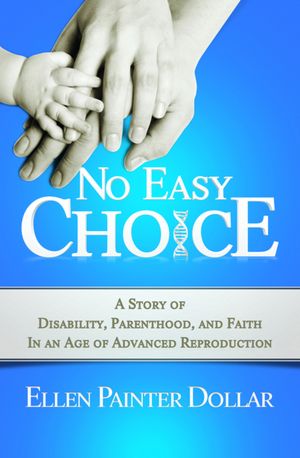
As the one-year anniversary of my book publication approaches in January, I’m devoting Fridays from now until the end of the year to revisiting the book’s major themes. Each Friday, I’ll post an excerpt from No Easy Choice: A Story of Disability, Parenthood, and Suffering in an Age of Advanced Reproduction. This week, I’m featuring a section on a Nobel prize given to a pioneer in developing in vitro fertilization (IVF), and how the media reaction to his prize shines a light on our culture’s confusion about the ethical questions raised by IVF and related technologies.
 In 2010, British biologist Robert G. Edwards won the Nobel Prize in medicine for his contribution to the development of in vitro fertilization (IVF) technology more than thirty years earlier. Edwards and his late research partner, Patrick Steptoe, pioneered the process by which the first so-called test-tube baby was born in 1978. Since then an estimated four million babies worldwide have been born as a result of IVF, in which embryos are created from eggs and sperm in a laboratory and then implanted in a woman’s uterus. As of this writing, here in the United States that process leads to the live birth of one or more infants about 30 percent of the time.
Media coverage of Edwards’s prize was noticeably superficial. Major media outlets known for rigorous reporting cited all those healthy babies and happy parents as proof that ethical concerns about reproductive technology are passé. NPR’s Robert Siegel began an interview with bioethicist Jeffrey Kahn by asking, “Have four million births through IVF trumped all the moral and ethical questions that were posed by the procedure?” Other news stories failed to address ethical questions at all, portraying Edwards as a brave pioneer who fought back against uptight alarmists. A New York Times article, for example, states:
Advances in human reproductive technology arouse people’s deepest concerns and often go through a cycle, first of outrage and charges of playing God, then of acceptance. In vitro fertilization proved no exception. “We know that I.V.F. was a great leap because Edwards and Steptoe were immediately attacked by an unlikely trinity—the press, the pope, and prominent Nobel laureates,” said the biochemist Joseph Goldstein in presenting the Lasker Award to Dr. Edwards in 2001. . . . The objections [to IVF] gradually died away—except on the part of the Roman Catholic Church—as it became clear that the babies born by in vitro fertilization were healthy and that their parents were overjoyed to be able to start a family.
When Edwards received his Nobel Prize, I was finishing [No Easy Choice], which is the culmination of a seven-year process of using my family’s story as a springboard for examining the many ethical questions posed by modern reproductive technology. I knew there was much more to the Edwards story than most media outlets reported.
I knew, for example, that the existence of all those happy families does not trump moral inquiry. Parental joy with their healthy IVF-conceived babies, while compelling and understandable, does not negate ethical concerns. I also knew that Roman Catholic leaders, while providing the most consistent and thorough Christian position on reproductive technology, are far from the only ones concerned with the moral questions it raises. Theologians from various religions, as well as bioethicists, journalists, bloggers, and regular folk faced with complex reproductive decisions regularly engage in lively, rigorous discussions about the moral implications of established and emerging technologies. Rather than the ethical questions raised by IVF diminishing as the technique has become commonplace, the number of ethical questions has actually grown as reproductive technologies—not only IVF, but also PGD, prenatal diagnosis, sperm and egg donation, and surrogacy—have become more sophisticated and ubiquitous.
I also knew the deep-seated contentment of being a mother. I knew how it felt to hold a baby in the glow of warming lights minutes after she emerged from my body. I knew the grateful amazement of realizing that the doctors and nurses were going to let me bring this baby home, to keep! I knew the visceral, fundamentally human desire for a child of one’s own, the heartache when that desire goes unfulfilled, and the joy when it is met.
But even knowing what I knew, as I continued to write about ethical concerns in the midst of the media’s uncritical assessment of Edwards’s accomplishments and the compelling portraits of happy families, I felt a little like the overly chatty aunt at a family wedding—the one who keeps reminding everyone that 50 percent of marriages end in divorce, and pointing out all the ways that the new husband and wife are polar opposites.
But I kept on writing because I also knew something else about Robert Edwards, something that appeared in very few of the news stories about his Nobel Prize. In 1999, Edwards did an interview with London’s Sunday Times, in which he said,
“Soon it will be a sin of parents to have a child that carries the heavy burden of genetic disease. We are entering a world where we have to consider the quality of our children.”
Edwards was referring to the use of PGD, which allows embryos created through IVF to be tested for genetic mutations, most commonly for those causing genetic disorders that affect children, such as Tay-Sachs disease, cystic fibrosis, Down syndrome, or my own genetic disorder, OI. In addition, PGD can be used to detect mutations for adult-onset diseases with a genetic component (such as Alzheimer’s, Huntington’s, and breast cancer), and genes for nondisease traits such as eye color, as well as determine whether an embryo is male or female. Clinicians and parents can thus select embryos with or without a particular trait to be implanted into a woman’s uterus.
On the surface, PGD is a straightforward medical technique. It gives families with a history of genetic anomalies, like mine, an opportunity to banish the physical and emotional pain of a disorder from their family forever. But Edwards’s statement about PGD reveals the potential for this technology to be used and misused in ways that could forever alter our perspective on sickness and health, parental choice and responsibility, and what makes a human being valuable. Edwards’s use of the word “sin” raises the terrible possibility that parents will bear ultimate responsibility for their children’s health—and be punished (by having essential medical or educational services withheld from their disabled children, for example) if they choose not to use available technology to ensure genetically healthy offspring. His use of the word “quality” makes clear how reproductive technology tempts us to commodify our children and transform them from gifts to be welcomed as they are, to products manufactured to parental and cultural specifications, literally subjected to quality control.
Will reproductive technologies such as PGD inevitably lead us down a slippery slope to a Brave New World society in which children are produced to meet the criteria set by a consumer society? Not necessarily. In this book I argue that these technologies pose significant moral questions that deserve our attention. I also encourage readers to pay attention to the stories of parents who have used IVF, PGD, and other reproductive technologies. Although egregious abuses of and dangerous attitudes toward such technologies exist, the stories of those who use these technologies are often the stories of loving, thoughtful parents who made the best decisions they could, given their circumstances—parents who love their children as gifts to be accepted as they are, not as engineered products.
Previous Post

December 6, 2012
Can the Christmas Rush Be Meaningful?
Browse Our Archives
Select a Category disability ethics parenthood Uncategorized
Select a Month September 2016 June 2016 May 2016 April 2016 March 2016 February 2016 January 2016 December 2015 November 2015 October 2015 September 2015 August 2015 July 2015 June 2015 May 2015 April 2015 March 2015 February 2015 January 2015 December 2014 November 2014 October 2014 September 2014 August 2014 July 2014 June 2014 May 2014 April 2014 March 2014 February 2014 January 2014 December 2013 November 2013 October 2013 September 2013 August 2013 July 2013 June 2013 May 2013 April 2013 March 2013 February 2013 January 2013 December 2012 November 2012 October 2012 September 2012 August 2012 July 2012 June 2012 May 2012 April 2012 March 2012 February 2012 January 2012 December 2011
Follow Us!
TAKE THE
Religious Wisdom Quiz
What was the name of the Jewish ruling council in Jesus’ time?
Select your answer to see how you score.
Sanhedrin Pharisees Sadducees Essenes
Related posts from Ellen Painter Dollar

Disability as the Last Acceptable Prejudice: A Farewell...

The Three Worst Stories That "Me Before You"...

Prince, Chronic Pain, Opioids & Why Dependence is...

A Mother's Call to Care for Other People's...
TRENDING AT PATHEOS Progressive Christian

What Being a Modern-Day Apostle Means to Me
In my last column, I discussed the ins and outs of modern-day...

Did Ancient China Once Worship the God of...
Across human history, a common thread weaves through the origins of the...

Love Your Neighbor – Including Earth-Kin: Lev. 19,...
God’s command to love your neighbor means acting in an ethical and...

Lead a Church Study of “Jesus and Lao...
Guest writer Jack Thomas (The Irreverent Reverend) reflects on leading his church...

Pastoral Wisdom for Responding to Sermon Pushback
Getting sermon pushback on your social justice sermon? Learn practical, Proverbs-based strategies...

Principles for Understanding the Apostolic Ministry Today
Whenever people discover that my formal ministry title is "apostle," as in...
view all Progressive Christian blogs
Ad-Free & Subscriber Log-In Subscription Support
- About Us
- 2026 Calendar
- Videos
- Podcasts
- Library of World Religions
- Faith In Media Tracker
- Advertise With Us
- Write for Us
- Privacy Policy
- Terms of Service
- Do Not Sell My Data
- Contact Us
- Radiant Digital
- Manage Newsletter Subscriptions
- Unsubscribe From Notifications
- Sitemap
Copyright 2008-2026, Patheos. All rights reserved.
Subscription Support Ad-Free & Subscriber Log-In
Follow Patheos