
BuddhistCatholicContemplativeEvangelicalGeneral ChristianHinduJewishLatter-day SaintMuslimNew VisionsProgressive Christian
Beliefs
- Buddhist
- Catholic
- Contemplative
- Evangelical
- General Christian
- Hindu
- Jewish
- Latter-day Saint
- More Voices
- Muslim
- New Visions
- Pagan
- Progressive Christian
Topics
- Religion News
- Food and Religion
- Sports and Religion
- Religious Art
- Religious Music and Entertainment
- Religious Events
- History and Religion
- Style and Religion
- Politics and Religion
- Women in Religion
- Recreation Outdoors and Religion
- Business Finance and Religion
- Careers Workplace and Religion
- Education and Religion
- Family Parenting and Religion
- Health Fitness and Religion
- Home and Religion
- Relationships and Religion
- Technology and Religion
- Travel and Religion
Columnists
- Buddhist Columnists
- Business Finance and Religion Columnists
- Careers Workplace and Religion Columnists
- Catholic Columnists
- Contemplative Columnists
- Education and Religion Columnists
- Evangelists Columnists
- Family Parenting and Religion Columnists
- General Christian Columnists
- Health Fitness and Religion Columnists
- Hindu Columnists
- History and Religion Columnists
- Home and Religion Columnists
- Jewish Columnists
- More Voices Columnists
- Latter Day Columnists
- Muslim Columnists
- New Visions Columnists
- Nonreligious Columnists
- Pagan Columnists
- Politics and Religion Columnists
- Progressive Columnists
- Recreation Outdoors and Religion Columnists
- Relationships and Religion Columnists
- Religion News Columnists
- Religious Art Columnists
- Religious Events Columnists
- Religious Music and Entertainment Columnists
- Sports and Religion Columnists
- Style and Religion Columnists
- Technology and Religion Columnists
- Travel and Religion Columnists
- Women in Religion Columnists
Resource Library
- 2026 Calendar
- Library of World Religions
- The 100 Most Holy Places on Earth
- Patheos Answers
- Podcasts
- Videos
- Faith Leaders Database
- Anglican Episcopalian
- Bahai
- Baptist
- Buddhism
- Christianity
- Confucianism
- Eastern Orthodoxy
- Hinduism
- Holiness and Pentecostal
- ISKCON
- Islam
- Judaism
- Lutheran
- Methodist
- The Church of Jesus Christ of Latter-day Saints
- New Age
- Paganism
- Presbytarian and Reformed
- Protestantism
- Religion Behind the Scenes
- Roman Catholic
- Scientology
- Shia Islam
- Sikhism
- Sufism
- Sunni Islam
- Taoism
- Zen
- See all religions
Research Tools
 Ad-Free & Subscriber Log-In Subscription Support
Ad-Free & Subscriber Log-In Subscription Support
Follow Patheos 

- Trending:
- Forgiveness
- |
- Marriage
- |
- Consciousness
- |
- Death Penalty
- |
- Election
- |
- Halloween
 Ellen Painter Dollar
- Home
- Progressive Christian
- Why I am Grateful to Be an Episcopalian: Part 1 – A Detour into Evangelicalism
Why I am Grateful to Be an Episcopalian: Part 1 – A Detour into Evangelicalism
Last updated on: November 19, 2012 at 4:00 am by Ellen Painter Dollar
Why I am Grateful to Be an Episcopalian: Part 1 – A Detour into Evangelicalism 2012-11-16T10:19:07-05:00 Ellen Painter Dollar
Patheos Explore the world's faith through different perspectives on religion and spirituality! Patheos has the views of the prevalent religions and spiritualities of the world.
Patheos has invited bloggers to reflect this month on what we are grateful for in our spiritual lives. As I was considering that focus, I was also contemplating a question I received from a reader via email about what denominations I might recommend for a committed Christian who tends to lean left on political and social issues. I am no denominational expert or church sociologist, so the only way I know how to answer that last question is to share how I have found a home in the Episcopal Church. I decided to bring these two strains of thought together—gratitude for what has influenced my spiritual life, finding a church/denomination where I am at home—into a three-part blog series on “Why I am Grateful to Be an Episcopalian.” Parts 1 and 2 are short versions of my spiritual autobiography, explaining how I started out as an Episcopalian, tried some other things, and ended up back in the Episcopal Church. Part 3 will more directly answer the question of why I am grateful to be an Episcopalian.
The short answer to why I’m an Episcopalian is that I was raised in the Episcopal Church, because my father is an ordained Episcopal priest. In my heavily Catholic peer group growing up, telling people that my father was a priest earned perplexed, slightly worried glances. I find that today, in the evangelical-rich Christian milieu in which I write, telling people that I am an Episcopalian earns similarly perplexed, occasionally worried responses.
I spent enough years immersed in evangelicalism (in college) to know that Episcopalians are often not assumed to be “Christians” the way evangelicals are Christians. Our ready-made, decidedly unspontaneous prayers, our focus on potlucks and food pantries rather than “Do you know Jesus?” evangelism, our reputation as establishment churches full of folk more concerned about their investment portfolios and the whereabouts of their next drink than the state of their eternal souls (surely you’ve heard that old joke, “Wherever there are four Episcopalians, you’re sure to find a fifth”)—all of these conspire to make Episcopalians, and members of other traditional mainline churches, suspect in evangelical eyes. In my college milieu, Episcopalians weren’t as suspect as the Catholics, who were the subject of glossy paperbacks blaring questions such as, “Can you be Catholic and Christian?!” But we were suspect enough.
After college, I joined a small urban coffee-house church that was much more liberal socially and politically than my college fellowship, but equally dubious of mainliners. In part, this was because our nontraditional worship and structure (we had no clergy, for example) attracted those who had been deeply hurt or turned off in some way by mainline churches. But the suspicion also spilled over into the same territory as that of conservative evangelicals—suspicion that the saying of the same old rote prayers every week in old buildings where people dressed up for Sunday worship could not possibly embody a vibrant, personal, life- and culture-changing faith.
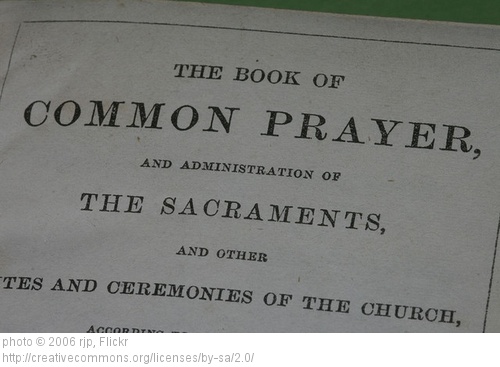 To some extent, that is probably true. Traditional mainline churches are bound to attract traditional, middle-of-the-road folk. They can be attractive places for people who are more comfortable repeating a memorized confession than dwelling at length on their individual and corporate sins, much less on what a young Jew’s tortured execution on a cross might have to do with those sins; for people who aren’t sure they really believe everything in the Nicene Creed and so stand silently, anonymously, while the rest of the congregation says it, confident that in this buttoned-up place, there will be no altar calls, no in-your-face demands to say once and for all if you accept Jesus as your personal lord and savior.
I admit that, during my evangelical college years, I saw the Episcopal Church of my childhood as an overly comfortable, non-demanding place. When a personal crisis of isolation and identity forced me to decide what, after all, I really believed, and led me to cling to Gospel promises (along with a new Christian social group), I found the more open, casual evangelical vibe to be just what I needed. I needed to talk about Jesus and what he had to do with MY life. I needed people to point me to the wisdom of scripture. I needed to pray spontaneous, heartfelt prayers, holding hands in a circle with my new friends. I needed to sing and clap in praise.
I remember thinking, “Why am I learning all of this stuff about Jesus only now, despite spending my entire life going to church?” It was my father who pointed out the obvious, which was that the churches we attended for my entire childhood, the hymns and anthems I sang with the church choir, the scriptures read from the lectern, the sermons given from the pulpit—all of these articulated the same truths that I was now discovering. That God loves the world, his creation. That God loves me. That Jesus Christ offers humanity’s, and my, best hope of redemption and renewal. That we all sin and fall short of what God wants for us, and God always stands ready to pick us up, help us dust ourselves off, and continue to feed us on the journey to wholeness of self and love for others. I had heard these truths my whole life in church, but it took a crisis to get me to really ponder them. That I ultimately heard these truths in an evangelical context didn’t mean that evangelicalism held the keys to the kingdom and Episcopalianism was a sham. It just meant that God is very creative and uses whatever means necessary to reach out to those he loves.
After college, I spent nine years in that little coffee-house church in D.C., where I met and married my husband. He grew up in the Methodist church and, like me, had a central and enriching college faith experience through the Baptist Student Union. So in 1999, we moved from D.C. to Connecticut without a commitment to a particular denomination. We began a process of “church shopping” that helped us refine and define what exactly we were—and weren’t—looking for in a church.
Come back tomorrow for Part 2!
Previous Post

November 16, 2012
Which Story Do You Live By?
Browse Our Archives
Select a Category disability ethics parenthood Uncategorized
Select a Month September 2016 June 2016 May 2016 April 2016 March 2016 February 2016 January 2016 December 2015 November 2015 October 2015 September 2015 August 2015 July 2015 June 2015 May 2015 April 2015 March 2015 February 2015 January 2015 December 2014 November 2014 October 2014 September 2014 August 2014 July 2014 June 2014 May 2014 April 2014 March 2014 February 2014 January 2014 December 2013 November 2013 October 2013 September 2013 August 2013 July 2013 June 2013 May 2013 April 2013 March 2013 February 2013 January 2013 December 2012 November 2012 October 2012 September 2012 August 2012 July 2012 June 2012 May 2012 April 2012 March 2012 February 2012 January 2012 December 2011
Follow Us!
TAKE THE
Religious Wisdom Quiz
What instrument did David play?
Select your answer to see how you score.
Lyre Harp Trumpet Flute
Related posts from Ellen Painter Dollar




Redefining "Fruitful": Is Procreation a Divine Mandate?
TRENDING AT PATHEOS Progressive Christian

Why Christians Have a Sacred Duty to Vote:...
The Bible offers strong support for the sacred duty to vote. Here...

What Being a Modern-Day Apostle Means to Me
In my last column, I discussed the ins and outs of modern-day...

Did Ancient China Once Worship the God of...
Across human history, a common thread weaves through the origins of the...

Love Your Neighbor – Including Earth-Kin: Lev. 19,...
God’s command to love your neighbor means acting in an ethical and...

Lead a Church Study of “Jesus and Lao...
Guest writer Jack Thomas (The Irreverent Reverend) reflects on leading his church...

Principles for Understanding the Apostolic Ministry Today
Whenever people discover that my formal ministry title is "apostle," as in...
view all Progressive Christian blogs
Ad-Free & Subscriber Log-In Subscription Support
- About Us
- 2026 Calendar
- Videos
- Podcasts
- Library of World Religions
- Faith In Media Tracker
- Advertise With Us
- Write for Us
- Privacy Policy
- Terms of Service
- Do Not Sell My Data
- Contact Us
- Radiant Digital
- Manage Newsletter Subscriptions
- Unsubscribe From Notifications
- Sitemap
Copyright 2008-2026, Patheos. All rights reserved.
Subscription Support Ad-Free & Subscriber Log-In
Follow Patheos