
BuddhistCatholicContemplativeEvangelicalGeneral ChristianHinduJewishLatter-day SaintMuslimNew VisionsProgressive Christian
Beliefs
- Buddhist
- Catholic
- Contemplative
- Evangelical
- General Christian
- Hindu
- Jewish
- Latter-day Saint
- More Voices
- Muslim
- New Visions
- Pagan
- Progressive Christian
Topics
- Religion News
- Food and Religion
- Sports and Religion
- Religious Art
- Religious Music and Entertainment
- Religious Events
- History and Religion
- Style and Religion
- Politics and Religion
- Women in Religion
- Recreation Outdoors and Religion
- Business Finance and Religion
- Careers Workplace and Religion
- Education and Religion
- Family Parenting and Religion
- Health Fitness and Religion
- Home and Religion
- Relationships and Religion
- Technology and Religion
- Travel and Religion
Columnists
- Buddhist Columnists
- Business Finance and Religion Columnists
- Careers Workplace and Religion Columnists
- Catholic Columnists
- Contemplative Columnists
- Education and Religion Columnists
- Evangelists Columnists
- Family Parenting and Religion Columnists
- General Christian Columnists
- Health Fitness and Religion Columnists
- Hindu Columnists
- History and Religion Columnists
- Home and Religion Columnists
- Jewish Columnists
- More Voices Columnists
- Latter Day Columnists
- Muslim Columnists
- New Visions Columnists
- Nonreligious Columnists
- Pagan Columnists
- Politics and Religion Columnists
- Progressive Columnists
- Recreation Outdoors and Religion Columnists
- Relationships and Religion Columnists
- Religion News Columnists
- Religious Art Columnists
- Religious Events Columnists
- Religious Music and Entertainment Columnists
- Sports and Religion Columnists
- Style and Religion Columnists
- Technology and Religion Columnists
- Travel and Religion Columnists
- Women in Religion Columnists
Resource Library
- 2026 Calendar
- Library of World Religions
- The 100 Most Holy Places on Earth
- Patheos Answers
- Podcasts
- Videos
- Faith Leaders Database
- Anglican Episcopalian
- Bahai
- Baptist
- Buddhism
- Christianity
- Confucianism
- Eastern Orthodoxy
- Hinduism
- Holiness and Pentecostal
- ISKCON
- Islam
- Judaism
- Lutheran
- Methodist
- The Church of Jesus Christ of Latter-day Saints
- New Age
- Paganism
- Presbytarian and Reformed
- Protestantism
- Religion Behind the Scenes
- Roman Catholic
- Scientology
- Shia Islam
- Sikhism
- Sufism
- Sunni Islam
- Taoism
- Zen
- See all religions
Research Tools
 Ad-Free & Subscriber Log-In Subscription Support
Ad-Free & Subscriber Log-In Subscription Support
Follow Patheos 

- Trending:
- Forgiveness
- |
- Marriage
- |
- Consciousness
- |
- Death Penalty
- |
- Election
- |
- Halloween
 Ellen Painter Dollar
- Home
- Progressive Christian
- What the Real St. Nicholas Teaches Us About Gift Giving
What the Real St. Nicholas Teaches Us About Gift Giving
Last updated on: November 27, 2012 at 4:00 am by Ellen Painter Dollar
What the Real St. Nicholas Teaches Us About Gift Giving 2012-11-26T14:27:19-05:00 Ellen Painter Dollar
Patheos Explore the world's faith through different perspectives on religion and spirituality! Patheos has the views of the prevalent religions and spiritualities of the world.
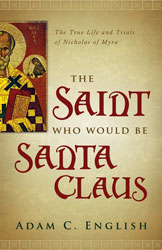 When I picked up Adam C. English’s new book, The Saint Who Would be Santa Claus: The True Life and Trials of Nicholas of Myra, I hoped for insights into how a fourth century bishop in what is now Turkey became our generous, child-loving symbol of Christmas giving. To an extent, I was disappointed. St. Nicholas of Myra left no letters or other written material, so what is known about him comes from a patchwork of other historical sources, some of them inaccurate, conflating the life of this St. Nicholas with another St. Nicholas who lived two centuries later, and others bordering on fairy tale. Furthermore, most of what Adam English tells us about St. Nicholas has no obvious connection to our Santa Claus. I was hoping to collect some heartwarming stories about St. Nick’s love for and generosity to children that I could share with my own kids, as a way of linking our Christian holiday celebrations with secular and commercial traditions. But it turns out that St. Nicholas of Myra was associated more with seafaring and money lending than with children.
So, short of portraying Santa Claus delivering gifts on water skis pulled by eight tiny porpoises, or buying all of our gifts at the neighborhood pawn shop, how can we allow the original St. Nicholas to inform our modern-day merrymaking?
Consider one of the two stories most often told about St. Nicholas of Myra: A man living in extreme poverty decided he had no choice but to sell his three daughters into prostitution. He understood that by doing so, not only was he dooming his daughters, he was also effectively abandoning his faith in God. (English points out that selling one’s children was, unfortunately, not unheard of in the ancient world.) St. Nicholas, moved by the family’s plight, threw a bag of gold coins into the family’s home in the middle of the night. When the father woke in the morning to find the coins—enough to provide a dowry for one of his daughters so he could marry her off rather than selling her off—he praised God in his joy and gratitude. Moved by the father’s transformation, Nicholas threw another bag of gold into the family’s home the next night, providing enough for the second daughter’s dowry. Glorifying God, the father once again responded in gratitude, daring to hope that a third gift would allow his third daughter to marry. Sure enough, when once again a bag of gold was thrown into his window in the middle of the night, the father rushed outside to find that Nicholas was his benefactor. With tears of thanksgiving, the father said to Nicholas, “If it were not for your goodness, which was stirred up by our Lord Jesus Christ, I would have long since consigned my life to ruin and shame.”
In this story, we see some obvious connections between St. Nicholas and Santa Claus, as they both give gifts surreptitiously in the dark of night. In some versions of the story, the gold coins landed in the daughters’ stockings, which were hanging by the fire to dry. Beyond seeing some faint echoes of Santa Claus in this ancient story, I see several lessons that we might apply to our own gift giving this Christmas.
The gift was focused on the recipient’s needs, not the giver’s. English points out that in this story, “Nicholas demonstrated the value of intentional, targeted giving; that is, giving in order to meet specific needs as opposed to giving randomly for the sake of generosity or for ridding oneself of possessions.” I am always disheartened by Christmas store displays or catalog pages labeled simply “Gifts.” Items given this generic label tend to be generic things: candles, picture frames, electric shavers, perfume, fancy chocolates. There is, of course, nothing wrong with giving someone a candle or electric shaver if they will truly enjoy and use such items. But so much of our gift giving, at Christmas and at other times of year (such as the inevitable search for the perfect teacher gift in June) stems from a sense of obligation, a desire to be recognized as generous, the need to meet social expectations, or the desire to get “buy gifts” checked off on our overlong to-do lists, rather than from a desire to give the recipient something he or she really needs. For those on our gift lists whose basic needs are already generously met, we might at least choose gifts they will really use or appreciate. Choosing three or four special gifts for our kids that reflect their passions and personalities takes much more time and effort than trolling the aisles of Target, picking up whatever catches my eye and hoping that a huge pile of gifts under the tree will guarantee that a few hit the mark. Joining forces with other families to buy teachers gifts that they might actually use takes more time and effort than adding to their vast and useless collections of “World’s Best Teacher” mugs. But though it requires some extra attention, our gift-giving ought to be focused, as St. Nicholas’s was, on the recipients rather than our own needs and vision—and that includes honoring the wishes of those who ask that we not buy them a gift.
The gift was given anonymously. While the father eventually figured out that Nicholas was his benefactor, the saint initially honored the Biblical injunction that “when you give to the needy, do not announce it with trumpets, as the hypocrites do in the synagogues and on the streets, to be honored by men” (Matthew 6:5). Giving children gifts marked “From Santa” may be our first or only experience of giving without expecting anything in return. When we give in Santa’s name, we get no thank you note, no boisterous exclamation that, “You’re the best mom ever!” Instead, we get the satisfaction of seeing our gift being received with joy. Or, we may see our gift set aside or ignored by an overwhelmed, worn out child. Giving anonymously forces us to ask why we give in the first place: To feel good about ourselves? To get recognition and thanks? Out of obligation? To get a particular response from the recipient? Out of gratitude for all we have? Because it feels good to meet another’s need? Because God asks us to?
A gift of “ordinary goodness” led to extraordinary transformation. Unlike stories about other saints popular in early Christianity, this story about St. Nicholas involves neither miracles nor extreme (and extremely painful) acts of asceticism or martyrdom. As English describes,
“Here was a young man—not even a bishop [yet] and certainly not an ascetic monk nor a trained theologian—performing a seemingly random act of kindness on behalf of three poor girls…The girls were not daughters of the emperor or some other celebrity; they were like anyone else caught in the trap of poverty and hunger, a trap that ensnared millions of faceless and nameless individuals in the ancient world. Their choices were enslavement, forced prostitution, homelessness, starvation. And Nicholas saved them.”
Most of us who choose to follow Christ will not become saints. We will not become famous for our work with the poor or for founding a vibrant new church or for writing a best-selling book that will lead millions of readers to deepen their faith. Most of us will exercise our faith through daily acts of “ordinary goodness” that meet the often mundane needs of others, whether by tending to children day after day, bringing a sandwich to the homeless man at our bus stop, or listening to an elderly relative tell the same stories over and over. The story of St. Nicholas and the three daughters illustrates how acts of ordinary goodness can lead to extraordinary transformation. Not only were the daughters saved from desperate lives of want and degradation, but the father who had abandoned God in his desperation ended up with his faith rekindled through Nicholas’s generosity.
I hope that receiving gifts that I have carefully chosen to match their personalities and passions helps my children know that they are loved for exactly who they are, and empowers them to both explore those passions and love others for who they are. I hope that giving gifts in Santa’s name reinforces for us the Biblical notion that giving is best done anonymously. I hope that by modeling St. Nicholas’s ordinary goodness, we might help bring about extraordinary transformation in our lives and the lives of those to whom we give gifts of all kinds this Christmas.
I wrote this post for a Patheos Book Club Roundtable, where you can read other bloggers’ reviews of this book.
The Saint Who Would Be Santa Claus
Previous Post

November 26, 2012
A Proposal for a Longer Christmas Season...In the OTHER Direction
Next Post
November 29, 2012 No Amount of Yoga or Perseverence Will Allow Me to Run
Browse Our Archives
Select a Category disability ethics parenthood Uncategorized
Select a Month September 2016 June 2016 May 2016 April 2016 March 2016 February 2016 January 2016 December 2015 November 2015 October 2015 September 2015 August 2015 July 2015 June 2015 May 2015 April 2015 March 2015 February 2015 January 2015 December 2014 November 2014 October 2014 September 2014 August 2014 July 2014 June 2014 May 2014 April 2014 March 2014 February 2014 January 2014 December 2013 November 2013 October 2013 September 2013 August 2013 July 2013 June 2013 May 2013 April 2013 March 2013 February 2013 January 2013 December 2012 November 2012 October 2012 September 2012 August 2012 July 2012 June 2012 May 2012 April 2012 March 2012 February 2012 January 2012 December 2011
Follow Us!
TAKE THE
Religious Wisdom Quiz
What animal tricked Eve in the garden?
Select your answer to see how you score.
A lion A serpent A fox A wolf
Related posts from Ellen Painter Dollar

The Three Worst Stories That "Me Before You"...


A Mother's Call to Care for Other People's...

Lenten Compline for the Weary Parent
TRENDING AT PATHEOS Progressive Christian

What Being a Modern-Day Apostle Means to Me
In my last column, I discussed the ins and outs of modern-day...

Did Ancient China Once Worship the God of...
Across human history, a common thread weaves through the origins of the...

Love Your Neighbor – Including Earth-Kin: Lev. 19,...
God’s command to love your neighbor means acting in an ethical and...

Lead a Church Study of “Jesus and Lao...
Guest writer Jack Thomas (The Irreverent Reverend) reflects on leading his church...

Pastoral Wisdom for Responding to Sermon Pushback
Getting sermon pushback on your social justice sermon? Learn practical, Proverbs-based strategies...

Principles for Understanding the Apostolic Ministry Today
Whenever people discover that my formal ministry title is "apostle," as in...
view all Progressive Christian blogs
Ad-Free & Subscriber Log-In Subscription Support
- About Us
- 2026 Calendar
- Videos
- Podcasts
- Library of World Religions
- Faith In Media Tracker
- Advertise With Us
- Write for Us
- Privacy Policy
- Terms of Service
- Do Not Sell My Data
- Contact Us
- Radiant Digital
- Manage Newsletter Subscriptions
- Unsubscribe From Notifications
- Sitemap
Copyright 2008-2026, Patheos. All rights reserved.
Subscription Support Ad-Free & Subscriber Log-In
Follow Patheos