
BuddhistCatholicContemplativeEvangelicalGeneral ChristianHinduJewishLatter-day SaintMuslimNew VisionsProgressive Christian
Beliefs
- Buddhist
- Catholic
- Contemplative
- Evangelical
- General Christian
- Hindu
- Jewish
- Latter-day Saint
- More Voices
- Muslim
- New Visions
- Pagan
- Progressive Christian
Topics
- Religion News
- Food and Religion
- Sports and Religion
- Religious Art
- Religious Music and Entertainment
- Religious Events
- History and Religion
- Style and Religion
- Politics and Religion
- Women in Religion
- Recreation Outdoors and Religion
- Business Finance and Religion
- Careers Workplace and Religion
- Education and Religion
- Family Parenting and Religion
- Health Fitness and Religion
- Home and Religion
- Relationships and Religion
- Technology and Religion
- Travel and Religion
Columnists
- Buddhist Columnists
- Business Finance and Religion Columnists
- Careers Workplace and Religion Columnists
- Catholic Columnists
- Contemplative Columnists
- Education and Religion Columnists
- Evangelists Columnists
- Family Parenting and Religion Columnists
- General Christian Columnists
- Health Fitness and Religion Columnists
- Hindu Columnists
- History and Religion Columnists
- Home and Religion Columnists
- Jewish Columnists
- More Voices Columnists
- Latter Day Columnists
- Muslim Columnists
- New Visions Columnists
- Nonreligious Columnists
- Pagan Columnists
- Politics and Religion Columnists
- Progressive Columnists
- Recreation Outdoors and Religion Columnists
- Relationships and Religion Columnists
- Religion News Columnists
- Religious Art Columnists
- Religious Events Columnists
- Religious Music and Entertainment Columnists
- Sports and Religion Columnists
- Style and Religion Columnists
- Technology and Religion Columnists
- Travel and Religion Columnists
- Women in Religion Columnists
Resource Library
- 2026 Calendar
- Library of World Religions
- The 100 Most Holy Places on Earth
- Patheos Answers
- Podcasts
- Videos
- Faith Leaders Database
- Anglican Episcopalian
- Bahai
- Baptist
- Buddhism
- Christianity
- Confucianism
- Eastern Orthodoxy
- Hinduism
- Holiness and Pentecostal
- ISKCON
- Islam
- Judaism
- Lutheran
- Methodist
- The Church of Jesus Christ of Latter-day Saints
- New Age
- Paganism
- Presbytarian and Reformed
- Protestantism
- Religion Behind the Scenes
- Roman Catholic
- Scientology
- Shia Islam
- Sikhism
- Sufism
- Sunni Islam
- Taoism
- Zen
- See all religions
Research Tools
 Ad-Free & Subscriber Log-In Subscription Support
Ad-Free & Subscriber Log-In Subscription Support
Follow Patheos 

- Trending:
- Forgiveness
- |
- Marriage
- |
- Consciousness
- |
- Death Penalty
- |
- Election
- |
- Halloween
 Ellen Painter Dollar
- Home
- Progressive Christian
- The Summer of My Bench (or, Everyday Resurrections)
The Summer of My Bench (or, Everyday Resurrections)
Last updated on: August 14, 2012 at 4:00 am by Ellen Painter Dollar
The Summer of My Bench (or, Everyday Resurrections) 2012-08-13T16:08:50-04:00 Ellen Painter Dollar
Patheos Explore the world's faith through different perspectives on religion and spirituality! Patheos has the views of the prevalent religions and spiritualities of the world.
I spend several hours a day sitting on this bench in our front yard.
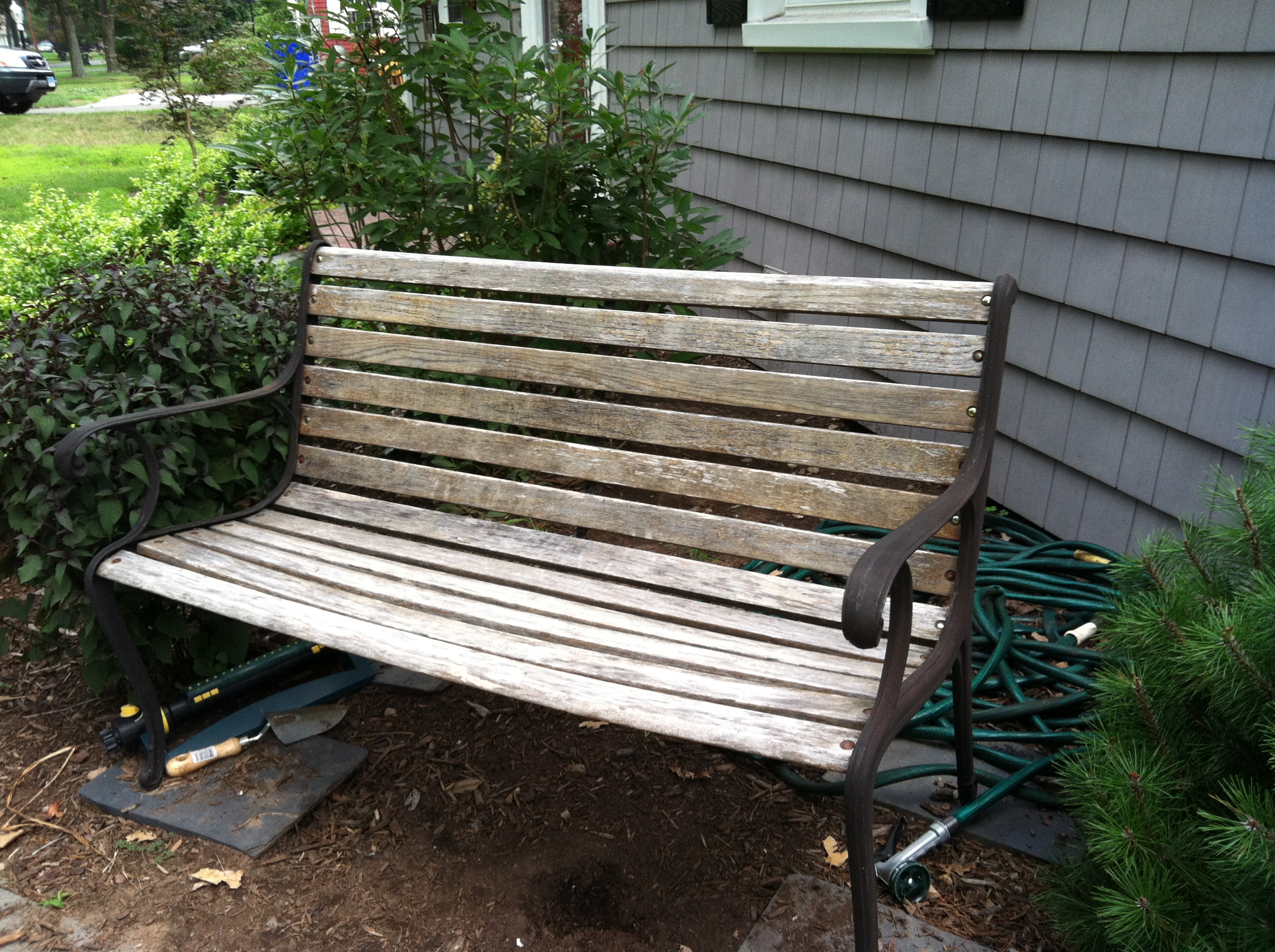
I do this to keep our puppy, Sunday, company as she roams the yard. I want to keep an eye on her to make sure she’s respecting the boundaries of our electric fence. Plus our neighborhood is home to coyotes and foxes, and in the past week neighbors have reported black bear and bobcat sightings, so I’m not comfortable with the pup—such inviting prey—being outside for long stretches by herself. Also, she likes my company.
So I bring my morning coffee or lunch out here, play Words with Friends, check e-mail, read, or work. In fact, I’m writing this blog post from my bench. It can get hot when the sun is high, but then again, I’m finding that warmth relieves my arthritis joint pain quite nicely, so am willing to put up with being a little too hot for the relief it brings.
We bought this bench five summers ago, the first summer we lived here, after having dozens of trees cut down, and a new lawn, new stone walkway, and new garden beds installed. This is what the yard and house looked like when we bought it.
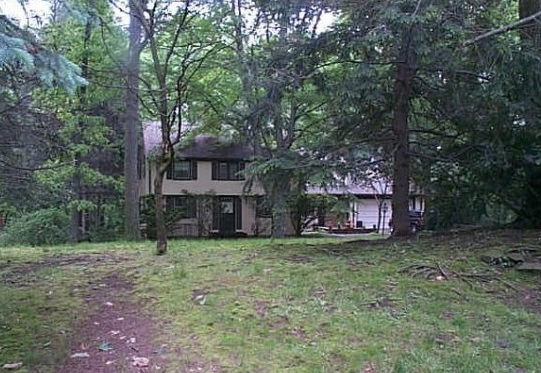
This house was darkness made tangible, so that you felt swallowed up into another, more sinister, and immeasurably sadder world the minute you stepped onto the property. The yard was shrouded in trees, the ground a hodgepodge of roots, mud, and moss. The interior was dominated by noxious dark brown carpet, while the upstairs hallway ceiling was black with mold. The house told a story, its darkness more than physical. The man who owned it had buried his wife about five years before, when she was far too young. And as far as we could tell, the life contained in that house—their life, his life—simply stopped when she died. Her clothes remained in the closet. Stains from the last days of her illness had soaked through the awful carpeting to the wood floors. When anything broke—a branch pierced the roof, bricks fell away from the chimney, the basement door was jimmied open—it simply stayed that way. That basement door, for example, simply stood open, flapping in the breeze, so that the basement filled with chipmunks and mice and the runoff from every rainstorm.
The owner finally decided to sell the house when he got remarried. And despite the mold, the mice, and the shower tiles coated with a brown film that we decided was nicotine from a chronic bathroom smoker, we saw in this house and its huge yard (three-quarters of an acre, which is gargantuan for our town, dominated as it is by quarter-acre lots) a place where we could raise our children until they left for college. Daniel peeled wallpaper from walls and ceilings (!), my mother scrubbed the knotty pine kitchen cabinets to reveal that they are actually several shades lighter than they originally appeared, my father tore up the hideous brown carpet, and I hired exterminators and masons and roofers and waterproofers and a couple of rough characters with a backhoe to hook the house up to the town sewers. The day we closed on the house, Tom—our general contractor—finished up work on our friends’ family room addition and came immediately around the corner to our house, where he gutted bathrooms, replaced doors and windows, painted, shored up the back porch, and did dozens of other jobs to turn a house that was literally unfit for human habitation into our family home.
The day we moved in, we had a working toilet in one bathroom, a working sink in another, and no working shower. When we came down to the kitchen in the morning, the drawers were all pushed out where legions of mice had emerged from their hiding places in the walls to do God knows what while we slept. The dining room was still papered in dark gold floral, with all the window trim and moldings painted a matching vomit-colored gold. The kitchen and living room walls would remain naked and unpainted for months.
Nevertheless, we moved in knowing this was probably it for us—the last major move barring an unexpected change of job. This “diamond in the rough,” as the real estate listing optimistically called it, would become our children’s primary definition of “home.”
And I felt strongly then, as I do now, that this house is more than a house, more even than a family’s home. It is testament to the power of resurrection, of new life rising from death and decay. In making this dark and sad and dysfunctional house into a bright and warm and functional home over the past five years, we have been engaged not merely in an act of service to our family, but in a witness to the power of hope, light, and love to overcome despair, darkness, and grief. In offering ourselves—our hard work, our routines of meals and chores and movie nights, our highs and lows as a family—to this house, we also allowed it to tell a new story. It does not tell the HGTV-approved story of decluttered, renovated efficiency, beauty, and style. The crabgrass thrives alongside the daylilies and hydrangeas, and our kitchen remains a model of 1950s knotty pine rusticity. But it does tell a story of the boisterous, contentious, full life of a family in which children are growing into themselves. A story of new life.
Today, as I sit on my bench watching the puppy play, this is what I see:
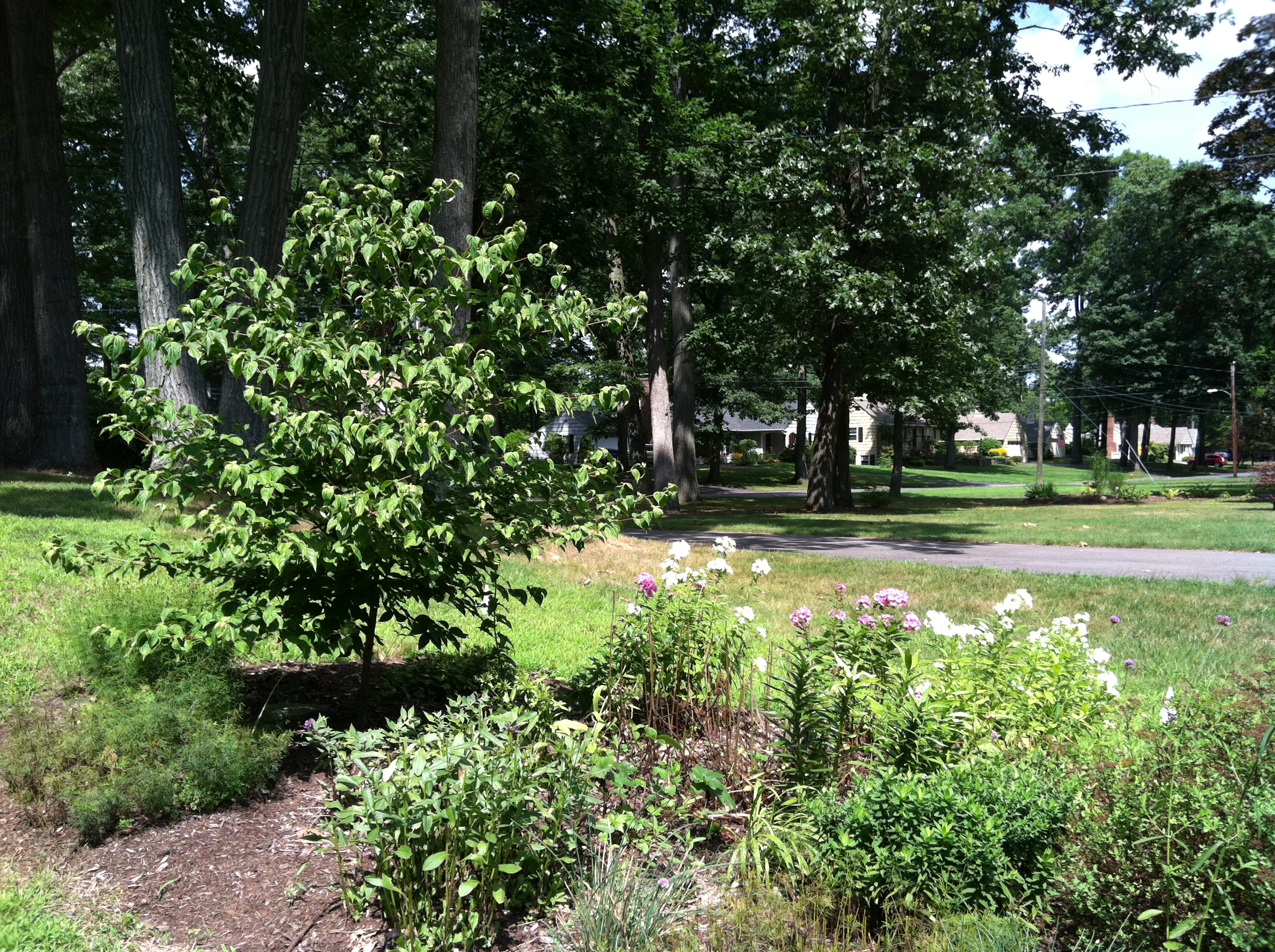
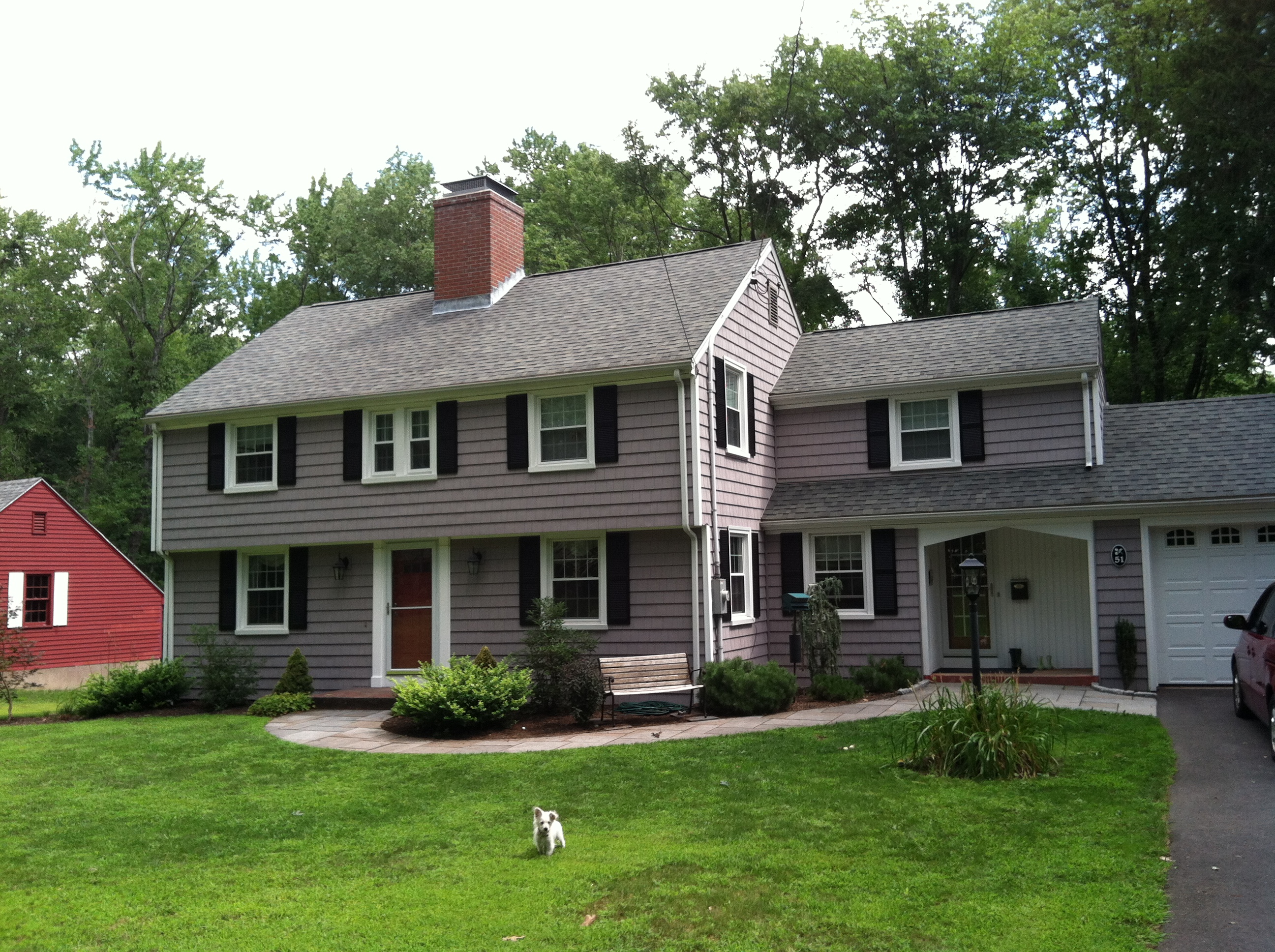
When it comes right down to it, this is why I am a Christian. I believe not only in the Resurrection—in an empty tomb in Palestine two thousand years ago and all that means for humanity—but also in everyday resurrections. Like a dead house being reborn into a lively home for a growing family. Like a friendly puppy frolicking in the same yard where we tried so hard to make a timid, anxious dog into a thriving family pet, and ultimately failed. Like the summertime itself, the season I have always disliked for its enervating heat and humidity and my childhood associations with summer surgeries, becoming a season that I can savor for its long days with time for sitting on a bench in the sun while the puppy digs and the children play, even if I will never love it.
These everyday resurrections point to the truth that I cling to when faced with darkness, whether in my own home or in the world: that light is stronger than dark, that love is stronger than death, and that “neither death nor life, neither angels nor demons, neither the present nor the future, nor any powers, neither height nor depth, nor anything else in all creation, will be able to separate us from the love of God that is in Christ Jesus our Lord.” (Romans 8:38–39).
Previous Post

August 8, 2012
Does Prenatal Testing Equal Eugenics?
Next Post
August 21, 2012 The Myth of the Overscheduled Child
Browse Our Archives
Select a Category disability ethics parenthood Uncategorized
Select a Month September 2016 June 2016 May 2016 April 2016 March 2016 February 2016 January 2016 December 2015 November 2015 October 2015 September 2015 August 2015 July 2015 June 2015 May 2015 April 2015 March 2015 February 2015 January 2015 December 2014 November 2014 October 2014 September 2014 August 2014 July 2014 June 2014 May 2014 April 2014 March 2014 February 2014 January 2014 December 2013 November 2013 October 2013 September 2013 August 2013 July 2013 June 2013 May 2013 April 2013 March 2013 February 2013 January 2013 December 2012 November 2012 October 2012 September 2012 August 2012 July 2012 June 2012 May 2012 April 2012 March 2012 February 2012 January 2012 December 2011
Follow Us!
TAKE THE
Religious Wisdom Quiz
What kind of bird brought Noah a sign of dry land?
Select your answer to see how you score.
A sparrow A raven An eagle A dove
Related posts from Ellen Painter Dollar

Disability as the Last Acceptable Prejudice: A Farewell...

The Three Worst Stories That "Me Before You"...

In Hamilton vs. Orlando, I Choose Hamilton

Prince, Chronic Pain, Opioids & Why Dependence is...
TRENDING AT PATHEOS Progressive Christian

Why Christians Have a Sacred Duty to Vote:...
The Bible offers strong support for the sacred duty to vote. Here...

What Being a Modern-Day Apostle Means to Me
In my last column, I discussed the ins and outs of modern-day...

Did Ancient China Once Worship the God of...
Across human history, a common thread weaves through the origins of the...

Love Your Neighbor – Including Earth-Kin: Lev. 19,...
God’s command to love your neighbor means acting in an ethical and...

Lead a Church Study of “Jesus and Lao...
Guest writer Jack Thomas (The Irreverent Reverend) reflects on leading his church...

Principles for Understanding the Apostolic Ministry Today
Whenever people discover that my formal ministry title is "apostle," as in...
view all Progressive Christian blogs
Ad-Free & Subscriber Log-In Subscription Support
- About Us
- 2026 Calendar
- Videos
- Podcasts
- Library of World Religions
- Faith In Media Tracker
- Advertise With Us
- Write for Us
- Privacy Policy
- Terms of Service
- Do Not Sell My Data
- Contact Us
- Radiant Digital
- Manage Newsletter Subscriptions
- Unsubscribe From Notifications
- Sitemap
Copyright 2008-2026, Patheos. All rights reserved.
Subscription Support Ad-Free & Subscriber Log-In
Follow Patheos