
BuddhistCatholicContemplativeEvangelicalGeneral ChristianHinduJewishLatter-day SaintMuslimNew VisionsProgressive Christian
Beliefs
- Buddhist
- Catholic
- Contemplative
- Evangelical
- General Christian
- Hindu
- Jewish
- Latter-day Saint
- More Voices
- Muslim
- New Visions
- Pagan
- Progressive Christian
Topics
- Religion News
- Food and Religion
- Sports and Religion
- Religious Art
- Religious Music and Entertainment
- Religious Events
- History and Religion
- Style and Religion
- Politics and Religion
- Women in Religion
- Recreation Outdoors and Religion
- Business Finance and Religion
- Careers Workplace and Religion
- Education and Religion
- Family Parenting and Religion
- Health Fitness and Religion
- Home and Religion
- Relationships and Religion
- Technology and Religion
- Travel and Religion
Columnists
- Buddhist Columnists
- Business Finance and Religion Columnists
- Careers Workplace and Religion Columnists
- Catholic Columnists
- Contemplative Columnists
- Education and Religion Columnists
- Evangelists Columnists
- Family Parenting and Religion Columnists
- General Christian Columnists
- Health Fitness and Religion Columnists
- Hindu Columnists
- History and Religion Columnists
- Home and Religion Columnists
- Jewish Columnists
- More Voices Columnists
- Latter Day Columnists
- Muslim Columnists
- New Visions Columnists
- Nonreligious Columnists
- Pagan Columnists
- Politics and Religion Columnists
- Progressive Columnists
- Recreation Outdoors and Religion Columnists
- Relationships and Religion Columnists
- Religion News Columnists
- Religious Art Columnists
- Religious Events Columnists
- Religious Music and Entertainment Columnists
- Sports and Religion Columnists
- Style and Religion Columnists
- Technology and Religion Columnists
- Travel and Religion Columnists
- Women in Religion Columnists
Resource Library
- 2026 Calendar
- Library of World Religions
- The 100 Most Holy Places on Earth
- Patheos Answers
- Podcasts
- Videos
- Faith Leaders Database
- Anglican Episcopalian
- Bahai
- Baptist
- Buddhism
- Christianity
- Confucianism
- Eastern Orthodoxy
- Hinduism
- Holiness and Pentecostal
- ISKCON
- Islam
- Judaism
- Lutheran
- Methodist
- The Church of Jesus Christ of Latter-day Saints
- New Age
- Paganism
- Presbytarian and Reformed
- Protestantism
- Religion Behind the Scenes
- Roman Catholic
- Scientology
- Shia Islam
- Sikhism
- Sufism
- Sunni Islam
- Taoism
- Zen
- See all religions
Research Tools
 Ad-Free & Subscriber Log-In Subscription Support
Ad-Free & Subscriber Log-In Subscription Support
Follow Patheos 

- Trending:
- Forgiveness
- |
- Marriage
- |
- Consciousness
- |
- Death Penalty
- |
- Election
- |
- Halloween
 Ellen Painter Dollar
- Home
- Progressive Christian
- Who Should Read My Book? And Why?
Who Should Read My Book? And Why?
Last updated on: March 7, 2012 at 4:00 am by Ellen Painter Dollar
Who Should Read My Book? And Why? 2012-03-06T12:40:02-05:00 Ellen Painter Dollar
Patheos Explore the world's faith through different perspectives on religion and spirituality! Patheos has the views of the prevalent religions and spiritualities of the world.
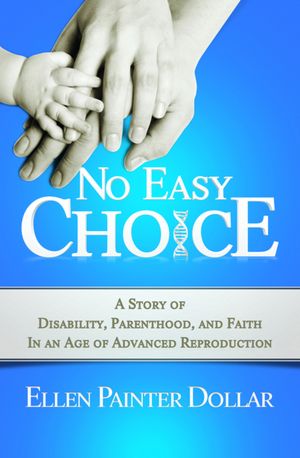 Yesterday, I had a great conversation at a local coffeehouse with Rick Green, a columnist from the Hartford Courant. Rick concluded his interview by asking two very important questions: Who should read No Easy Choice? And why? (He also asked why I didn’t end the book with a clear conclusion that reproductive technologies are a good or bad thing, or that using such technologies is right or wrong. I’ll tackle that question tomorrow.)
So who should read my book? Or perhaps the better way to phrase this is, who do I hope will read this book? And why?
1. Parents or parents-to-be facing complex reproductive decisions.
I wrote the sort of book that I wish Daniel and I had back in 2002, when we were deciding whether or not to use preimplantation genetic diagnosis (PGD) to ensure that our second child would not inherit my bone disorder. Though we were fortunate to have several friends willing to talk things through with us, for the most part, we and our loved ones weren’t even sure what questions to ask, much less how to answer them. By laying out some of the big ethical questions around reproductive technologies, I hope to give other people facing difficult reproductive decisions some helpful direction and resources.
2. Pastors and others called upon to counsel people facing complex reproductive decisions.
Daniel and I also discovered that fellow Christians and pastors, while faithful, kind, and well-intentioned, were poorly equipped to help us sort through the moral and theological questions raised by our situation. As reproductive technologies grow in scope and capability, more and more people sitting in our church pews on Sunday mornings will face decisions about whether and how to use them. And no longer are these technologies only relevant for people with long-term infertility or a family history of disabling genetic conditions (although those people will continue to need support and counsel as well).
Today, a young woman’s gynecologist might ask her if she would like to freeze some of her eggs to use in her 40s, so she can spend her 20s and 30s building a successful career without the distraction of her biological clock. A young man who has watched his mother and sister fight breast cancer might wonder if he and his wife should do preimplantation genetic diagnosis (PGD) to ensure that their children do not inherit one of the BRCA genes that predispose people to such cancers. An elderly couple whose childbearing is long past might be bewildered and troubled by their adult child’s interest in hiring an Indian surrogate to bear a child on his or her behalf.
If and when any of these people go to their pastors for guidance and support, those pastors need to be informed about reproductive technologies—what they can and can’t do, and the significant ethical, theological, medical, emotional, and financial questions they raise. I see my book as a starting point for pastors who want to provide informed counsel, as well as other professionals in similar roles, such as pastoral counselors.
3. Medical professionals involved in reproductive technologies.
When my own genetic counselor read my book a few weeks ago, I asked if she could see herself recommending it to other patients. She said yes, and that the book also gave her a deeper understanding of how Christian faith and ethical concerns might influence her patients’ decisions. The medical professionals involved in reproductive medicine, including genetic counselors, physicians, nurses, and others, need such an understanding in order to provide compassionate, supportive care to patients. Fertility clinics are notorious for being high-pressure, success-focused environments that provide little time, support, or consideration for the non-medical dilemmas patients face, from finances to ethics. I hope that reading my book will make practitioners more sympathetic to their patients’ difficult situations, and perhaps even encourage clinicians to build more time and space into clinical processes for patients to ponder non-medical concerns with staff support.
4. Students and teachers of bioethics and Christian ethics.
No Easy Choice arose from my fundamental belief that bioethics and Christian ethics cannot be discussed in a vacuum, that pondering ethical questions without also pondering the highly specific, intimate stories of real people is meaningless. I hope to see the book adopted as a supplemental text for bioethics and “contemporary issues” classes in colleges, universities, and seminaries.
5. Everyone else!
The gratifying truth is that many of the most enthusiastic early readers of No Easy Choice are not facing reproductive decisions of their own, are not pastors, are not medical professionals, and are not studying ethics. In fact, a number of the early reviews posted on Amazon and elsewhere are not even from Christians. This book has found a receptive audience among agnostics and atheists as well as Christians, among people who have chosen to use reproductive technologies and those who have chosen to forgo such technologies, and among people who don’t have any personal or professional connection to the topic.
So what does No Easy Choice offer to such readers? First, I hope it offers a good story. Beyond that, it offers provocative questions and food for thought for anyone who cares about the state of our world and our culture, and particularly how we human beings treat one another.
Reproductive technologies have the power to influence (indeed, are already influencing) how we perceive parental responsibility and the nature of parenthood itself, health and disability, the promises and perils of reproductive choice, how we interpret and respond to suffering, and the sometimes troubling, always tricky ways that medicine, parenthood, and moral decision-making intersect. I hope that No Easy Choice appeals to readers not just because it tells my story, but because it points readers to vital concerns regarding the larger human story.
Of course, when I say the book should appeal to “everyone else,” I do so tongue in cheek. I know that no book appeals to everyone. And there is one audience for whom I know my book will be a huge disappointment: people who are looking for a clear directive as to whether use of reproductive technologies is or is not acceptable for Christians, whether it is or is not moral. From the beginning, No Easy Choice was meant to be descriptive and not prescriptive, to focus on raising questions rather than providing answers. In a way, mine is a wishy-washy book, offering lots of food for thought but failing to provide a “moral of the story.” Tomorrow I’ll explain why I decided to write a wishy-washy book, and am glad I did so.
Previous Post

March 6, 2012
Praying to a God Who Cares About Suffering Nations, and Also My Dog
Next Post
March 8, 2012 Why I Wrote a Wishy-Washy Book
Browse Our Archives
Select a Category disability ethics parenthood Uncategorized
Select a Month September 2016 June 2016 May 2016 April 2016 March 2016 February 2016 January 2016 December 2015 November 2015 October 2015 September 2015 August 2015 July 2015 June 2015 May 2015 April 2015 March 2015 February 2015 January 2015 December 2014 November 2014 October 2014 September 2014 August 2014 July 2014 June 2014 May 2014 April 2014 March 2014 February 2014 January 2014 December 2013 November 2013 October 2013 September 2013 August 2013 July 2013 June 2013 May 2013 April 2013 March 2013 February 2013 January 2013 December 2012 November 2012 October 2012 September 2012 August 2012 July 2012 June 2012 May 2012 April 2012 March 2012 February 2012 January 2012 December 2011
Follow Us!
TAKE THE
Religious Wisdom Quiz
Though commanded to prophesy, I could not speak or warn the people until God opened my mouth. What affliction kept me silent?
Select your answer to see how you score.
Paralysis Fear A disease Muteness
Related posts from Ellen Painter Dollar

Disability as the Last Acceptable Prejudice: A Farewell...

The Three Worst Stories That "Me Before You"...

Prince, Chronic Pain, Opioids & Why Dependence is...

Consider the Birds: What happens to a writer...
TRENDING AT PATHEOS Progressive Christian

What Being a Modern-Day Apostle Means to Me
In my last column, I discussed the ins and outs of modern-day...

Did Ancient China Once Worship the God of...
Across human history, a common thread weaves through the origins of the...

Love Your Neighbor – Including Earth-Kin: Lev. 19,...
God’s command to love your neighbor means acting in an ethical and...

Lead a Church Study of “Jesus and Lao...
Guest writer Jack Thomas (The Irreverent Reverend) reflects on leading his church...

Pastoral Wisdom for Responding to Sermon Pushback
Getting sermon pushback on your social justice sermon? Learn practical, Proverbs-based strategies...

Principles for Understanding the Apostolic Ministry Today
Whenever people discover that my formal ministry title is "apostle," as in...
view all Progressive Christian blogs
Ad-Free & Subscriber Log-In Subscription Support
- About Us
- 2026 Calendar
- Videos
- Podcasts
- Library of World Religions
- Faith In Media Tracker
- Advertise With Us
- Write for Us
- Privacy Policy
- Terms of Service
- Do Not Sell My Data
- Contact Us
- Radiant Digital
- Manage Newsletter Subscriptions
- Unsubscribe From Notifications
- Sitemap
Copyright 2008-2026, Patheos. All rights reserved.
Subscription Support Ad-Free & Subscriber Log-In
Follow Patheos