
BuddhistCatholicContemplativeEvangelicalGeneral ChristianHinduJewishLatter-day SaintMuslimNew VisionsProgressive Christian
Beliefs
- Buddhist
- Catholic
- Contemplative
- Evangelical
- General Christian
- Hindu
- Jewish
- Latter-day Saint
- More Voices
- Muslim
- New Visions
- Pagan
- Progressive Christian
Topics
- Religion News
- Food and Religion
- Sports and Religion
- Religious Art
- Religious Music and Entertainment
- Religious Events
- History and Religion
- Style and Religion
- Politics and Religion
- Women in Religion
- Recreation Outdoors and Religion
- Business Finance and Religion
- Careers Workplace and Religion
- Education and Religion
- Family Parenting and Religion
- Health Fitness and Religion
- Home and Religion
- Relationships and Religion
- Technology and Religion
- Travel and Religion
Columnists
- Buddhist Columnists
- Business Finance and Religion Columnists
- Careers Workplace and Religion Columnists
- Catholic Columnists
- Contemplative Columnists
- Education and Religion Columnists
- Evangelists Columnists
- Family Parenting and Religion Columnists
- General Christian Columnists
- Health Fitness and Religion Columnists
- Hindu Columnists
- History and Religion Columnists
- Home and Religion Columnists
- Jewish Columnists
- More Voices Columnists
- Latter Day Columnists
- Muslim Columnists
- New Visions Columnists
- Nonreligious Columnists
- Pagan Columnists
- Politics and Religion Columnists
- Progressive Columnists
- Recreation Outdoors and Religion Columnists
- Relationships and Religion Columnists
- Religion News Columnists
- Religious Art Columnists
- Religious Events Columnists
- Religious Music and Entertainment Columnists
- Sports and Religion Columnists
- Style and Religion Columnists
- Technology and Religion Columnists
- Travel and Religion Columnists
- Women in Religion Columnists
Resource Library
- 2026 Calendar
- Library of World Religions
- The 100 Most Holy Places on Earth
- Patheos Answers
- Podcasts
- Videos
- Faith Leaders Database
- Anglican Episcopalian
- Bahai
- Baptist
- Buddhism
- Christianity
- Confucianism
- Eastern Orthodoxy
- Hinduism
- Holiness and Pentecostal
- ISKCON
- Islam
- Judaism
- Lutheran
- Methodist
- The Church of Jesus Christ of Latter-day Saints
- New Age
- Paganism
- Presbytarian and Reformed
- Protestantism
- Religion Behind the Scenes
- Roman Catholic
- Scientology
- Shia Islam
- Sikhism
- Sufism
- Sunni Islam
- Taoism
- Zen
- See all religions
Research Tools
 Ad-Free & Subscriber Log-In Subscription Support
Ad-Free & Subscriber Log-In Subscription Support
Follow Patheos 

- Trending:
- Forgiveness
- |
- Marriage
- |
- Consciousness
- |
- Death Penalty
- |
- Election
- |
- Halloween
 Ellen Painter Dollar
- Home
- Progressive Christian
- Revisiting the Daisies (Or, Why the Online World Isn’t All Bad)
Revisiting the Daisies (Or, Why the Online World Isn’t All Bad)
Last updated on: February 23, 2012 at 5:49 am by Ellen Painter Dollar
Revisiting the Daisies (Or, Why the Online World Isn’t All Bad) 2012-02-23T05:49:12-05:00 Ellen Painter Dollar
Patheos Explore the world's faith through different perspectives on religion and spirituality! Patheos has the views of the prevalent religions and spiritualities of the world.
My Facebook news feed yesterday morning was full of good-byes from friends who will fast from social media for Lent. I understand this impulse; social media can be distracting and disconnecting, tempting us to interact with a computer screen instead of what is right in front of us—our work, our families, our friends, ourselves. My own Lent discipline involves being more intentional about how I use my computer when I’m working.
But the online world has also given me connections—real, substantial, life-changing connections—with people I would not otherwise know.
Today, in fact, I’m taking the day off from working because Rachel Stone, who blogs about faith, food, and justice at Eat with Joy, is visiting from New York. We were colleagues at the Christianity Today women’s blog, and we both have the brittle-bone disorder osteogenesis imperfecta (OI), as well as children who inherited OI. We’ve become friends not just because of the OI thing or the writing thing, but because we see the world in similar ways. Today, we’re meeting each other in person for the first time. But we’re already friends, thanks to our mutual involvement in the blogosphere, Facebook, and other online tools.
And last week, I got an e-mail out of the blue from a woman I don’t know (I’ll call her “J”). I am a huge fan of writer Catherine Newman, and sometimes comment on her blog. J, who also reads Catherine’s blog, learned about me and my work after reading one of my comments. She saw all the things we have in common; she also has a physical disability, is a mom, sees her childbearing decisions as wrapped up with her disability, and is a Christian. She e-mailed me last week to introduce herself, let me know she bought my book, and also ask how I deal with intrusive or bizarre comments that strangers are so prone to making when they are talking to someone with a physical disability.
That conversation fit right into this week’s posts focusing on people with disabilities, including Monday’s post on welcoming people with disabilities into your home, and Tuesday’s post on handicapped parking. So I dusted off an old favorite post from my former Five Dollars and Some Common Sense blog, revising and updating it a bit. Here, once again (and especially for J) is:
It’s Okay to Ask About the Daisies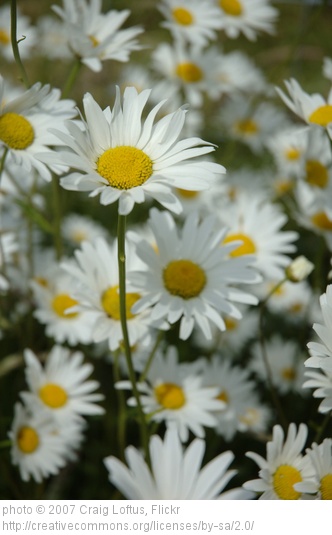
Imagine that you were born with a rare birth defect that causes you to grow daisies out of one side of your head, instead of hair. Most people, trying to be polite, don’t say anything. But you know that when an acquaintance is describing you to someone else, they probably mention the daisy thing. “Oh, I’m sure you know who she is,” people say. “She’s the one with the daisies? Growing out of her head? You’ve seen her, right?”
Part of you is grateful for people’s polite discretion. You do not, after all, want to be defined as the Daisy Lady. You want people to know you as a good mom, a skilled worker, a nice neighbor. But sometimes you wish people would just ask about the daisies, because you know they notice the daisies, and God knows you notice them—they’re a little hard to miss when you’re brushing your teeth in front of the bathroom mirror—and it would be such a relief to just talk about the daisies and then move on.
This is, of course, a completely transparent metaphor for living with a physical disability like mine—osteogenesis imperfecta (OI).
One day several years ago, I was finishing up my laps at the pool when a man came over to ask if he could have my lane. As I was gathering my things, he said, “Forgive me for asking, but how did you get all those scars?” I told him about my fractures and surgeries, we chatted for a few minutes and then said good-bye. In any public place, especially one where my body is so exposed, some part of my brain is always wondering what people are seeing, if they wonder about what they see, if they make assumptions, and what assumptions they make. So having someone ask a simple question, then answering the question and moving on, was a relief. Much simpler than all that wondering.
I spent a lot of my early life wishing people would not notice my disability. When an elementary school teacher assigned us to write an autobiography, my mother kept asking me how on earth I could completely leave out the part about being born with OI and having 30-odd broken bones. I just didn’t want to write about that, I answered. Clearly, I am now making up for lost time, as OI is a central topic in my new book, my blog, and much of my other writing. It is often a relief to talk so openly about this central facet of my identity, both formally in my writing and informally, such as in that poolside conversation.
And yet, it can also be maddening and hurtful when outward traits associated with a disability inspire people to make inappropriate and intrusive comments, as well as assume that they know more about you than they really do.
People with disabilities have lots of opinions about how appropriate it is for others to ask about their illness or injury. Some welcome questions as a teaching opportunity. Others resent the invasion of privacy. I can go either way. I appreciated the pool guy’s question because he showed genuine interest in my answer, and made no assumptions.
In contrast, I resented a comment that a super-fit hiker made as Daniel and I were trudging up a steep, rocky path to a waterfall in Yosemite National Park in 1998. As he left us in his dust, hiker-dude gushed, “Wow, I really admire you for doing this,” which I interpreted as, “I can see you’re struggling because you look so tired and awkward, but good for you, lame girl.” Years later, a similar thing happened when I was marching in the town Memorial Day parade with my daughter’s Girl Scout troop. Parent after parent sidled up alongside me and said things like, “I just want you to know that I really admire you for doing this.” They admired me for marching in a parade? Gee. What a boost to my self-esteem. Just what every writer, parent, and good citizen wants to be admired for.
As a general rule, being admired really pisses me off. Admiring someone who is disabled isn’t really all that different than admiring someone who is beautiful. In both cases, it reduces a whole person to their most noticeable trait—a trait the person has very little control over.
But while I don’t want admiration, I’ve decided, finally, that I don’t mind questions, if they are polite, straightforward, honest, and free of preconceived notions. Sometimes the nicest thing you can do is just ask about the daisies.
It’s when the questions veer into assumptions—about what I can and can’t do, about how the outer scars relate to the inner person, about what I should be admired for—that I want to cover my daisy-head with a big old hat, and just be seen for what I am. A woman. A wife. A mother. A writer. A swimmer. A hiker.
Me.
Previous Post

February 22, 2012
Lent 2012: Breaking the Cycle of Bad Habits
Next Post
February 24, 2012 Patheos Peeps: Adam McHugh on Dealing with Criticism
Browse Our Archives
Select a Category disability ethics parenthood Uncategorized
Select a Month September 2016 June 2016 May 2016 April 2016 March 2016 February 2016 January 2016 December 2015 November 2015 October 2015 September 2015 August 2015 July 2015 June 2015 May 2015 April 2015 March 2015 February 2015 January 2015 December 2014 November 2014 October 2014 September 2014 August 2014 July 2014 June 2014 May 2014 April 2014 March 2014 February 2014 January 2014 December 2013 November 2013 October 2013 September 2013 August 2013 July 2013 June 2013 May 2013 April 2013 March 2013 February 2013 January 2013 December 2012 November 2012 October 2012 September 2012 August 2012 July 2012 June 2012 May 2012 April 2012 March 2012 February 2012 January 2012 December 2011
Follow Us!
TAKE THE
Religious Wisdom Quiz
According to Jesus, what should you do when you pray?
Select your answer to see how you score.
Pray loudly for show Only pray at church Pray in secret Pray once a year
Related posts from Ellen Painter Dollar

Disability as the Last Acceptable Prejudice: A Farewell...

The Three Worst Stories That "Me Before You"...

Prince, Chronic Pain, Opioids & Why Dependence is...
Consider the Birds: What happens to a writer...
TRENDING AT PATHEOS Progressive Christian

Why Christians Have a Sacred Duty to Vote:...
The Bible offers strong support for the sacred duty to vote. Here...

What Being a Modern-Day Apostle Means to Me
In my last column, I discussed the ins and outs of modern-day...

Did Ancient China Once Worship the God of...
Across human history, a common thread weaves through the origins of the...

Love Your Neighbor – Including Earth-Kin: Lev. 19,...
God’s command to love your neighbor means acting in an ethical and...

Lead a Church Study of “Jesus and Lao...
Guest writer Jack Thomas (The Irreverent Reverend) reflects on leading his church...

Principles for Understanding the Apostolic Ministry Today
Whenever people discover that my formal ministry title is "apostle," as in...
view all Progressive Christian blogs
Ad-Free & Subscriber Log-In Subscription Support
- About Us
- 2026 Calendar
- Videos
- Podcasts
- Library of World Religions
- Faith In Media Tracker
- Advertise With Us
- Write for Us
- Privacy Policy
- Terms of Service
- Do Not Sell My Data
- Contact Us
- Radiant Digital
- Manage Newsletter Subscriptions
- Unsubscribe From Notifications
- Sitemap
Copyright 2008-2026, Patheos. All rights reserved.
Subscription Support Ad-Free & Subscriber Log-In
Follow Patheos