
BuddhistCatholicContemplativeEvangelicalGeneral ChristianHinduJewishLatter-day SaintMuslimNew VisionsProgressive Christian
Beliefs
- Buddhist
- Catholic
- Contemplative
- Evangelical
- General Christian
- Hindu
- Jewish
- Latter-day Saint
- More Voices
- Muslim
- New Visions
- Pagan
- Progressive Christian
Topics
- Religion News
- Food and Religion
- Sports and Religion
- Religious Art
- Religious Music and Entertainment
- Religious Events
- History and Religion
- Style and Religion
- Politics and Religion
- Women in Religion
- Recreation Outdoors and Religion
- Business Finance and Religion
- Careers Workplace and Religion
- Education and Religion
- Family Parenting and Religion
- Health Fitness and Religion
- Home and Religion
- Relationships and Religion
- Technology and Religion
- Travel and Religion
Columnists
- Buddhist Columnists
- Business Finance and Religion Columnists
- Careers Workplace and Religion Columnists
- Catholic Columnists
- Contemplative Columnists
- Education and Religion Columnists
- Evangelists Columnists
- Family Parenting and Religion Columnists
- General Christian Columnists
- Health Fitness and Religion Columnists
- Hindu Columnists
- History and Religion Columnists
- Home and Religion Columnists
- Jewish Columnists
- More Voices Columnists
- Latter Day Columnists
- Muslim Columnists
- New Visions Columnists
- Nonreligious Columnists
- Pagan Columnists
- Politics and Religion Columnists
- Progressive Columnists
- Recreation Outdoors and Religion Columnists
- Relationships and Religion Columnists
- Religion News Columnists
- Religious Art Columnists
- Religious Events Columnists
- Religious Music and Entertainment Columnists
- Sports and Religion Columnists
- Style and Religion Columnists
- Technology and Religion Columnists
- Travel and Religion Columnists
- Women in Religion Columnists
Resource Library
- 2026 Calendar
- Library of World Religions
- The 100 Most Holy Places on Earth
- Patheos Answers
- Podcasts
- Videos
- Faith Leaders Database
- Anglican Episcopalian
- Bahai
- Baptist
- Buddhism
- Christianity
- Confucianism
- Eastern Orthodoxy
- Hinduism
- Holiness and Pentecostal
- ISKCON
- Islam
- Judaism
- Lutheran
- Methodist
- The Church of Jesus Christ of Latter-day Saints
- New Age
- Paganism
- Presbytarian and Reformed
- Protestantism
- Religion Behind the Scenes
- Roman Catholic
- Scientology
- Shia Islam
- Sikhism
- Sufism
- Sunni Islam
- Taoism
- Zen
- See all religions
Research Tools
 Ad-Free & Subscriber Log-In Subscription Support
Ad-Free & Subscriber Log-In Subscription Support
Follow Patheos 

- Trending:
- Forgiveness
- |
- Marriage
- |
- Consciousness
- |
- Death Penalty
- |
- Election
- |
- Halloween
 Ellen Painter Dollar
- Home
- Progressive Christian
- Family Portrait: September 29, 2003
Family Portrait: September 29, 2003
Last updated on: January 13, 2012 at 4:00 am by Ellen Painter Dollar
Family Portrait: September 29, 2003 2012-01-12T11:20:58-05:00 Ellen Painter Dollar
Patheos Explore the world's faith through different perspectives on religion and spirituality! Patheos has the views of the prevalent religions and spiritualities of the world.
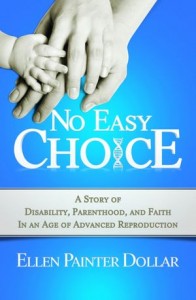
*This is an excerpt from the introduction to my book, No Easy Choice: A Story of Disability, Parenthood, and Faith in an Age of Advanced Reproduction, which will be released next Tuesday, January 17, by Westminster John Knox Press.*
 We have been in the emergency room (ER) for several hours and have reached that point when things are calm, almost—unbelievably—relaxing. My nearly four-year-old daughter, Leah, is lying on a gurney next to me, spaced out on sedatives and pain relievers and watching a Winnie the Pooh video for the third time. I am digging peanut M&M’s out of my purse, eating them slowly, one by one, so the nurses and doctors going in and out won’t think me insensitive for chowing down on vending-machine food while my daughter lies there pale and defeated. Now that we are beyond the worst—the first harrowing moments of knowing that Leah has just broken another bone (this time both left forearm bones, so unmistakably, heartsinkingly broken, bent at a 45-degree angle), the anxious conversations with the triage nurses, the IV and X-ray and sedation and casting—I need a sugar rush.
The staff at the children’s hospital have all commented on my pregnant belly, asking me if I know what we’re having (another girl) and if I’ll be delivering the baby across the street at the main city hospital. Yes, I answer—though the hushed, dark-paneled delivery suites seem, at this moment, miles away from this bright room where crutches of all sizes hang from wall pegs as flat-headed, one-legged observers of children in anguish and parents aching over their little ones’ broken limbs. But those delivery suites are not so far away after all. Our baby will be born there in just four days.
The pivotal times in our journey toward having a second baby were always, it seemed, accompanied by one of Leah’s fractures. So this ER visit just a few days before I was to give birth fit the pattern. I tried to read meaning into this coincidence, which was probably a silly exercise given how often Leah broke bones during the two years when we were so focused on having a second baby. But maybe it wasn’t so silly. Because our decisions about our second child revolved around Leah and her diagnosis of osteogenesis imperfecta (OI), a genetic disorder better known as “brittle-bone disease.” Frequent broken bones, often as the result of little or no trauma, are the hallmark of OI.
Leah did not walk until she was two-and-a-half because of weakness in her muscles and joints. Because she was not fully mobile, she was spared bone fractures for her first two years. In fact, her first fracture happened on her second birthday, when she fell while climbing on her new child-size couch—purchased explicitly to provide a safer alternative to climbing around on the full-size couch. I could not make up a more appropriate introduction to the illogical, unpredictable nature of this disorder. Kids with OI can have spectacular falls and be fine, and they can break bones during the most mundane activities, like climbing around on a minicouch.
When Leah finally started walking several months after that fracture healed, she also started falling, and broke three bones in three months that first summer she was mobile. We then had a glorious nine months without a fracture, during which she started preschool and became truly active for the first time in her life. Then summer came again—a fracture of the tibia and fibula (both lower leg bones) in June, followed by the broken arm that landed us in the ER four days before our second daughter’s birth. Both of these last fractures were gruesome, ugly things, with bones bent at stomach-turning angles and huge bruises instantly swelling and discoloring her tender skin. Like most of her other fractures, they both happened in our living room when I was within arm’s reach.
Like other parents, I worry about my children out in the world: Will they remember to look both ways when they cross the street? Do they understand that when I say, “Never go anywhere with anyone without asking Mom or Dad if it’s OK,” I really mean never, even if the guy down the street asks you to help him find his lost puppy? But unlike other parents, I cannot assume a relative absence of risk even when my daughter is playing in the living room while I leaf through the L. L. Bean catalog nearby. Neither my proximity nor the familiar confines of home can protect Leah from breaking.
Between her second and fourth birthdays, Leah had six broken bones. As much as I hated the harrowing hours following each fracture, they were a crisis, so I was propelled by adrenaline. The days and weeks that followed offered no such boost. I became weary and sad. The routines we hardly thought about in healthy times became dreaded chores, requiring brute strength and mental gymnastics. How to carry her—leg sticking straight out and encased in purple fiberglass—into our narrow bathroom, get her pants down, and sit her on the toilet with her leg elevated, all without hurting her?
We had to adjust to how this fracture would change our plans. The disappointments piled up, each one surprising me more than it should have. I kept forgetting that we inhabited a different world now, one in which making plans was foolhardy and the simplest of childhood rituals, from playing in the bathtub to attending a birthday party without Mom, were forbidden. There would be no swimming for Leah during our vacation to sweltering eastern North Carolina, where relatives run a church camp and have a swimming hole fifty yards from their front door. Our brand-new swing set, with its sturdy wide steps and not-too-high slide, chosen especially for Leah’s safety, sat empty and unused for most of the first summer we owned it. Each loss carved a chunk out of the optimism and faith I tried to cultivate in sunnier times. My pain was that of observer and absorber of my child’s agony. Leah did not talk about being sad, but she flew into rages more easily than usual, reverted to an arm-flapping ritual that she developed as a baby, wailed when I demanded that we make a trip to the bathroom because she hadn’t gone in five hours.
In this postfracture state, I inevitably questioned my desire for another child. The sheer logistics seemed overwhelming. Caring for a child with a newly broken bone while caring for other children is a challenge many parents have met—once or twice, maybe. But we could potentially be in this position several times a year for the next 10, 12, or 14 years. And we could easily have another child with OI. Because I have OI too, there is a 50 percent chance that any child of mine will inherit it. Any sane person, you would think, would have left well enough alone. I had a smart, beautiful daughter, healthy in all ways save her fragile bones. The thing is, I am sane—practical, level-headed, deliberate, thoughtful. I should have just accepted that one child was enough. But I could not. My husband, Daniel, could not.
As Leah was going through her relentless fracture cycle, Daniel and I were picking our way along a tangled and twisted path toward having another baby. We confronted questions—many of them unanswerable—concerning medicine, family, faith, and the reproductive choices available to twenty-first-century Americans with even a modest amount of disposable income. We struggled and cursed. We prayed and talked and e-mailed. And so we ended up in the ER that night, a child’s broken arm and a woman’s pregnant belly linked in ways no casual observer could imagine, leading characters in the mundane and extraordinary life that our family has been given.
Want to hear more of this story?
- Buy the book! It is available from pretty much any online book retailer, including Barnes and Noble, Amazon, and the Thoughtful Christian.
- If you are local, you are cordially invited to my book launch event on February 12, at which I will read an excerpt, answer questions, and have books available for purchase (along with some great food). Go to the Events page of my web site for more information.
- Consider whether your church, community, student, or book group might like me to lead a discussion about my book as well as the ethical and theological questions raised by reproductive technologies, such as IVF and genetic screening of embryos. Contact me to discuss possibilities. Again, locals can check out my Events page to find out where I’m speaking in the Hartford area in the coming months. I’d love to travel further afield and branch out from the Episcopal audiences that currently make up most of my event calendar, so get in touch if you have any ideas.
Previous Post

January 11, 2012
What My Dog is Teaching Me About Grace
Next Post
January 17, 2012 Today's the Day
Browse Our Archives
Select a Category disability ethics parenthood Uncategorized
Select a Month September 2016 June 2016 May 2016 April 2016 March 2016 February 2016 January 2016 December 2015 November 2015 October 2015 September 2015 August 2015 July 2015 June 2015 May 2015 April 2015 March 2015 February 2015 January 2015 December 2014 November 2014 October 2014 September 2014 August 2014 July 2014 June 2014 May 2014 April 2014 March 2014 February 2014 January 2014 December 2013 November 2013 October 2013 September 2013 August 2013 July 2013 June 2013 May 2013 April 2013 March 2013 February 2013 January 2013 December 2012 November 2012 October 2012 September 2012 August 2012 July 2012 June 2012 May 2012 April 2012 March 2012 February 2012 January 2012 December 2011
Follow Us!
TAKE THE
Religious Wisdom Quiz
Who said, "Let there be light"?
Select your answer to see how you score.
Elijah Paul Moses God
Related posts from Ellen Painter Dollar

Disability as the Last Acceptable Prejudice: A Farewell...

The Three Worst Stories That "Me Before You"...

Prince, Chronic Pain, Opioids & Why Dependence is...

Consider the Birds: What happens to a writer...
TRENDING AT PATHEOS Progressive Christian

Why Christians Have a Sacred Duty to Vote:...
The Bible offers strong support for the sacred duty to vote. Here...

What Being a Modern-Day Apostle Means to Me
In my last column, I discussed the ins and outs of modern-day...

Did Ancient China Once Worship the God of...
Across human history, a common thread weaves through the origins of the...

Love Your Neighbor – Including Earth-Kin: Lev. 19,...
God’s command to love your neighbor means acting in an ethical and...

Lead a Church Study of “Jesus and Lao...
Guest writer Jack Thomas (The Irreverent Reverend) reflects on leading his church...

Principles for Understanding the Apostolic Ministry Today
Whenever people discover that my formal ministry title is "apostle," as in...
view all Progressive Christian blogs
Ad-Free & Subscriber Log-In Subscription Support
- About Us
- 2026 Calendar
- Videos
- Podcasts
- Library of World Religions
- Faith In Media Tracker
- Advertise With Us
- Write for Us
- Privacy Policy
- Terms of Service
- Do Not Sell My Data
- Contact Us
- Radiant Digital
- Manage Newsletter Subscriptions
- Unsubscribe From Notifications
- Sitemap
Copyright 2008-2026, Patheos. All rights reserved.
Subscription Support Ad-Free & Subscriber Log-In
Follow Patheos