
BuddhistCatholicContemplativeEvangelicalGeneral ChristianHinduJewishLatter-day SaintMuslimNew VisionsProgressive Christian
Beliefs
- Buddhist
- Catholic
- Contemplative
- Evangelical
- General Christian
- Hindu
- Jewish
- Latter-day Saint
- More Voices
- Muslim
- New Visions
- Pagan
- Progressive Christian
Topics
- Religion News
- Food and Religion
- Sports and Religion
- Religious Art
- Religious Music and Entertainment
- Religious Events
- History and Religion
- Style and Religion
- Politics and Religion
- Women in Religion
- Recreation Outdoors and Religion
- Business Finance and Religion
- Careers Workplace and Religion
- Education and Religion
- Family Parenting and Religion
- Health Fitness and Religion
- Home and Religion
- Relationships and Religion
- Technology and Religion
- Travel and Religion
Columnists
- Buddhist Columnists
- Business Finance and Religion Columnists
- Careers Workplace and Religion Columnists
- Catholic Columnists
- Contemplative Columnists
- Education and Religion Columnists
- Evangelists Columnists
- Family Parenting and Religion Columnists
- General Christian Columnists
- Health Fitness and Religion Columnists
- Hindu Columnists
- History and Religion Columnists
- Home and Religion Columnists
- Jewish Columnists
- More Voices Columnists
- Latter Day Columnists
- Muslim Columnists
- New Visions Columnists
- Nonreligious Columnists
- Pagan Columnists
- Politics and Religion Columnists
- Progressive Columnists
- Recreation Outdoors and Religion Columnists
- Relationships and Religion Columnists
- Religion News Columnists
- Religious Art Columnists
- Religious Events Columnists
- Religious Music and Entertainment Columnists
- Sports and Religion Columnists
- Style and Religion Columnists
- Technology and Religion Columnists
- Travel and Religion Columnists
- Women in Religion Columnists
Resource Library
- 2026 Calendar
- Library of World Religions
- The 100 Most Holy Places on Earth
- Patheos Answers
- Podcasts
- Videos
- Faith Leaders Database
- Anglican Episcopalian
- Bahai
- Baptist
- Buddhism
- Christianity
- Confucianism
- Eastern Orthodoxy
- Hinduism
- Holiness and Pentecostal
- ISKCON
- Islam
- Judaism
- Lutheran
- Methodist
- The Church of Jesus Christ of Latter-day Saints
- New Age
- Paganism
- Presbytarian and Reformed
- Protestantism
- Religion Behind the Scenes
- Roman Catholic
- Scientology
- Shia Islam
- Sikhism
- Sufism
- Sunni Islam
- Taoism
- Zen
- See all religions
Research Tools
 Ad-Free & Subscriber Log-In Subscription Support
Ad-Free & Subscriber Log-In Subscription Support
Follow Patheos 

- Trending:
- Forgiveness
- |
- Marriage
- |
- Consciousness
- |
- Death Penalty
- |
- Election
- |
- Halloween
 Letters from the Edge of Elfland
- Home
- About
- Distributist Resources
- Publications and Presentations
- Support
- Works in Progress
- The Epistolarian Around the Web
- Home
- Catholic
- Poetry Shapes the World around Us: Reflecting on Poetry with William Wordsworth
Poetry Shapes the World around Us: Reflecting on Poetry with William Wordsworth
Last updated on: November 11, 2019 at 5:06 pm by David Russell Mosley
Poetry Shapes the World around Us: Reflecting on Poetry with William Wordsworth 2019-11-11T17:06:30-04:00 David Russell Mosley
Patheos Explore the world's faith through different perspectives on religion and spirituality! Patheos has the views of the prevalent religions and spiritualities of the world.
Ordinary Time
11 November 2019
The Edge of Elfland
Concord, New Hampshire
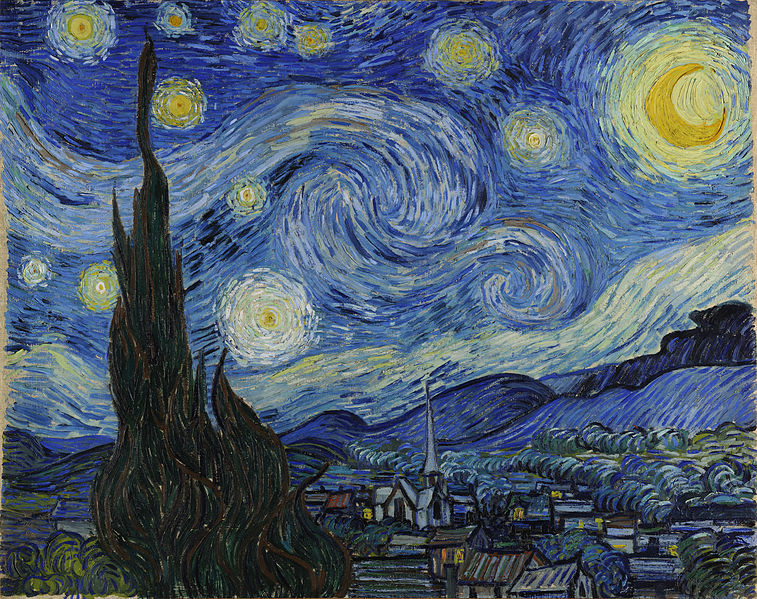
Artist
Vincent van Gogh (1853–1890)
Title The Starry Night
Date 1889
Source Wikimedia Commons, Public Domain
Dearest Readers,
I’m sorry for the radio silence. It has been a busy semester so far. But I wanted to take some time to write about poetry. Recently, I finished reading Lyrical Ballads, but the 1798 and 1802 editions. For those unfamiliar, Lyrical Ballads was a book of poetry put together by William Wordsworth and Samuel Taylor Coleridge. Coleridge only contributed 4 poems total, even when Wordsworth expanded into two volumes for the 1802 edition. Still, this book, initially unremarkable, was a watershed moment in English Romanticism.
Coleridge described Wordsworth’s intents as “to give the charm of novelty to things of every day, and to excite a feeling analogous to the supernatural, by awakening the mind’s attention from the lethargy of custom, and directing it to the loveliness and the wonders of the world before us; and inexhaustible treasure, but for which in consequence of the film of familiarity and selfish solicitude we have eyes, yet see not, ears that hear not, and hearts that neither feel nor understand.” Wordsworth’s desire for his own poems in this volume was to write in language common to people in his own day, with scenes common to people in his own day, but so described as to say something more, to go beyond, deeper.
One of the poems in both editions, “The Idiot Boy,” tells the story of Johnny Foy, the “idiot” son of Betty Foy, sent on a mission to fetch a doctor for the ailing Susan Gayle. It is an interesting story, where Betty worries about the possible misfortunes that may have befallen her son. The story ends happily, but apparently some of Wordsworth’s readers were not fans. A man named John Wilson wrote to Wordsworth in 1802 to complain about it. Apparently Wilson loved all the other poems, but couldn’t bring himself to like “The Idiot Boy.” The term idiot here appears to refer to all who have any kind of mental, behavioral, and/or physical disorder. Wilson complains that many of these “idiots” are not lovely to look upon and thus should not be the subject of art, either visual or written. Wordsworth disagreed.
Among the many, rather good for the time, arguments Wordsworth makes, he gives a suggestion of what great poets are and do. “But a great Poet,” he writes “ought to do more than this, he ought to a certain degree rectify men’s feelings, to give them new compositions of feeling, to render their feelings more sane pure and permanent, in short, more consonant to nature, that is, to eternal nature, and the great moving spirit of things.” In other words, a poet’s job is to change just how we understand things. He ought to lead the charge in changing our perception of reality. Wordsworth goes on to excoriate Mr. Wilson’s notions of “idiots” but his words continue to have lasting impact.
We must demand of our poets, of ourselves, that we look forward as well as at the world as it is. We must have eyes to see, ears to hear, hearts that both feel and understand. In his preface to the second edition, Wordsworth says that any revolutions created by science, would require the poet’s work. “If the time should ever come,” he writes, “when what is now called Science, thus familiarized to men, shall be ready to put on, as it were, a form of flesh and blood, the Poet will lend his divine spirit to aid the transfiguration, and will welcome the Being thus produced, as a dear and genuine inmate of the household of man.” For Wordsworth, poetic knowledge is the deeper, truer knowledge. It precedes scientific knowledge and accompanies it. Poetry gives shape to the unknown world around us. As Shakespeare says, though Theseus means these words depreciatively,
The poet’s eye, in fine frenzy rolling,
Doth glance from heaven to earth, from earth to heaven;
And as imagination bodies forth
The forms of things unknown, the poet’s pen
Turns them to shapes and gives to airy nothing
A local habitation and a name.
Poetry and the poet, and really all artists, do not simply respond to the world around them, but help give that world shape. And we have need of such art today, as we always have.
Sincerely,
David Russell Mosley
Next Post

November 27, 2019 Working on a Book of Poetry: An Apology for My Silence on the Blog
Browse Our Archives
Select a Category A Secular Age Advent Apologetics Atheism Beauty Being a Catholic Evangelical Being Catholic Being Deified: Poetry and Fantasy on the Path to God Blogging Book Reviews C. S. Lewis Catholic Imagination Catholic Social Teaching Catholicism Christmas Church Calendar Church Fathers Church Life Community Conferences Cosmology Creation Curdled Words Deification Distributism Easter Economics Education Epiphany Essay Extracts Eucharist Faerie Faeriean Metaphysics Fatherhood Films Folk Liturgy Food and Drink G. K. Chesterton Harry Potter J. R. R. Tolkien Jove King Arthur Language Lent Life Literature and Poetry Liturgy Medieval Theology Music My Publications Mythology On the Edges of Elfland Ordinary Time Ordination Parenthood Parish Patristic Theology Pentecost Politics Prayer Racism Radical Orthodoxy Restoration Movement Sacramental Ontology Saints Science Sex and Sexuality Sophiology Stories The Inklings The Radical Catholic Reimagination of Everything Theologians in the Church Theopoetics Thesis Research Uncategorized University of Nottingham What I'm Reading Writing
Select a Month December 2019 November 2019 October 2019 September 2019 August 2019 July 2019 June 2019 May 2019 April 2019 March 2019 February 2019 January 2019 December 2018 November 2018 October 2018 September 2018 August 2018 July 2018 June 2018 May 2018 April 2018 March 2018 February 2018 January 2018 December 2017 November 2017 October 2017 August 2017 July 2017 June 2017 May 2017 April 2017 March 2017 February 2017 January 2017 December 2016 November 2016 October 2016 September 2016 August 2016 July 2016 June 2016 May 2016 April 2016 March 2016 February 2016 January 2016 December 2015 November 2015 October 2015 September 2015 August 2015 July 2015 June 2015 May 2015 April 2015 March 2015 February 2015 January 2015 December 2014 November 2014 October 2014 September 2014 August 2014 July 2014 June 2014 May 2014 April 2014 March 2014 February 2014 January 2014 December 2013 November 2013 October 2013 September 2013 August 2013 July 2013 June 2013 May 2013 April 2013 March 2013 February 2013 January 2013 December 2012 November 2012 October 2012 September 2012 July 2012
Follow Us!
TAKE THE
Religious Wisdom Quiz
What did Hannah bring annually for Samuel when he lived at the Tabernacle?
Select your answer to see how you score.
A crown A candle A robe A staff
Related posts from Letters from the Edge of Elfland

Poetry, Podcasts, and More: Some Updates on Other...
Letters from the Edge of Elfland

Working on a Book of Poetry: An Apology...
Letters from the Edge of Elfland
The Journey Is Almost Over: Reflecting on Six...
Letters from the Edge of Elfland
The Tortured Artist: Must Artists Be Depressed to...
Letters from the Edge of Elfland
TRENDING AT PATHEOS Catholic

Rejecting Doom: Christian Hope And Human Action
Christianity is a religion of hope. We are to have hope and...

It’s What Comes From Within Which Matters
One of the most difficult things for us to understand is why...

Why I Choose the Eucharist Over the Sermon
Choose the Eucharist, Not the Sermon What are we supposed to get...

5 Design Elements Found in Spiritually Rooted Homes
Putting Spirituality Into Home Decor Our homes are more than our living...

Credo: A Story of God Told with the...
About 10 years ago, I began to imagine a personal "Credo" that...

The Anatomy of Divine Revelation in Catholic Thought
The claim that God has made Himself known to human beings is...
view all Catholic blogs
Ad-Free & Subscriber Log-In Subscription Support
- About Us
- 2026 Calendar
- Videos
- Podcasts
- Library of World Religions
- Faith In Media Tracker
- Advertise With Us
- Write for Us
- Privacy Policy
- Terms of Service
- Do Not Sell My Data
- Contact Us
- Radiant Digital
- Manage Newsletter Subscriptions
- Unsubscribe From Notifications
- Sitemap
Copyright 2008-2026, Patheos. All rights reserved.
Subscription Support Ad-Free & Subscriber Log-In
Follow Patheos