
BuddhistCatholicContemplativeEvangelicalGeneral ChristianHinduJewishLatter-day SaintMuslimNew VisionsProgressive Christian
Beliefs
- Buddhist
- Catholic
- Contemplative
- Evangelical
- General Christian
- Hindu
- Jewish
- Latter-day Saint
- More Voices
- Muslim
- New Visions
- Pagan
- Progressive Christian
Topics
- Religion News
- Food and Religion
- Sports and Religion
- Religious Art
- Religious Music and Entertainment
- Religious Events
- History and Religion
- Style and Religion
- Politics and Religion
- Women in Religion
- Recreation Outdoors and Religion
- Business Finance and Religion
- Careers Workplace and Religion
- Education and Religion
- Family Parenting and Religion
- Health Fitness and Religion
- Home and Religion
- Relationships and Religion
- Technology and Religion
- Travel and Religion
Columnists
- Buddhist Columnists
- Business Finance and Religion Columnists
- Careers Workplace and Religion Columnists
- Catholic Columnists
- Contemplative Columnists
- Education and Religion Columnists
- Evangelists Columnists
- Family Parenting and Religion Columnists
- General Christian Columnists
- Health Fitness and Religion Columnists
- Hindu Columnists
- History and Religion Columnists
- Home and Religion Columnists
- Jewish Columnists
- More Voices Columnists
- Latter Day Columnists
- Muslim Columnists
- New Visions Columnists
- Nonreligious Columnists
- Pagan Columnists
- Politics and Religion Columnists
- Progressive Columnists
- Recreation Outdoors and Religion Columnists
- Relationships and Religion Columnists
- Religion News Columnists
- Religious Art Columnists
- Religious Events Columnists
- Religious Music and Entertainment Columnists
- Sports and Religion Columnists
- Style and Religion Columnists
- Technology and Religion Columnists
- Travel and Religion Columnists
- Women in Religion Columnists
Resource Library
- 2026 Calendar
- Library of World Religions
- The 100 Most Holy Places on Earth
- Patheos Answers
- Podcasts
- Videos
- Faith Leaders Database
- Anglican Episcopalian
- Bahai
- Baptist
- Buddhism
- Christianity
- Confucianism
- Eastern Orthodoxy
- Hinduism
- Holiness and Pentecostal
- ISKCON
- Islam
- Judaism
- Lutheran
- Methodist
- The Church of Jesus Christ of Latter-day Saints
- New Age
- Paganism
- Presbytarian and Reformed
- Protestantism
- Religion Behind the Scenes
- Roman Catholic
- Scientology
- Shia Islam
- Sikhism
- Sufism
- Sunni Islam
- Taoism
- Zen
- See all religions
Research Tools
 Ad-Free & Subscriber Log-In Subscription Support
Ad-Free & Subscriber Log-In Subscription Support
Follow Patheos 

- Trending:
- Forgiveness
- |
- Marriage
- |
- Consciousness
- |
- Death Penalty
- |
- Election
- |
- Halloween
 Letters from the Edge of Elfland
- Home
- About
- Distributist Resources
- Publications and Presentations
- Support
- Works in Progress
- The Epistolarian Around the Web
- Home
- Catholic
- The Tortured Artist: Must Artists Be Depressed to Produce Great Art?
The Tortured Artist: Must Artists Be Depressed to Produce Great Art?
Last updated on: September 26, 2019 at 7:00 am by David Russell Mosley
The Tortured Artist: Must Artists Be Depressed to Produce Great Art? 2019-09-26T06:12:40-04:00 David Russell Mosley
Patheos Explore the world's faith through different perspectives on religion and spirituality! Patheos has the views of the prevalent religions and spiritualities of the world.
Ordinary Time
26 September 2019
The Edge of Elfland
Concord, NH
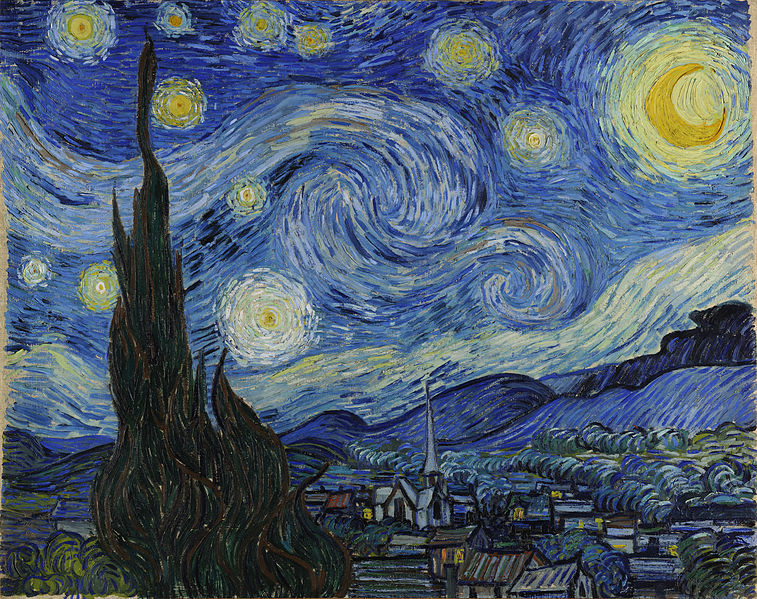
Artist
Vincent van Gogh (1853–1890)
Title The Starry Night
Date 1889
Source Wikimedia Commons, Public Domain
Dearest Readers,
As most of you know, I was recently at the Catholic Imagination Conference at Loyola Chicago. I had intended to write a review, further to the day 1 letter I wrote last Friday. But instead I want to write about writing itself. The conference––for whatever its faults were, and there were many excellent aspects as well––certainly did one thing for this writer, it helped reinvigorate my desire to write. I wanted to think through how I could spend more time writing during my already busy days. And I began to make plans, to draft schedules. But then depression hit again.
That small voice, sometimes not so small, at the back of my head telling me that I’m not good enough, that I’m too white, too male, too inexperienced, that I haven’t gone about this the right way. I mean how could I hope to write poetry? I didn’t study English in college. I haven’t done an MFA. And even in those times when I feel like maybe I can do this, I will slip into comparing myself to my favorite writers, hoping maybe to be like them, to be them. And again the reality (or perception of reality) steps back in and I spiral downward. Sometimes, this darkness leads to new works of art. Sometimes, to help give voice to my concerns and anxieties, I will write a poem. One of them even got published last year. And this made me think, must art and darkness go together? Must the artist be tortured to create good art?
Blessedly, I think not. Coleridge knew this, I believe. Early in his life he was prescribed opium to manage his pain and this became a lifelong struggle. He would win in the end, even though it would take his life. But it is easy, I think, to look at Coleridge and see the depression, the pain, and the opium as essential to his creative process. After all, he had conceived of and written “Kubla Khan” under its influences. But Coleridge knew better. Later in life he came to call opium poison and was always grateful when he had no need of it. He knew that rather than making his art possible, his addiction was keeping him from it.
This is how I feel about my depression. Yes, under its sway I sometimes create good works of art. But ultimately I believe it holds me back. It keeps me from truly growing as a writer, a poet, and a scholar, whatever order those words come in. And this says nothing about the effects it has on my family. Coleridge knew this as well. He practically abandoned his wife and children, first for creative genius, and then for his addiction. And while it Coleridge did choose to take opium and I did not choose depression, we must remember that he was prescribed a “safe” drug to help him manage his pain. Similarly, those with depression are often seen as people who just feel “a bit down” or perhaps they should just try being happy. This is like telling an addict, “Just stop taking the drugs.” It fails to recognize that the will’s power in this arena has been diminished.
But perhaps the biggest lie we so often believe is that this is just how writers and artists are. They have to be depressed and addicted. For only from great pain or great suffering does great art arise. This does not need to be the case. That it often is may say something about many who have turned to the arts for solace, but it does not make it a prerequisite. It does not mean that you need to keep your addiction or not seek help for your depression. Do so, in whatever way works best for you, and I believe your art will get better. I believe that joy, real, true joy can lead to even greater works of art, even ones that recognize and give voice to the darkness inside us, than addiction or depression ever can.
I don’t know if any of you needed to read this. Perhaps, as that small voice whispers to me, I am the only one who feels this way. But I don’t believe it. I believe that joy is and will be triumphant. I believe that after the darkest night, the sun will rise again in the east. And even if I cannot always see him through the clouds, I still see by him. The clouds cannot keep his light out totally. They cannot keep it out forever.
Sincerely,
David Russell Mosley
Previous Post

September 20, 2019
Day 1 of the Catholic Imagination Conference: Exhaustion and Hope
Browse Our Archives
Select a Category A Secular Age Advent Apologetics Atheism Beauty Being a Catholic Evangelical Being Catholic Being Deified: Poetry and Fantasy on the Path to God Blogging Book Reviews C. S. Lewis Catholic Imagination Catholic Social Teaching Catholicism Christmas Church Calendar Church Fathers Church Life Community Conferences Cosmology Creation Curdled Words Deification Distributism Easter Economics Education Epiphany Essay Extracts Eucharist Faerie Faeriean Metaphysics Fatherhood Films Folk Liturgy Food and Drink G. K. Chesterton Harry Potter J. R. R. Tolkien Jove King Arthur Language Lent Life Literature and Poetry Liturgy Medieval Theology Music My Publications Mythology On the Edges of Elfland Ordinary Time Ordination Parenthood Parish Patristic Theology Pentecost Politics Prayer Racism Radical Orthodoxy Restoration Movement Sacramental Ontology Saints Science Sex and Sexuality Sophiology Stories The Inklings The Radical Catholic Reimagination of Everything Theologians in the Church Theopoetics Thesis Research Uncategorized University of Nottingham What I'm Reading Writing
Select a Month December 2019 November 2019 October 2019 September 2019 August 2019 July 2019 June 2019 May 2019 April 2019 March 2019 February 2019 January 2019 December 2018 November 2018 October 2018 September 2018 August 2018 July 2018 June 2018 May 2018 April 2018 March 2018 February 2018 January 2018 December 2017 November 2017 October 2017 August 2017 July 2017 June 2017 May 2017 April 2017 March 2017 February 2017 January 2017 December 2016 November 2016 October 2016 September 2016 August 2016 July 2016 June 2016 May 2016 April 2016 March 2016 February 2016 January 2016 December 2015 November 2015 October 2015 September 2015 August 2015 July 2015 June 2015 May 2015 April 2015 March 2015 February 2015 January 2015 December 2014 November 2014 October 2014 September 2014 August 2014 July 2014 June 2014 May 2014 April 2014 March 2014 February 2014 January 2014 December 2013 November 2013 October 2013 September 2013 August 2013 July 2013 June 2013 May 2013 April 2013 March 2013 February 2013 January 2013 December 2012 November 2012 October 2012 September 2012 July 2012
Follow Us!
TAKE THE
Religious Wisdom Quiz
Love is patient, love is kind. Love does not _____ or boast...
Select your answer to see how you score.
Envy Brag Scream
Related posts from Letters from the Edge of Elfland
Enduring the Valleys of Life: My Struggle with...
Letters from the Edge of Elfland

Poetry Shapes the World around Us: Reflecting on...
Letters from the Edge of Elfland
Can You Imagine? Beginning a Definition of the...
Letters from the Edge of Elfland

“Wherefore stopp’st thou me?” Coleridge’s Creative Message to...
Letters from the Edge of Elfland
TRENDING AT PATHEOS Catholic

Rejecting Doom: Christian Hope And Human Action
Christianity is a religion of hope. We are to have hope and...

It’s What Comes From Within Which Matters
One of the most difficult things for us to understand is why...

Why I Choose the Eucharist Over the Sermon
Choose the Eucharist, Not the Sermon What are we supposed to get...

5 Design Elements Found in Spiritually Rooted Homes
Putting Spirituality Into Home Decor Our homes are more than our living...

Credo: A Story of God Told with the...
About 10 years ago, I began to imagine a personal "Credo" that...

The Anatomy of Divine Revelation in Catholic Thought
The claim that God has made Himself known to human beings is...
view all Catholic blogs
Ad-Free & Subscriber Log-In Subscription Support
- About Us
- 2026 Calendar
- Videos
- Podcasts
- Library of World Religions
- Faith In Media Tracker
- Advertise With Us
- Write for Us
- Privacy Policy
- Terms of Service
- Do Not Sell My Data
- Contact Us
- Radiant Digital
- Manage Newsletter Subscriptions
- Unsubscribe From Notifications
- Sitemap
Copyright 2008-2026, Patheos. All rights reserved.
Subscription Support Ad-Free & Subscriber Log-In
Follow Patheos