
BuddhistCatholicContemplativeEvangelicalGeneral ChristianHinduJewishLatter-day SaintMuslimNew VisionsProgressive Christian
Beliefs
- Buddhist
- Catholic
- Contemplative
- Evangelical
- General Christian
- Hindu
- Jewish
- Latter-day Saint
- More Voices
- Muslim
- New Visions
- Pagan
- Progressive Christian
Topics
- Religion News
- Food and Religion
- Sports and Religion
- Religious Art
- Religious Music and Entertainment
- Religious Events
- History and Religion
- Style and Religion
- Politics and Religion
- Women in Religion
- Recreation Outdoors and Religion
- Business Finance and Religion
- Careers Workplace and Religion
- Education and Religion
- Family Parenting and Religion
- Health Fitness and Religion
- Home and Religion
- Relationships and Religion
- Technology and Religion
- Travel and Religion
Columnists
- Buddhist Columnists
- Business Finance and Religion Columnists
- Careers Workplace and Religion Columnists
- Catholic Columnists
- Contemplative Columnists
- Education and Religion Columnists
- Evangelists Columnists
- Family Parenting and Religion Columnists
- General Christian Columnists
- Health Fitness and Religion Columnists
- Hindu Columnists
- History and Religion Columnists
- Home and Religion Columnists
- Jewish Columnists
- More Voices Columnists
- Latter Day Columnists
- Muslim Columnists
- New Visions Columnists
- Nonreligious Columnists
- Pagan Columnists
- Politics and Religion Columnists
- Progressive Columnists
- Recreation Outdoors and Religion Columnists
- Relationships and Religion Columnists
- Religion News Columnists
- Religious Art Columnists
- Religious Events Columnists
- Religious Music and Entertainment Columnists
- Sports and Religion Columnists
- Style and Religion Columnists
- Technology and Religion Columnists
- Travel and Religion Columnists
- Women in Religion Columnists
Resource Library
- 2026 Calendar
- Library of World Religions
- The 100 Most Holy Places on Earth
- Patheos Answers
- Podcasts
- Videos
- Faith Leaders Database
- Anglican Episcopalian
- Bahai
- Baptist
- Buddhism
- Christianity
- Confucianism
- Eastern Orthodoxy
- Hinduism
- Holiness and Pentecostal
- ISKCON
- Islam
- Judaism
- Lutheran
- Methodist
- The Church of Jesus Christ of Latter-day Saints
- New Age
- Paganism
- Presbytarian and Reformed
- Protestantism
- Religion Behind the Scenes
- Roman Catholic
- Scientology
- Shia Islam
- Sikhism
- Sufism
- Sunni Islam
- Taoism
- Zen
- See all religions
Research Tools
 Ad-Free & Subscriber Log-In Subscription Support
Ad-Free & Subscriber Log-In Subscription Support
Follow Patheos 

- Trending:
- Forgiveness
- |
- Marriage
- |
- Consciousness
- |
- Death Penalty
- |
- Election
- |
- Halloween
 Letters from the Edge of Elfland
- Home
- About
- Distributist Resources
- Publications and Presentations
- Support
- Works in Progress
- The Epistolarian Around the Web
- Home
- Catholic
- Harry Potter, Demons, and Exorcists: A Follow Up on the Catholic School Ban of Harry Potter
Harry Potter, Demons, and Exorcists: A Follow Up on the Catholic School Ban of Harry Potter
Last updated on: September 10, 2019 at 4:19 pm by David Russell Mosley
Harry Potter, Demons, and Exorcists: A Follow Up on the Catholic School Ban of Harry Potter 2019-09-10T16:19:36-04:00 David Russell Mosley
Patheos Explore the world's faith through different perspectives on religion and spirituality! Patheos has the views of the prevalent religions and spiritualities of the world.
Ordinary Time
4 September 2019
The Edge of Elfland
Concord, New Hampshire
PD
Dearest Readers,
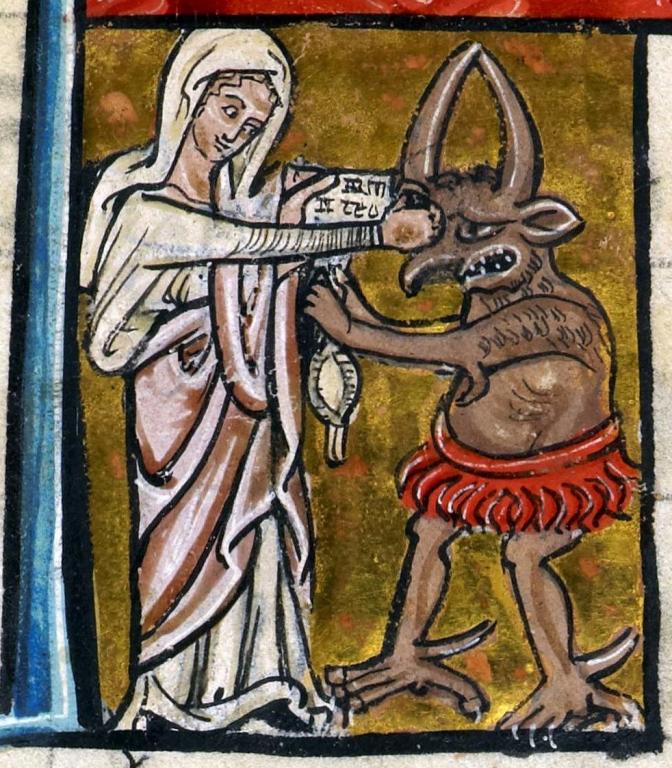
When I wrote about St. Edward’s School banning the Harry Potter series, I hoped this would be the last time for a while I would need to write in defense of the Harry Potter series. Don’t get me wrong, I’m happy to write about Harry Potter, but I prefer to examine and discuss the stories themselves, not bad reactions to them. Sadly, a reader has brought something to my attention that, while I could ignore, I find needs some refuting.
A few months ago, a certain Fr. David Nix of the Pilgrim Priest blog, wrote a post concerning the effects of Harry Potter on children. At the center of his post was a portion of an interview with Fr. Ripperger, a Catholic priest and exorcist. I want to begin with Fr. Ripperger’s words before getting to the rest of the blog post. Fr. Nix helpfully transcribed the relevant portion and linked to it here (go to the 57 minute mark to hear them yourself):
Every time I give a conference, people ask me about Harry Potter. JK Rowlings went to witch school before she wrote the books. The spells in the book are actual spells. How do we know that? Well, because witches tell us they’re real. And there was a woman in Spain who decided to try one of the spells of fire and it burnt her house to the ground. Now JK Rowlings has denied she’s a witch. Ok… You walk like one, you quack like one, you write books like one…One exorcist told me…60% of the names in Harry Potter are actual names of demons that exorcists have booted out of people. There is an exorcist I know who is a friend of mine. He and I are always comparing notes on Judas, because Judas is a hard guy to get out of people. [That exorcist] has had to exorcise three children just for reading the books. I had a case of possession. I wasn’t the one to liberate him; I started the case but I had to pass it to someone else because I had to move to another location of a person who was possessed by five demons who claimed that they were the demons who inspired JK Rowlings to write Harry Potter. So I tell people: Avoid it. All exorcists who are worth their weight—there’s only one guy who says it’s okay—there’s something wrong with that guy. But all the other exorcists I know who are experienced are clear: Stay away from it.
It is difficult to know where even to begin. Here again we have the same claim that the spells are real. But we add to it the claim that someone actually successfully burnt down their house. Two seconds of googling show that the woman effectively created bomb by trying to cook a potion. She certainly didn’t wave a wand and shout Incendio! Then we get the strange claim that the names of characters, as much as 60%, are the names of demons. First, do demons have names? Second, if they do, are they names like Hagrid or Albus or Harry or Ron? Nearly every name in Harry Potter can be traced back either to some mythological or supposedly magical creature or person. Those that can’t tend to have more symbolic meanings. Albus Dumbledore means white bumblebee, for instance. Then there is the strange claim that Judas is a demon. I have no idea what the source for this is, but to be clear, both metaphysically and theologically people do not become demons. As I said in my last letter, I tend to be sceptical of exorcists talking publicly about their jobs, the lack of facts or even attempts to get them from this priest continues to affirm I’m right in doing so.
But let’s move onto the post itself. The main impetus of the post surrounds the name of a character in Harry Potter who wrote the divination textbook Unfogging the Future (incorrectly called Hogwarts School of Witchcraft and Wizardy in the post). The authors name is Cassandra Vablatsky. It is likely this name is a play on Helena Blavatsky a Russian occultist and theosophist. Fr. Nix refers to her as a satanist, but no where on the wikipedia page to which he links is she so identified. It seems possible, Fr. Nix’s definition of satanism is anything that isn’t Christianity. Thus, all non-Christians are satanists because to be a satanist is to be a non-Christian. I find his issue even more interesting, however, precisely because divination as a subject is considered by all competent professors at Hogwarts as hogwash. So even if Blavatsky were a satanist properly speaking, she is the namesake of a character who has written what must be a largely false textbook, equivalent to astrology as we understand it today. So it is just as likely that Rowling is making fun of Blavatsky as it is that Rowling is somehow enshrining her.
The post ends with an email from a woman who reached out to Fr. Nix. She is a former Potter fan and recently returned to her Catholic faith. She recounts going to Universal Studies and considering buying a wand when she decides not to because why would she want such a toy, she’d rather have her rosary. I’m fairly certain she has set herself a false dilemma. More problematic is a point she makes about the unforgivable curses which first appear in the fourth book, Harry Potter and the Goblet of Fire. She notes that one of the curses is the Imperius curse. She links this to Imperative prayers used against demons, or so she cites from a book called Manual for Spiritual Warfare by Paul Thigpen*.* Here we see the principle correlation does not equal causation in action. Yes, there may be (this is well outside my theological expertise) an Imperative Prayer for commanding demons. But clearly, Rowling is using the term to mean command (which is actually also how the word imperative is being used in this imperative prayer). The imperative mood, grammatically speaking, is when a verb is used as a command. Tolle lege, take and read! Sit down! Behave! (Well now I’ve stumbled into parent mode). But you see the point, the Imperius curse is used to command people to do things. It is not used to summon demons, nor is that the natural conclusion to draw.
In the end, what we have here is a failure to read carefully, a failure to attend to facts, and a failure to look further into questions. Fr. Ripperger starts with the assumption Harry Potter is bad, hear’s a story or two that seems to confirm his presupposition and doesn’t look anymore closely at the stories to see whether or not their true. Fr. Nix doesn’t attend to the content of the stories and so make’s an assumption which could be exactly the opposite of reality. And the woman who emailed Fr. Nix failed to consider other possible interpretations of a word, but instead assumed J.K. Rowling had read Thigpen and was directly influenced by the “Imperative Prayer.” And this is what frightens almost more than exorcists making spectacles of themselves. At least two-thirds of the people in this blog post should know how to read a text carefully and that they should double-check any facts which confirm their bias. But instead we get bad readings, bad reporting, and ultimately, bad theology.
To quote from another famous literary character, “What do they teach in schools these days?”
Sincerely,
David Russell Mosley
Previous Post

September 2, 2019
Catholic School Removes Harry Potter from New Library
Next Post
September 20, 2019 Day 1 of the Catholic Imagination Conference: Exhaustion and Hope
Browse Our Archives
Select a Category A Secular Age Advent Apologetics Atheism Beauty Being a Catholic Evangelical Being Catholic Being Deified: Poetry and Fantasy on the Path to God Blogging Book Reviews C. S. Lewis Catholic Imagination Catholic Social Teaching Catholicism Christmas Church Calendar Church Fathers Church Life Community Conferences Cosmology Creation Curdled Words Deification Distributism Easter Economics Education Epiphany Essay Extracts Eucharist Faerie Faeriean Metaphysics Fatherhood Films Folk Liturgy Food and Drink G. K. Chesterton Harry Potter J. R. R. Tolkien Jove King Arthur Language Lent Life Literature and Poetry Liturgy Medieval Theology Music My Publications Mythology On the Edges of Elfland Ordinary Time Ordination Parenthood Parish Patristic Theology Pentecost Politics Prayer Racism Radical Orthodoxy Restoration Movement Sacramental Ontology Saints Science Sex and Sexuality Sophiology Stories The Inklings The Radical Catholic Reimagination of Everything Theologians in the Church Theopoetics Thesis Research Uncategorized University of Nottingham What I'm Reading Writing
Select a Month December 2019 November 2019 October 2019 September 2019 August 2019 July 2019 June 2019 May 2019 April 2019 March 2019 February 2019 January 2019 December 2018 November 2018 October 2018 September 2018 August 2018 July 2018 June 2018 May 2018 April 2018 March 2018 February 2018 January 2018 December 2017 November 2017 October 2017 August 2017 July 2017 June 2017 May 2017 April 2017 March 2017 February 2017 January 2017 December 2016 November 2016 October 2016 September 2016 August 2016 July 2016 June 2016 May 2016 April 2016 March 2016 February 2016 January 2016 December 2015 November 2015 October 2015 September 2015 August 2015 July 2015 June 2015 May 2015 April 2015 March 2015 February 2015 January 2015 December 2014 November 2014 October 2014 September 2014 August 2014 July 2014 June 2014 May 2014 April 2014 March 2014 February 2014 January 2014 December 2013 November 2013 October 2013 September 2013 August 2013 July 2013 June 2013 May 2013 April 2013 March 2013 February 2013 January 2013 December 2012 November 2012 October 2012 September 2012 July 2012
Follow Us!
TAKE THE
Religious Wisdom Quiz
What worldwide Christian youth movement was started by Robert Baden-Powell with a focus on outdoor activities and morality?
Select your answer to see how you score.
Boy Scouts Sisters of Charity Wesley Guild Young Life
Related posts from Letters from the Edge of Elfland

Day 1 of the Catholic Imagination Conference: Exhaustion...
Letters from the Edge of Elfland
Catholic School Removes Harry Potter from New Library
Letters from the Edge of Elfland
Burial Gardens and Life from Death: On Taking...
Letters from the Edge of Elfland
Get Him to the Catholic Imagination Conference
Letters from the Edge of Elfland
TRENDING AT PATHEOS Catholic

Rejecting Doom: Christian Hope And Human Action
Christianity is a religion of hope. We are to have hope and...

It’s What Comes From Within Which Matters
One of the most difficult things for us to understand is why...

Why I Choose the Eucharist Over the Sermon
Choose the Eucharist, Not the Sermon What are we supposed to get...

5 Design Elements Found in Spiritually Rooted Homes
Putting Spirituality Into Home Decor Our homes are more than our living...

Credo: A Story of God Told with the...
About 10 years ago, I began to imagine a personal "Credo" that...

The Anatomy of Divine Revelation in Catholic Thought
The claim that God has made Himself known to human beings is...
view all Catholic blogs
Ad-Free & Subscriber Log-In Subscription Support
- About Us
- 2026 Calendar
- Videos
- Podcasts
- Library of World Religions
- Faith In Media Tracker
- Advertise With Us
- Write for Us
- Privacy Policy
- Terms of Service
- Do Not Sell My Data
- Contact Us
- Radiant Digital
- Manage Newsletter Subscriptions
- Unsubscribe From Notifications
- Sitemap
Copyright 2008-2026, Patheos. All rights reserved.
Subscription Support Ad-Free & Subscriber Log-In
Follow Patheos