
BuddhistCatholicContemplativeEvangelicalGeneral ChristianHinduJewishLatter-day SaintMuslimNew VisionsProgressive Christian
Beliefs
- Buddhist
- Catholic
- Contemplative
- Evangelical
- General Christian
- Hindu
- Jewish
- Latter-day Saint
- More Voices
- Muslim
- New Visions
- Pagan
- Progressive Christian
Topics
- Religion News
- Food and Religion
- Sports and Religion
- Religious Art
- Religious Music and Entertainment
- Religious Events
- History and Religion
- Style and Religion
- Politics and Religion
- Women in Religion
- Recreation Outdoors and Religion
- Business Finance and Religion
- Careers Workplace and Religion
- Education and Religion
- Family Parenting and Religion
- Health Fitness and Religion
- Home and Religion
- Relationships and Religion
- Technology and Religion
- Travel and Religion
Columnists
- Buddhist Columnists
- Business Finance and Religion Columnists
- Careers Workplace and Religion Columnists
- Catholic Columnists
- Contemplative Columnists
- Education and Religion Columnists
- Evangelists Columnists
- Family Parenting and Religion Columnists
- General Christian Columnists
- Health Fitness and Religion Columnists
- Hindu Columnists
- History and Religion Columnists
- Home and Religion Columnists
- Jewish Columnists
- More Voices Columnists
- Latter Day Columnists
- Muslim Columnists
- New Visions Columnists
- Nonreligious Columnists
- Pagan Columnists
- Politics and Religion Columnists
- Progressive Columnists
- Recreation Outdoors and Religion Columnists
- Relationships and Religion Columnists
- Religion News Columnists
- Religious Art Columnists
- Religious Events Columnists
- Religious Music and Entertainment Columnists
- Sports and Religion Columnists
- Style and Religion Columnists
- Technology and Religion Columnists
- Travel and Religion Columnists
- Women in Religion Columnists
Resource Library
- 2026 Calendar
- Library of World Religions
- The 100 Most Holy Places on Earth
- Patheos Answers
- Podcasts
- Videos
- Faith Leaders Database
- Anglican Episcopalian
- Bahai
- Baptist
- Buddhism
- Christianity
- Confucianism
- Eastern Orthodoxy
- Hinduism
- Holiness and Pentecostal
- ISKCON
- Islam
- Judaism
- Lutheran
- Methodist
- The Church of Jesus Christ of Latter-day Saints
- New Age
- Paganism
- Presbytarian and Reformed
- Protestantism
- Religion Behind the Scenes
- Roman Catholic
- Scientology
- Shia Islam
- Sikhism
- Sufism
- Sunni Islam
- Taoism
- Zen
- See all religions
Research Tools
 Ad-Free & Subscriber Log-In Subscription Support
Ad-Free & Subscriber Log-In Subscription Support
Follow Patheos 

- Trending:
- Forgiveness
- |
- Marriage
- |
- Consciousness
- |
- Death Penalty
- |
- Election
- |
- Halloween
 Letters from the Edge of Elfland
- Home
- About
- Distributist Resources
- Publications and Presentations
- Support
- Works in Progress
- The Epistolarian Around the Web
- Home
- Catholic
- Never Pursue Literature as a Trade: Reflecting on Coleridge’s Advice to Young Writers
Never Pursue Literature as a Trade: Reflecting on Coleridge’s Advice to Young Writers
Last updated on: May 26, 2019 at 12:04 pm by David Russell Mosley
Never Pursue Literature as a Trade: Reflecting on Coleridge’s Advice to Young Writers 2019-05-26T12:04:56-04:00 David Russell Mosley
Patheos Explore the world's faith through different perspectives on religion and spirituality! Patheos has the views of the prevalent religions and spiritualities of the world.
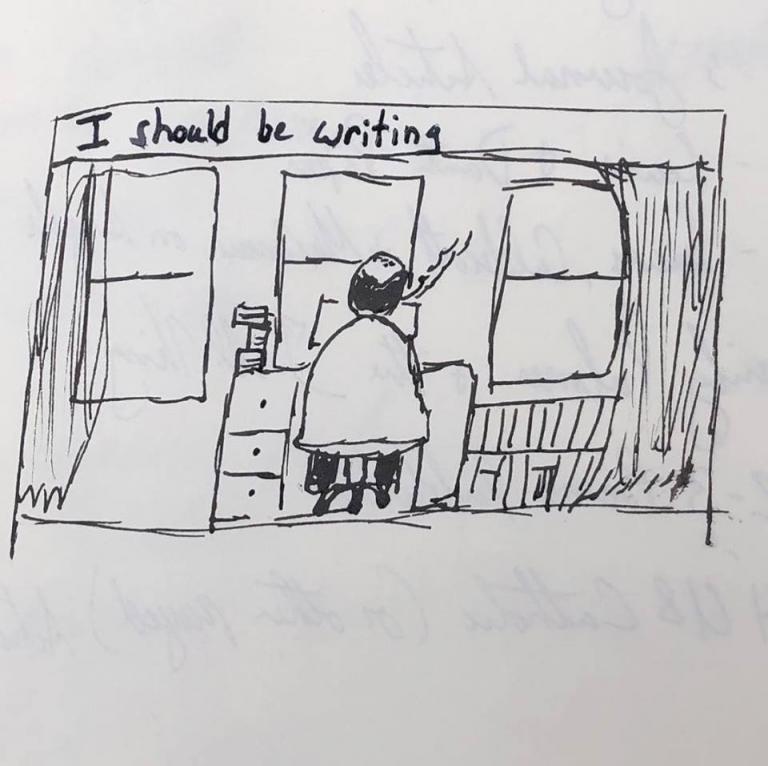
Original drawing by David Russell Mosley
Eastertide
26 May 2019
On the Edge of Elfland
Concord, NH
Dearest Readers,
As part of my research for a current project, I have been reading Samuel Taylor Coleridge’s Biographia Literaria for the first time. Today, as I was reading, attempting to make my way to chapter 13––the celebrated chapter putting forth Coleridge’s theory/theology of imagination––I came across chapter 11. This chapter is entitled, “An affectionate exhortation to those who in early life feel themselves to become authors.” Coleridge himself was 44 when he published the Biographia Literaria and he was 26 (or there about) when he wrote the first edition of The Rime of the Ancient Mariner. Still, knowing that he was relatively young himself, my interest was piqued when I saw the nature of the chapter.
Coleridge sums up his advice in six word: “Never pursue literature as a trade.” He does not mean, do not write. Rather, Coleridge spends the rest of the chapter suggesting that those who wish to write should take up some full-time occupation, preferably one with set hours. Then, in the hours off, those who wish to write should do so. Coleridge’s ideas are certainly idealistic and don’t always reflect what he himself did. Worse still, Coleridge veers into sexism. At one point he suggests that men are more naturally meant to be from home during the day as women are meant to be more at home “for the most part.” One can do more than wonder if some of Coleridge’s own domestic issues might have been solved had he been home more often.
Nevertheless, I think, or at least I certainly hope, that his overall point remains true. It is better for writers to have a profession of some sort and to write in one’s leisure hours. Coleridge sets the scene for us:
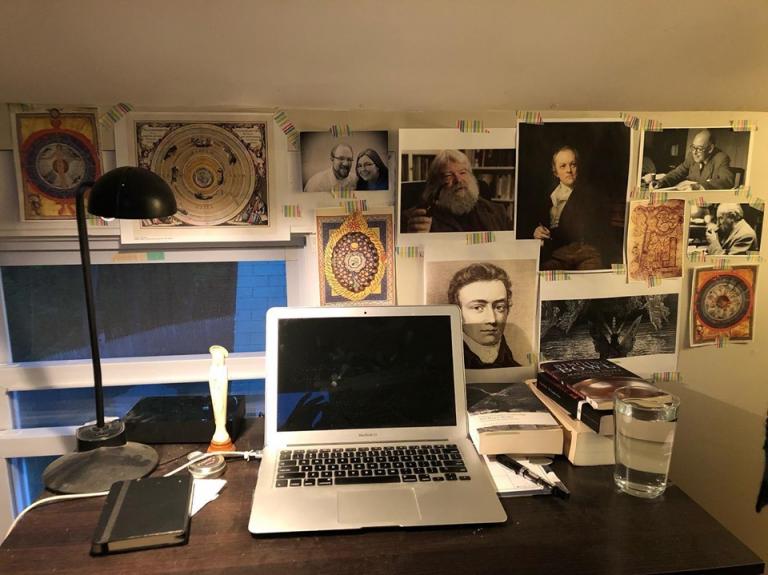
Actual picture of my writing desk.
“[Y]ou have satisfied the demands of the day by the labour of the day. Then, when you retire into your study, in the books on your shelves you revisit so many venerable friends with whom you can converse. Your own spirit scarcely less free from personal anxieties than the great minds, that in those books are still living for you! Even your writing-desk with its blank paper and all its other implements will appear as a chain of flowers, capable of linking your feelings as well as thoughts to events and characters past or to come; not a chain of iron which binds you down to think of the future and the remote by recalling the claims and feelings of the peremptory present. But why should I say retire? The habits of active life and daily intercourse with the stir of the world will tend to give you such self-command, that the presence of your family will be no interruption. Nay, the social silence, or undisturbing voices of wife or sister will be like a restorative atmosphere, or soft music which moulds a dream without becoming its object.”
We can clearly see that Coleridge’s vision chiefly works for those who have few or no duties to attend to at home. And yet, I think we can learn much from Coleridge’s advice. He writes earlier in the chapter, “Three hours of leisure, unannoyed by any alien anxiety, and looked forward to with delight as a change and recreation, will suffice to realize in literature a larger product of what is truly genial, than weeks of compulsion.” His overall point is that writing, for those who wish to do it, should be an act of leisure. Whether one’s home life involves three hours of leisure a day or three minutes. I think his point remains, that coming home and entertaining yourself (without neglecting your family or home obligations) for a time with writing will produce better work than spending all the hours of everyday in writing.
I could certainly point to the now numerous examples of authors famous and otherwise who make all of their money, however little or much, by writing. But for myself, despite all the potential problems and presumptions embedded in Coleridge’s approach, I take heart. I am emboldened to think that perhaps writing can happen best in my leisure hours, surrounded by my wife and children (as I am right now). Perhaps it’s just been laziness, sloth, acedia which have kept me from producing the kind of work I should have. Perhaps my next (or first really) great book or poem will come out of writing in the in between times. Perhaps Coleridge is right, and having my job as a teacher is precisely what will keep me from losing the common touch. I certainly hope he is right. Coleridge has inspired me to write, to grasp hold of the time available to me, and to make of it what I will. I pray you will do the same.
Sincerely,
David Russell Mosley
Previous Post

May 15, 2019
Stop, Christian Passer-by: A Spiritual Review of Mariner by Malcolm Guite
Next Post
June 12, 2019 “Wherefore stopp’st thou me?” Coleridge’s Creative Message to the World
Browse Our Archives
Select a Category A Secular Age Advent Apologetics Atheism Beauty Being a Catholic Evangelical Being Catholic Being Deified: Poetry and Fantasy on the Path to God Blogging Book Reviews C. S. Lewis Catholic Imagination Catholic Social Teaching Catholicism Christmas Church Calendar Church Fathers Church Life Community Conferences Cosmology Creation Curdled Words Deification Distributism Easter Economics Education Epiphany Essay Extracts Eucharist Faerie Faeriean Metaphysics Fatherhood Films Folk Liturgy Food and Drink G. K. Chesterton Harry Potter J. R. R. Tolkien Jove King Arthur Language Lent Life Literature and Poetry Liturgy Medieval Theology Music My Publications Mythology On the Edges of Elfland Ordinary Time Ordination Parenthood Parish Patristic Theology Pentecost Politics Prayer Racism Radical Orthodoxy Restoration Movement Sacramental Ontology Saints Science Sex and Sexuality Sophiology Stories The Inklings The Radical Catholic Reimagination of Everything Theologians in the Church Theopoetics Thesis Research Uncategorized University of Nottingham What I'm Reading Writing
Select a Month December 2019 November 2019 October 2019 September 2019 August 2019 July 2019 June 2019 May 2019 April 2019 March 2019 February 2019 January 2019 December 2018 November 2018 October 2018 September 2018 August 2018 July 2018 June 2018 May 2018 April 2018 March 2018 February 2018 January 2018 December 2017 November 2017 October 2017 August 2017 July 2017 June 2017 May 2017 April 2017 March 2017 February 2017 January 2017 December 2016 November 2016 October 2016 September 2016 August 2016 July 2016 June 2016 May 2016 April 2016 March 2016 February 2016 January 2016 December 2015 November 2015 October 2015 September 2015 August 2015 July 2015 June 2015 May 2015 April 2015 March 2015 February 2015 January 2015 December 2014 November 2014 October 2014 September 2014 August 2014 July 2014 June 2014 May 2014 April 2014 March 2014 February 2014 January 2014 December 2013 November 2013 October 2013 September 2013 August 2013 July 2013 June 2013 May 2013 April 2013 March 2013 February 2013 January 2013 December 2012 November 2012 October 2012 September 2012 July 2012
Follow Us!
TAKE THE
Religious Wisdom Quiz
What was the primary beverage in biblical times?
Select your answer to see how you score.
Water Wine Milk Beer
Related posts from Letters from the Edge of Elfland

Poetry, Podcasts, and More: Some Updates on Other...
Letters from the Edge of Elfland

Working on a Book of Poetry: An Apology...
Letters from the Edge of Elfland

Poetry Shapes the World around Us: Reflecting on...
Letters from the Edge of Elfland

The Journey Is Almost Over: Reflecting on Six...
Letters from the Edge of Elfland
TRENDING AT PATHEOS Catholic

Creation, Preservation, and Teleology in Catholic Theology
As I write this, it is very early Monday morning. Like millions...

The Parable Of The Sower And The Word...
One of Christ’s most famous parables is that of the sower who...

Rejecting Doom: Christian Hope And Human Action
Christianity is a religion of hope. We are to have hope and...

Why I Choose the Eucharist Over the Sermon
Choose the Eucharist, Not the Sermon What are we supposed to get...

5 Design Elements Found in Spiritually Rooted Homes
Putting Spirituality Into Home Decor Our homes are more than our living...

Credo: A Story of God Told with the...
About 10 years ago, I began to imagine a personal "Credo" that...
view all Catholic blogs
Ad-Free & Subscriber Log-In Subscription Support
- About Us
- 2026 Calendar
- Videos
- Podcasts
- Library of World Religions
- Faith In Media Tracker
- Advertise With Us
- Write for Us
- Privacy Policy
- Terms of Service
- Do Not Sell My Data
- Contact Us
- Radiant Digital
- Manage Newsletter Subscriptions
- Unsubscribe From Notifications
- Sitemap
Copyright 2008-2026, Patheos. All rights reserved.
Subscription Support Ad-Free & Subscriber Log-In
Follow Patheos