
BuddhistCatholicContemplativeEvangelicalGeneral ChristianHinduJewishLatter-day SaintMuslimNew VisionsProgressive Christian
Beliefs
- Buddhist
- Catholic
- Contemplative
- Evangelical
- General Christian
- Hindu
- Jewish
- Latter-day Saint
- More Voices
- Muslim
- New Visions
- Pagan
- Progressive Christian
Topics
- Religion News
- Food and Religion
- Sports and Religion
- Religious Art
- Religious Music and Entertainment
- Religious Events
- History and Religion
- Style and Religion
- Politics and Religion
- Women in Religion
- Recreation Outdoors and Religion
- Business Finance and Religion
- Careers Workplace and Religion
- Education and Religion
- Family Parenting and Religion
- Health Fitness and Religion
- Home and Religion
- Relationships and Religion
- Technology and Religion
- Travel and Religion
Columnists
- Buddhist Columnists
- Business Finance and Religion Columnists
- Careers Workplace and Religion Columnists
- Catholic Columnists
- Contemplative Columnists
- Education and Religion Columnists
- Evangelists Columnists
- Family Parenting and Religion Columnists
- General Christian Columnists
- Health Fitness and Religion Columnists
- Hindu Columnists
- History and Religion Columnists
- Home and Religion Columnists
- Jewish Columnists
- More Voices Columnists
- Latter Day Columnists
- Muslim Columnists
- New Visions Columnists
- Nonreligious Columnists
- Pagan Columnists
- Politics and Religion Columnists
- Progressive Columnists
- Recreation Outdoors and Religion Columnists
- Relationships and Religion Columnists
- Religion News Columnists
- Religious Art Columnists
- Religious Events Columnists
- Religious Music and Entertainment Columnists
- Sports and Religion Columnists
- Style and Religion Columnists
- Technology and Religion Columnists
- Travel and Religion Columnists
- Women in Religion Columnists
Resource Library
- 2026 Calendar
- Library of World Religions
- The 100 Most Holy Places on Earth
- Patheos Answers
- Podcasts
- Videos
- Faith Leaders Database
- Anglican Episcopalian
- Bahai
- Baptist
- Buddhism
- Christianity
- Confucianism
- Eastern Orthodoxy
- Hinduism
- Holiness and Pentecostal
- ISKCON
- Islam
- Judaism
- Lutheran
- Methodist
- The Church of Jesus Christ of Latter-day Saints
- New Age
- Paganism
- Presbytarian and Reformed
- Protestantism
- Religion Behind the Scenes
- Roman Catholic
- Scientology
- Shia Islam
- Sikhism
- Sufism
- Sunni Islam
- Taoism
- Zen
- See all religions
Research Tools
 Ad-Free & Subscriber Log-In Subscription Support
Ad-Free & Subscriber Log-In Subscription Support
Follow Patheos 

- Trending:
- Forgiveness
- |
- Marriage
- |
- Consciousness
- |
- Death Penalty
- |
- Election
- |
- Halloween
 Letters from the Edge of Elfland
- Home
- About
- Distributist Resources
- Publications and Presentations
- Support
- Works in Progress
- The Epistolarian Around the Web
- Home
- Catholic
- Stop, Christian Passer-by: A Spiritual Review of Mariner by Malcolm Guite
Stop, Christian Passer-by: A Spiritual Review of Mariner by Malcolm Guite
Last updated on: May 15, 2019 at 7:30 am by David Russell Mosley
Stop, Christian Passer-by: A Spiritual Review of Mariner by Malcolm Guite 2019-05-15T05:42:57-04:00 David Russell Mosley
Patheos Explore the world's faith through different perspectives on religion and spirituality! Patheos has the views of the prevalent religions and spiritualities of the world.
Eastertide
15 April 2019
On the Edge of Elfland
Concord, NH
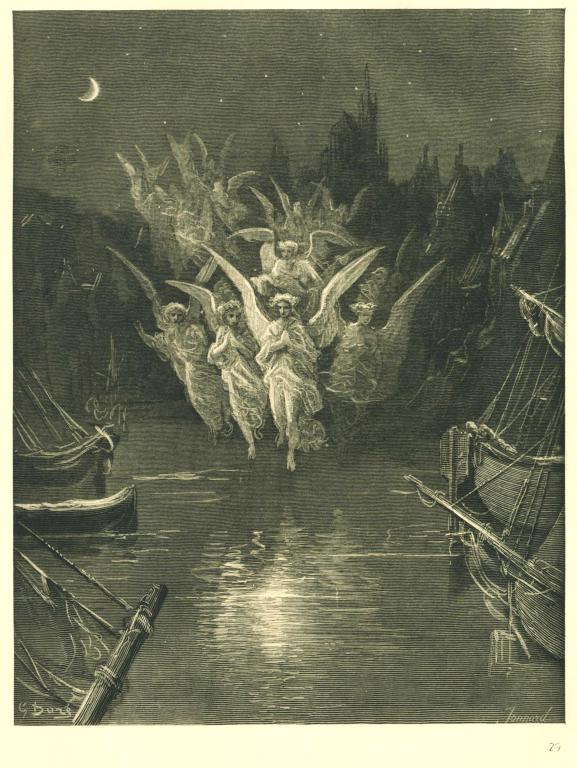
Doré, PD
Dearest Readers,
Recently, I finished reading Malcolm Guite’s Mariner: A Voyage with Samuel Taylor Coleridge. The book itself is a heavy one, weighing (with notes, bibliography, and index) at 471 pages. It is, in one sense, a biography of Samuel Taylor Coleridge. It gives what any biography should: dates, names, places, and a narrative to direct them all. Any biographer worth their salt knows that a certain theme must be found or constructed in order to make a compelling biography. Otherwise, biographies would be little more than annotated timelines. Similarly, biographers of writers and poets must include some semblance of literary criticism to highlight the writings of their subject. Malcolm Guite, of course, does both. But rather than see those as separate categories, he does them together. Guite’s major argument is this: The Rime of the Ancient Mariner serves as an interpretive key to Coleridge’s life.
Throughout the book, especially in part 2––which takes place after Coleridge has written The Rime of the Ancient Mariner––Guite shows not only how aspects of Coleridge’s life can be mapped onto the poem he first wrote in his twenties, but also how Coleridge began to associate himself with the titular Mariner. Malcolm’s examples are fascinating and compelling. For Guite, part of this key revolves around opium. According to Guite, many have seen Coleridge as a poetic genius whose genius was enlivened by his use of opium. But Coleridge himself says otherwise. In his notebooks and some of his letters, Coleridge shows that opium is keeping him from his work. And Guite pulls no punches. This is not simple hero-worship. Coleridge appears warts and all, and we see not an albatross but a poppy around his neck.
I could, and likely will, write more about the book itself, but I want to move in a slightly different direction. In reading Guite’s account of Coleridge, I have been shocked by certain striking similarities between aspects of Coleridge’s life and my own. Now, this may come off as more grandiose than I mean it to. I don’t mean to imply that I am as great a poet or writer or philosopher as Samuel Taylor Coleridge. Nor do I mean that I have aspirations to his level of fame. Rather, I mean I can see myself in Coleridge.
Not unlike Coleridge, my upbringing was uncommon. I suffered no death of parents as a boy, nor was I sent off to a fancy school (nor did anyone expect me at the time to become a minister). But, like the young Coleridge, I was at home with adults and could keep them entertained, yes, but also often keep up with their conversations, voicing my own opinion. What is more, I was adopted at a young age (as I have mentioned before) by my paternal grandparents causing my upbringing to be out of the ordinary.
The other small similarities, Coleridge’s fondness for long walks in nature, his habit of keeping and drafting in notebooks, the pain in his knee (caused by rheumatism) which initially caused his turn to laudanum. All, in one form or another, I share. The painful legs and knees is the most uncanny, though I do not know the cause of my pain. Yet it is Coleridge’s addiction and even some of his solutions for it that is most striking.
I should say quickly I have no addiction to any substance. I use nothing illegal nor do I use anything legal illegally. My own addiction or perhaps compulsions are of a more spiritual nature, but they nevertheless lead to many of the same results and stem from similar hurts. I have always struggled with depression and this can turn me to my sins, so I can feel something, anything, other than the oppressive weight of depression. I often have trouble sleeping. My wife has even suggested that I may be having mini-panic attacks at night as my heart races and I cannot find sleep. But I have also finally realized, thanks to Guite and Coleridge, that my turns inward, to self, have drastically reduced my creative and scholarly output. Writing is one of the first things to go as I turn to my compulsions and reading follows as well. Yet, just as it was for Coleridge, these things serve as part of the cure.
I am not often this publicly transparent (and I hope I have been opaque enough that you only have vague hints of what I mean about myself). But I feel I had to share the spiritual effect Guite’s Mariner and Coleridge’s life have had on me. I have been in so many ways “a wiser and sadder man” since I finished this book. I pray that having been stopped by the “grey-beard loon” (and I’ll let you decide if he is Malcolm himself or Coleridge or both) I will learn from Coleridge’s mistakes and his triumphs. And I pray that others in a similar state take up Guite’s book, preferably with a copy of The Rime of the Ancient Mariner near at hand, so too will find themselves transformed.
Sincerely,
David Russell Mosley
Mariner: A Voyage with Samuel Taylor Coleridge
Previous Post

April 28, 2019
C.S. Lewis's Cosmic Turn: Finding Virtue through the Heavens
Browse Our Archives
Select a Category A Secular Age Advent Apologetics Atheism Beauty Being a Catholic Evangelical Being Catholic Being Deified: Poetry and Fantasy on the Path to God Blogging Book Reviews C. S. Lewis Catholic Imagination Catholic Social Teaching Catholicism Christmas Church Calendar Church Fathers Church Life Community Conferences Cosmology Creation Curdled Words Deification Distributism Easter Economics Education Epiphany Essay Extracts Eucharist Faerie Faeriean Metaphysics Fatherhood Films Folk Liturgy Food and Drink G. K. Chesterton Harry Potter J. R. R. Tolkien Jove King Arthur Language Lent Life Literature and Poetry Liturgy Medieval Theology Music My Publications Mythology On the Edges of Elfland Ordinary Time Ordination Parenthood Parish Patristic Theology Pentecost Politics Prayer Racism Radical Orthodoxy Restoration Movement Sacramental Ontology Saints Science Sex and Sexuality Sophiology Stories The Inklings The Radical Catholic Reimagination of Everything Theologians in the Church Theopoetics Thesis Research Uncategorized University of Nottingham What I'm Reading Writing
Select a Month December 2019 November 2019 October 2019 September 2019 August 2019 July 2019 June 2019 May 2019 April 2019 March 2019 February 2019 January 2019 December 2018 November 2018 October 2018 September 2018 August 2018 July 2018 June 2018 May 2018 April 2018 March 2018 February 2018 January 2018 December 2017 November 2017 October 2017 August 2017 July 2017 June 2017 May 2017 April 2017 March 2017 February 2017 January 2017 December 2016 November 2016 October 2016 September 2016 August 2016 July 2016 June 2016 May 2016 April 2016 March 2016 February 2016 January 2016 December 2015 November 2015 October 2015 September 2015 August 2015 July 2015 June 2015 May 2015 April 2015 March 2015 February 2015 January 2015 December 2014 November 2014 October 2014 September 2014 August 2014 July 2014 June 2014 May 2014 April 2014 March 2014 February 2014 January 2014 December 2013 November 2013 October 2013 September 2013 August 2013 July 2013 June 2013 May 2013 April 2013 March 2013 February 2013 January 2013 December 2012 November 2012 October 2012 September 2012 July 2012
Follow Us!
TAKE THE
Religious Wisdom Quiz
Which Christian festival celebrates the revelation of Christ to the Gentiles (as symbolized by the Magi)?
Select your answer to see how you score.
Pentecost Epiphany Lent Advent
Related posts from Letters from the Edge of Elfland

Poetry, Podcasts, and More: Some Updates on Other...
Letters from the Edge of Elfland

Working on a Book of Poetry: An Apology...
Letters from the Edge of Elfland

Poetry Shapes the World around Us: Reflecting on...
Letters from the Edge of Elfland
The Tortured Artist: Must Artists Be Depressed to...
Letters from the Edge of Elfland
TRENDING AT PATHEOS Catholic

The Parable Of The Sower And The Word...
One of Christ’s most famous parables is that of the sower who...

Rejecting Doom: Christian Hope And Human Action
Christianity is a religion of hope. We are to have hope and...

Why I Choose the Eucharist Over the Sermon
Choose the Eucharist, Not the Sermon What are we supposed to get...

5 Design Elements Found in Spiritually Rooted Homes
Putting Spirituality Into Home Decor Our homes are more than our living...

Credo: A Story of God Told with the...
About 10 years ago, I began to imagine a personal "Credo" that...

The Anatomy of Divine Revelation in Catholic Thought
The claim that God has made Himself known to human beings is...
view all Catholic blogs
Ad-Free & Subscriber Log-In Subscription Support
- About Us
- 2026 Calendar
- Videos
- Podcasts
- Library of World Religions
- Faith In Media Tracker
- Advertise With Us
- Write for Us
- Privacy Policy
- Terms of Service
- Do Not Sell My Data
- Contact Us
- Radiant Digital
- Manage Newsletter Subscriptions
- Unsubscribe From Notifications
- Sitemap
Copyright 2008-2026, Patheos. All rights reserved.
Subscription Support Ad-Free & Subscriber Log-In
Follow Patheos