
BuddhistCatholicContemplativeEvangelicalGeneral ChristianHinduJewishLatter-day SaintMuslimNew VisionsProgressive Christian
Beliefs
- Buddhist
- Catholic
- Contemplative
- Evangelical
- General Christian
- Hindu
- Jewish
- Latter-day Saint
- More Voices
- Muslim
- New Visions
- Pagan
- Progressive Christian
Topics
- Religion News
- Food and Religion
- Sports and Religion
- Religious Art
- Religious Music and Entertainment
- Religious Events
- History and Religion
- Style and Religion
- Politics and Religion
- Women in Religion
- Recreation Outdoors and Religion
- Business Finance and Religion
- Careers Workplace and Religion
- Education and Religion
- Family Parenting and Religion
- Health Fitness and Religion
- Home and Religion
- Relationships and Religion
- Technology and Religion
- Travel and Religion
Columnists
- Buddhist Columnists
- Business Finance and Religion Columnists
- Careers Workplace and Religion Columnists
- Catholic Columnists
- Contemplative Columnists
- Education and Religion Columnists
- Evangelists Columnists
- Family Parenting and Religion Columnists
- General Christian Columnists
- Health Fitness and Religion Columnists
- Hindu Columnists
- History and Religion Columnists
- Home and Religion Columnists
- Jewish Columnists
- More Voices Columnists
- Latter Day Columnists
- Muslim Columnists
- New Visions Columnists
- Nonreligious Columnists
- Pagan Columnists
- Politics and Religion Columnists
- Progressive Columnists
- Recreation Outdoors and Religion Columnists
- Relationships and Religion Columnists
- Religion News Columnists
- Religious Art Columnists
- Religious Events Columnists
- Religious Music and Entertainment Columnists
- Sports and Religion Columnists
- Style and Religion Columnists
- Technology and Religion Columnists
- Travel and Religion Columnists
- Women in Religion Columnists
Resource Library
- 2026 Calendar
- Library of World Religions
- The 100 Most Holy Places on Earth
- Patheos Answers
- Podcasts
- Videos
- Faith Leaders Database
- Anglican Episcopalian
- Bahai
- Baptist
- Buddhism
- Christianity
- Confucianism
- Eastern Orthodoxy
- Hinduism
- Holiness and Pentecostal
- ISKCON
- Islam
- Judaism
- Lutheran
- Methodist
- The Church of Jesus Christ of Latter-day Saints
- New Age
- Paganism
- Presbytarian and Reformed
- Protestantism
- Religion Behind the Scenes
- Roman Catholic
- Scientology
- Shia Islam
- Sikhism
- Sufism
- Sunni Islam
- Taoism
- Zen
- See all religions
Research Tools
 Ad-Free & Subscriber Log-In Subscription Support
Ad-Free & Subscriber Log-In Subscription Support
Follow Patheos 

- Trending:
- Forgiveness
- |
- Marriage
- |
- Consciousness
- |
- Death Penalty
- |
- Election
- |
- Halloween
 Letters from the Edge of Elfland
- Home
- About
- Distributist Resources
- Publications and Presentations
- Support
- Works in Progress
- The Epistolarian Around the Web
- Home
- Catholic
- Finding the Real Unicorn: On Stories, Language, and Mythology
Finding the Real Unicorn: On Stories, Language, and Mythology
Last updated on: February 25, 2019 at 9:52 am by David Russell Mosley
Finding the Real Unicorn: On Stories, Language, and Mythology 2019-02-25T09:52:32-04:00 David Russell Mosley
Patheos Explore the world's faith through different perspectives on religion and spirituality! Patheos has the views of the prevalent religions and spiritualities of the world.
Ordinary Time
25 February 2019
The Edge of Elfland
Concord, New Hampshire
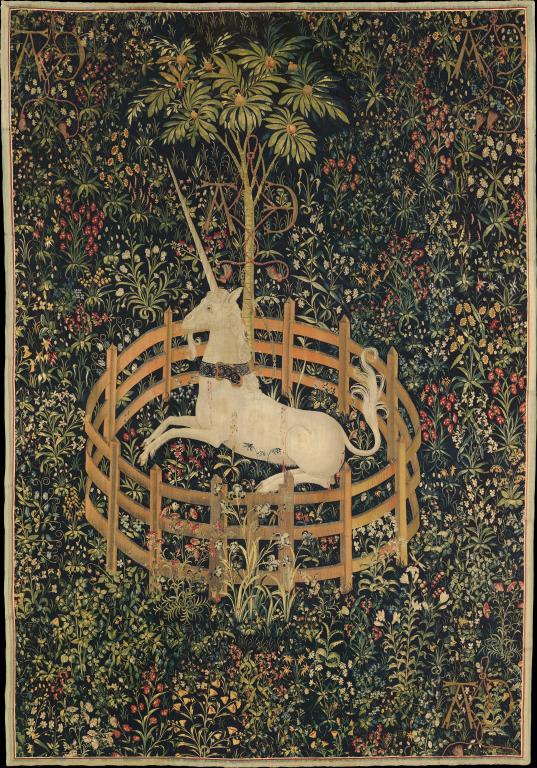
Public Domain/Wikimedia Commons
Dearest Readers,
Recently I came across a Ranker “article” concerning the real unicorn. The article (CNN actually has one just like it) was concerned with two issues: first, to disabuse modern readers of misconceptions concerning unicorns, primarily their existence or non-existence; second, to show readers the “real unicorn,” a creature whose bones we have found and who, according to the articles, is the source of all our modern stories about unicorns. This reminded me of similar articles concerning Neanderthals. These argued that perhaps Neanderthals stand at the back of our stories about elves, trolls, ogres, etc.
A younger me might have found these arguments convincing. As a child I was particularly obsessed with bigfoot. I would plot sightings of it I discovered on the internet on a giant map of the world I had in my bedroom. I loved this idea of a creature that spanned man and our more irrational ancestors. And so these articles would have been of interest. I would have been able to say, “See! They were real, just not in the way we thought.” I would have basked in the possibility of these fantastical creatures existing even along such modernistic lines. Now, however, I see them as containing two chief errors.
The first error is that of demythology. This is a trend one sees especially in biblical studies. It typically starts with the presupposition that something which appears miraculous must have a purely natural explanation (and by purely natural they mean to bracket out anything “supernatural”). Thus these events, if they really happened, are in need of a more realistic explanation. Thus, when Christ feeds the five thousand, there was not a miraculous multiplication of food, but a miraculous act of sharing on the parts of those who did bring food with them as a response to Christ’s message. Of course, this doesn’t explain why the people kept following him looking for food, but I digress.
So, take the “real unicorn” or Elasmotherium sibiricu. It was a creature that existed as early as 29000 years ago, when humans were roaming the earth. The story essentially goes like this then. These early humans saw the Siberian unicorn, probably killed and ate it, but also told stories about it. These stories get passed on, but like in a game of telephone they get distorted in the retellings. Eventually, this large rhinoceros type creature gets remembered as a stately goat-like creature or as an even statelier horse who prefers the company of virgins. You can see the demythology at work. We have stories about unicorns. Unicorns, as described in these stories, cannot exist. Therefore, this more naturalistic explanation is the real story. This works for the Neanderthals are elves/trolls/ogres demythology. These fay-creatures cannot exist, so we must find a more natural explanation. Neanderthals were weird looking and unusual compared to their homosapiens cousins and so gave rise to the stories we’ve told ourselves about creatures like us but also vastly different from us.
The second error I think these authors have engaged in, which is tied to their demythology, is the desire to find an origin for these stories. J.R.R. Tolkien writes in his essay, “On Fairy-stories,” “To ask what is the origin of stories (however qualified) is to ask what is the origin of language and of mind.” For Tolkien, story, myth, and language all arise as one. This is why, when he started inventing his own languages now found in his Legendarium, he wrote his Legendarium. It was not enough, for him, to say that the Sindarin word for tree is galadh is not enough for Tolkien. Not only does he want to understand how it arrived at its present form, but how it has been used, what stories are involved with it. Tolkien admits that there is, good, interest in unraveling, “the intricately knotted and ramified history of the branches on the Tree of Tales,” but he goes on to say, “that it is more interesting, and also in its way more difficult to consider what they are, what they have become for us, and what values the long alchemic processes of time have produced in them.”
Thus when these articles suggest that Elasmotherium sibiricu is the real unicorn or that Neanderthals are the real trolls they have, in a sense, done some violence to our stories about unicorns and trolls. Now, the origin of our stories of trolls and unicorns is still important, or at least of interest. But looking only at the biological or archaeological will not give us the answers. This is not because Elasmotherium sibiricu isn’t the one of the sources for our stories about unicorns. It is entirely possible that it played a role. But to say that it is the real unicorn is to act as though our stories about unicorns are simply a distorted picture of reality. It is, in short, to ignore the actual story. By all means do your detective work, but remember that etymology plays an even more significant role here that biology or archaeology. Remember that the stories themselves have life and that they call on us to attend to them, to the stories as a whole, not just to the parts.
Sincerely,
David Russell Mosley
Previous Post

February 22, 2019
Curdled Words: Wordsworth, Daffodils, and the Stars
Next Post
February 26, 2019 Malcolm Guite and Marty O'Donnell's Music of the Spheres
Browse Our Archives
Select a Category A Secular Age Advent Apologetics Atheism Beauty Being a Catholic Evangelical Being Catholic Being Deified: Poetry and Fantasy on the Path to God Blogging Book Reviews C. S. Lewis Catholic Imagination Catholic Social Teaching Catholicism Christmas Church Calendar Church Fathers Church Life Community Conferences Cosmology Creation Curdled Words Deification Distributism Easter Economics Education Epiphany Essay Extracts Eucharist Faerie Faeriean Metaphysics Fatherhood Films Folk Liturgy Food and Drink G. K. Chesterton Harry Potter J. R. R. Tolkien Jove King Arthur Language Lent Life Literature and Poetry Liturgy Medieval Theology Music My Publications Mythology On the Edges of Elfland Ordinary Time Ordination Parenthood Parish Patristic Theology Pentecost Politics Prayer Racism Radical Orthodoxy Restoration Movement Sacramental Ontology Saints Science Sex and Sexuality Sophiology Stories The Inklings The Radical Catholic Reimagination of Everything Theologians in the Church Theopoetics Thesis Research Uncategorized University of Nottingham What I'm Reading Writing
Select a Month December 2019 November 2019 October 2019 September 2019 August 2019 July 2019 June 2019 May 2019 April 2019 March 2019 February 2019 January 2019 December 2018 November 2018 October 2018 September 2018 August 2018 July 2018 June 2018 May 2018 April 2018 March 2018 February 2018 January 2018 December 2017 November 2017 October 2017 August 2017 July 2017 June 2017 May 2017 April 2017 March 2017 February 2017 January 2017 December 2016 November 2016 October 2016 September 2016 August 2016 July 2016 June 2016 May 2016 April 2016 March 2016 February 2016 January 2016 December 2015 November 2015 October 2015 September 2015 August 2015 July 2015 June 2015 May 2015 April 2015 March 2015 February 2015 January 2015 December 2014 November 2014 October 2014 September 2014 August 2014 July 2014 June 2014 May 2014 April 2014 March 2014 February 2014 January 2014 December 2013 November 2013 October 2013 September 2013 August 2013 July 2013 June 2013 May 2013 April 2013 March 2013 February 2013 January 2013 December 2012 November 2012 October 2012 September 2012 July 2012
Follow Us!
TAKE THE
Religious Wisdom Quiz
What does Paul say in Colossians has been nailed to the cross?
Select your answer to see how you score.
Satan's authority Our sins The written code with its regulations The old covenant
Related posts from Letters from the Edge of Elfland

William Blake on the Creative Spirit, Beauty, and...
Letters from the Edge of Elfland
Friendship, Love, and the Arts: A Belated Review...
Letters from the Edge of Elfland

“Wherefore stopp’st thou me?” Coleridge’s Creative Message to...
Letters from the Edge of Elfland
Good Morning, Mr. Magpie: On Folklore and Science
Letters from the Edge of Elfland
TRENDING AT PATHEOS Catholic

Creation, Preservation, and Teleology in Catholic Theology
As I write this, it is very early Monday morning. Like millions...

The Parable Of The Sower And The Word...
One of Christ’s most famous parables is that of the sower who...

Rejecting Doom: Christian Hope And Human Action
Christianity is a religion of hope. We are to have hope and...

Why I Choose the Eucharist Over the Sermon
Choose the Eucharist, Not the Sermon What are we supposed to get...

5 Design Elements Found in Spiritually Rooted Homes
Putting Spirituality Into Home Decor Our homes are more than our living...

Credo: A Story of God Told with the...
About 10 years ago, I began to imagine a personal "Credo" that...
view all Catholic blogs
Ad-Free & Subscriber Log-In Subscription Support
- About Us
- 2026 Calendar
- Videos
- Podcasts
- Library of World Religions
- Faith In Media Tracker
- Advertise With Us
- Write for Us
- Privacy Policy
- Terms of Service
- Do Not Sell My Data
- Contact Us
- Radiant Digital
- Manage Newsletter Subscriptions
- Unsubscribe From Notifications
- Sitemap
Copyright 2008-2026, Patheos. All rights reserved.
Subscription Support Ad-Free & Subscriber Log-In
Follow Patheos