
BuddhistCatholicContemplativeEvangelicalGeneral ChristianHinduJewishLatter-day SaintMuslimNew VisionsProgressive Christian
Beliefs
- Buddhist
- Catholic
- Contemplative
- Evangelical
- General Christian
- Hindu
- Jewish
- Latter-day Saint
- More Voices
- Muslim
- New Visions
- Pagan
- Progressive Christian
Topics
- Religion News
- Food and Religion
- Sports and Religion
- Religious Art
- Religious Music and Entertainment
- Religious Events
- History and Religion
- Style and Religion
- Politics and Religion
- Women in Religion
- Recreation Outdoors and Religion
- Business Finance and Religion
- Careers Workplace and Religion
- Education and Religion
- Family Parenting and Religion
- Health Fitness and Religion
- Home and Religion
- Relationships and Religion
- Technology and Religion
- Travel and Religion
Columnists
- Buddhist Columnists
- Business Finance and Religion Columnists
- Careers Workplace and Religion Columnists
- Catholic Columnists
- Contemplative Columnists
- Education and Religion Columnists
- Evangelists Columnists
- Family Parenting and Religion Columnists
- General Christian Columnists
- Health Fitness and Religion Columnists
- Hindu Columnists
- History and Religion Columnists
- Home and Religion Columnists
- Jewish Columnists
- More Voices Columnists
- Latter Day Columnists
- Muslim Columnists
- New Visions Columnists
- Nonreligious Columnists
- Pagan Columnists
- Politics and Religion Columnists
- Progressive Columnists
- Recreation Outdoors and Religion Columnists
- Relationships and Religion Columnists
- Religion News Columnists
- Religious Art Columnists
- Religious Events Columnists
- Religious Music and Entertainment Columnists
- Sports and Religion Columnists
- Style and Religion Columnists
- Technology and Religion Columnists
- Travel and Religion Columnists
- Women in Religion Columnists
Resource Library
- 2026 Calendar
- Library of World Religions
- The 100 Most Holy Places on Earth
- Patheos Answers
- Podcasts
- Videos
- Faith Leaders Database
- Anglican Episcopalian
- Bahai
- Baptist
- Buddhism
- Christianity
- Confucianism
- Eastern Orthodoxy
- Hinduism
- Holiness and Pentecostal
- ISKCON
- Islam
- Judaism
- Lutheran
- Methodist
- The Church of Jesus Christ of Latter-day Saints
- New Age
- Paganism
- Presbytarian and Reformed
- Protestantism
- Religion Behind the Scenes
- Roman Catholic
- Scientology
- Shia Islam
- Sikhism
- Sufism
- Sunni Islam
- Taoism
- Zen
- See all religions
Research Tools
 Ad-Free & Subscriber Log-In Subscription Support
Ad-Free & Subscriber Log-In Subscription Support
Follow Patheos 

- Trending:
- Forgiveness
- |
- Marriage
- |
- Consciousness
- |
- Death Penalty
- |
- Election
- |
- Halloween
 Letters from the Edge of Elfland
- Home
- About
- Distributist Resources
- Publications and Presentations
- Support
- Works in Progress
- The Epistolarian Around the Web
- Home
- Catholic
- On Teaching Francis’ “Canticle of Brother Sun”
On Teaching Francis’ “Canticle of Brother Sun”
Last updated on: January 19, 2019 at 4:22 pm by David Russell Mosley
On Teaching Francis’ “Canticle of Brother Sun” 2019-01-19T16:22:21-04:00 David Russell Mosley
Patheos Explore the world's faith through different perspectives on religion and spirituality! Patheos has the views of the prevalent religions and spiritualities of the world.
Ordinary Time
19 January 2018
The Edge of Elfland
Concord, NH
Description
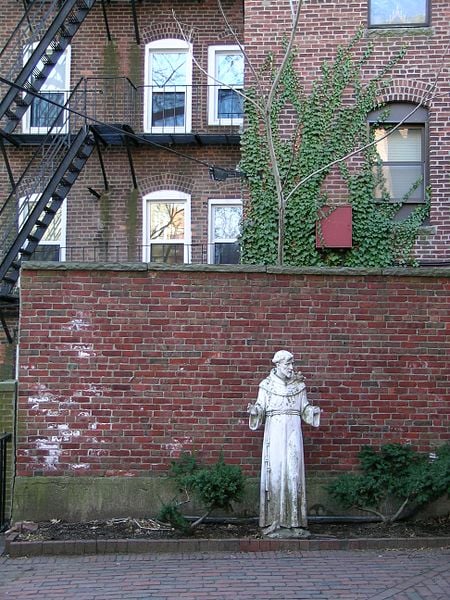
English: This statue of Saint Francis of Assisi in the North End of Boston is indicative of the historically Roman Catholic nature of that neighborhood’s Italian-American community. March 2008 photo by John Stephen Dwyer.
Date 25 March 2008 (according to Exif data)
Source Own work
Author User:Boston
(CC BY-SA 3.0)
Dearest Readers,
Every year in my Fundamentals of the Christian Faith class, my text for discussion during our unit on Creation is St. Francis’ “Canticle of Brother Sun and Sister Moon.” I choose this text for a few reasons. First, I find that many of my college students have not been introduced to poetry, and certainly don’t think that poetry and theology can inform each other. Second, I find that Francis’ poem does an excellent job confronting a lot of their presuppositions about creation. It makes them uncomfortable in all the right ways. Third, and perhaps most importantly, it prepares them for our final week on Sacramental Imagination where we read Dante, Hopkins, Chesterton, and more.
I am truly surprised at how many of my begin with a dislike of poetry. I suppose I shouldn’t be. After all, my high school students often don’t like it either. So, if they begin that way in high school (or have been formed that way, a subject for another letter), it should come as no surprise when I see posts (I should note that this is an online class) which begin with some iteration of “I don’t really like poetry.” And many of them maintain that. One question I always ask is if my students agree or disagree with what they’ve read. I want them thinking critically. But with Francis, sometimes they struggle. It is poetry after all. It’s all about how we feel, so what is there to disagree with. Some get it, and I work for those moments. And I can only hope that those who don’t will some day.
Whether they like poetry or not, Francis’ often makes them uncomfortable. Because Francis uses phrases like brother sun, and most especially, mother earth (actually sister, mother earth), many walk away nervous that Francis is some kind of proto-New Ager. Even if they don’t think that, some fear that Francis might confuse those who are interested in New Age spiritualism. I like to hope that reading Francis helps them overcome some of our modern presuppositions. I take a guilty pleasure in confronting students, even those who seem to like the poem, when they suggest that Francis doesn’t really mean that the Sun can praise God. Who says he can’t? Ramandu’s words are always close to me, “Even in your world, my son, that is not what a star is but only what it is made of.” I don’t want them getting too comfortable too quickly, even when they agree. We need to let Francis’ words reach us, not as mere sentimentality, but for the full force of their meaning. This is why I specifically ask them to reflect on this line:
Praised be You, my Lord through Sister Death,
from whom no-one living can escape. Woe to those who die in mortal sin! Blessed are they She finds doing Your Will.
Finally, and really the main reason I assign Francis, is to help prepare them to see poetry and theology working together. This is not to conflate poetry and theology. They are different, but this does not mean that they cannot and do not work in conjunction with one another. This poem has the added benefit of beginning to train them to see creation in a new light, one in which we are related to it and it is, apparently, more worthy to praise God than we are. It is essential that students of theology begin to learn and see in these ways. Neglect of the poetic leads to a kind of phariseeism, just as neglect of the theological (in its more academic sense) can lead to a kind of boundless, and often shallow sense of feeling.
My only regret in all of this is that I cannot sit with these students and talk through this poem. The format of my class does not allow for it, but I hope that it still forces my students, as it often forces me, out of the haze of habit and into new and deeper ways of knowing and being.
I leave you now with Francis.
Sincerely,
David Russell Mosley
“Canticle of Brother Sun and Sister Moon” by St. Francis of Assisi
Most High, all-powerful, all-good Lord, All praise is Yours, all glory, all honour and all blessings.
To you alone, Most High, do they belong, and no mortal lips are worthy to pronounce Your Name.
Praised be You my Lord with all Your creatures,
especially Sir Brother Sun,
Who is the day through whom You give us light.
And he is beautiful and radiant with great splendour,
Of You Most High, he bears the likeness.Praised be You, my Lord, through Sister Moon and the stars,
In the heavens you have made them bright, precious and fair.Praised be You, my Lord, through Brothers Wind and Air,
And fair and stormy, all weather’s moods,
by which You cherish all that You have made.Praised be You my Lord through Sister Water,
So useful, humble, precious and pure.Praised be You my Lord through Brother Fire,
through whom You light the night and he is beautiful and playful and robust and strong.Praised be You my Lord through our Sister,
Mother Earth
who sustains and governs us,
producing varied fruits with coloured flowers and herbs.
Praise be You my Lord through those who grant pardon for love of You and bear sickness and trial.Blessed are those who endure in peace, By You Most High, they will be crowned.
Praised be You, my Lord through Sister Death,
from whom no-one living can escape. Woe to those who die in mortal sin! Blessed are they She finds doing Your Will.No second death can do them harm. Praise and bless my Lord and give Him thanks,
And serve Him with great humility.
Previous Post

January 3, 2019
Augustine against the Astrologers: Stars, Meaning, and Enchantment
Next Post
January 20, 2019 Covington Catholic, Racism, and the March for Life
Browse Our Archives
Select a Category A Secular Age Advent Apologetics Atheism Beauty Being a Catholic Evangelical Being Catholic Being Deified: Poetry and Fantasy on the Path to God Blogging Book Reviews C. S. Lewis Catholic Imagination Catholic Social Teaching Catholicism Christmas Church Calendar Church Fathers Church Life Community Conferences Cosmology Creation Curdled Words Deification Distributism Easter Economics Education Epiphany Essay Extracts Eucharist Faerie Faeriean Metaphysics Fatherhood Films Folk Liturgy Food and Drink G. K. Chesterton Harry Potter J. R. R. Tolkien Jove King Arthur Language Lent Life Literature and Poetry Liturgy Medieval Theology Music My Publications Mythology On the Edges of Elfland Ordinary Time Ordination Parenthood Parish Patristic Theology Pentecost Politics Prayer Racism Radical Orthodoxy Restoration Movement Sacramental Ontology Saints Science Sex and Sexuality Sophiology Stories The Inklings The Radical Catholic Reimagination of Everything Theologians in the Church Theopoetics Thesis Research Uncategorized University of Nottingham What I'm Reading Writing
Select a Month December 2019 November 2019 October 2019 September 2019 August 2019 July 2019 June 2019 May 2019 April 2019 March 2019 February 2019 January 2019 December 2018 November 2018 October 2018 September 2018 August 2018 July 2018 June 2018 May 2018 April 2018 March 2018 February 2018 January 2018 December 2017 November 2017 October 2017 August 2017 July 2017 June 2017 May 2017 April 2017 March 2017 February 2017 January 2017 December 2016 November 2016 October 2016 September 2016 August 2016 July 2016 June 2016 May 2016 April 2016 March 2016 February 2016 January 2016 December 2015 November 2015 October 2015 September 2015 August 2015 July 2015 June 2015 May 2015 April 2015 March 2015 February 2015 January 2015 December 2014 November 2014 October 2014 September 2014 August 2014 July 2014 June 2014 May 2014 April 2014 March 2014 February 2014 January 2014 December 2013 November 2013 October 2013 September 2013 August 2013 July 2013 June 2013 May 2013 April 2013 March 2013 February 2013 January 2013 December 2012 November 2012 October 2012 September 2012 July 2012
Follow Us!
TAKE THE
Religious Wisdom Quiz
How did Saul die?
Select your answer to see how you score.
Killed by Philistines Stoned by Israelites Fell on his own sword Died of old age
Related posts from Letters from the Edge of Elfland

Poetry, Podcasts, and More: Some Updates on Other...
Letters from the Edge of Elfland

Working on a Book of Poetry: An Apology...
Letters from the Edge of Elfland

Poetry Shapes the World around Us: Reflecting on...
Letters from the Edge of Elfland
The Journey Is Almost Over: Reflecting on Six...
Letters from the Edge of Elfland
TRENDING AT PATHEOS Catholic

Rejecting Doom: Christian Hope And Human Action
Christianity is a religion of hope. We are to have hope and...

It’s What Comes From Within Which Matters
One of the most difficult things for us to understand is why...

Why I Choose the Eucharist Over the Sermon
Choose the Eucharist, Not the Sermon What are we supposed to get...

5 Design Elements Found in Spiritually Rooted Homes
Putting Spirituality Into Home Decor Our homes are more than our living...

Credo: A Story of God Told with the...
About 10 years ago, I began to imagine a personal "Credo" that...

The Anatomy of Divine Revelation in Catholic Thought
The claim that God has made Himself known to human beings is...
view all Catholic blogs
Ad-Free & Subscriber Log-In Subscription Support
- About Us
- 2026 Calendar
- Videos
- Podcasts
- Library of World Religions
- Faith In Media Tracker
- Advertise With Us
- Write for Us
- Privacy Policy
- Terms of Service
- Do Not Sell My Data
- Contact Us
- Radiant Digital
- Manage Newsletter Subscriptions
- Unsubscribe From Notifications
- Sitemap
Copyright 2008-2026, Patheos. All rights reserved.
Subscription Support Ad-Free & Subscriber Log-In
Follow Patheos