
BuddhistCatholicContemplativeEvangelicalGeneral ChristianHinduJewishLatter-day SaintMuslimNew VisionsProgressive Christian
Beliefs
- Buddhist
- Catholic
- Contemplative
- Evangelical
- General Christian
- Hindu
- Jewish
- Latter-day Saint
- More Voices
- Muslim
- New Visions
- Pagan
- Progressive Christian
Topics
- Religion News
- Food and Religion
- Sports and Religion
- Religious Art
- Religious Music and Entertainment
- Religious Events
- History and Religion
- Style and Religion
- Politics and Religion
- Women in Religion
- Recreation Outdoors and Religion
- Business Finance and Religion
- Careers Workplace and Religion
- Education and Religion
- Family Parenting and Religion
- Health Fitness and Religion
- Home and Religion
- Relationships and Religion
- Technology and Religion
- Travel and Religion
Columnists
- Buddhist Columnists
- Business Finance and Religion Columnists
- Careers Workplace and Religion Columnists
- Catholic Columnists
- Contemplative Columnists
- Education and Religion Columnists
- Evangelists Columnists
- Family Parenting and Religion Columnists
- General Christian Columnists
- Health Fitness and Religion Columnists
- Hindu Columnists
- History and Religion Columnists
- Home and Religion Columnists
- Jewish Columnists
- More Voices Columnists
- Latter Day Columnists
- Muslim Columnists
- New Visions Columnists
- Nonreligious Columnists
- Pagan Columnists
- Politics and Religion Columnists
- Progressive Columnists
- Recreation Outdoors and Religion Columnists
- Relationships and Religion Columnists
- Religion News Columnists
- Religious Art Columnists
- Religious Events Columnists
- Religious Music and Entertainment Columnists
- Sports and Religion Columnists
- Style and Religion Columnists
- Technology and Religion Columnists
- Travel and Religion Columnists
- Women in Religion Columnists
Resource Library
- 2026 Calendar
- Library of World Religions
- The 100 Most Holy Places on Earth
- Patheos Answers
- Podcasts
- Videos
- Faith Leaders Database
- Anglican Episcopalian
- Bahai
- Baptist
- Buddhism
- Christianity
- Confucianism
- Eastern Orthodoxy
- Hinduism
- Holiness and Pentecostal
- ISKCON
- Islam
- Judaism
- Lutheran
- Methodist
- The Church of Jesus Christ of Latter-day Saints
- New Age
- Paganism
- Presbytarian and Reformed
- Protestantism
- Religion Behind the Scenes
- Roman Catholic
- Scientology
- Shia Islam
- Sikhism
- Sufism
- Sunni Islam
- Taoism
- Zen
- See all religions
Research Tools
 Ad-Free & Subscriber Log-In Subscription Support
Ad-Free & Subscriber Log-In Subscription Support
Follow Patheos 

- Trending:
- Forgiveness
- |
- Marriage
- |
- Consciousness
- |
- Death Penalty
- |
- Election
- |
- Halloween
 Letters from the Edge of Elfland
- Home
- About
- Distributist Resources
- Publications and Presentations
- Support
- Works in Progress
- The Epistolarian Around the Web
- Home
- Catholic
- A Manifesto for the Radical Catholic Reimagination of Everything
A Manifesto for the Radical Catholic Reimagination of Everything
Last updated on: December 13, 2018 at 3:36 pm by David Russell Mosley
A Manifesto for the Radical Catholic Reimagination of Everything 2018-12-13T15:36:47-04:00 David Russell Mosley
Patheos Explore the world's faith through different perspectives on religion and spirituality! Patheos has the views of the prevalent religions and spiritualities of the world.
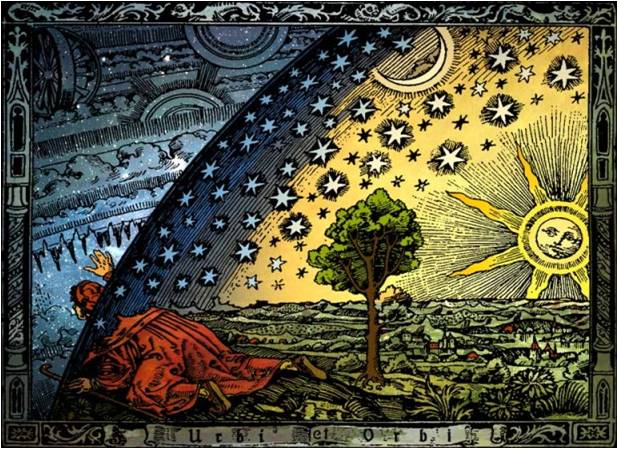
La version en noir & blanc connue est dans Camille Flammarion (1842-1925).- L’atmosphère : météorologie populaire, Hachette, Paris, 1888, p. 163
Author Heikenwaelder Hugo, Austria, Email : [email protected], www.heikenwaelder.at, CC BY-SA 2.5
Advent
St. Lucy’s Day 2018
The Edge of Elfland
Concord, NH
Dearest Readers,
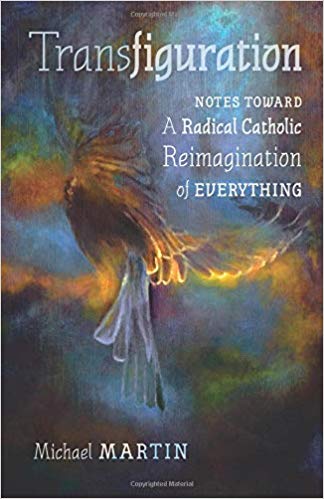 Now that it has been officially released, I would like to tell everyone about Michael Martin’s most recent book, Transfiguration: Notes Toward A Radical Catholic Reimagination of Everything. This book is Martin’s manifesto, his declaration of how we ought to see and interact with the world around us. It is not, however, a program. Martin isn’t here to tell us all the ins and outs of how we ought to put the radical Catholic reimagination of everything into practice. Rather, he wants to draw our attention to better ways of knowing, of seeing the world around us.
Martin even says in his introduction, “I do not expect that the ideas in this book will be taken up by my contemporaries. That may seem a maudlin confession, but the sense of vocation out of which this book was written did not come with a promise of reward. My only hope is to leave an artifact, a broken shard of pottery from a vessel that once held wine. It no longer belongs to me.”
There many things I could focus on as reviewer. But I would rather keep this review short and not reveal too much so that you will desire to read the book for yourself. So first, I would like to discuss two points of contention. In the second chapter, “Art as Eschatology,” Martin discusses the need for art to look forward rather than back. In one swipe he takes a swing at Great Books Programs and Lewis, Tolkien, and O’Connor. I will leave O’Connor to be considered by those who know her better. I will also leave the Greek Books to my next section on education in Martin’s book. Rather, my focus is on Lewis and Tolkien.
Martin writes, “This is even the case with the all-too-habitual invocations of inhabitants of a more recent past—C.S. Lewis, J.R.R. Tolkien, or Flannery O’Connor—and whose acolytes often see fit to adopt the requisite uniforms of beards, pipes, tweeds, if not crutches and peacocks. These tombs are beautiful, brothers and sisters, but they are still tombs” (37). I understand what Martin means. Devotees of Lewis and Tolkien can be a peculiar bunch, thinking that the height of art or life was to be found in the 1940s and 50s. This is, of course, untrue. Of course, I also take this a bit personally since I do have a proclivity for tweed and pipe tobacco. Nevertheless, I think Martin too dismissive here as much of what he goes on to write about I have found and learned to love first through the works of both Lewis and Tolkien. Even if one tried to claim that much of their work is a look back, it is so only in order to then look forward.
My next point of contention comes from the third chapter, “The Reimagination fo Education and the Postmodern Sophiological Hedge School.” Here Martin takes to task not only the Great Books programs that have been growing for the last 60 or so years but also the rise of Catholic Classical schools. He points instead to the hedge schools of occupied Ireland, where Catholics taught children in secret. Here I am even more understanding of Martin’s point. Accreditation, standardized testing, and mimicry of secular models of learning have led many Catholic schools astray. Still, I find his characterization does not fully fit the very school in which I currently work. Here again, of course, I could just be personally biased, but I think things may be more hopeful, or be better prepared for the kind of education he envisions, than he allows.
These two points of contention aside, I cannot recommend this book enough. In such a short space, Martin has clearly and beautifully expressed better ways of knowing and understanding reality. All of this, as should be expected for readers of Martin, comes through a sophianic lens. Science, for instance, ought to be undertaken in and as a relationship between the knower and the things to be known. Martin holds Goethe, David Bohm, and Rupert Sheldrake as scientists not of the laboratory but of creation, of the cosmos. And it is this, the cosmological that ties together the entire book.
Martin is calling us to an integrated way of being, one which allows the cosmos, the seasons, the liturgical calendar, our art, our education all to be related and mutually informing of and to one another. Martin writes:
“Cosmological awareness” is a fancy way to say that we need to attend to and interiorize the rhythms of nature and their relationship to the Church year. This would have different applications in the southern hemisphere than in the northern, of course, but, wherever one lives, it should not be all that difficult to connect the two.
I am reminded not only of Louis Bouyer, but of Dante and Tolkien and Lewis, here. The claim we ought to be making as Catholics is that the liturgical calendar is disclosive of reality, not simply in some ethereal, spiritual sense, but in a real, phenomenological sense. Christmas being celebrated on December 25th, whether in conjunction with the Winter Solstice or the Summer (depending on one’s hemisphere) is on purpose and not simply an accident of history. What is more, December 25th has a name, not a date, and this should change how we encounter it.
Wholistic, were it not such a buzzword, is precisely the word I think most would understand as the key to Martin’s Transfiguration. He, of course, would prefer such words as sophianic, sophiological, or even cosmic/cosmological. And he would be right. Still, his emphasis is on the whole, an integrated whole where everything in creation touches everything else. And thus our science, our art, and our education ought to serve as aids and examples of this reality. Whatever issues I may take with aspects of Martin’s approach, his emphasis on the whole is, in my opinion, precisely the right one and precisely the one we need now more than almost anything else.
So take up this book and read. Prove Martin wrong that his contemporaries will not act on his words. By all means challenge him, but do not ignore him. We do so, I fear, to our peril.
Sincerely,
David
The Radical Catholic Reimagination of Everything
Next Post

December 23, 2018 A New Speaking Engagement: The Catholic Literature Conference in Concord
Browse Our Archives
Select a Category A Secular Age Advent Apologetics Atheism Beauty Being a Catholic Evangelical Being Catholic Being Deified: Poetry and Fantasy on the Path to God Blogging Book Reviews C. S. Lewis Catholic Imagination Catholic Social Teaching Catholicism Christmas Church Calendar Church Fathers Church Life Community Conferences Cosmology Creation Curdled Words Deification Distributism Easter Economics Education Epiphany Essay Extracts Eucharist Faerie Faeriean Metaphysics Fatherhood Films Folk Liturgy Food and Drink G. K. Chesterton Harry Potter J. R. R. Tolkien Jove King Arthur Language Lent Life Literature and Poetry Liturgy Medieval Theology Music My Publications Mythology On the Edges of Elfland Ordinary Time Ordination Parenthood Parish Patristic Theology Pentecost Politics Prayer Racism Radical Orthodoxy Restoration Movement Sacramental Ontology Saints Science Sex and Sexuality Sophiology Stories The Inklings The Radical Catholic Reimagination of Everything Theologians in the Church Theopoetics Thesis Research Uncategorized University of Nottingham What I'm Reading Writing
Select a Month December 2019 November 2019 October 2019 September 2019 August 2019 July 2019 June 2019 May 2019 April 2019 March 2019 February 2019 January 2019 December 2018 November 2018 October 2018 September 2018 August 2018 July 2018 June 2018 May 2018 April 2018 March 2018 February 2018 January 2018 December 2017 November 2017 October 2017 August 2017 July 2017 June 2017 May 2017 April 2017 March 2017 February 2017 January 2017 December 2016 November 2016 October 2016 September 2016 August 2016 July 2016 June 2016 May 2016 April 2016 March 2016 February 2016 January 2016 December 2015 November 2015 October 2015 September 2015 August 2015 July 2015 June 2015 May 2015 April 2015 March 2015 February 2015 January 2015 December 2014 November 2014 October 2014 September 2014 August 2014 July 2014 June 2014 May 2014 April 2014 March 2014 February 2014 January 2014 December 2013 November 2013 October 2013 September 2013 August 2013 July 2013 June 2013 May 2013 April 2013 March 2013 February 2013 January 2013 December 2012 November 2012 October 2012 September 2012 July 2012
Follow Us!
TAKE THE
Religious Wisdom Quiz
"______ is the same yesterday and today and forever."
Select your answer to see how you score.
Jesus Christ The Universe God's Plan Our Calling
Related posts from Letters from the Edge of Elfland

William Blake on the Creative Spirit, Beauty, and...
Letters from the Edge of Elfland

“Wherefore stopp’st thou me?” Coleridge’s Creative Message to...
Letters from the Edge of Elfland
Stop, Christian Passer-by: A Spiritual Review of Mariner...
Letters from the Edge of Elfland

Augustine against the Astrologers: Stars, Meaning, and Enchantment
Letters from the Edge of Elfland
TRENDING AT PATHEOS Catholic

Creation, Preservation, and Teleology in Catholic Theology
As I write this, it is very early Monday morning. Like millions...

The Parable Of The Sower And The Word...
One of Christ’s most famous parables is that of the sower who...

Rejecting Doom: Christian Hope And Human Action
Christianity is a religion of hope. We are to have hope and...

Why I Choose the Eucharist Over the Sermon
Choose the Eucharist, Not the Sermon What are we supposed to get...

5 Design Elements Found in Spiritually Rooted Homes
Putting Spirituality Into Home Decor Our homes are more than our living...

Credo: A Story of God Told with the...
About 10 years ago, I began to imagine a personal "Credo" that...
view all Catholic blogs
Ad-Free & Subscriber Log-In Subscription Support
- About Us
- 2026 Calendar
- Videos
- Podcasts
- Library of World Religions
- Faith In Media Tracker
- Advertise With Us
- Write for Us
- Privacy Policy
- Terms of Service
- Do Not Sell My Data
- Contact Us
- Radiant Digital
- Manage Newsletter Subscriptions
- Unsubscribe From Notifications
- Sitemap
Copyright 2008-2026, Patheos. All rights reserved.
Subscription Support Ad-Free & Subscriber Log-In
Follow Patheos