
BuddhistCatholicContemplativeEvangelicalGeneral ChristianHinduJewishLatter-day SaintMuslimNew VisionsProgressive Christian
Beliefs
- Buddhist
- Catholic
- Contemplative
- Evangelical
- General Christian
- Hindu
- Jewish
- Latter-day Saint
- More Voices
- Muslim
- New Visions
- Pagan
- Progressive Christian
Topics
- Religion News
- Food and Religion
- Sports and Religion
- Religious Art
- Religious Music and Entertainment
- Religious Events
- History and Religion
- Style and Religion
- Politics and Religion
- Women in Religion
- Recreation Outdoors and Religion
- Business Finance and Religion
- Careers Workplace and Religion
- Education and Religion
- Family Parenting and Religion
- Health Fitness and Religion
- Home and Religion
- Relationships and Religion
- Technology and Religion
- Travel and Religion
Columnists
- Buddhist Columnists
- Business Finance and Religion Columnists
- Careers Workplace and Religion Columnists
- Catholic Columnists
- Contemplative Columnists
- Education and Religion Columnists
- Evangelists Columnists
- Family Parenting and Religion Columnists
- General Christian Columnists
- Health Fitness and Religion Columnists
- Hindu Columnists
- History and Religion Columnists
- Home and Religion Columnists
- Jewish Columnists
- More Voices Columnists
- Latter Day Columnists
- Muslim Columnists
- New Visions Columnists
- Nonreligious Columnists
- Pagan Columnists
- Politics and Religion Columnists
- Progressive Columnists
- Recreation Outdoors and Religion Columnists
- Relationships and Religion Columnists
- Religion News Columnists
- Religious Art Columnists
- Religious Events Columnists
- Religious Music and Entertainment Columnists
- Sports and Religion Columnists
- Style and Religion Columnists
- Technology and Religion Columnists
- Travel and Religion Columnists
- Women in Religion Columnists
Resource Library
- 2026 Calendar
- Library of World Religions
- The 100 Most Holy Places on Earth
- Patheos Answers
- Podcasts
- Videos
- Faith Leaders Database
- Anglican Episcopalian
- Bahai
- Baptist
- Buddhism
- Christianity
- Confucianism
- Eastern Orthodoxy
- Hinduism
- Holiness and Pentecostal
- ISKCON
- Islam
- Judaism
- Lutheran
- Methodist
- The Church of Jesus Christ of Latter-day Saints
- New Age
- Paganism
- Presbytarian and Reformed
- Protestantism
- Religion Behind the Scenes
- Roman Catholic
- Scientology
- Shia Islam
- Sikhism
- Sufism
- Sunni Islam
- Taoism
- Zen
- See all religions
Research Tools
 Ad-Free & Subscriber Log-In Subscription Support
Ad-Free & Subscriber Log-In Subscription Support
Follow Patheos 

- Trending:
- Forgiveness
- |
- Marriage
- |
- Consciousness
- |
- Death Penalty
- |
- Election
- |
- Halloween
 Letters from the Edge of Elfland
- Home
- About
- Distributist Resources
- Publications and Presentations
- Support
- Works in Progress
- The Epistolarian Around the Web
- Home
- Catholic
- The Case for the Cosmic Trilogy: Renaming Lewis’ Science Fiction Trilogy
The Case for the Cosmic Trilogy: Renaming Lewis’ Science Fiction Trilogy
Last updated on: November 2, 2018 at 10:58 am by David Russell Mosley
The Case for the Cosmic Trilogy: Renaming Lewis’ Science Fiction Trilogy 2018-11-02T10:58:47-04:00 David Russell Mosley
Patheos Explore the world's faith through different perspectives on religion and spirituality! Patheos has the views of the prevalent religions and spiritualities of the world.
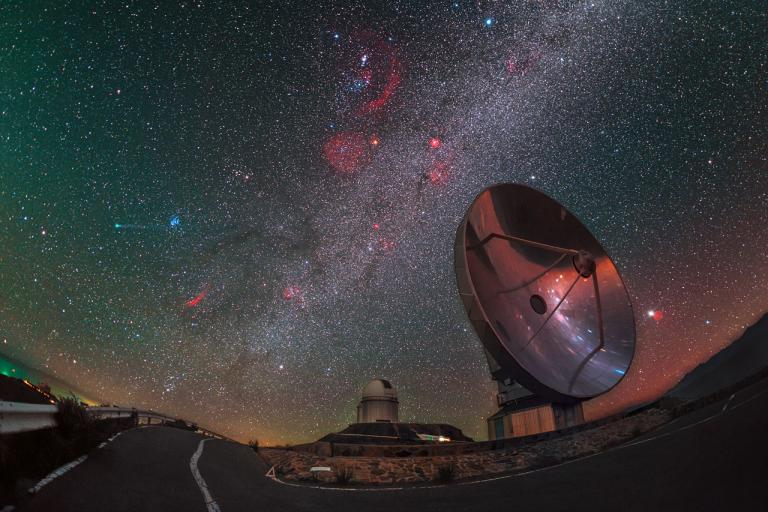
An unusual type of tourist is seen visiting ESO’s La Silla Observatory in this stunning wide-angle photograph taken in January 2015. Captured by ESO Photo Ambassador Petr Horálek, Comet C/2014 Q2 (Lovejoy) appears to streak across the sky (centre left of the image), sneaking past the two telescopes below: ESO’s 3.6-metre telescope (left) and the Swedish-ESO Submillimetre Telescope (SEST). Like most comets, Comet Lovejoy enjoys a long, elliptical and eccentric orbit around the Sun. It entered the inner Solar System for the first recorded time in 2014, and reached perihelion — its closest approach to the Sun — on 30 January 2015. The distance between the Earth and the Sun is defined as 1 astronomical unit (au), or just under 150 million kilometres; Comet Lovejoy came within 1.29 au of our star, placing it between the orbits of Earth and Mars (1.52 au). This image displays the characteristic soft green glow of the comet, produced as molecules of carbon are heated by the Sun. A tail of material splays out behind the comet’s nucleus, crafted by gas and dust blown from the comet by the wind of charged particles streaming out from the Sun. This comet is actually the fifth to be discovered by its namesake, Terry Lovejoy, an amateur astronomer based in Queensland, Australia. Lovejoy previously discovered comets C/2007 E2, C/2007 K5, C/2011 W3, and C/2013 R1.
Ordinary Time
All Souls Day 2018
The Edge of Elfland
Manchester, NH
Dearest Readers,
As I continue my slow work on my Reclaiming the Discarded Image, I have been re-reading Lewis’s Out of the Silent Planet, Perelandra, and That Hideous Strength. In fact, just last night I finally began That Hideous Strength, my personal favorite out of the trilogy. One of my chief complaints over the years, however, has been the collective name for this Trilogy. While a few people, mostly scholars, occasionally call it the Ransom Trilogy, most know it as the Space Trilogy. In fact, this is how they are titled on my copy of That Hideous Strength and how one volume copies are often titled. Yet that very title violates in large part the nature and point of the books themselves.
Now, I have heard Dr. Michael Ward argue that Lewis’s trilogy are primarily about sex and gender (and I think he’s right about that). Nevertheless, I still believe that one of the other chief purposes of these books is to introduce readers to the origin of myth through an updated medieval understanding of the universe. In short, the books are meant to introduce us to the notion of cosmos, a created and ordered whole. Thus, I believe we should call the trilogy the Cosmic Trilogy as it, I believe, better describes these three books.
First, the Space Trilogy is rejected as a possible title from within Out of the Silent Planet. Ransom rejects the word space to describe the ocean in which the planets swim: “Now the very name “Space” seemed a blasphemous libel for this empyrean ocean of radiance in which they swam…. Older thinkers had been wiser when they named it simply the heavens––the heavens which declared the glory….” This line alone ought to make it clear that the Space Trilogy is the most unfitting, and therefore ugly and violent, title for these three books. Lewis is trying to get us to reject the notion that space or vacuum, that is emptiness, is what “fills the void” between the planets and stars. It isn’t empty space but presence, light, an aether through which the planets dance. And yet we can, I think, even reject now the possible title caused by this line, the Heavenly Trilogy, since this connotes something different today than it would have to our medieval ancestors (who would have heard in it both our meaning and a description of the universe).
Second, the title is inaccurate as not every story in the trilogy takes place in space properly speaking. In fact, one could argue that very little of any of the three books actually takes place in space as much more time is spent on a planet. But even leaving that aside, the third and final book is entirely terrestrial. No one travels to or through space. Even the oyarses (guiding, angelic intelligences for the planets) do not, properly speaking travel through space when they visit Ransom and Merlin in the Blue Room. Rather, they live in it in such a way that violates it as space and is rather called the Fields of Arbol. But that aside, the setting of That Hideous Strength is decidedly terrestrial and thus the Space Trilogy is a title that does not fit the content.
The other possible title, the Ransom Trilogy, I also reject as it is not descriptive of the content of the books. Yes, Ransom appears in each book and is the chief protagonist of the first two. But still, Ransom understands that he on his own is no one particularly special. So calling the trilogy after him would go against Ransom’s own understanding of his place in these stories. What is more, Ransom is a secondary character for most of That Hideous Strength; while he is like Arthur in much Arthurian literature, appearing as the context around which these stories are being told, that is not enough of a reason, for me, to call the series after him, especially since he is not the context of the first two stories but an actor in them. No, the Ransom Trilogy does not work either.
And so, what are we left with? I believe the only answer that fits what the books are trying to do and accurately describes them is the Cosmic Trilogy. Seeing the universe as cosmic, that is ordered, is precisely what Lewis is doing in these books. The first two while serving as a discussion of sex also serve as the origin of myth. On Malacandra we meet the reality behind our stories of giants and cyclops, we make come true that faeriean desire to talk with “animals”. On Perelandra we meet Adam and Eve but in new skin, we see the beginning of history, and we even meet, or see in a fleeting moment, elves. And of course, we meet the angels who guide the planets through their spheres as our ancient and medieval ancestors believed they did. In other words, we see the ordered whole, we see that even the heavens are connected to what happens on Earth. And even the discussion of sex is cosmic, both as Lewis depicts the gods as sexed but genderless and as he discusses the relationships between the sexes here on earth. No matter which way you slice it, these books are arguing that all things in creation are connected to one another and have been ordered in a particular way.
So, I call on all of you and the people who publish Lewis’s work, stop calling Out of the Silent Planet, Perelandra, and That Hideous Strength the Space or Ransom Trilogy and rather begin calling them the Cosmic Trilogy. Doing so will not only be more accurate, but may actually help us better understand the story––and thus the way of seeing things––Lewis is trying to describe to us.
Sincerely,
David Russell Mosley
The Radical Catholic Reimagination of Everything
Previous Post

October 28, 2018
Autumn Rising: Reflections on Autumn and the Liturgical Year
Next Post
November 5, 2018 Return to the Sources: On Reading Old Books
Browse Our Archives
Select a Category A Secular Age Advent Apologetics Atheism Beauty Being a Catholic Evangelical Being Catholic Being Deified: Poetry and Fantasy on the Path to God Blogging Book Reviews C. S. Lewis Catholic Imagination Catholic Social Teaching Catholicism Christmas Church Calendar Church Fathers Church Life Community Conferences Cosmology Creation Curdled Words Deification Distributism Easter Economics Education Epiphany Essay Extracts Eucharist Faerie Faeriean Metaphysics Fatherhood Films Folk Liturgy Food and Drink G. K. Chesterton Harry Potter J. R. R. Tolkien Jove King Arthur Language Lent Life Literature and Poetry Liturgy Medieval Theology Music My Publications Mythology On the Edges of Elfland Ordinary Time Ordination Parenthood Parish Patristic Theology Pentecost Politics Prayer Racism Radical Orthodoxy Restoration Movement Sacramental Ontology Saints Science Sex and Sexuality Sophiology Stories The Inklings The Radical Catholic Reimagination of Everything Theologians in the Church Theopoetics Thesis Research Uncategorized University of Nottingham What I'm Reading Writing
Select a Month December 2019 November 2019 October 2019 September 2019 August 2019 July 2019 June 2019 May 2019 April 2019 March 2019 February 2019 January 2019 December 2018 November 2018 October 2018 September 2018 August 2018 July 2018 June 2018 May 2018 April 2018 March 2018 February 2018 January 2018 December 2017 November 2017 October 2017 August 2017 July 2017 June 2017 May 2017 April 2017 March 2017 February 2017 January 2017 December 2016 November 2016 October 2016 September 2016 August 2016 July 2016 June 2016 May 2016 April 2016 March 2016 February 2016 January 2016 December 2015 November 2015 October 2015 September 2015 August 2015 July 2015 June 2015 May 2015 April 2015 March 2015 February 2015 January 2015 December 2014 November 2014 October 2014 September 2014 August 2014 July 2014 June 2014 May 2014 April 2014 March 2014 February 2014 January 2014 December 2013 November 2013 October 2013 September 2013 August 2013 July 2013 June 2013 May 2013 April 2013 March 2013 February 2013 January 2013 December 2012 November 2012 October 2012 September 2012 July 2012
Follow Us!
TAKE THE
Religious Wisdom Quiz
What was the name of the first murderer in the Bible?
Select your answer to see how you score.
Esau Ishmael Cain Lamech
Related posts from Letters from the Edge of Elfland

Poetry, Podcasts, and More: Some Updates on Other...
Letters from the Edge of Elfland

Working on a Book of Poetry: An Apology...
Letters from the Edge of Elfland

Poetry Shapes the World around Us: Reflecting on...
Letters from the Edge of Elfland

William Blake on the Creative Spirit, Beauty, and...
Letters from the Edge of Elfland
TRENDING AT PATHEOS Catholic

Creation, Preservation, and Teleology in Catholic Theology
As I write this, it is very early Monday morning. Like millions...

The Parable Of The Sower And The Word...
One of Christ’s most famous parables is that of the sower who...

Rejecting Doom: Christian Hope And Human Action
Christianity is a religion of hope. We are to have hope and...

Why I Choose the Eucharist Over the Sermon
Choose the Eucharist, Not the Sermon What are we supposed to get...

5 Design Elements Found in Spiritually Rooted Homes
Putting Spirituality Into Home Decor Our homes are more than our living...

Credo: A Story of God Told with the...
About 10 years ago, I began to imagine a personal "Credo" that...
view all Catholic blogs
Ad-Free & Subscriber Log-In Subscription Support
- About Us
- 2026 Calendar
- Videos
- Podcasts
- Library of World Religions
- Faith In Media Tracker
- Advertise With Us
- Write for Us
- Privacy Policy
- Terms of Service
- Do Not Sell My Data
- Contact Us
- Radiant Digital
- Manage Newsletter Subscriptions
- Unsubscribe From Notifications
- Sitemap
Copyright 2008-2026, Patheos. All rights reserved.
Subscription Support Ad-Free & Subscriber Log-In
Follow Patheos