
BuddhistCatholicContemplativeEvangelicalGeneral ChristianHinduJewishLatter-day SaintMuslimNew VisionsProgressive Christian
Beliefs
- Buddhist
- Catholic
- Contemplative
- Evangelical
- General Christian
- Hindu
- Jewish
- Latter-day Saint
- More Voices
- Muslim
- New Visions
- Pagan
- Progressive Christian
Topics
- Religion News
- Food and Religion
- Sports and Religion
- Religious Art
- Religious Music and Entertainment
- Religious Events
- History and Religion
- Style and Religion
- Politics and Religion
- Women in Religion
- Recreation Outdoors and Religion
- Business Finance and Religion
- Careers Workplace and Religion
- Education and Religion
- Family Parenting and Religion
- Health Fitness and Religion
- Home and Religion
- Relationships and Religion
- Technology and Religion
- Travel and Religion
Columnists
- Buddhist Columnists
- Business Finance and Religion Columnists
- Careers Workplace and Religion Columnists
- Catholic Columnists
- Contemplative Columnists
- Education and Religion Columnists
- Evangelists Columnists
- Family Parenting and Religion Columnists
- General Christian Columnists
- Health Fitness and Religion Columnists
- Hindu Columnists
- History and Religion Columnists
- Home and Religion Columnists
- Jewish Columnists
- More Voices Columnists
- Latter Day Columnists
- Muslim Columnists
- New Visions Columnists
- Nonreligious Columnists
- Pagan Columnists
- Politics and Religion Columnists
- Progressive Columnists
- Recreation Outdoors and Religion Columnists
- Relationships and Religion Columnists
- Religion News Columnists
- Religious Art Columnists
- Religious Events Columnists
- Religious Music and Entertainment Columnists
- Sports and Religion Columnists
- Style and Religion Columnists
- Technology and Religion Columnists
- Travel and Religion Columnists
- Women in Religion Columnists
Resource Library
- 2026 Calendar
- Library of World Religions
- The 100 Most Holy Places on Earth
- Patheos Answers
- Podcasts
- Videos
- Faith Leaders Database
- Anglican Episcopalian
- Bahai
- Baptist
- Buddhism
- Christianity
- Confucianism
- Eastern Orthodoxy
- Hinduism
- Holiness and Pentecostal
- ISKCON
- Islam
- Judaism
- Lutheran
- Methodist
- The Church of Jesus Christ of Latter-day Saints
- New Age
- Paganism
- Presbytarian and Reformed
- Protestantism
- Religion Behind the Scenes
- Roman Catholic
- Scientology
- Shia Islam
- Sikhism
- Sufism
- Sunni Islam
- Taoism
- Zen
- See all religions
Research Tools
 Ad-Free & Subscriber Log-In Subscription Support
Ad-Free & Subscriber Log-In Subscription Support
Follow Patheos 

- Trending:
- Forgiveness
- |
- Marriage
- |
- Consciousness
- |
- Death Penalty
- |
- Election
- |
- Halloween
 Letters from the Edge of Elfland
- Home
- About
- Distributist Resources
- Publications and Presentations
- Support
- Works in Progress
- The Epistolarian Around the Web
- Home
- Catholic
- Is Ancient Literature Unconcerned with the Interior Life?
Is Ancient Literature Unconcerned with the Interior Life?
Last updated on: October 22, 2018 at 7:21 am by David Russell Mosley
Is Ancient Literature Unconcerned with the Interior Life? 2018-10-22T07:21:48-04:00 David Russell Mosley
Patheos Explore the world's faith through different perspectives on religion and spirituality! Patheos has the views of the prevalent religions and spiritualities of the world.
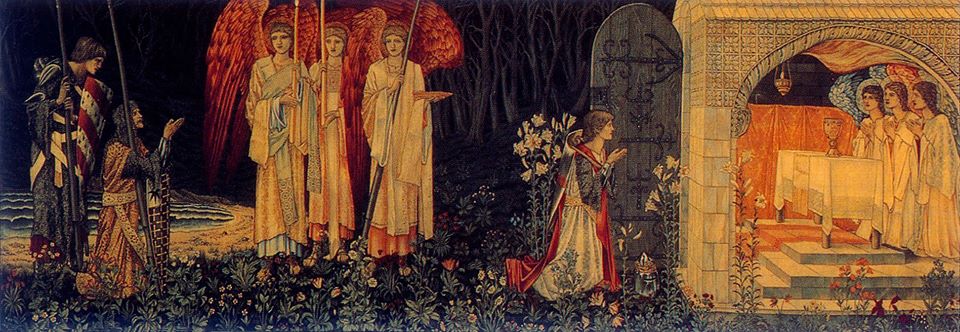
Sir Edward Burne-Jones, overall design and figures; William Morris, overall design and execution; John Henry Dearle, flowers and decorative details, The Attainment: The Vision of the Holy Grail to Sir Galahad, Sir Bors, and Sir Perceval (also known as The Achievement of the Grail or The Achievement of Sir Galahad, accompanied by Sir Bors, and Sir Perceval), 1895-96, PD-1923
Ordinary Time
St. John Paul II 2018
The Edge of Elfland
Concord, NH
Dearest Readers,
Recently I came across an article titled, “Why Doesn’t Ancient Fiction Talk About Feelings?” The basic argument seems to boil down to two chief ideas. First, ancient (and by ancient they also mean medieval) literature is chiefly told in a “just-the-facts” manner with little or no explanation of what characters are thinking and feeling. The second, which is harder to ferret out precisely, is that the reason for this derives from a combination of social and biological characteristics which have evolved and changed over time. There’s only one problem, I think the article is quite wrong.
Several friends have pointed to the fact that both ancient and medieval literature contain clear examples of authors showing us something of the inner lives of their characters. One could point to Augustine, Boethius, Sophocles, Dante, Bernard, Theresa of Avila, and more as counter-examples. But even were we to bracket out some of these examples, their premise, or their understanding of ancient and medieval storytelling is simply wrong-headed. Let me attempt to explain what I mean by way of an example.
Beowulf, that standard of Anglo-Saxon poetry, is, on the face of it, a simple tale about a hero who is a monster-slayer. Beowulf is strong and good and thus kills monsters until he is ultimately killed by the dragon in the end (whom he also slays). Never once are we given any insight into what Beowulf is thinking at any given point. His mind is opaque to us. And yet, the story itself is so drenched with meaning that attentive readers are still sifting through it to see what all the story actually says. Tolkien, for instance, believed that there was an older, oral, fairy-tale at the back of Beowulf which was transformed into the story we now know by its first author, the anonymous Christian monk. Joseph Pearce has suggested the book is actually about the anti-pelagian debates. What’s more, from within the story there are all sorts of deeper meanings meant to convey certain ideas to the audience. Grendel is described both as being so large that he is able to put 30 men into his pouch and yet is small enough to fit inside Heorot and grapple with Beowulf. All of these things are not possible simultaneously, but the author isn’t trying to give us an accurate description of Grendel’s precise size, but he is trying to help us understand the stature of Grendel, the enormity of his evil, and, therefore, the enormity of Beowulf’s virtue and strength.
And this is just one example amongst many that I could make. Once we allow back in Augustine or Dante (or even the Scriptures where Christ frequently knows what people are thinking) the whole conversation shifts again as both authors frequently tell us what they or their characters were thinking and feeling. Equally, I think it rather clear that many ancient and medieval authors were worthy students of the school of show-don’t-tell. We needn’t be told what Achilles’ was thinking when he is told about Patroclus’ death. Rather we are shown by his entrance into battle and the rage with which he fights. Virgil never tells us about the inner workings of Turnus’ mind or Juno’s and yet who can deny that Turnus’ is being fueled by a rage-filled, perverted sense of patriotism, forgetting what is due to Jove who has proclaimed these events. Perhaps our language about feelings and thoughts has expanded, allowing for the Shakespearean soliloquy given to the audience, but even those are the characters telling us how they feel, not the author giving us insight into their emotions. And even more so do the plays require the lines be read with feeling in order to be understood.
The article also seems to lack a sense of understanding how language has developed. Barfield has argued, convincingly I find, that in the earliest days you could not separate out metaphor and the literal. The two coexisted, inextricably tied together and used to mean both simultaneously, only later do our languages begin to divide the literal and the metaphorical. And there appears, in this article, a progressivist assumption. Thus, even if you could get them to assent to Barfield’s point, they seem to be saying that this development is an obvious good. This is made most evident in their exploration of studies done showing that heavy readers of fiction are better at mentalizing and engaging with thoughts and emotions of others. By focusing on fiction (thus contrasting the evidently emotionless or interiorless fiction of the ancients and medievals with that of the moderns) the article misses out on the centrality of thought and emotion and will that was the subject of intensive philosophical and theological work. Augustine compares the Trinity to the mind in his De Trin.; Lady Philosophy tells Boethius to put away both hope and fear as both will mislead him at the beginning of The Consolation of Philosophy, Maximus the Confessor is concerned with how the mind and body of man images God, the Cosmos, and the Church, and let’s not forget the interior castles of Theresa.
I don’t have a contrary argument to make, though a friend did suggest that perhaps modern authors have to do the leg work for us by telling us what their characters are thinking. But I do want to suggest that maybe this rather snobbish view of ancient and medieval literature has rather missed the boat. Maybe with a little more attention on our parts we can better understand not just why they wrote they way they did, but how they understood the human person. Perhaps then we can find some practices of storytelling that we have abandoned and bring them to light again, alongside the real developments we have made. But we can only do this if we remain attentive readers with no metaphorical axes to grind.
Sincerely,
David
Previous Post

October 16, 2018
Patheos Catholic's Pagan Problem, or Is Patheos Catholic Liberal?
Next Post
October 28, 2018 Autumn Rising: Reflections on Autumn and the Liturgical Year
Browse Our Archives
Select a Category A Secular Age Advent Apologetics Atheism Beauty Being a Catholic Evangelical Being Catholic Being Deified: Poetry and Fantasy on the Path to God Blogging Book Reviews C. S. Lewis Catholic Imagination Catholic Social Teaching Catholicism Christmas Church Calendar Church Fathers Church Life Community Conferences Cosmology Creation Curdled Words Deification Distributism Easter Economics Education Epiphany Essay Extracts Eucharist Faerie Faeriean Metaphysics Fatherhood Films Folk Liturgy Food and Drink G. K. Chesterton Harry Potter J. R. R. Tolkien Jove King Arthur Language Lent Life Literature and Poetry Liturgy Medieval Theology Music My Publications Mythology On the Edges of Elfland Ordinary Time Ordination Parenthood Parish Patristic Theology Pentecost Politics Prayer Racism Radical Orthodoxy Restoration Movement Sacramental Ontology Saints Science Sex and Sexuality Sophiology Stories The Inklings The Radical Catholic Reimagination of Everything Theologians in the Church Theopoetics Thesis Research Uncategorized University of Nottingham What I'm Reading Writing
Select a Month December 2019 November 2019 October 2019 September 2019 August 2019 July 2019 June 2019 May 2019 April 2019 March 2019 February 2019 January 2019 December 2018 November 2018 October 2018 September 2018 August 2018 July 2018 June 2018 May 2018 April 2018 March 2018 February 2018 January 2018 December 2017 November 2017 October 2017 August 2017 July 2017 June 2017 May 2017 April 2017 March 2017 February 2017 January 2017 December 2016 November 2016 October 2016 September 2016 August 2016 July 2016 June 2016 May 2016 April 2016 March 2016 February 2016 January 2016 December 2015 November 2015 October 2015 September 2015 August 2015 July 2015 June 2015 May 2015 April 2015 March 2015 February 2015 January 2015 December 2014 November 2014 October 2014 September 2014 August 2014 July 2014 June 2014 May 2014 April 2014 March 2014 February 2014 January 2014 December 2013 November 2013 October 2013 September 2013 August 2013 July 2013 June 2013 May 2013 April 2013 March 2013 February 2013 January 2013 December 2012 November 2012 October 2012 September 2012 July 2012
Follow Us!
TAKE THE
Religious Wisdom Quiz
What does Paul say in Colossians has been nailed to the cross?
Select your answer to see how you score.
Satan's authority Our sins The written code with its regulations The old covenant
Related posts from Letters from the Edge of Elfland

Poetry, Podcasts, and More: Some Updates on Other...
Letters from the Edge of Elfland

Working on a Book of Poetry: An Apology...
Letters from the Edge of Elfland

Poetry Shapes the World around Us: Reflecting on...
Letters from the Edge of Elfland

Day 1 of the Catholic Imagination Conference: Exhaustion...
Letters from the Edge of Elfland
TRENDING AT PATHEOS Catholic

Creation, Preservation, and Teleology in Catholic Theology
As I write this, it is very early Monday morning. Like millions...

The Parable Of The Sower And The Word...
One of Christ’s most famous parables is that of the sower who...

Rejecting Doom: Christian Hope And Human Action
Christianity is a religion of hope. We are to have hope and...

Why I Choose the Eucharist Over the Sermon
Choose the Eucharist, Not the Sermon What are we supposed to get...

5 Design Elements Found in Spiritually Rooted Homes
Putting Spirituality Into Home Decor Our homes are more than our living...

Credo: A Story of God Told with the...
About 10 years ago, I began to imagine a personal "Credo" that...
view all Catholic blogs
Ad-Free & Subscriber Log-In Subscription Support
- About Us
- 2026 Calendar
- Videos
- Podcasts
- Library of World Religions
- Faith In Media Tracker
- Advertise With Us
- Write for Us
- Privacy Policy
- Terms of Service
- Do Not Sell My Data
- Contact Us
- Radiant Digital
- Manage Newsletter Subscriptions
- Unsubscribe From Notifications
- Sitemap
Copyright 2008-2026, Patheos. All rights reserved.
Subscription Support Ad-Free & Subscriber Log-In
Follow Patheos