
BuddhistCatholicContemplativeEvangelicalGeneral ChristianHinduJewishLatter-day SaintMuslimNew VisionsProgressive Christian
Beliefs
- Buddhist
- Catholic
- Contemplative
- Evangelical
- General Christian
- Hindu
- Jewish
- Latter-day Saint
- More Voices
- Muslim
- New Visions
- Pagan
- Progressive Christian
Topics
- Religion News
- Food and Religion
- Sports and Religion
- Religious Art
- Religious Music and Entertainment
- Religious Events
- History and Religion
- Style and Religion
- Politics and Religion
- Women in Religion
- Recreation Outdoors and Religion
- Business Finance and Religion
- Careers Workplace and Religion
- Education and Religion
- Family Parenting and Religion
- Health Fitness and Religion
- Home and Religion
- Relationships and Religion
- Technology and Religion
- Travel and Religion
Columnists
- Buddhist Columnists
- Business Finance and Religion Columnists
- Careers Workplace and Religion Columnists
- Catholic Columnists
- Contemplative Columnists
- Education and Religion Columnists
- Evangelists Columnists
- Family Parenting and Religion Columnists
- General Christian Columnists
- Health Fitness and Religion Columnists
- Hindu Columnists
- History and Religion Columnists
- Home and Religion Columnists
- Jewish Columnists
- More Voices Columnists
- Latter Day Columnists
- Muslim Columnists
- New Visions Columnists
- Nonreligious Columnists
- Pagan Columnists
- Politics and Religion Columnists
- Progressive Columnists
- Recreation Outdoors and Religion Columnists
- Relationships and Religion Columnists
- Religion News Columnists
- Religious Art Columnists
- Religious Events Columnists
- Religious Music and Entertainment Columnists
- Sports and Religion Columnists
- Style and Religion Columnists
- Technology and Religion Columnists
- Travel and Religion Columnists
- Women in Religion Columnists
Resource Library
- 2026 Calendar
- Library of World Religions
- The 100 Most Holy Places on Earth
- Patheos Answers
- Podcasts
- Videos
- Faith Leaders Database
- Anglican Episcopalian
- Bahai
- Baptist
- Buddhism
- Christianity
- Confucianism
- Eastern Orthodoxy
- Hinduism
- Holiness and Pentecostal
- ISKCON
- Islam
- Judaism
- Lutheran
- Methodist
- The Church of Jesus Christ of Latter-day Saints
- New Age
- Paganism
- Presbytarian and Reformed
- Protestantism
- Religion Behind the Scenes
- Roman Catholic
- Scientology
- Shia Islam
- Sikhism
- Sufism
- Sunni Islam
- Taoism
- Zen
- See all religions
Research Tools
 Ad-Free & Subscriber Log-In Subscription Support
Ad-Free & Subscriber Log-In Subscription Support
Follow Patheos 

- Trending:
- Forgiveness
- |
- Marriage
- |
- Consciousness
- |
- Death Penalty
- |
- Election
- |
- Halloween
 Letters from the Edge of Elfland
- Home
- About
- Distributist Resources
- Publications and Presentations
- Support
- Works in Progress
- The Epistolarian Around the Web
- Home
- Catholic
- The Catholic Church Has a Geography Problem: Reflections on the Parish
The Catholic Church Has a Geography Problem: Reflections on the Parish
Last updated on: July 31, 2018 at 6:33 pm by David Russell Mosley
The Catholic Church Has a Geography Problem: Reflections on the Parish 2018-07-31T18:33:03-04:00 David Russell Mosley
Patheos Explore the world's faith through different perspectives on religion and spirituality! Patheos has the views of the prevalent religions and spiritualities of the world.
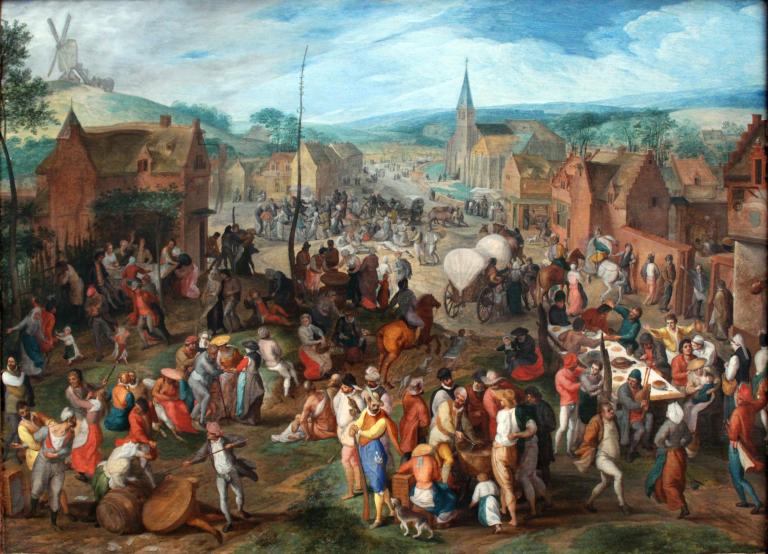
Artist Gillis Mostaert (1528–1598) Blue pencil.svg wikidata:Q2313016 Title Village fair Date 1590 Medium painting Current location Gemäldegalerie Blue pencil.svg wikidata:Q165631 Source/Photographer Own work, anagoria PD
Ordinary Time
31 July 2018
The Edge of Elfland
Concord, New Hampshire
Dearest Readers,
When I first started writing these letters, long before becoming Catholic was even on the horizon, I saw that Church universal, at least in the UK (where I was then living and this was called Letters from Nottingham) and the US had a geography problem. With the rise of the car and the interstate highway (or motorways in the UK) people no longer needed to attend their local churches. This problem was exacerbated in Protestant circles especially if an individual or family was tied to a certain denomination that was not locally present. And thus while you have some local churches which are truly local (made up entirely of local residents) they are often, though by no means always, small and dying. The big churches, the mega-churches, would have people driving an hour or more every week in order to go to church at the big church, the special church. In England I saw the possibility for another way, one that lay forgotten, the way of the parish.
When I lived in England we eventually started attending at an Anglican Church. I even began the process of ordination––which I ultimately had to stop. But we did not attend our parish church. Still, the church we did attend was only a 10 minute bus ride away. But I couldn’t help but think something was lost in the process. We were not as connected to Beeston, the town in which we lived, as we could have been had we attended the parish church. And I think, especially as churches––the Catholic Church in particular––focus more on mission and evangelism that this sense of the parish, of the local needs to be reclaimed. I am not pooh-poohing those who chose to drive outside their parish. After all, some parishes are truly awful and need to be avoided, especially by those who have experienced trauma, particularly trauma at the hands of the Church. But for those of us who are in that position, some dedication to our local parish churches may be precisely what is needed.
The parish church of the Middle Ages was by no means perfect. There are those who think a simple return to medieval times (the period, not the campy horse show), a simple return to Christendom will make all the difference. Michael Martin has taken this on particularly well over at The Center for Sophiological Studies. We cannot return, we cannot go back. What we can do is make the good aspects of the past, especially those that have been forgotten and left on the wayside, present again. After all, as Catholics, we see the past made present again weekly if not daily in the Eucharist, ever ancient, ever new. So there were aspects of the medieval parish I would see return. I will beat this drum until I see change, but I would love to see a return to Lammas and Plough Sunday as integral aspects of the liturgical calendar because it reconnects the liturgical to the agricultural. I would see the parish life to be so vibrant as to be almost, at least for whatever segment of your parish (because remember that the parish is a geographic marker as much as it a spiritual one) is Catholic, that it could be identified with the broader community life. But the key is not to separate out those who belong and those who do not.
In some Protestant churches in which I have been involved, they would often have large gatherings. Some had fall festivals with face painting, others did big summer celebrations. The purpose of these was evangelization, so much so that as a member of the congregation I often felt as if the party wasn’t actually for me it was for “them.” This is the wrong attitude for it creates an us vs. them mentality, but instead of prioritizing us as is usual, it prioritizes the other. In some ways, of course, this is good. After all, as Catholics we know that there is a preferential treatment for the poor. This is a pillar of the gospel. And truth be told, I think Catholics often, rather unintentionally, do precisely the opposite. When we have celebrations they are often only for “us” and not particularly for “them.” We need a marriage of the two. One that seeks to evangelize not simply by getting as many people to come to your program, for after all the party as evangelization is a program, but to be a coming together of the parish and the Parish (if you’ll allow this capitalization for emphasis).
So as I said, I think we have a geography problem, one that came about with the car and the motorway and one that has spread through globalization. And these things are not entirely evil. The car and the motorway have made it possible for some to get to Mass when before it would have been difficult if not impossible. They have also opened up communication and globalization has done this even more. We have been reminded the the Northern Hemisphere is not the only one (though I think the North American Church––excepting Mexico––could learn this lesson a little better) and this is good. But as the Church continues to grow globally it must also continue to grow locally. Our local communities need to see the Church as a place of beauty, of community, of justice, of joy. We must become small again so we can continue to grow.
Sincerely,
David
The Radical Catholic Reimagination of Everything
Previous Post

July 18, 2018
"How to Be a Poet": Reflections on a Poem by Wendell Berry
Next Post
August 10, 2018 Hiking with My Children: Seeing the World Differently
Browse Our Archives
Select a Category A Secular Age Advent Apologetics Atheism Beauty Being a Catholic Evangelical Being Catholic Being Deified: Poetry and Fantasy on the Path to God Blogging Book Reviews C. S. Lewis Catholic Imagination Catholic Social Teaching Catholicism Christmas Church Calendar Church Fathers Church Life Community Conferences Cosmology Creation Curdled Words Deification Distributism Easter Economics Education Epiphany Essay Extracts Eucharist Faerie Faeriean Metaphysics Fatherhood Films Folk Liturgy Food and Drink G. K. Chesterton Harry Potter J. R. R. Tolkien Jove King Arthur Language Lent Life Literature and Poetry Liturgy Medieval Theology Music My Publications Mythology On the Edges of Elfland Ordinary Time Ordination Parenthood Parish Patristic Theology Pentecost Politics Prayer Racism Radical Orthodoxy Restoration Movement Sacramental Ontology Saints Science Sex and Sexuality Sophiology Stories The Inklings The Radical Catholic Reimagination of Everything Theologians in the Church Theopoetics Thesis Research Uncategorized University of Nottingham What I'm Reading Writing
Select a Month December 2019 November 2019 October 2019 September 2019 August 2019 July 2019 June 2019 May 2019 April 2019 March 2019 February 2019 January 2019 December 2018 November 2018 October 2018 September 2018 August 2018 July 2018 June 2018 May 2018 April 2018 March 2018 February 2018 January 2018 December 2017 November 2017 October 2017 August 2017 July 2017 June 2017 May 2017 April 2017 March 2017 February 2017 January 2017 December 2016 November 2016 October 2016 September 2016 August 2016 July 2016 June 2016 May 2016 April 2016 March 2016 February 2016 January 2016 December 2015 November 2015 October 2015 September 2015 August 2015 July 2015 June 2015 May 2015 April 2015 March 2015 February 2015 January 2015 December 2014 November 2014 October 2014 September 2014 August 2014 July 2014 June 2014 May 2014 April 2014 March 2014 February 2014 January 2014 December 2013 November 2013 October 2013 September 2013 August 2013 July 2013 June 2013 May 2013 April 2013 March 2013 February 2013 January 2013 December 2012 November 2012 October 2012 September 2012 July 2012
Follow Us!
TAKE THE
Religious Wisdom Quiz
Who was thrown into a fiery furnace but survived?
Select your answer to see how you score.
Joseph Shadrach, Meshach, Abednego Noah Daniel
Related posts from Letters from the Edge of Elfland

William Blake on the Creative Spirit, Beauty, and...
Letters from the Edge of Elfland

“Wherefore stopp’st thou me?” Coleridge’s Creative Message to...
Letters from the Edge of Elfland
Letters from the Edge of Elfland

Augustine against the Astrologers: Stars, Meaning, and Enchantment
Letters from the Edge of Elfland
TRENDING AT PATHEOS Catholic

Rejecting Doom: Christian Hope And Human Action
Christianity is a religion of hope. We are to have hope and...

It’s What Comes From Within Which Matters
One of the most difficult things for us to understand is why...

Why I Choose the Eucharist Over the Sermon
Choose the Eucharist, Not the Sermon What are we supposed to get...

5 Design Elements Found in Spiritually Rooted Homes
Putting Spirituality Into Home Decor Our homes are more than our living...

Credo: A Story of God Told with the...
About 10 years ago, I began to imagine a personal "Credo" that...

The Anatomy of Divine Revelation in Catholic Thought
The claim that God has made Himself known to human beings is...
view all Catholic blogs
Ad-Free & Subscriber Log-In Subscription Support
- About Us
- 2026 Calendar
- Videos
- Podcasts
- Library of World Religions
- Faith In Media Tracker
- Advertise With Us
- Write for Us
- Privacy Policy
- Terms of Service
- Do Not Sell My Data
- Contact Us
- Radiant Digital
- Manage Newsletter Subscriptions
- Unsubscribe From Notifications
- Sitemap
Copyright 2008-2026, Patheos. All rights reserved.
Subscription Support Ad-Free & Subscriber Log-In
Follow Patheos