
BuddhistCatholicContemplativeEvangelicalGeneral ChristianHinduJewishLatter-day SaintMuslimNew VisionsProgressive Christian
Beliefs
- Buddhist
- Catholic
- Contemplative
- Evangelical
- General Christian
- Hindu
- Jewish
- Latter-day Saint
- More Voices
- Muslim
- New Visions
- Pagan
- Progressive Christian
Topics
- Religion News
- Food and Religion
- Sports and Religion
- Religious Art
- Religious Music and Entertainment
- Religious Events
- History and Religion
- Style and Religion
- Politics and Religion
- Women in Religion
- Recreation Outdoors and Religion
- Business Finance and Religion
- Careers Workplace and Religion
- Education and Religion
- Family Parenting and Religion
- Health Fitness and Religion
- Home and Religion
- Relationships and Religion
- Technology and Religion
- Travel and Religion
Columnists
- Buddhist Columnists
- Business Finance and Religion Columnists
- Careers Workplace and Religion Columnists
- Catholic Columnists
- Contemplative Columnists
- Education and Religion Columnists
- Evangelists Columnists
- Family Parenting and Religion Columnists
- General Christian Columnists
- Health Fitness and Religion Columnists
- Hindu Columnists
- History and Religion Columnists
- Home and Religion Columnists
- Jewish Columnists
- More Voices Columnists
- Latter Day Columnists
- Muslim Columnists
- New Visions Columnists
- Nonreligious Columnists
- Pagan Columnists
- Politics and Religion Columnists
- Progressive Columnists
- Recreation Outdoors and Religion Columnists
- Relationships and Religion Columnists
- Religion News Columnists
- Religious Art Columnists
- Religious Events Columnists
- Religious Music and Entertainment Columnists
- Sports and Religion Columnists
- Style and Religion Columnists
- Technology and Religion Columnists
- Travel and Religion Columnists
- Women in Religion Columnists
Resource Library
- 2026 Calendar
- Library of World Religions
- The 100 Most Holy Places on Earth
- Patheos Answers
- Podcasts
- Videos
- Faith Leaders Database
- Anglican Episcopalian
- Bahai
- Baptist
- Buddhism
- Christianity
- Confucianism
- Eastern Orthodoxy
- Hinduism
- Holiness and Pentecostal
- ISKCON
- Islam
- Judaism
- Lutheran
- Methodist
- The Church of Jesus Christ of Latter-day Saints
- New Age
- Paganism
- Presbytarian and Reformed
- Protestantism
- Religion Behind the Scenes
- Roman Catholic
- Scientology
- Shia Islam
- Sikhism
- Sufism
- Sunni Islam
- Taoism
- Zen
- See all religions
Research Tools
 Ad-Free & Subscriber Log-In Subscription Support
Ad-Free & Subscriber Log-In Subscription Support
Follow Patheos 

- Trending:
- Forgiveness
- |
- Marriage
- |
- Consciousness
- |
- Death Penalty
- |
- Election
- |
- Halloween
 Letters from the Edge of Elfland
- Home
- About
- Distributist Resources
- Publications and Presentations
- Support
- Works in Progress
- The Epistolarian Around the Web
- Home
- Catholic
- Stags, Green Men, Creation, and Mystagogy in the Church
Stags, Green Men, Creation, and Mystagogy in the Church
Last updated on: June 4, 2018 at 10:35 am by David Russell Mosley
Stags, Green Men, Creation, and Mystagogy in the Church 2018-06-04T10:35:42-04:00 David Russell Mosley
Patheos Explore the world's faith through different perspectives on religion and spirituality! Patheos has the views of the prevalent religions and spiritualities of the world.
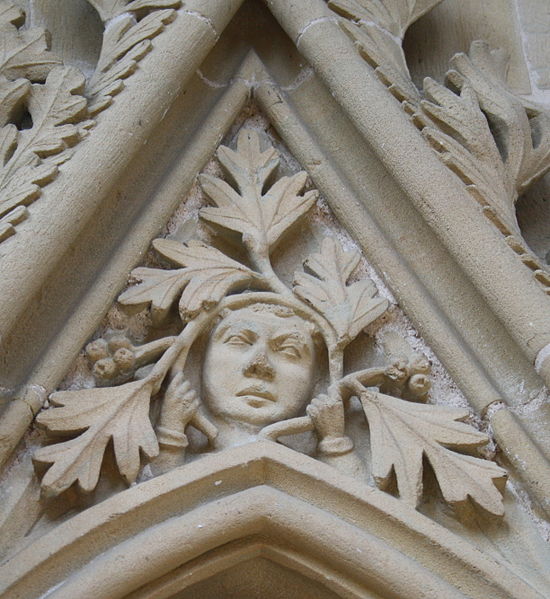
Description
Deutsch: Eine der Gestalten der Leaves of Southwell, ein Mann, der sich in Zweigen verbirgt. Steinschnitzerei im Chapter House des en:Southwell Minster
Date 25 July 2012
Source Own work
Author Kuhwert (CC BY-SA 3.0)
Ordinary Time
4 June 2018
The Edge of Elfland
Concord, New Hampshire
Dearest Readers,
A few years ago in the church of St. Eustace in Paris, France a stag was filmed walking around inside. This has been bouncing around my newsfeed again, lately, so I thought I would look into it.
I am a little disappointed to say that it turns out the stag was not wild, but a trained deer named Chambord and he was being filmed for an art project at the church. The stag, of course, was chosen because St. Eustace saw a vision of the cross between the antlers of a stag. That this was staged and not a mere chance moment, ultimately, does not ruin or reduce this moment for me. Rather, it serves as a reminder that we have often sought to bring the outside in, to reflect creation in our houses of worship.
The ancient Israelites are the first in our direct line of descent to do this. Look at this description of the inner parts of the first temple:
He carved the walls of the house all round about with carved engravings of cherubim, palm trees, and open flowers, in the inner and outer rooms. The floor of the house he overlaid with gold, in the inner and outer rooms.
For the entrance to the inner sanctuary he made doors of olive wood; the lintel and the doorposts were five-sided. He covered the two doors of olive wood with carvings of cherubim, palm trees, and open flowers; he overlaid them with gold, and spread gold on the cherubim and on the palm trees.
So also he made for the entrance to the nave doorposts of olive wood, each four-sided, and two doors of cypress wood; the two leaves of one door were folding, and the two leaves of the other door were folding. He carved cherubim, palm trees, and open flowers, overlaying them with gold evenly applied upon the carved work. He built the inner court with three courses of dressed stone to one course of cedar beams.
Cherubim, palm trees, and flowers are everywhere, and it doesn’t stop here. The priestly robes themselves were adorned with images from creation, and even the tabernacle before the temple had elements of nature built into it. There is something about creation itself, the true temple of the Lord, that makes us want to incorporate it into our churches. All of this reminds me of the Southwell Minster in Nottingham.
While now an Anglican minster and the cathedral for the Southwell/Nottinghamshire Diocese in the Church of England, the church’s foundations go back to the seventh century. Most of the current building, however, date to the 13th century. It was during that time that many “green men” carvings were made. If you ever have a chance to walk around the minster, I encourage it, stone foliage can be seen everywhere, as if creation itself has built the church. But what is most fascinating is the inclusion of the green men. Green men are part of traditional folklore, sometimes they are giants, other times giant walking plant men, similar to but not identical with Tolkien’s ents. Somehow, and for some reason, they find themselves here in the church. I don’t know why the stone-masons decided to include them, but I think it has something to do with their view of reality. Not that they believed these green men existed, though they may have, but they understood nature itself to have an identity, to be personified, and to be subject to the same Lord as the rest of us.
Maximos the Confessor in his Mystagogy tells us that according to Dionysius:
God’s holy church in itself is a symbol of the sensible world as such, since it possesses the divine sanctuary as heaven and the beauty of the nave as earth. Likewise the world is a church since it possesses heaven corresponding to a sanctuary, and for a nave it has the adornment of the earth.
The world, and by this Maximos means the cosmos, is a symbol of a church and vice versa, each is imprinted on the other. He goes on to tell us how the church and creation are both like a man and vice versa. The point being this, for those with the eyes to see there is not a hard distinction between creation, humanity, and the Church. So when the ancient Israelites depicted angels and bulls and pomegranates in the temple or on their priestly robes, and when the stonewrights working on Southwell Minster included green men, they were simply depicting a deeper reality, that these things are inextricably connected to one another, that churches are the particularities that allow us to see creation itself as the Church. What is more, it is a reminder that through the person of Christ, all of these things have been united to God since Christ united not only humanity, but all of creation to himself.
Sincerely,
David
The Radical Catholic Reimagination of Everything
Previous Post

May 30, 2018
Camping on the Edge of Elfland: Pat Noone and Green Hills Farm
Browse Our Archives
Select a Category A Secular Age Advent Apologetics Atheism Beauty Being a Catholic Evangelical Being Catholic Being Deified: Poetry and Fantasy on the Path to God Blogging Book Reviews C. S. Lewis Catholic Imagination Catholic Social Teaching Catholicism Christmas Church Calendar Church Fathers Church Life Community Conferences Cosmology Creation Curdled Words Deification Distributism Easter Economics Education Epiphany Essay Extracts Eucharist Faerie Faeriean Metaphysics Fatherhood Films Folk Liturgy Food and Drink G. K. Chesterton Harry Potter J. R. R. Tolkien Jove King Arthur Language Lent Life Literature and Poetry Liturgy Medieval Theology Music My Publications Mythology On the Edges of Elfland Ordinary Time Ordination Parenthood Parish Patristic Theology Pentecost Politics Prayer Racism Radical Orthodoxy Restoration Movement Sacramental Ontology Saints Science Sex and Sexuality Sophiology Stories The Inklings The Radical Catholic Reimagination of Everything Theologians in the Church Theopoetics Thesis Research Uncategorized University of Nottingham What I'm Reading Writing
Select a Month December 2019 November 2019 October 2019 September 2019 August 2019 July 2019 June 2019 May 2019 April 2019 March 2019 February 2019 January 2019 December 2018 November 2018 October 2018 September 2018 August 2018 July 2018 June 2018 May 2018 April 2018 March 2018 February 2018 January 2018 December 2017 November 2017 October 2017 August 2017 July 2017 June 2017 May 2017 April 2017 March 2017 February 2017 January 2017 December 2016 November 2016 October 2016 September 2016 August 2016 July 2016 June 2016 May 2016 April 2016 March 2016 February 2016 January 2016 December 2015 November 2015 October 2015 September 2015 August 2015 July 2015 June 2015 May 2015 April 2015 March 2015 February 2015 January 2015 December 2014 November 2014 October 2014 September 2014 August 2014 July 2014 June 2014 May 2014 April 2014 March 2014 February 2014 January 2014 December 2013 November 2013 October 2013 September 2013 August 2013 July 2013 June 2013 May 2013 April 2013 March 2013 February 2013 January 2013 December 2012 November 2012 October 2012 September 2012 July 2012
Follow Us!
TAKE THE
Religious Wisdom Quiz
True or False: The fruit of the Spirit includes love, joy, peace, and twelve other qualities.
Select your answer to see how you score.
TRUE FALSE
Related posts from Letters from the Edge of Elfland

Day 1 of the Catholic Imagination Conference: Exhaustion...
Letters from the Edge of Elfland
Harry Potter, Demons, and Exorcists: A Follow Up...
Letters from the Edge of Elfland
Catholic School Removes Harry Potter from New Library
Letters from the Edge of Elfland
William Blake on the Creative Spirit, Beauty, and...
Letters from the Edge of Elfland
TRENDING AT PATHEOS Catholic

Rejecting Doom: Christian Hope And Human Action
Christianity is a religion of hope. We are to have hope and...

It’s What Comes From Within Which Matters
One of the most difficult things for us to understand is why...

Why I Choose the Eucharist Over the Sermon
Choose the Eucharist, Not the Sermon What are we supposed to get...

5 Design Elements Found in Spiritually Rooted Homes
Putting Spirituality Into Home Decor Our homes are more than our living...

Credo: A Story of God Told with the...
About 10 years ago, I began to imagine a personal "Credo" that...

The Anatomy of Divine Revelation in Catholic Thought
The claim that God has made Himself known to human beings is...
view all Catholic blogs
Ad-Free & Subscriber Log-In Subscription Support
- About Us
- 2026 Calendar
- Videos
- Podcasts
- Library of World Religions
- Faith In Media Tracker
- Advertise With Us
- Write for Us
- Privacy Policy
- Terms of Service
- Do Not Sell My Data
- Contact Us
- Radiant Digital
- Manage Newsletter Subscriptions
- Unsubscribe From Notifications
- Sitemap
Copyright 2008-2026, Patheos. All rights reserved.
Subscription Support Ad-Free & Subscriber Log-In
Follow Patheos