
BuddhistCatholicContemplativeEvangelicalGeneral ChristianHinduJewishLatter-day SaintMuslimNew VisionsProgressive Christian
Beliefs
- Buddhist
- Catholic
- Contemplative
- Evangelical
- General Christian
- Hindu
- Jewish
- Latter-day Saint
- More Voices
- Muslim
- New Visions
- Pagan
- Progressive Christian
Topics
- Religion News
- Food and Religion
- Sports and Religion
- Religious Art
- Religious Music and Entertainment
- Religious Events
- History and Religion
- Style and Religion
- Politics and Religion
- Women in Religion
- Recreation Outdoors and Religion
- Business Finance and Religion
- Careers Workplace and Religion
- Education and Religion
- Family Parenting and Religion
- Health Fitness and Religion
- Home and Religion
- Relationships and Religion
- Technology and Religion
- Travel and Religion
Columnists
- Buddhist Columnists
- Business Finance and Religion Columnists
- Careers Workplace and Religion Columnists
- Catholic Columnists
- Contemplative Columnists
- Education and Religion Columnists
- Evangelists Columnists
- Family Parenting and Religion Columnists
- General Christian Columnists
- Health Fitness and Religion Columnists
- Hindu Columnists
- History and Religion Columnists
- Home and Religion Columnists
- Jewish Columnists
- More Voices Columnists
- Latter Day Columnists
- Muslim Columnists
- New Visions Columnists
- Nonreligious Columnists
- Pagan Columnists
- Politics and Religion Columnists
- Progressive Columnists
- Recreation Outdoors and Religion Columnists
- Relationships and Religion Columnists
- Religion News Columnists
- Religious Art Columnists
- Religious Events Columnists
- Religious Music and Entertainment Columnists
- Sports and Religion Columnists
- Style and Religion Columnists
- Technology and Religion Columnists
- Travel and Religion Columnists
- Women in Religion Columnists
Resource Library
- 2026 Calendar
- Library of World Religions
- The 100 Most Holy Places on Earth
- Patheos Answers
- Podcasts
- Videos
- Faith Leaders Database
- Anglican Episcopalian
- Bahai
- Baptist
- Buddhism
- Christianity
- Confucianism
- Eastern Orthodoxy
- Hinduism
- Holiness and Pentecostal
- ISKCON
- Islam
- Judaism
- Lutheran
- Methodist
- The Church of Jesus Christ of Latter-day Saints
- New Age
- Paganism
- Presbytarian and Reformed
- Protestantism
- Religion Behind the Scenes
- Roman Catholic
- Scientology
- Shia Islam
- Sikhism
- Sufism
- Sunni Islam
- Taoism
- Zen
- See all religions
Research Tools
 Ad-Free & Subscriber Log-In Subscription Support
Ad-Free & Subscriber Log-In Subscription Support
Follow Patheos 

- Trending:
- Forgiveness
- |
- Marriage
- |
- Consciousness
- |
- Death Penalty
- |
- Election
- |
- Halloween
 Letters from the Edge of Elfland
- Home
- About
- Distributist Resources
- Publications and Presentations
- Support
- Works in Progress
- The Epistolarian Around the Web
- Home
- Catholic
- Saint-Haunted: How St. Cuthbert Found Me
Saint-Haunted: How St. Cuthbert Found Me
Last updated on: March 26, 2018 at 10:05 am by David Russell Mosley
Saint-Haunted: How St. Cuthbert Found Me 2018-03-26T10:05:42-04:00 David Russell Mosley
Patheos Explore the world's faith through different perspectives on religion and spirituality! Patheos has the views of the prevalent religions and spiritualities of the world.
David Russell Mosley
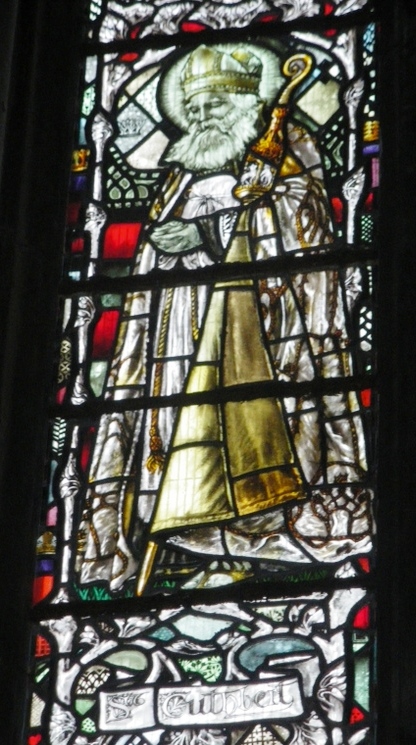
Description English: Detail from Christopher Whall window in Gloucester Cathedral. Date 17 May 2012 Source Own work Author Weglinde (CC BY-SA 3.0)
Holy Week
Holy Monday 2018
The Edge of Elfland
Hudson, New Hampshire
Dearest Readers,
We’re coming up on the liturgical anniversary of my reception into the Church. As Easter draws nearer I find myself reflecting on where I was a year ago. One of the hardest things for me as I was going through my confirmation class was deciding on a confirmation saint. There were so many I loved, whose writings or lives had influenced me. In the end, I chose three names, changing one at the last minute, and had none of them used when I was received into the Church. While I was oscillating between choices a friend told me not to worry too much, that certain saints will haunt us at certain times.
I’ve latched onto this notion of being haunted by the saints. I love the evocative nature of it. After all a haunt is a place frequented by someone or something, so to be haunted by a saint means that the place they are haunting is you. Still, I had not experienced a saint haunting, not until I encountered St. Cuthbert.
While I’m nearly certain I must have learned about St. Cuthbert in my Medieval Church History class when we discussed the Council of Whitby, he remained nothing more than a name to me until March 20th, his feast day. I have been reading my way through Malcolm Guite’s excellent Word in the Wilderness: A Poem a Day of Lent and Easter. Guite excerpts or writes a poem for each day throughout all of Lent, but he also has an appendix of oases, islands in the desert where we feast again as we remember the great saints. Of course Patrick is there and the Annunciation, but on March 20th, there was St. Cuthbert, good ol’ Cuddy who gave his name and his protection to a group of ducks now called Cuddy Ducks.
Cuthbert was a seventh century monk and later bishop. He entered the monastic life after having a vision the night St. Aidan of Lindisfarne died. He was known for his generosity and humility, hiding for some time before finally allowing himself to be made bishop of Lindisfarne. His name is Anglo-Saxon, and so is he, and means bright-fame. He was born after the reign of St. Edwin (after whom I named one of my sons) and is the patron of Northumbria. And yet he is associated with what many call “Celtic” Christianity. He is in himself the marriage of the two sides that brought me into the Catholic Church. You’ve read, or can here, my Rolling English Road to Rome, but there was an Irish/Welsh one as well. And here is old Cuddy ready made to be a saint to haunt a man like me. What’s more, he established laws on the Farne Islands to protect the wildlife, especially ducks, making him one of the first conservationists. He seems to have loved the land and loved the people. He could, as Kipling might say, talk with crowds and keep his virtue, and walk with kings but not lose the common touch.
I’m still learning more about him, reading my way slowly through Bede’s prose Life of St. Cuthbert. But what astonishes me more is the aid he has provided me. In thinking of him and asking for his intercession I have been on more than one occasion able to combat temptations that normally would bowl me over. So it seems for now I am being haunted by St. Cuthbert. He sought me out, not the other way round, and so now I am returning the favor. I pray you too become the haunt for someone, that you too may be saint-haunted.
Sincerely,
David
The Radical Catholic Reimagination of Everything
Previous Post

March 2, 2018
Signed Copies of On the Edges of Elfland: A Fairy-Tale for Grown Ups
Next Post

March 27, 2018 Arthur Rising: Reexamination of Archaeological Finds at Glastonbury Abbey
Browse Our Archives
Select a Category A Secular Age Advent Apologetics Atheism Beauty Being a Catholic Evangelical Being Catholic Being Deified: Poetry and Fantasy on the Path to God Blogging Book Reviews C. S. Lewis Catholic Imagination Catholic Social Teaching Catholicism Christmas Church Calendar Church Fathers Church Life Community Conferences Cosmology Creation Curdled Words Deification Distributism Easter Economics Education Epiphany Essay Extracts Eucharist Faerie Faeriean Metaphysics Fatherhood Films Folk Liturgy Food and Drink G. K. Chesterton Harry Potter J. R. R. Tolkien Jove King Arthur Language Lent Life Literature and Poetry Liturgy Medieval Theology Music My Publications Mythology On the Edges of Elfland Ordinary Time Ordination Parenthood Parish Patristic Theology Pentecost Politics Prayer Racism Radical Orthodoxy Restoration Movement Sacramental Ontology Saints Science Sex and Sexuality Sophiology Stories The Inklings The Radical Catholic Reimagination of Everything Theologians in the Church Theopoetics Thesis Research Uncategorized University of Nottingham What I'm Reading Writing
Select a Month December 2019 November 2019 October 2019 September 2019 August 2019 July 2019 June 2019 May 2019 April 2019 March 2019 February 2019 January 2019 December 2018 November 2018 October 2018 September 2018 August 2018 July 2018 June 2018 May 2018 April 2018 March 2018 February 2018 January 2018 December 2017 November 2017 October 2017 August 2017 July 2017 June 2017 May 2017 April 2017 March 2017 February 2017 January 2017 December 2016 November 2016 October 2016 September 2016 August 2016 July 2016 June 2016 May 2016 April 2016 March 2016 February 2016 January 2016 December 2015 November 2015 October 2015 September 2015 August 2015 July 2015 June 2015 May 2015 April 2015 March 2015 February 2015 January 2015 December 2014 November 2014 October 2014 September 2014 August 2014 July 2014 June 2014 May 2014 April 2014 March 2014 February 2014 January 2014 December 2013 November 2013 October 2013 September 2013 August 2013 July 2013 June 2013 May 2013 April 2013 March 2013 February 2013 January 2013 December 2012 November 2012 October 2012 September 2012 July 2012
Follow Us!
TAKE THE
Religious Wisdom Quiz
Who said, "Come, follow me, and I will make you fishers of men"?
Select your answer to see how you score.
John the Baptist Paul Jesus Peter
Related posts from Letters from the Edge of Elfland

William Blake on the Creative Spirit, Beauty, and...
Letters from the Edge of Elfland

“Wherefore stopp’st thou me?” Coleridge’s Creative Message to...
Letters from the Edge of Elfland

Celebrating England and the World with St. George...
Letters from the Edge of Elfland
Letters from the Edge of Elfland
TRENDING AT PATHEOS Catholic

Rejecting Doom: Christian Hope And Human Action
Christianity is a religion of hope. We are to have hope and...

It’s What Comes From Within Which Matters
One of the most difficult things for us to understand is why...

Why I Choose the Eucharist Over the Sermon
Choose the Eucharist, Not the Sermon What are we supposed to get...

5 Design Elements Found in Spiritually Rooted Homes
Putting Spirituality Into Home Decor Our homes are more than our living...

Credo: A Story of God Told with the...
About 10 years ago, I began to imagine a personal "Credo" that...

The Anatomy of Divine Revelation in Catholic Thought
The claim that God has made Himself known to human beings is...
view all Catholic blogs
Ad-Free & Subscriber Log-In Subscription Support
- About Us
- 2026 Calendar
- Videos
- Podcasts
- Library of World Religions
- Faith In Media Tracker
- Advertise With Us
- Write for Us
- Privacy Policy
- Terms of Service
- Do Not Sell My Data
- Contact Us
- Radiant Digital
- Manage Newsletter Subscriptions
- Unsubscribe From Notifications
- Sitemap
Copyright 2008-2026, Patheos. All rights reserved.
Subscription Support Ad-Free & Subscriber Log-In
Follow Patheos