
BuddhistCatholicContemplativeEvangelicalGeneral ChristianHinduJewishLatter-day SaintMuslimNew VisionsProgressive Christian
Beliefs
- Buddhist
- Catholic
- Contemplative
- Evangelical
- General Christian
- Hindu
- Jewish
- Latter-day Saint
- More Voices
- Muslim
- New Visions
- Pagan
- Progressive Christian
Topics
- Religion News
- Food and Religion
- Sports and Religion
- Religious Art
- Religious Music and Entertainment
- Religious Events
- History and Religion
- Style and Religion
- Politics and Religion
- Women in Religion
- Recreation Outdoors and Religion
- Business Finance and Religion
- Careers Workplace and Religion
- Education and Religion
- Family Parenting and Religion
- Health Fitness and Religion
- Home and Religion
- Relationships and Religion
- Technology and Religion
- Travel and Religion
Columnists
- Buddhist Columnists
- Business Finance and Religion Columnists
- Careers Workplace and Religion Columnists
- Catholic Columnists
- Contemplative Columnists
- Education and Religion Columnists
- Evangelists Columnists
- Family Parenting and Religion Columnists
- General Christian Columnists
- Health Fitness and Religion Columnists
- Hindu Columnists
- History and Religion Columnists
- Home and Religion Columnists
- Jewish Columnists
- More Voices Columnists
- Latter Day Columnists
- Muslim Columnists
- New Visions Columnists
- Nonreligious Columnists
- Pagan Columnists
- Politics and Religion Columnists
- Progressive Columnists
- Recreation Outdoors and Religion Columnists
- Relationships and Religion Columnists
- Religion News Columnists
- Religious Art Columnists
- Religious Events Columnists
- Religious Music and Entertainment Columnists
- Sports and Religion Columnists
- Style and Religion Columnists
- Technology and Religion Columnists
- Travel and Religion Columnists
- Women in Religion Columnists
Resource Library
- 2026 Calendar
- Library of World Religions
- The 100 Most Holy Places on Earth
- Patheos Answers
- Podcasts
- Videos
- Faith Leaders Database
- Anglican Episcopalian
- Bahai
- Baptist
- Buddhism
- Christianity
- Confucianism
- Eastern Orthodoxy
- Hinduism
- Holiness and Pentecostal
- ISKCON
- Islam
- Judaism
- Lutheran
- Methodist
- The Church of Jesus Christ of Latter-day Saints
- New Age
- Paganism
- Presbytarian and Reformed
- Protestantism
- Religion Behind the Scenes
- Roman Catholic
- Scientology
- Shia Islam
- Sikhism
- Sufism
- Sunni Islam
- Taoism
- Zen
- See all religions
Research Tools
 Ad-Free & Subscriber Log-In Subscription Support
Ad-Free & Subscriber Log-In Subscription Support
Follow Patheos 

- Trending:
- Forgiveness
- |
- Marriage
- |
- Consciousness
- |
- Death Penalty
- |
- Election
- |
- Halloween
 Letters from the Edge of Elfland
- Home
- About
- Distributist Resources
- Publications and Presentations
- Support
- Works in Progress
- The Epistolarian Around the Web
- Home
- Catholic
- Christ Is My Druid: “Neo-Paganism” and Christianity
Christ Is My Druid: “Neo-Paganism” and Christianity
Last updated on: February 27, 2018 at 9:55 am by David Russell Mosley
Christ Is My Druid: “Neo-Paganism” and Christianity 2018-02-27T09:55:53-04:00 David Russell Mosley
Patheos Explore the world's faith through different perspectives on religion and spirituality! Patheos has the views of the prevalent religions and spiritualities of the world.
David Russell Mosley
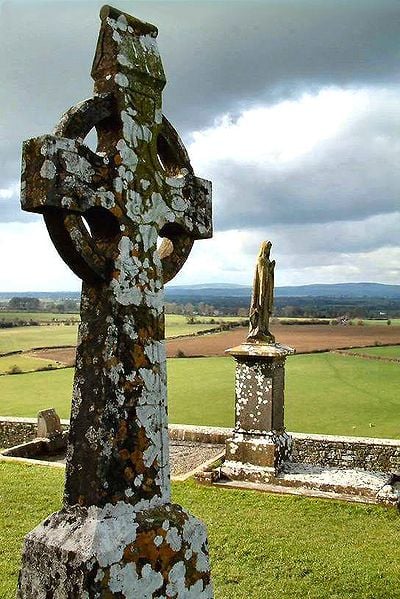
A High Cross at the Rock of Cashel in Ireland.
The photograph was taken by Chmouel. See [1]. It was originally uploaded to the English Wikipedia, with the upload history:
02:54, 17 Sep 2004 . . User:Redquark (90603 bytes) (photoshopped to add top part of cross)
18:33, 23 Mar 2004 . . User:Chmouel (115833 bytes) (High Cross in Ireland)
(CC BY-SA 3.0)
Lent
27 February 2018
The Edge of Elfland
Hudson, New Hampshire
Dearest Readers,
A reader recently sent me a link to the CBC Radio article, “Jesus Christ is my chief Druid”: meet the Anglican Priest who is also a pagan. I wasn’t entirely sure what I was going to find. The image at the top of the article was of Rev. Shawn Sanford Beck. On one side there was a picture of him in robe and alb delivering his homily. On the other he was cowled in a large forest green cloak, with a plaid shirt and staff. Rev. Beck refers to himself as a ChristoPagan, he is member of the Order of Bards, Ovates and Druids as well as an ordained priest in the Anglican Church of Canada.
I am intrigued by Rev. Beck, but I’m not certain his approach is precisely the right one. He is clearly, and openly, influenced by what he calls Neo-Paganism as well as “the writings of the early Celtic saints from the 5th to 7th centuries.” Yet I wonder what precisely he has been reading. The works of Columbanus, for instance, cannot have made up too much of his common fare since there is nothing by Columbanus that hints at this relationship between the “Celtic” church and the druids. Much of what we even know about druids is shrouded in mystery and pseudo-history created by nineteenth century antiquarians. So, I have to worry, even if only a small amount, about commitments to a past we cannot even ascertain the history of. After all, if we cannot be certain what the druids were or what they practiced, how can we have a resurgence that’s actually in line with their teachings.
This––to me––is the same problem one meets when addressing those who claim to follow the Old Norse religion. All of the written information about Odin and Thor and Ragnarok comes after Christianity had been introduced to the Scandinavian countries. Snorri Sturluson himself, one our chief sources, was reviving Old Norse myths in order to revive Old Norse poetry which he feared would be lost. Sturluson argues that Odin learned magic in the East and confounded the natives with it. I was once at a conference presenting on medieval cosmology (to which I shall return in a moment) where a professor was presenting on the similarities between Irish myth and Christianity. I asked her how we could be certain that the relationship was accidental when all of the stories were written down (or at least all of our copies come from a time) after Ireland had become fully Christianized. Unfortunately, I misworded my question and so she misunderstood and didn’t answer the question I meant to ask.
So my first reaction to this article is one of caution, not because I think Rev. Beck’s approach is necessarily dangerous spiritually but because it may very well be anachronistic. Another example is Rev. Beck’s statement about St. Columba calling Christ his chief druid. This comes from a song called the Song of Trust. It is attributed to Columba but I have not been able to find any hard evidence. It appears, I think, to originate from a Life of St, Columba written in the late nineteenth century. I can’t get my hands on the book, so I cannot look into it any more deeply, but I am leery of simply taking it on trust. Many songs have been written over the centuries and been attributed to all sorts of people, but we have no real evidence, nor even a predominant tradition. I should note that Beck does make reference to a Prof. Ronald E. Hutton at the University of Bristol. Hutton has certainly done research I haven’t, and I would be interested in reading his books on the evolution of paganism.
But what about what the good Rev. Actually believes? What makes him different from Christianity without “paganism”? In truth, I think the answer is not much, not for anyone with a proper understanding of theology and history. Beck says, “My theology is Christian, my cosmology is pagan.” Now, in the article this is never fully fleshed out, but it seems by pagan cosmology Beck means animism and, “bringing in the feminine face of the divine.” By animism, Rev. Beck seems to mean recognizing the inherent value of non-human creation. He says, “It’s about recognizing that that tree that I’ve been praying beside, is actually alive and conscious and praying with me. It’s about recognizing that if I’m having beef for supper I know who I’m eating, not what I’m eating.” On the face of it, this may seem very pagan indeed, but I’m not so sure.
As regards the feminine face of the divine, followers of sophiology would certainly say that this does not reside solely in the hands of the pagans (or even primarily). And Christians in the Middle Ages, and not just the ones from Ireland or Wales, certainly believed that trees were more than what we often think them to be today. Many, though by no means all, medieval Christians believed in fairies and elves, after all. What’s more, these Christians believed the planets were moved through the heavens by angelic intelligences that were, in essence, the gods of old. They also believed these planets had influence on the earth, caused various metals, humors in people, and events in history. And they believed all of this without the druids of Ireland.
In the end, I have no theological problem with the kinds of things it appears Rev. Beck does and believes. I believe nearly everything he talks about in this article (I have not read his book on Christian Animism) can be found in various Christian sources from very early on and from very far from Ireland––I think of Maximus the Confessor and logoi or Augustine and the angels guiding the kinds in Genesis 1 as intimately related to the interconnectedness of non-human and human creation. I don’t think I would ever go about reintroducing some of these ideas the way Rev. Beck is since I think we can find better sources for most if not all of them. Still, I applaud anyone who wants us to turn to a more interconnected, a faeriean understanding of reality.
Sincerely,
David
The Radical Catholic Reimagination of Everything

Next Post
March 2, 2018 Signed Copies of On the Edges of Elfland: A Fairy-Tale for Grown Ups
Browse Our Archives
Select a Category A Secular Age Advent Apologetics Atheism Beauty Being a Catholic Evangelical Being Catholic Being Deified: Poetry and Fantasy on the Path to God Blogging Book Reviews C. S. Lewis Catholic Imagination Catholic Social Teaching Catholicism Christmas Church Calendar Church Fathers Church Life Community Conferences Cosmology Creation Curdled Words Deification Distributism Easter Economics Education Epiphany Essay Extracts Eucharist Faerie Faeriean Metaphysics Fatherhood Films Folk Liturgy Food and Drink G. K. Chesterton Harry Potter J. R. R. Tolkien Jove King Arthur Language Lent Life Literature and Poetry Liturgy Medieval Theology Music My Publications Mythology On the Edges of Elfland Ordinary Time Ordination Parenthood Parish Patristic Theology Pentecost Politics Prayer Racism Radical Orthodoxy Restoration Movement Sacramental Ontology Saints Science Sex and Sexuality Sophiology Stories The Inklings The Radical Catholic Reimagination of Everything Theologians in the Church Theopoetics Thesis Research Uncategorized University of Nottingham What I'm Reading Writing
Select a Month December 2019 November 2019 October 2019 September 2019 August 2019 July 2019 June 2019 May 2019 April 2019 March 2019 February 2019 January 2019 December 2018 November 2018 October 2018 September 2018 August 2018 July 2018 June 2018 May 2018 April 2018 March 2018 February 2018 January 2018 December 2017 November 2017 October 2017 August 2017 July 2017 June 2017 May 2017 April 2017 March 2017 February 2017 January 2017 December 2016 November 2016 October 2016 September 2016 August 2016 July 2016 June 2016 May 2016 April 2016 March 2016 February 2016 January 2016 December 2015 November 2015 October 2015 September 2015 August 2015 July 2015 June 2015 May 2015 April 2015 March 2015 February 2015 January 2015 December 2014 November 2014 October 2014 September 2014 August 2014 July 2014 June 2014 May 2014 April 2014 March 2014 February 2014 January 2014 December 2013 November 2013 October 2013 September 2013 August 2013 July 2013 June 2013 May 2013 April 2013 March 2013 February 2013 January 2013 December 2012 November 2012 October 2012 September 2012 July 2012
Follow Us!
TAKE THE
Religious Wisdom Quiz
James says that trials of many kinds test what, producing perseverance?
Select your answer to see how you score.
Your faith Your character Your love Your patience
Related posts from Letters from the Edge of Elfland

William Blake on the Creative Spirit, Beauty, and...
Letters from the Edge of Elfland

“Wherefore stopp’st thou me?” Coleridge’s Creative Message to...
Letters from the Edge of Elfland
Good Morning, Mr. Magpie: On Folklore and Science
Letters from the Edge of Elfland
Letters from the Edge of Elfland
TRENDING AT PATHEOS Catholic

The Parable Of The Sower And The Word...
One of Christ’s most famous parables is that of the sower who...

Rejecting Doom: Christian Hope And Human Action
Christianity is a religion of hope. We are to have hope and...

Why I Choose the Eucharist Over the Sermon
Choose the Eucharist, Not the Sermon What are we supposed to get...

5 Design Elements Found in Spiritually Rooted Homes
Putting Spirituality Into Home Decor Our homes are more than our living...

Credo: A Story of God Told with the...
About 10 years ago, I began to imagine a personal "Credo" that...

The Anatomy of Divine Revelation in Catholic Thought
The claim that God has made Himself known to human beings is...
view all Catholic blogs
Ad-Free & Subscriber Log-In Subscription Support
- About Us
- 2026 Calendar
- Videos
- Podcasts
- Library of World Religions
- Faith In Media Tracker
- Advertise With Us
- Write for Us
- Privacy Policy
- Terms of Service
- Do Not Sell My Data
- Contact Us
- Radiant Digital
- Manage Newsletter Subscriptions
- Unsubscribe From Notifications
- Sitemap
Copyright 2008-2026, Patheos. All rights reserved.
Subscription Support Ad-Free & Subscriber Log-In
Follow Patheos