
BuddhistCatholicContemplativeEvangelicalGeneral ChristianHinduJewishLatter-day SaintMuslimNew VisionsProgressive Christian
Beliefs
- Buddhist
- Catholic
- Contemplative
- Evangelical
- General Christian
- Hindu
- Jewish
- Latter-day Saint
- More Voices
- Muslim
- New Visions
- Pagan
- Progressive Christian
Topics
- Religion News
- Food and Religion
- Sports and Religion
- Religious Art
- Religious Music and Entertainment
- Religious Events
- History and Religion
- Style and Religion
- Politics and Religion
- Women in Religion
- Recreation Outdoors and Religion
- Business Finance and Religion
- Careers Workplace and Religion
- Education and Religion
- Family Parenting and Religion
- Health Fitness and Religion
- Home and Religion
- Relationships and Religion
- Technology and Religion
- Travel and Religion
Columnists
- Buddhist Columnists
- Business Finance and Religion Columnists
- Careers Workplace and Religion Columnists
- Catholic Columnists
- Contemplative Columnists
- Education and Religion Columnists
- Evangelists Columnists
- Family Parenting and Religion Columnists
- General Christian Columnists
- Health Fitness and Religion Columnists
- Hindu Columnists
- History and Religion Columnists
- Home and Religion Columnists
- Jewish Columnists
- More Voices Columnists
- Latter Day Columnists
- Muslim Columnists
- New Visions Columnists
- Nonreligious Columnists
- Pagan Columnists
- Politics and Religion Columnists
- Progressive Columnists
- Recreation Outdoors and Religion Columnists
- Relationships and Religion Columnists
- Religion News Columnists
- Religious Art Columnists
- Religious Events Columnists
- Religious Music and Entertainment Columnists
- Sports and Religion Columnists
- Style and Religion Columnists
- Technology and Religion Columnists
- Travel and Religion Columnists
- Women in Religion Columnists
Resource Library
- 2026 Calendar
- Library of World Religions
- The 100 Most Holy Places on Earth
- Patheos Answers
- Podcasts
- Videos
- Faith Leaders Database
- Anglican Episcopalian
- Bahai
- Baptist
- Buddhism
- Christianity
- Confucianism
- Eastern Orthodoxy
- Hinduism
- Holiness and Pentecostal
- ISKCON
- Islam
- Judaism
- Lutheran
- Methodist
- The Church of Jesus Christ of Latter-day Saints
- New Age
- Paganism
- Presbytarian and Reformed
- Protestantism
- Religion Behind the Scenes
- Roman Catholic
- Scientology
- Shia Islam
- Sikhism
- Sufism
- Sunni Islam
- Taoism
- Zen
- See all religions
Research Tools
 Ad-Free & Subscriber Log-In Subscription Support
Ad-Free & Subscriber Log-In Subscription Support
Follow Patheos 

- Trending:
- Forgiveness
- |
- Marriage
- |
- Consciousness
- |
- Death Penalty
- |
- Election
- |
- Halloween
 Letters from the Edge of Elfland
- Home
- About
- Distributist Resources
- Publications and Presentations
- Support
- Works in Progress
- The Epistolarian Around the Web
- Home
- Catholic
- Death, Sin, and Fasting: Reflections before the Start of Lent
Death, Sin, and Fasting: Reflections before the Start of Lent
Last updated on: February 10, 2018 at 5:14 pm by David Russell Mosley
Death, Sin, and Fasting: Reflections before the Start of Lent 2018-02-10T17:14:55-04:00 David Russell Mosley
Patheos Explore the world's faith through different perspectives on religion and spirituality! Patheos has the views of the prevalent religions and spiritualities of the world.
David Russell Mosley
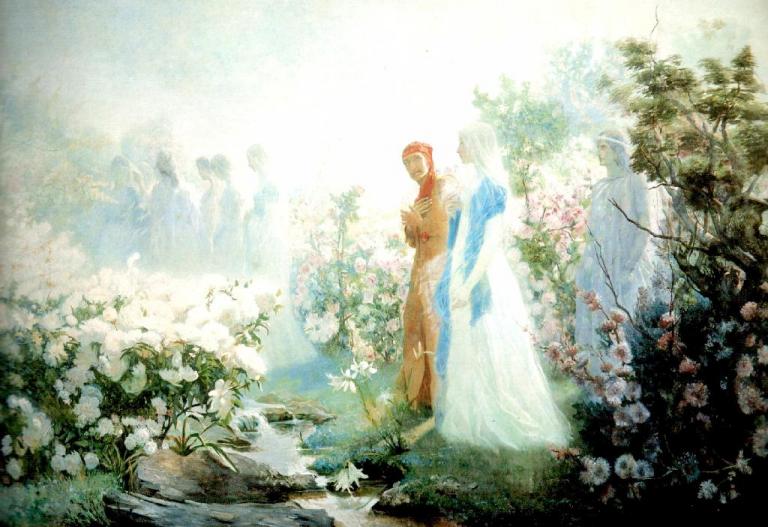
Author Cristóbal Rojas (1857–1890) Blue pencil Dante y Beatriz a orillas del Leteo Date 1889 Medium oil on canvas Dimensions 297 × 428 cm (116.9 × 168.5 in). Current location GAN.Cararas – Venezuela. Source/Photographer Obra de arte, Pintura de Cristóbal Rojas (1857-1890)
Ordinary Time
10 February 2018
The Edge of Elfland
Hudson, New Hampshire
Dearest Readers,
Goodness me, where have I been? It’s been a busy few months. Teaching keeps me busy, of course (especially I work full-time at a high school and part-time at a university, teaching online). And my lovely twin three year olds also keep me plenty busy. But still, I should have been writing here more often. Mea culpa.
As an update, for those who haven’t already seen, I’ve had a piece published in U.S. Catholic Magazine on pipe smoking and contemplation. Be sure to give it a read. Now, onto something different.
Lent is on its way. This will be my first Lent as a Catholic and, as usual, I’m struggling to decide what I should give up or take on. I’ve considered my usual Facebook fast, perhaps meat, or sugar, or alcohol; maybe I’ll stop getting on my phone first thing in the morning and go straight into the shower. I don’t know. Hopefully I think of something soon. But there are two things Lent always makes me think about, perhaps more so now as a Catholic.
Lent always makes me think about my sins. This, of course, is part of the point of Lent, to remind us of the sins we bear, the sins that sent Christ to the cross out of his love for us. But this year, I’m thinking about my sin more than ever. It probably has something to do with teaching Dante’s Divine Comedy for the first time ever, to high school sophomores of all people. We’re currently in the Purgatorio, and the pilgrim has just received the 7 P’s on his forehead, each of which will need to be washed off as he ascends the mountain. I know at least two of those sins are pet projects of mine and I would love to give them up this Lent.
Of course, giving up sin isn’t really what we mean by fasting. We fast from things that are good, things that are necessary, food, for instance. We do this both to prepare ourselves for the feasting to come, but also to remind us that we don’t live “by bread alone” but by the very Word of God. Still, sin and death are there in Lent, constantly looking at us, mocking us, reminding us of the ends for which we’re made. Or so they want us to believe. But Christ knew and knows better. We are not made for sin and death but to see as we are seen, to encounter the Beatific Vision, to be deified. So, maybe along with the good things, we really ought to think of sins we can actively try to abstain from and the virtues we need to acquire to overcome those sins.
The second thing Lent always brings to mind is time. What am I doing with my time? Why aren’t I writing more? Whether here, or in my journals, or in letters owed to friends, or on my new novel, or on articles I could publish, or a new work of theology? Why does it seem like every moment comes and goes without my recognition of it? I don’t really know the answers to any of these. But Lent has me thinking that maybe I should try to find some. Maybe I should be more intentional with my time. After all, I am going to die. Do I want to leave behind things unwritten, games unplayed with children, words unsaid, books unread? Hell no.
Of course Lent is a time to remember that we will die. And when I think about my death, I always turn to Keats’ poem, “When I have fears that I may cease to be.” The poem wasn’t published until 27 years after his untimely death, but it was written 3 years before it. Keats’ fears were, at least partially I’m sure, realized. He did, in one sense, cease to be before his pen could glean his teaming brain. Nevertheless, he wrote, unpopular in his day he wrote and wrote and wrote. I hope to, in my own small way, emulate his example. I too want to be spurred on by the fact that I will die. If I live a life that remembers my death, maybe, when he comes for me, death and I can go forward, arm-in-arm, as friends. In the meantime, here is Keats’ poem.
When I have fears that I may cease to be
Before my pen has glean’d my teeming brain,
Before high-piled books, in charact’ry,
Hold like rich garners the full-ripen’d grain;
When I behold, upon the night’s starr’d face,
Huge cloudy symbols of a high romance,
And think that I may never live to trace
Their shadows, with the magic hand of chance;
And when I feel, fair creature of an hour,
That I shall never look upon thee more,
Never have relish in the faery power
Of unreflecting love!—then on the shore
Of the wide world I stand alone, and think
Till Love and Fame to nothingness do sink.
Sincerely,
David Russell Mosley
Previous Post

January 2, 2018
Speaking on the Catholic Imagination for Spirited Theology
Browse Our Archives
Select a Category A Secular Age Advent Apologetics Atheism Beauty Being a Catholic Evangelical Being Catholic Being Deified: Poetry and Fantasy on the Path to God Blogging Book Reviews C. S. Lewis Catholic Imagination Catholic Social Teaching Catholicism Christmas Church Calendar Church Fathers Church Life Community Conferences Cosmology Creation Curdled Words Deification Distributism Easter Economics Education Epiphany Essay Extracts Eucharist Faerie Faeriean Metaphysics Fatherhood Films Folk Liturgy Food and Drink G. K. Chesterton Harry Potter J. R. R. Tolkien Jove King Arthur Language Lent Life Literature and Poetry Liturgy Medieval Theology Music My Publications Mythology On the Edges of Elfland Ordinary Time Ordination Parenthood Parish Patristic Theology Pentecost Politics Prayer Racism Radical Orthodoxy Restoration Movement Sacramental Ontology Saints Science Sex and Sexuality Sophiology Stories The Inklings The Radical Catholic Reimagination of Everything Theologians in the Church Theopoetics Thesis Research Uncategorized University of Nottingham What I'm Reading Writing
Select a Month December 2019 November 2019 October 2019 September 2019 August 2019 July 2019 June 2019 May 2019 April 2019 March 2019 February 2019 January 2019 December 2018 November 2018 October 2018 September 2018 August 2018 July 2018 June 2018 May 2018 April 2018 March 2018 February 2018 January 2018 December 2017 November 2017 October 2017 August 2017 July 2017 June 2017 May 2017 April 2017 March 2017 February 2017 January 2017 December 2016 November 2016 October 2016 September 2016 August 2016 July 2016 June 2016 May 2016 April 2016 March 2016 February 2016 January 2016 December 2015 November 2015 October 2015 September 2015 August 2015 July 2015 June 2015 May 2015 April 2015 March 2015 February 2015 January 2015 December 2014 November 2014 October 2014 September 2014 August 2014 July 2014 June 2014 May 2014 April 2014 March 2014 February 2014 January 2014 December 2013 November 2013 October 2013 September 2013 August 2013 July 2013 June 2013 May 2013 April 2013 March 2013 February 2013 January 2013 December 2012 November 2012 October 2012 September 2012 July 2012
Follow Us!
TAKE THE
Religious Wisdom Quiz
Which prophet was a shepherd and a sycamore-fig farmer?
Select your answer to see how you score.
Daniel Amos Joel Micah
Related posts from Letters from the Edge of Elfland
Hope and Death in Advent: Reflecting on Adventual...
Letters from the Edge of Elfland

Poetry, Podcasts, and More: Some Updates on Other...
Letters from the Edge of Elfland

Working on a Book of Poetry: An Apology...
Letters from the Edge of Elfland

Poetry Shapes the World around Us: Reflecting on...
Letters from the Edge of Elfland
TRENDING AT PATHEOS Catholic

Rejecting Doom: Christian Hope And Human Action
Christianity is a religion of hope. We are to have hope and...

It’s What Comes From Within Which Matters
One of the most difficult things for us to understand is why...

Why I Choose the Eucharist Over the Sermon
Choose the Eucharist, Not the Sermon What are we supposed to get...

5 Design Elements Found in Spiritually Rooted Homes
Putting Spirituality Into Home Decor Our homes are more than our living...

Credo: A Story of God Told with the...
About 10 years ago, I began to imagine a personal "Credo" that...

The Anatomy of Divine Revelation in Catholic Thought
The claim that God has made Himself known to human beings is...
view all Catholic blogs
Ad-Free & Subscriber Log-In Subscription Support
- About Us
- 2026 Calendar
- Videos
- Podcasts
- Library of World Religions
- Faith In Media Tracker
- Advertise With Us
- Write for Us
- Privacy Policy
- Terms of Service
- Do Not Sell My Data
- Contact Us
- Radiant Digital
- Manage Newsletter Subscriptions
- Unsubscribe From Notifications
- Sitemap
Copyright 2008-2026, Patheos. All rights reserved.
Subscription Support Ad-Free & Subscriber Log-In
Follow Patheos