
BuddhistCatholicContemplativeEvangelicalGeneral ChristianHinduJewishLatter-day SaintMuslimNew VisionsProgressive Christian
Beliefs
- Buddhist
- Catholic
- Contemplative
- Evangelical
- General Christian
- Hindu
- Jewish
- Latter-day Saint
- More Voices
- Muslim
- New Visions
- Pagan
- Progressive Christian
Topics
- Religion News
- Food and Religion
- Sports and Religion
- Religious Art
- Religious Music and Entertainment
- Religious Events
- History and Religion
- Style and Religion
- Politics and Religion
- Women in Religion
- Recreation Outdoors and Religion
- Business Finance and Religion
- Careers Workplace and Religion
- Education and Religion
- Family Parenting and Religion
- Health Fitness and Religion
- Home and Religion
- Relationships and Religion
- Technology and Religion
- Travel and Religion
Columnists
- Buddhist Columnists
- Business Finance and Religion Columnists
- Careers Workplace and Religion Columnists
- Catholic Columnists
- Contemplative Columnists
- Education and Religion Columnists
- Evangelists Columnists
- Family Parenting and Religion Columnists
- General Christian Columnists
- Health Fitness and Religion Columnists
- Hindu Columnists
- History and Religion Columnists
- Home and Religion Columnists
- Jewish Columnists
- More Voices Columnists
- Latter Day Columnists
- Muslim Columnists
- New Visions Columnists
- Nonreligious Columnists
- Pagan Columnists
- Politics and Religion Columnists
- Progressive Columnists
- Recreation Outdoors and Religion Columnists
- Relationships and Religion Columnists
- Religion News Columnists
- Religious Art Columnists
- Religious Events Columnists
- Religious Music and Entertainment Columnists
- Sports and Religion Columnists
- Style and Religion Columnists
- Technology and Religion Columnists
- Travel and Religion Columnists
- Women in Religion Columnists
Resource Library
- 2026 Calendar
- Library of World Religions
- The 100 Most Holy Places on Earth
- Patheos Answers
- Podcasts
- Videos
- Faith Leaders Database
- Anglican Episcopalian
- Bahai
- Baptist
- Buddhism
- Christianity
- Confucianism
- Eastern Orthodoxy
- Hinduism
- Holiness and Pentecostal
- ISKCON
- Islam
- Judaism
- Lutheran
- Methodist
- The Church of Jesus Christ of Latter-day Saints
- New Age
- Paganism
- Presbytarian and Reformed
- Protestantism
- Religion Behind the Scenes
- Roman Catholic
- Scientology
- Shia Islam
- Sikhism
- Sufism
- Sunni Islam
- Taoism
- Zen
- See all religions
Research Tools
 Ad-Free & Subscriber Log-In Subscription Support
Ad-Free & Subscriber Log-In Subscription Support
Follow Patheos 

- Trending:
- Forgiveness
- |
- Marriage
- |
- Consciousness
- |
- Death Penalty
- |
- Election
- |
- Halloween
 Letters from the Edge of Elfland
- Home
- About
- Distributist Resources
- Publications and Presentations
- Support
- Works in Progress
- The Epistolarian Around the Web
- Home
- Catholic
- On “Farewell Rewards and Fairies” by Richard Corbet
On “Farewell Rewards and Fairies” by Richard Corbet
Last updated on: December 30, 2017 at 8:00 am by David Russell Mosley
On “Farewell Rewards and Fairies” by Richard Corbet 2017-12-30T00:04:30-04:00 David Russell Mosley
Patheos Explore the world's faith through different perspectives on religion and spirituality! Patheos has the views of the prevalent religions and spiritualities of the world.
David Russell Mosley
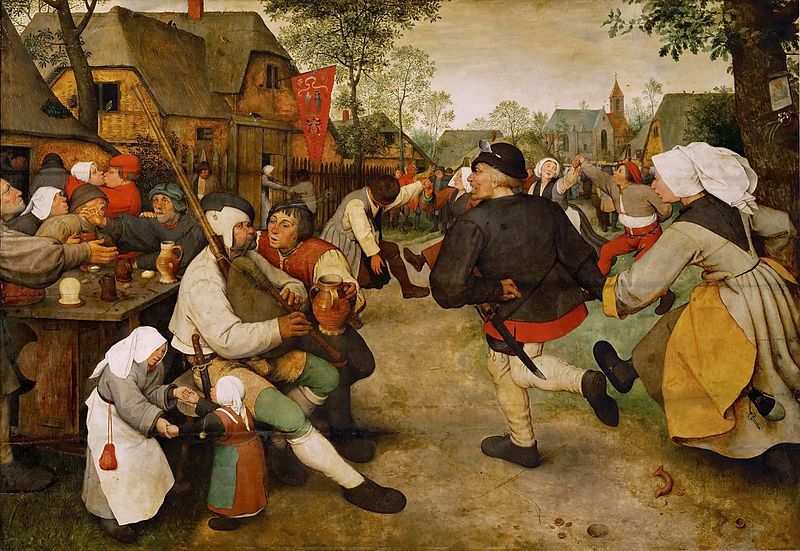
Artist
Pieter Brueghel the Elder (1526/1530–1569) Link back to Creator infobox template wikidata:Q43270
Title The Peasant Dance wikidata:Q95562
Date circa 1568
Source/Photographer
1. The Yorck Project: 10.000 Meisterwerke der Malerei. DVD-ROM, 2002. ISBN 3936122202. Distributed by DIRECTMEDIA Publishing GmbH.
2. GalleriX
(PD 100, 23)
Christmastide
30 December 2017
The Edge of Elfland
Hudson, New Hampshire
Dearest Readers,
There is a poem with which I have long been enamoured, but have not, until recently, sought to understand more. The poem is Richard Corbet’s “Farewell Rewards and Fairies.” I reproduce here for you in full:
Farewell rewards and fairies
Good housewives now may say,
For now foul sluts in dairies
Do fare as well as they;
And though they sweep their hearths no less
Than maids were wont to doe,
Yet who of late for cleanliness,
Finds sixpence in her shoe?Lament, lament old abbeys
The fairies’ lost command,
They did but change priests’ babies,
But some have changed your land
And all your children stolen from thence
Are now grown puritans,
Who live as changelings ever since
For love of your demesnes.At morning and at evening both,
You merry were and glad,
So little care of sleep and sloth,
These pretty ladies had,
When Tom came home from labour,
Or Cisse to milking rose;
Then merrily went their tabor
And nimbly went their toes.Witness those rings and roundelays
Of theirs which yet remain,
Were footed in Queen Mary’s days
On many a grassy plain.
But since of late Elizabeth
And later James came in,
They never danced on any heath
As when the time had been.By which we note the fairies
Were of the old profession,
Their songs were Ave Maries,
Their dances were procession;
But now alas they all are dead
Or gone beyond the seas,
Or further from religion fled
Or else they take their ease.A tell-tale in their company
They never could endure,
And who so kept not secretly
Their mirth was punished sure.
It was a just and Christian deed
To pinch such black and blue;
O how the commonwealth doth need
Such Justices as you!Now they have left our quarters,
A Register they have,
Who can preserve their charters;
A man both wise and grave.
A hundred of their merry pranks
By one that I could name,
Are kept in store; con twenty thanks
To William for the same.To William Churne of Staffordshire,
Give laud and praises due;
Who every meal can mend your cheer,
With tales both old and true.
To William all give audience,
And pray you for his noddle;
For all the fairies’ evidence,
Were lost if it were addle.
Several versions I have online leave off the last two stanzas, I include them for the sake of accuracy.
I find this poem so very interesting. The first time I read it I assumed Corbet was a Catholic writing in the recently Protestant England. I was half right. As it turns out, Corbet––who lived from 1582–1635––was the Bishop of Oxford and later Bishop of Norwhich in the Church of England! So what on earth is he doing writing what has always seemed to me such a pro-Catholic a pro-Enchantment (if you’ll allow me the use of a word which is, even I must admit, rather overused these days) poem?
Well, it turns out for starters that Corbet was noted for his wit and his satire. Is this piece, then, a satire, meant to denigrate the Catholic faith by associating it with belief in fairies? I don’t think so. The key, I think, lies in two places: first, Corbet’s well documented love of good wine and thus a good time, as well as Corbet’s equally well-documented disdain for Puritans. Note the second stanza:
Lament, lament old abbeys
The fairies’ lost command,
They did but change priests’ babies,
But some have changed your land
And all your children stolen from thence
Are now grown puritans,
Who live as changelings ever since
For love of your demesnes.
Now it is true that Corbet here suggests when priests (then Catholic and thus celibate) were “getting” children on women the fairies changed them out for fairy children called changelings. This is not, I must admit, propitious––though it is funny. But note how the line continues, fairies may have stolen bastard children, but others have changed the land itself, have bastardized the land and now all children seem disconnected from it. Why? Because they have grown into puritans, noted killjoys (at least stereotypically). As much as this stanza drips with satire, I think it is soaked in real lament as well. The abbeys have been changed into demesnes, manor houses (Northanger Abbey my Austen friends?).
I haven’t the time, nor the expertise to pick this poem apart line by line or even stanza by stanza. But this is what I will say, Corbett is clearly blending here a kind of satire of the association of Catholicism with folk beliefs as well as an appreciation of the Catholic sensibility as regards feasting and joviality, something in the process of being lost under the puritans. I find it interesting that the nineteenth century Anglican priest, Francis Edward Paget, who would come to be known as a supporter of the Oxford Movement within the Church of England (a movement to re-Catholicize the Church of England) would use William of Churne (the mysterious repository of fairy legends) as a pseudonym for several of his own books dealing with Faërie. This, at the very least, says something to me about the reception of Corbet’s poem and thus, possibly, something about the true meaning of it.
I will continue to enjoy “Farewell Rewards and Fairies,” now a little more deeply than I have before. I think it hints in just the right way, for if it is a joke it is one that is funny precisely because it is true, that there is some strange connection, some triangle made between the Catholic Church, the land, and Faërie. Corbet, it seems to me, saw a glimpse of this, even if he laughed while he did so. I too laugh, it is absurd, but no less likely to be true.
Sincerely,
David
The Radical Catholic Reimagination of Everything
Next Post

January 2, 2018 Speaking on the Catholic Imagination for Spirited Theology
Browse Our Archives
Select a Category A Secular Age Advent Apologetics Atheism Beauty Being a Catholic Evangelical Being Catholic Being Deified: Poetry and Fantasy on the Path to God Blogging Book Reviews C. S. Lewis Catholic Imagination Catholic Social Teaching Catholicism Christmas Church Calendar Church Fathers Church Life Community Conferences Cosmology Creation Curdled Words Deification Distributism Easter Economics Education Epiphany Essay Extracts Eucharist Faerie Faeriean Metaphysics Fatherhood Films Folk Liturgy Food and Drink G. K. Chesterton Harry Potter J. R. R. Tolkien Jove King Arthur Language Lent Life Literature and Poetry Liturgy Medieval Theology Music My Publications Mythology On the Edges of Elfland Ordinary Time Ordination Parenthood Parish Patristic Theology Pentecost Politics Prayer Racism Radical Orthodoxy Restoration Movement Sacramental Ontology Saints Science Sex and Sexuality Sophiology Stories The Inklings The Radical Catholic Reimagination of Everything Theologians in the Church Theopoetics Thesis Research Uncategorized University of Nottingham What I'm Reading Writing
Select a Month December 2019 November 2019 October 2019 September 2019 August 2019 July 2019 June 2019 May 2019 April 2019 March 2019 February 2019 January 2019 December 2018 November 2018 October 2018 September 2018 August 2018 July 2018 June 2018 May 2018 April 2018 March 2018 February 2018 January 2018 December 2017 November 2017 October 2017 August 2017 July 2017 June 2017 May 2017 April 2017 March 2017 February 2017 January 2017 December 2016 November 2016 October 2016 September 2016 August 2016 July 2016 June 2016 May 2016 April 2016 March 2016 February 2016 January 2016 December 2015 November 2015 October 2015 September 2015 August 2015 July 2015 June 2015 May 2015 April 2015 March 2015 February 2015 January 2015 December 2014 November 2014 October 2014 September 2014 August 2014 July 2014 June 2014 May 2014 April 2014 March 2014 February 2014 January 2014 December 2013 November 2013 October 2013 September 2013 August 2013 July 2013 June 2013 May 2013 April 2013 March 2013 February 2013 January 2013 December 2012 November 2012 October 2012 September 2012 July 2012
Follow Us!
TAKE THE
Religious Wisdom Quiz
"Thou preparest a table for me in the presence of mine _____."
Select your answer to see how you score.
Kinsmen Friends Children Enemies
Related posts from Letters from the Edge of Elfland

William Blake on the Creative Spirit, Beauty, and...
Letters from the Edge of Elfland

“Wherefore stopp’st thou me?” Coleridge’s Creative Message to...
Letters from the Edge of Elfland
Celebrating England and the World with St. George...
Letters from the Edge of Elfland

Good Morning, Mr. Magpie: On Folklore and Science
Letters from the Edge of Elfland
TRENDING AT PATHEOS Catholic

Creation, Preservation, and Teleology in Catholic Theology
As I write this, it is very early Monday morning. Like millions...

The Parable Of The Sower And The Word...
One of Christ’s most famous parables is that of the sower who...

Rejecting Doom: Christian Hope And Human Action
Christianity is a religion of hope. We are to have hope and...

Why I Choose the Eucharist Over the Sermon
Choose the Eucharist, Not the Sermon What are we supposed to get...

5 Design Elements Found in Spiritually Rooted Homes
Putting Spirituality Into Home Decor Our homes are more than our living...

Credo: A Story of God Told with the...
About 10 years ago, I began to imagine a personal "Credo" that...
view all Catholic blogs
Ad-Free & Subscriber Log-In Subscription Support
- About Us
- 2026 Calendar
- Videos
- Podcasts
- Library of World Religions
- Faith In Media Tracker
- Advertise With Us
- Write for Us
- Privacy Policy
- Terms of Service
- Do Not Sell My Data
- Contact Us
- Radiant Digital
- Manage Newsletter Subscriptions
- Unsubscribe From Notifications
- Sitemap
Copyright 2008-2026, Patheos. All rights reserved.
Subscription Support Ad-Free & Subscriber Log-In
Follow Patheos