
BuddhistCatholicContemplativeEvangelicalGeneral ChristianHinduJewishLatter-day SaintMuslimNew VisionsProgressive Christian
Beliefs
- Buddhist
- Catholic
- Contemplative
- Evangelical
- General Christian
- Hindu
- Jewish
- Latter-day Saint
- More Voices
- Muslim
- New Visions
- Pagan
- Progressive Christian
Topics
- Religion News
- Food and Religion
- Sports and Religion
- Religious Art
- Religious Music and Entertainment
- Religious Events
- History and Religion
- Style and Religion
- Politics and Religion
- Women in Religion
- Recreation Outdoors and Religion
- Business Finance and Religion
- Careers Workplace and Religion
- Education and Religion
- Family Parenting and Religion
- Health Fitness and Religion
- Home and Religion
- Relationships and Religion
- Technology and Religion
- Travel and Religion
Columnists
- Buddhist Columnists
- Business Finance and Religion Columnists
- Careers Workplace and Religion Columnists
- Catholic Columnists
- Contemplative Columnists
- Education and Religion Columnists
- Evangelists Columnists
- Family Parenting and Religion Columnists
- General Christian Columnists
- Health Fitness and Religion Columnists
- Hindu Columnists
- History and Religion Columnists
- Home and Religion Columnists
- Jewish Columnists
- More Voices Columnists
- Latter Day Columnists
- Muslim Columnists
- New Visions Columnists
- Nonreligious Columnists
- Pagan Columnists
- Politics and Religion Columnists
- Progressive Columnists
- Recreation Outdoors and Religion Columnists
- Relationships and Religion Columnists
- Religion News Columnists
- Religious Art Columnists
- Religious Events Columnists
- Religious Music and Entertainment Columnists
- Sports and Religion Columnists
- Style and Religion Columnists
- Technology and Religion Columnists
- Travel and Religion Columnists
- Women in Religion Columnists
Resource Library
- 2026 Calendar
- Library of World Religions
- The 100 Most Holy Places on Earth
- Patheos Answers
- Podcasts
- Videos
- Faith Leaders Database
- Anglican Episcopalian
- Bahai
- Baptist
- Buddhism
- Christianity
- Confucianism
- Eastern Orthodoxy
- Hinduism
- Holiness and Pentecostal
- ISKCON
- Islam
- Judaism
- Lutheran
- Methodist
- The Church of Jesus Christ of Latter-day Saints
- New Age
- Paganism
- Presbytarian and Reformed
- Protestantism
- Religion Behind the Scenes
- Roman Catholic
- Scientology
- Shia Islam
- Sikhism
- Sufism
- Sunni Islam
- Taoism
- Zen
- See all religions
Research Tools
 Ad-Free & Subscriber Log-In Subscription Support
Ad-Free & Subscriber Log-In Subscription Support
Follow Patheos 

- Trending:
- Forgiveness
- |
- Marriage
- |
- Consciousness
- |
- Death Penalty
- |
- Election
- |
- Halloween
 Letters from the Edge of Elfland
- Home
- About
- Distributist Resources
- Publications and Presentations
- Support
- Works in Progress
- The Epistolarian Around the Web
- Home
- Catholic
- On Belief in Fairies: Reflections from Robert Kirk’s The Secret Commonwealth
On Belief in Fairies: Reflections from Robert Kirk’s The Secret Commonwealth
Last updated on: December 29, 2017 at 1:50 pm by David Russell Mosley
On Belief in Fairies: Reflections from Robert Kirk’s The Secret Commonwealth 2017-12-29T13:50:03-04:00 David Russell Mosley
Patheos Explore the world's faith through different perspectives on religion and spirituality! Patheos has the views of the prevalent religions and spiritualities of the world.
David Russell Mosley
Author
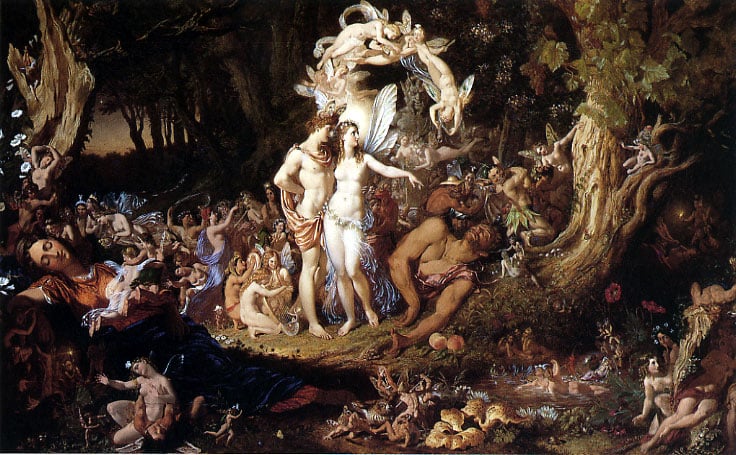
Joseph Noel Paton (1821–1901)
Description
English: The Reconciliation of Titania and Oberon
Date 1847
According to the book, Titania and Oberon are the functional, human names, for the overqueen and king of Faërie.
(Public Domain)
Christmastide
29 December 2017
The Edge of Elfland
Manchester, New Hampshire
Dearest Readers,
Description
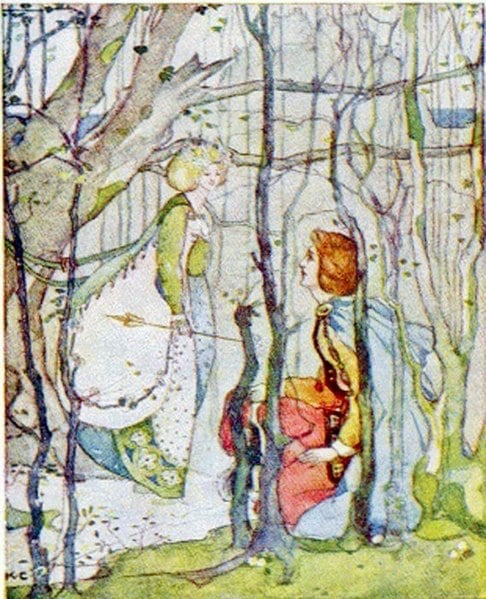
Italiano: Thomas il Rimatore e la Regina degli Elfi
Date before 1901
Source https://i.pinimg.com/736x/d5/24/81/d5248137e1980a13dfc6597467bfe94d–public-domain-fairy-tales.jpg
Author Katharine Cameron (1874–1965)
(Public Domain)
Recently I finally purchased my own copy of Robert Kirk’s The Secret Commonwealth of Elves, Fauns and Fairies. The book, which I have discussed before, is really quite fascinating. Written in the 17th century but went, seemingly unpublished until the 19th century, the book lays out how and why humans might interact with the subterranean creatures often called elves or fairies. Kirk was a Presbyterian minister from Scotland and may have sought to ensure that peasants living in the remoter parts of Scotland were not unduly punished for occultism or witchcraft. After all, most of what they were doing was not bad and all of them seemed to have truly worshipped God (you can see more of Scottish folk beliefs and practices in Alexander Carmichael’s Carmina Gadelica from the early 20th century).
After having spent most of the book discussing how humans come to have the second sight and recounting things seen, Kirk discusses why it is that some humans have been given the second sight and why they sometimes seem to be able to tell things about the future. Kirk writes:
“Since the things seen by the seers are real entities, the presages and predictions found true, but a few endowed with this sight and those not of bad lives or addicted to malefic, the true solution of the phenomenon seems rather to be the courteous endeavours of our own fellow creatures in the invisible world to convince us (in opposition to Saduce’s, Socinians, and atheists) of a deity, of spirits, of a possible and harmless method of correspondence betwixt men and them even in this life, of their operation or our caution and warning, of the orders and degrees of angels, whereof one order of bodies of air condensed and curiously shaped may be next to man, superior to him in understanding yet unconfirmed, and of their region, habitation, and influences on man, greater than that of stars on inanimate bodies; a knowledge (belike) reserved for these last atheistic ages, wherein the profanity of men’s lives hath debauched and blinded their understanding as to Moses, Jesus, and the prophets (unless they get convictions from things formerly known) as from the regions of the dead.”
Now it is clear that Kirk contemplates the possibility that some of the elves are, in fact, an order of angels. But his angelology aside, here is what I find most interesting about Kirk’s statement here. The reason, he says, that some people are given the ability to communicate with elves and fairies is in order to overcome notions of what Paul Tyson calls a 1 dimensional metaphysic, wherein, what we can sense and observe directly (or scientifically) is all there really is. Belief in
Description
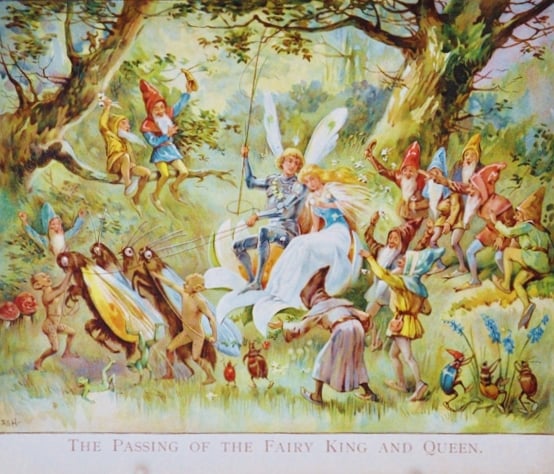
English: Illustration by E. Stuart Hardy for “The Book of Gnomes” Fred. E. Weatherly, 1895.
Date 23 July 2009, 21:21:34
Source http://theprintportfoliogallery.com/index.php?main_page=index&cPath=116_127
Author E. Stuart Hardy (illustrator)
(Public Domain)
fairies, Kirk tells us, helps us to understand that there “are more things in Heaven and Earth than are dreamt of in [our] philosophies.”
It is true that this won’t convince modern atheists. In fact, suggesting that fairies are real, might make them think we are mad. Some have even used arguments to suggest that they no more believe in God than they believe in fairies at the bottom of their garden. So wouldn’t Kirk’s argument fall on rather deaf ears? Perhaps, but that doesn’t make him wrong.
David Bentley Hart, whom I have cited on this subject many times, makes two arguments I think helpful to round out Kirk’s. The first comes in his essay, “God, Gods, and Fairies.” There, Hart notes that belief or disbelief in fairies is unrelated to belief or disbelief in God. This would seem to argue against Kirk. But there is an important distinction that must be made. What Hart means is that God and fairies are two qualitatively different. Fairies, if they exist, are discreet objects that exist within creation like trees or frogs or human beings. God, properly understood, is the ground of all being. So belief in either is unrelated if you mean they are the same kind of thing. However, they may very well be related in other ways. If there are creatures that exist, but do not conform to our normal understanding of things that exist, it might point us to the fact that there are thus other kinds out there, perhaps even a source of all kinds seen and unseen.
Hart notes in a different essay, “The Secret Commonwealth” that there is nothing inherently illogical about belief in fairies or other such things. Doing so, Hart reminds us, reminds us that the world is more than just a collection of atoms and quarks, more than just what we can sense or test in a laboratory. He writes:
“Finally, though, and perhaps a mite perversely, I want to urge the essential sanity of Kirk’s approach to reality. One need not believe in fairies to grasp that there is no good reason why one ought not to do so. To see the world as inhabited by these vital intelligences, or to believe that behind the outward forms of nature there might be an unperceived realm of intelligent order, is simply to respond rationally to one of the ways in which the world seems to address us, when we intuit simultaneously its rational frame and the depth of mystery it seems to hide from us. It may be that the apprehension of such an unseen order, when it comes in the form of folklore about fabulous beings, has been overlaid by numerous strata of illusion, but so what? Everything we know about reality comes to us with a certain alloy of illusion, not accidentally, but as an indispensable condition. Even the dreariest Kantian can tell you that our ability to know the world depends upon those transcendental qualities the mind impresses upon it before it can impress them upon the mind, and that all perception requires the supreme fictions of the synthetic a priori. At the most primordial level of consciousness, the discrimination between truth and fantasy if by truth, one means the strictly empirically verifiable becomes merely formal.”
Hart notes that whether one believes in fairies or not is inconsequential. What matters about Kirk’s view is twofold: First, it is not irrational, it is, as Hart says, a response, and a rational one, to how the world presents itself to us. And second, that there is certain to be some illusion, perhaps even delusion, involved in such a view as Kirk’s, but that his matters not. All of our interactions with reality require perception and interpretation. Sometimes that will mean getting some of the “facts” wrong but the truth right.
So, believe in fairies or don’t, but as Michael Martin––and before him, G.K. Chesterton––has noted, a little superstition might be just what this post enlightenment world needs, a little superstition grounded in a return to the land and older ways of knowing.
Sincerely,
David
The Radical Catholic Reimagination of Everything
Previous Post

December 14, 2017
On Culture Wars and Culture Warriors: Wondering Which Way is Up
Next Post

December 30, 2017 On "Farewell Rewards and Fairies" by Richard Corbet
Browse Our Archives
Select a Category A Secular Age Advent Apologetics Atheism Beauty Being a Catholic Evangelical Being Catholic Being Deified: Poetry and Fantasy on the Path to God Blogging Book Reviews C. S. Lewis Catholic Imagination Catholic Social Teaching Catholicism Christmas Church Calendar Church Fathers Church Life Community Conferences Cosmology Creation Curdled Words Deification Distributism Easter Economics Education Epiphany Essay Extracts Eucharist Faerie Faeriean Metaphysics Fatherhood Films Folk Liturgy Food and Drink G. K. Chesterton Harry Potter J. R. R. Tolkien Jove King Arthur Language Lent Life Literature and Poetry Liturgy Medieval Theology Music My Publications Mythology On the Edges of Elfland Ordinary Time Ordination Parenthood Parish Patristic Theology Pentecost Politics Prayer Racism Radical Orthodoxy Restoration Movement Sacramental Ontology Saints Science Sex and Sexuality Sophiology Stories The Inklings The Radical Catholic Reimagination of Everything Theologians in the Church Theopoetics Thesis Research Uncategorized University of Nottingham What I'm Reading Writing
Select a Month December 2019 November 2019 October 2019 September 2019 August 2019 July 2019 June 2019 May 2019 April 2019 March 2019 February 2019 January 2019 December 2018 November 2018 October 2018 September 2018 August 2018 July 2018 June 2018 May 2018 April 2018 March 2018 February 2018 January 2018 December 2017 November 2017 October 2017 August 2017 July 2017 June 2017 May 2017 April 2017 March 2017 February 2017 January 2017 December 2016 November 2016 October 2016 September 2016 August 2016 July 2016 June 2016 May 2016 April 2016 March 2016 February 2016 January 2016 December 2015 November 2015 October 2015 September 2015 August 2015 July 2015 June 2015 May 2015 April 2015 March 2015 February 2015 January 2015 December 2014 November 2014 October 2014 September 2014 August 2014 July 2014 June 2014 May 2014 April 2014 March 2014 February 2014 January 2014 December 2013 November 2013 October 2013 September 2013 August 2013 July 2013 June 2013 May 2013 April 2013 March 2013 February 2013 January 2013 December 2012 November 2012 October 2012 September 2012 July 2012
Follow Us!
TAKE THE
Religious Wisdom Quiz
Where was Timothy from?
Select your answer to see how you score.
Derbe Iconium Lystra Antioch
Related posts from Letters from the Edge of Elfland

William Blake on the Creative Spirit, Beauty, and...
Letters from the Edge of Elfland

“Wherefore stopp’st thou me?” Coleridge’s Creative Message to...
Letters from the Edge of Elfland
Good Morning, Mr. Magpie: On Folklore and Science
Letters from the Edge of Elfland
Letters from the Edge of Elfland
TRENDING AT PATHEOS Catholic

The Parable Of The Sower And The Word...
One of Christ’s most famous parables is that of the sower who...

Rejecting Doom: Christian Hope And Human Action
Christianity is a religion of hope. We are to have hope and...

Why I Choose the Eucharist Over the Sermon
Choose the Eucharist, Not the Sermon What are we supposed to get...

5 Design Elements Found in Spiritually Rooted Homes
Putting Spirituality Into Home Decor Our homes are more than our living...

Credo: A Story of God Told with the...
About 10 years ago, I began to imagine a personal "Credo" that...

The Anatomy of Divine Revelation in Catholic Thought
The claim that God has made Himself known to human beings is...
view all Catholic blogs
Ad-Free & Subscriber Log-In Subscription Support
- About Us
- 2026 Calendar
- Videos
- Podcasts
- Library of World Religions
- Faith In Media Tracker
- Advertise With Us
- Write for Us
- Privacy Policy
- Terms of Service
- Do Not Sell My Data
- Contact Us
- Radiant Digital
- Manage Newsletter Subscriptions
- Unsubscribe From Notifications
- Sitemap
Copyright 2008-2026, Patheos. All rights reserved.
Subscription Support Ad-Free & Subscriber Log-In
Follow Patheos