
BuddhistCatholicContemplativeEvangelicalGeneral ChristianHinduJewishLatter-day SaintMuslimNew VisionsProgressive Christian
Beliefs
- Buddhist
- Catholic
- Contemplative
- Evangelical
- General Christian
- Hindu
- Jewish
- Latter-day Saint
- More Voices
- Muslim
- New Visions
- Pagan
- Progressive Christian
Topics
- Religion News
- Food and Religion
- Sports and Religion
- Religious Art
- Religious Music and Entertainment
- Religious Events
- History and Religion
- Style and Religion
- Politics and Religion
- Women in Religion
- Recreation Outdoors and Religion
- Business Finance and Religion
- Careers Workplace and Religion
- Education and Religion
- Family Parenting and Religion
- Health Fitness and Religion
- Home and Religion
- Relationships and Religion
- Technology and Religion
- Travel and Religion
Columnists
- Buddhist Columnists
- Business Finance and Religion Columnists
- Careers Workplace and Religion Columnists
- Catholic Columnists
- Contemplative Columnists
- Education and Religion Columnists
- Evangelists Columnists
- Family Parenting and Religion Columnists
- General Christian Columnists
- Health Fitness and Religion Columnists
- Hindu Columnists
- History and Religion Columnists
- Home and Religion Columnists
- Jewish Columnists
- More Voices Columnists
- Latter Day Columnists
- Muslim Columnists
- New Visions Columnists
- Nonreligious Columnists
- Pagan Columnists
- Politics and Religion Columnists
- Progressive Columnists
- Recreation Outdoors and Religion Columnists
- Relationships and Religion Columnists
- Religion News Columnists
- Religious Art Columnists
- Religious Events Columnists
- Religious Music and Entertainment Columnists
- Sports and Religion Columnists
- Style and Religion Columnists
- Technology and Religion Columnists
- Travel and Religion Columnists
- Women in Religion Columnists
Resource Library
- 2026 Calendar
- Library of World Religions
- The 100 Most Holy Places on Earth
- Patheos Answers
- Podcasts
- Videos
- Faith Leaders Database
- Anglican Episcopalian
- Bahai
- Baptist
- Buddhism
- Christianity
- Confucianism
- Eastern Orthodoxy
- Hinduism
- Holiness and Pentecostal
- ISKCON
- Islam
- Judaism
- Lutheran
- Methodist
- The Church of Jesus Christ of Latter-day Saints
- New Age
- Paganism
- Presbytarian and Reformed
- Protestantism
- Religion Behind the Scenes
- Roman Catholic
- Scientology
- Shia Islam
- Sikhism
- Sufism
- Sunni Islam
- Taoism
- Zen
- See all religions
Research Tools
 Ad-Free & Subscriber Log-In Subscription Support
Ad-Free & Subscriber Log-In Subscription Support
Follow Patheos 

- Trending:
- Forgiveness
- |
- Marriage
- |
- Consciousness
- |
- Death Penalty
- |
- Election
- |
- Halloween
 Letters from the Edge of Elfland
- Home
- About
- Distributist Resources
- Publications and Presentations
- Support
- Works in Progress
- The Epistolarian Around the Web
- Home
- Catholic
- Beauty on the Ground: A Call for Beautiful Architecture
Beauty on the Ground: A Call for Beautiful Architecture
Last updated on: November 3, 2017 at 8:49 am by David Russell Mosley
Beauty on the Ground: A Call for Beautiful Architecture 2017-11-03T08:49:10-04:00 David Russell Mosley
Patheos Explore the world's faith through different perspectives on religion and spirituality! Patheos has the views of the prevalent religions and spiritualities of the world.
David Russell Mosley
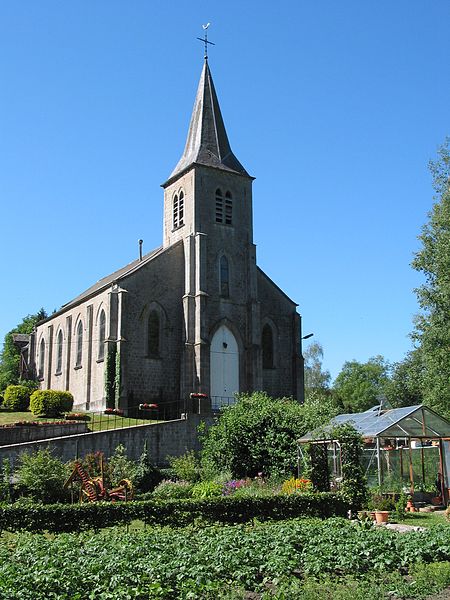
Image by Jean-Pol GRANDAUNT (CC By 3.0)
Lompret, (Belgium), the St Nicolas’ church (1879)
Ordinary Time
All Souls’ Day 2017
The Edge of Elfland
Manchester, New Hampshire
Dearest Readers,
This morning as I briefly made my way through my Facebook feed, I came across an article entitled, “Why You Hate Contemporary Architecture: And if you don’t, why you should…” by Brianna Rennix & Nathan J. Robinson. It was a fascinating, and rather long article that articulated my own misgivings about modern architecture. I was glad to see, in this article, that I was not alone. But what is more, I was happy to see some justifications for my own feelings. This a fantastic article that actually looks at the history of architecture and the way it has been taught to show how and why we have made the shifts we have.
Chief among them, according Rennix and Robinson, is a shift away from beauty. According to Rennix and Robinson, the postwar West had to deal more fully with the brutalities of life and architecture began to reflect this. Life is ugly and our architecture ought not to hide that fact. Ornamentation is bourgeois. Life is brutal and so should our homes and buildings be. Much of this comes from slightly more socialistic sources, but Rennix and Robinson point out that this was not always so. William Morris and his ilk all believed that things in life should be beautiful. And yet, architecture has shifted, capitalism, or so say our authors, and other influences have given us architecture that is either simply bleak and lifeless, or intentionally ugly. Now, Rennix and Robinson have several solutions for this, but before I engage with this I want to turn to an article from several years ago, written by an unlikely source.
Back in December of 2014, His Royal Highness Prince Charles wrote an article outlining, at the end, 10 rules that the modern architect ought to follow. Here are his ten rules:
1 Developments must respect the land. They should not be intrusive; they should be designed to fit within the landscape they occupy.
2 Architecture is a language. We have to abide by the grammatical ground rules, otherwise dissonance and confusion abound. This is why a building code can be so valuable.
3 Scale is also key. Not only should buildings relate to human proportions, they should correspond to the scale of the other buildings and elements around them. Too many of our towns have been spoiled by casually placed, oversized buildings of little distinction that carry no civic meaning.
4 Harmony − the playing together of all parts. The look of each building should be in tune with its neighbours, which does not mean creating uniformity. Richness comes from diversity, as Nature demonstrates, but there must be coherence, which is often achieved by attention to details like the style of door cases, balconies, cornices and railings.
5 The creation of well-designed enclosures. Rather than clusters of separate houses set at jagged angles, spaces that are bounded and enclosed by buildings are not only more visually satisfying, they encourage walking and feel safer.
6 Materials also matter. In the UK, as elsewhere, we have become dependent upon bland, standardized building materials. There is much too much concrete, plastic cladding, aluminium, glass and steel employed, which lends a place no distinctive character. For buildings to look as if they belong, we need to draw on local building materials and regional traditional styles.
7 Signs, lights and utilities. They can be easily overused. We should also bury as many wires as possible and limit signage. A lesson learned from Poundbury is that it is possible to rid the street of nearly all road signs by using ‘events’ like a bend, square or tree every 60-80 metres, which cause drivers to slow down naturally.
8 The pedestrian must be at the centre of the design process. Streets must be reclaimed from the car.
9 Density. Space is at a premium, but we do not have to resort to high-rise tower blocks which alienate and isolate. I believe there are far more communal benefits from terraces and the mansion block. You only have to consider the charm and beauty of a place like Kensington and Chelsea in London to see what I mean. It is often forgotten that this borough is the most densely populated one in London.
10 Flexibility. Rigid, conventional planning and rules of road engineering render all the above instantly null and void, but I have found it is possible to build flexibility into schemes and I am pleased to say that many of the innovations we have tried out in the past 20 years are now reflected in national engineering guidance, such as The Manual For Streets.
I am so fascinated by this list, though I am led to believe that many architects disdained it. Based on the more recent article by Rennix and Robinson, it is no wonder. And yet these principles seem right and to derive from common sense. Buildings should match their surroundings, they should be made for people to live in, work in, use, and observe from the outside. The should be fitting and be beautiful.
These ten points dovetail nicely with the solutions provided by Rennix and Robinson. They suggest overcoming fear (of beauty, ornament, tradition, symmetry, and looking foolish,); to be both complex and simple; to integrate nature; to put feelings over form; to have coherence; and to follow democratic values (as well as to abolish skyscrapers).
The last of these is the most interesting to me, the democratic values, not the “abolition of skyscrapers.” After all, as Rennix and Robinson note, many things are popular that are considered by many bad (the Transformers films, Thomas Kinkade, etc.). But the difference they note is that just because bad things might be popular (Fifty Shades, anyone) doesn’t mean we’re all inflicted with it. No one makes us read bad novels at night, or listen to bad music. But architects, by not following the public voice and desire, do inflict on us bad architecture.
In the end, I am drawn to discussions such as these for they have to do with beauty. And while Rennix and Robinson briefly bracket out the glory of God as the reason for making something (a cathedral for instance) beautiful. As a Catholic, I can recognize that the very reason beauty is subjective is because beauty is knit into the very fabric of reality by the One who is the source of beauty.
Sincerely,
David
The Radical Catholic Reimagination of Everything


Browse Our Archives
Select a Category A Secular Age Advent Apologetics Atheism Beauty Being a Catholic Evangelical Being Catholic Being Deified: Poetry and Fantasy on the Path to God Blogging Book Reviews C. S. Lewis Catholic Imagination Catholic Social Teaching Catholicism Christmas Church Calendar Church Fathers Church Life Community Conferences Cosmology Creation Curdled Words Deification Distributism Easter Economics Education Epiphany Essay Extracts Eucharist Faerie Faeriean Metaphysics Fatherhood Films Folk Liturgy Food and Drink G. K. Chesterton Harry Potter J. R. R. Tolkien Jove King Arthur Language Lent Life Literature and Poetry Liturgy Medieval Theology Music My Publications Mythology On the Edges of Elfland Ordinary Time Ordination Parenthood Parish Patristic Theology Pentecost Politics Prayer Racism Radical Orthodoxy Restoration Movement Sacramental Ontology Saints Science Sex and Sexuality Sophiology Stories The Inklings The Radical Catholic Reimagination of Everything Theologians in the Church Theopoetics Thesis Research Uncategorized University of Nottingham What I'm Reading Writing
Select a Month December 2019 November 2019 October 2019 September 2019 August 2019 July 2019 June 2019 May 2019 April 2019 March 2019 February 2019 January 2019 December 2018 November 2018 October 2018 September 2018 August 2018 July 2018 June 2018 May 2018 April 2018 March 2018 February 2018 January 2018 December 2017 November 2017 October 2017 August 2017 July 2017 June 2017 May 2017 April 2017 March 2017 February 2017 January 2017 December 2016 November 2016 October 2016 September 2016 August 2016 July 2016 June 2016 May 2016 April 2016 March 2016 February 2016 January 2016 December 2015 November 2015 October 2015 September 2015 August 2015 July 2015 June 2015 May 2015 April 2015 March 2015 February 2015 January 2015 December 2014 November 2014 October 2014 September 2014 August 2014 July 2014 June 2014 May 2014 April 2014 March 2014 February 2014 January 2014 December 2013 November 2013 October 2013 September 2013 August 2013 July 2013 June 2013 May 2013 April 2013 March 2013 February 2013 January 2013 December 2012 November 2012 October 2012 September 2012 July 2012
Follow Us!
TAKE THE
Religious Wisdom Quiz
Who became jealous and tried to kill David several times?
Select your answer to see how you score.
Abiathar Saul Samuel Abner
Related posts from Letters from the Edge of Elfland

William Blake on the Creative Spirit, Beauty, and...
Letters from the Edge of Elfland

“Wherefore stopp’st thou me?” Coleridge’s Creative Message to...
Letters from the Edge of Elfland
Letters from the Edge of Elfland

On Walking and Longing for the Woods: A...
Letters from the Edge of Elfland
TRENDING AT PATHEOS Catholic

Rejecting Doom: Christian Hope And Human Action
Christianity is a religion of hope. We are to have hope and...

It’s What Comes From Within Which Matters
One of the most difficult things for us to understand is why...

Why I Choose the Eucharist Over the Sermon
Choose the Eucharist, Not the Sermon What are we supposed to get...

5 Design Elements Found in Spiritually Rooted Homes
Putting Spirituality Into Home Decor Our homes are more than our living...

Credo: A Story of God Told with the...
About 10 years ago, I began to imagine a personal "Credo" that...

The Anatomy of Divine Revelation in Catholic Thought
The claim that God has made Himself known to human beings is...
view all Catholic blogs
Ad-Free & Subscriber Log-In Subscription Support
- About Us
- 2026 Calendar
- Videos
- Podcasts
- Library of World Religions
- Faith In Media Tracker
- Advertise With Us
- Write for Us
- Privacy Policy
- Terms of Service
- Do Not Sell My Data
- Contact Us
- Radiant Digital
- Manage Newsletter Subscriptions
- Unsubscribe From Notifications
- Sitemap
Copyright 2008-2026, Patheos. All rights reserved.
Subscription Support Ad-Free & Subscriber Log-In
Follow Patheos