
BuddhistCatholicContemplativeEvangelicalGeneral ChristianHinduJewishLatter-day SaintMuslimNew VisionsProgressive Christian
Beliefs
- Buddhist
- Catholic
- Contemplative
- Evangelical
- General Christian
- Hindu
- Jewish
- Latter-day Saint
- More Voices
- Muslim
- New Visions
- Pagan
- Progressive Christian
Topics
- Religion News
- Food and Religion
- Sports and Religion
- Religious Art
- Religious Music and Entertainment
- Religious Events
- History and Religion
- Style and Religion
- Politics and Religion
- Women in Religion
- Recreation Outdoors and Religion
- Business Finance and Religion
- Careers Workplace and Religion
- Education and Religion
- Family Parenting and Religion
- Health Fitness and Religion
- Home and Religion
- Relationships and Religion
- Technology and Religion
- Travel and Religion
Columnists
- Buddhist Columnists
- Business Finance and Religion Columnists
- Careers Workplace and Religion Columnists
- Catholic Columnists
- Contemplative Columnists
- Education and Religion Columnists
- Evangelists Columnists
- Family Parenting and Religion Columnists
- General Christian Columnists
- Health Fitness and Religion Columnists
- Hindu Columnists
- History and Religion Columnists
- Home and Religion Columnists
- Jewish Columnists
- More Voices Columnists
- Latter Day Columnists
- Muslim Columnists
- New Visions Columnists
- Nonreligious Columnists
- Pagan Columnists
- Politics and Religion Columnists
- Progressive Columnists
- Recreation Outdoors and Religion Columnists
- Relationships and Religion Columnists
- Religion News Columnists
- Religious Art Columnists
- Religious Events Columnists
- Religious Music and Entertainment Columnists
- Sports and Religion Columnists
- Style and Religion Columnists
- Technology and Religion Columnists
- Travel and Religion Columnists
- Women in Religion Columnists
Resource Library
- 2026 Calendar
- Library of World Religions
- The 100 Most Holy Places on Earth
- Patheos Answers
- Podcasts
- Videos
- Faith Leaders Database
- Anglican Episcopalian
- Bahai
- Baptist
- Buddhism
- Christianity
- Confucianism
- Eastern Orthodoxy
- Hinduism
- Holiness and Pentecostal
- ISKCON
- Islam
- Judaism
- Lutheran
- Methodist
- The Church of Jesus Christ of Latter-day Saints
- New Age
- Paganism
- Presbytarian and Reformed
- Protestantism
- Religion Behind the Scenes
- Roman Catholic
- Scientology
- Shia Islam
- Sikhism
- Sufism
- Sunni Islam
- Taoism
- Zen
- See all religions
Research Tools
 Ad-Free & Subscriber Log-In Subscription Support
Ad-Free & Subscriber Log-In Subscription Support
Follow Patheos 

- Trending:
- Forgiveness
- |
- Marriage
- |
- Consciousness
- |
- Death Penalty
- |
- Election
- |
- Halloween
 Letters from the Edge of Elfland
- Home
- About
- Distributist Resources
- Publications and Presentations
- Support
- Works in Progress
- The Epistolarian Around the Web
- Home
- Catholic
- The Most Important Document of the Modern Age? Humanae Vitae and Rerum Novarum
The Most Important Document of the Modern Age? Humanae Vitae and Rerum Novarum
Last updated on: October 27, 2017 at 9:15 am by David Russell Mosley
The Most Important Document of the Modern Age? Humanae Vitae and Rerum Novarum 2017-10-27T09:15:15-04:00 David Russell Mosley
Patheos Explore the world's faith through different perspectives on religion and spirituality! Patheos has the views of the prevalent religions and spiritualities of the world.
David Russell Mosley
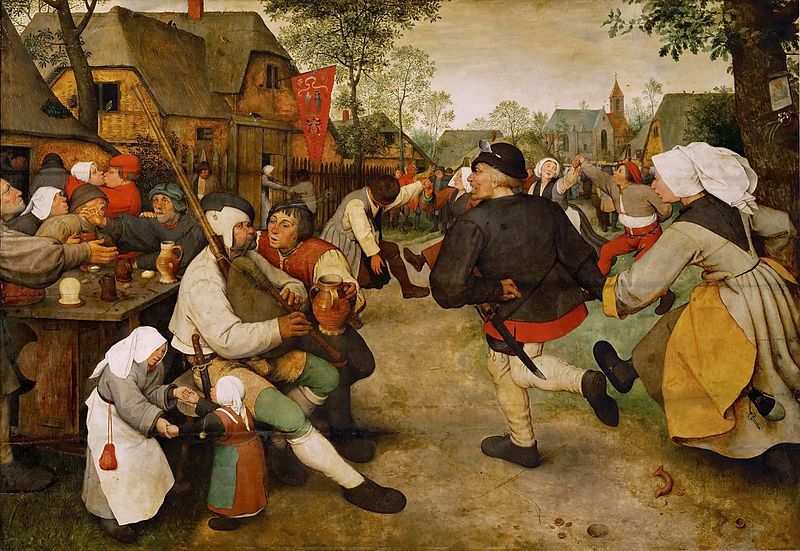
Artist
Pieter Brueghel the Elder (1526/1530–1569)
Title The Peasant Dance
Date circa 1568
Source/Photographer
1. The Yorck Project: 10.000 Meisterwerke der Malerei. DVD-ROM, 2002. ISBN 3936122202. Distributed by DIRECTMEDIA Publishing GmbH.
2. GalleriX
(PD 100, 23)
Ordinary Time
27 October 2017
The Edge of Elfland
Manchester, New Hampshire
Dearest Readers,
A few months back I was invited to go hear a talk. I won’t mention where or precisely when or who was speaking. Since I missed the actual talk itself none of that is particularly pertinent. Nevertheless, the title of lecture had gotten me thinking. It dealt with Humanae Vitae and called it, ” the Most Important Document of Modern Times.” Now, I think this claim in general is a bit of a stretch. After all, since we are still in “modern times” how can we safely agree, let alone be correct in our assessment, even as Catholics, on what is the most important document for modern times. Still, it got me thinking. If I had to pick a “most important document” what would it be? Would I pick from papal encyclicals, maybe a Vatican II document, maybe something else altogether?
Well, the amount of potential choices was overwhelming, so I limited myself to papal documents only, encyclicals in particular, so as to keep in line with the original talk. Once I had made those limitations, the selection was easy: Pope Leo XIII’s Rerum Novarum often also called, On the Condition of the Working Classes. You might perhaps question whether or not this is properly a document for “modern” times since it was written in 1891 and Humanae Vitae was written in 1968. Still, I think my choice is defensible. After all, it is Rerum Novarum and not Humanae Vitae which not only launched a new kind of encyclical, the social encyclical, but it is also the one which has had numerous anniversary encyclicals written about it: Quadragesimo Anno or “On the Fortieth Year” (1931) by Pope Pius XI, Octogesima Adveniens or “On the Eightieth Year” (1971) by Pope Paul VI, and Centesimus Annus or “The One Hundredth Year” (1991) by Pope John Paul II. Then, of course, there is the fact that nearly all the social encyclicals that weren’t direct responses to the anniversary of Rerum Novarum themselves mention and/or cite from Rerum Novarum (the only exceptions being Evangelii Gaudium and Laudato Si’ by Pope Francis).
Then, of course, there is the text itself. Its content is precisely why it has become so popular and so foundational. The pope manages to find a balance between the goods of private property and public solidarity. The whole document is a call for those who hire others to give them just wages so that they may earn enough to support a family and to buy property. And of course, the purpose of buying property is to have land where one can, through frugality and hard work, become more and more self-sufficient. What is more, the text is incredibly pro-family. And while it is true that Rerum Novarum focuses primarily on men as the workers and women as the mistresses of the house, the purpose is not so that women cannot work, but for the good of having someone in the home, for having someone to care for your children. This dynamic is easily translatable to having only wife work and not the husband. For the underlying principle, which we should never forget, is this: a family should be able to support itself and own property on a single income. How foreign is this to modern sensibilities and yet how right should it be? This understanding views the family as central and not work. In this case is neither the father’s nor the mother’s identity found in their work but in their families (and ultimately, of course, in Christ).
And of course, through all of this, the document is neither socialist/communist nor capitalist. It is something else altogether. The rights of the worker are seen as of inherent, even foundational, value as they participate in the notion of the family (even should they be single). On labor and capital, Pope Leo writes, “Each needs the other: capital cannot do without labor, nor labor without capital.”1 Yet on how one uses one’s property, the Pope writes, quoting St. Thomas Aquinas:
‘”Man should not consider his material possessions as his own, but as common to all, so as to share them without hesitation when others are in need. Whence the Apostle with, ‘Command the rich of this world… to offer with no stint, to apportion largely.’”(12) True, no one is commanded to distribute to others that which is required for his own needs and those of his household; nor even to give away what is reasonably required to keep up becomingly his condition in life, “for no one ought to live other than becomingly.”(13) But, when what necessity demands has been supplied, and one’s standing fairly taken thought for, it becomes a duty to give to the indigent out of what remains over. “Of that which remaineth, give alms.”‘2
Of course, there is much more I could say about the content of Rerum Novarum about its impact on Catholic Social Teaching, but the key is this: If we’re going to declare one of the papal encyclicals to be the most important document of modern times I think it must be this one. For it is here that we see the principles laid out for all future Catholic Social Teaching. It is here that we see the preferential treatment for both the poor and the under represented, the marginalized, the oppressed. It is true that this document does not, like Laudato Si‘ focus on the goodness of creation and our need to care for it, but I think it harmonizes well. It is true also that this document does not lay out the rules for sex, but again, the place of the family in it shows us clearly that we ought to build a society of life, not of death. And of course, Rerum Novarum is not a replacement for the Gospel itself. But its foundation is in the Gospel. So, if we’re going to declare a document as most important from and for modern times, I say it should not be 16 page Humanae Vitae (against whose contents I am not arguing), but rather the text that I would argue paved the way for Humanae Vitae: Rerum Novarum.
Sincerely,
David
1 Pope Leo XIII,Rerum novarum [Encyclical on Capital and Labor], Vatican Website, May 15 1891, 19, accessed 14 May 2015, http://w2.vatican.va/content/leo-xiii/en/encyclicals/documents/hf_l-xiii_enc_15051891_rerum-novarum.html.
2 Pope Leo XIII,Rerum novarum [Encyclical on Capital and Labor], Vatican Website, May 15 1891, 22, accessed 14 May 2015, http://w2.vatican.va/content/leo-xiii/en/encyclicals/documents/hf_l-xiii_enc_15051891_rerum-novarum.html.
Next Post

November 2, 2017 Beauty on the Ground: A Call for Beautiful Architecture
Browse Our Archives
Select a Category A Secular Age Advent Apologetics Atheism Beauty Being a Catholic Evangelical Being Catholic Being Deified: Poetry and Fantasy on the Path to God Blogging Book Reviews C. S. Lewis Catholic Imagination Catholic Social Teaching Catholicism Christmas Church Calendar Church Fathers Church Life Community Conferences Cosmology Creation Curdled Words Deification Distributism Easter Economics Education Epiphany Essay Extracts Eucharist Faerie Faeriean Metaphysics Fatherhood Films Folk Liturgy Food and Drink G. K. Chesterton Harry Potter J. R. R. Tolkien Jove King Arthur Language Lent Life Literature and Poetry Liturgy Medieval Theology Music My Publications Mythology On the Edges of Elfland Ordinary Time Ordination Parenthood Parish Patristic Theology Pentecost Politics Prayer Racism Radical Orthodoxy Restoration Movement Sacramental Ontology Saints Science Sex and Sexuality Sophiology Stories The Inklings The Radical Catholic Reimagination of Everything Theologians in the Church Theopoetics Thesis Research Uncategorized University of Nottingham What I'm Reading Writing
Select a Month December 2019 November 2019 October 2019 September 2019 August 2019 July 2019 June 2019 May 2019 April 2019 March 2019 February 2019 January 2019 December 2018 November 2018 October 2018 September 2018 August 2018 July 2018 June 2018 May 2018 April 2018 March 2018 February 2018 January 2018 December 2017 November 2017 October 2017 August 2017 July 2017 June 2017 May 2017 April 2017 March 2017 February 2017 January 2017 December 2016 November 2016 October 2016 September 2016 August 2016 July 2016 June 2016 May 2016 April 2016 March 2016 February 2016 January 2016 December 2015 November 2015 October 2015 September 2015 August 2015 July 2015 June 2015 May 2015 April 2015 March 2015 February 2015 January 2015 December 2014 November 2014 October 2014 September 2014 August 2014 July 2014 June 2014 May 2014 April 2014 March 2014 February 2014 January 2014 December 2013 November 2013 October 2013 September 2013 August 2013 July 2013 June 2013 May 2013 April 2013 March 2013 February 2013 January 2013 December 2012 November 2012 October 2012 September 2012 July 2012
Follow Us!
TAKE THE
Religious Wisdom Quiz
How was the land divided among the tribes of Israel?
Select your answer to see how you score.
By age By strength in battle By family wealth By casting lots
Related posts from Letters from the Edge of Elfland
On Turning 32 During the March for Life...
Letters from the Edge of Elfland

Covington Catholic, Racism, and the March for Life
Letters from the Edge of Elfland
The Catholic Church Has a Geography Problem: Reflections...
Letters from the Edge of Elfland
Chesterton, Dragons, and Cancer: A Reflection on this...
Letters from the Edge of Elfland
TRENDING AT PATHEOS Catholic

The Parable Of The Sower And The Word...
One of Christ’s most famous parables is that of the sower who...

Rejecting Doom: Christian Hope And Human Action
Christianity is a religion of hope. We are to have hope and...

Why I Choose the Eucharist Over the Sermon
Choose the Eucharist, Not the Sermon What are we supposed to get...

5 Design Elements Found in Spiritually Rooted Homes
Putting Spirituality Into Home Decor Our homes are more than our living...

Credo: A Story of God Told with the...
About 10 years ago, I began to imagine a personal "Credo" that...

The Anatomy of Divine Revelation in Catholic Thought
The claim that God has made Himself known to human beings is...
view all Catholic blogs
Ad-Free & Subscriber Log-In Subscription Support
- About Us
- 2026 Calendar
- Videos
- Podcasts
- Library of World Religions
- Faith In Media Tracker
- Advertise With Us
- Write for Us
- Privacy Policy
- Terms of Service
- Do Not Sell My Data
- Contact Us
- Radiant Digital
- Manage Newsletter Subscriptions
- Unsubscribe From Notifications
- Sitemap
Copyright 2008-2026, Patheos. All rights reserved.
Subscription Support Ad-Free & Subscriber Log-In
Follow Patheos