
BuddhistCatholicContemplativeEvangelicalGeneral ChristianHinduJewishLatter-day SaintMuslimNew VisionsProgressive Christian
Beliefs
- Buddhist
- Catholic
- Contemplative
- Evangelical
- General Christian
- Hindu
- Jewish
- Latter-day Saint
- More Voices
- Muslim
- New Visions
- Pagan
- Progressive Christian
Topics
- Religion News
- Food and Religion
- Sports and Religion
- Religious Art
- Religious Music and Entertainment
- Religious Events
- History and Religion
- Style and Religion
- Politics and Religion
- Women in Religion
- Recreation Outdoors and Religion
- Business Finance and Religion
- Careers Workplace and Religion
- Education and Religion
- Family Parenting and Religion
- Health Fitness and Religion
- Home and Religion
- Relationships and Religion
- Technology and Religion
- Travel and Religion
Columnists
- Buddhist Columnists
- Business Finance and Religion Columnists
- Careers Workplace and Religion Columnists
- Catholic Columnists
- Contemplative Columnists
- Education and Religion Columnists
- Evangelists Columnists
- Family Parenting and Religion Columnists
- General Christian Columnists
- Health Fitness and Religion Columnists
- Hindu Columnists
- History and Religion Columnists
- Home and Religion Columnists
- Jewish Columnists
- More Voices Columnists
- Latter Day Columnists
- Muslim Columnists
- New Visions Columnists
- Nonreligious Columnists
- Pagan Columnists
- Politics and Religion Columnists
- Progressive Columnists
- Recreation Outdoors and Religion Columnists
- Relationships and Religion Columnists
- Religion News Columnists
- Religious Art Columnists
- Religious Events Columnists
- Religious Music and Entertainment Columnists
- Sports and Religion Columnists
- Style and Religion Columnists
- Technology and Religion Columnists
- Travel and Religion Columnists
- Women in Religion Columnists
Resource Library
- 2026 Calendar
- Library of World Religions
- The 100 Most Holy Places on Earth
- Patheos Answers
- Podcasts
- Videos
- Faith Leaders Database
- Anglican Episcopalian
- Bahai
- Baptist
- Buddhism
- Christianity
- Confucianism
- Eastern Orthodoxy
- Hinduism
- Holiness and Pentecostal
- ISKCON
- Islam
- Judaism
- Lutheran
- Methodist
- The Church of Jesus Christ of Latter-day Saints
- New Age
- Paganism
- Presbytarian and Reformed
- Protestantism
- Religion Behind the Scenes
- Roman Catholic
- Scientology
- Shia Islam
- Sikhism
- Sufism
- Sunni Islam
- Taoism
- Zen
- See all religions
Research Tools
 Ad-Free & Subscriber Log-In Subscription Support
Ad-Free & Subscriber Log-In Subscription Support
Follow Patheos 

- Trending:
- Forgiveness
- |
- Marriage
- |
- Consciousness
- |
- Death Penalty
- |
- Election
- |
- Halloween
 Letters from the Edge of Elfland
- Home
- About
- Distributist Resources
- Publications and Presentations
- Support
- Works in Progress
- The Epistolarian Around the Web
- Home
- Catholic
- An Uncomfortable Comparison: David Russell Mosley and Tom Riddle
An Uncomfortable Comparison: David Russell Mosley and Tom Riddle
Last updated on: July 3, 2017 at 1:50 pm by David Russell Mosley
An Uncomfortable Comparison: David Russell Mosley and Tom Riddle 2017-07-03T13:50:13-04:00 David Russell Mosley
Patheos Explore the world's faith through different perspectives on religion and spirituality! Patheos has the views of the prevalent religions and spiritualities of the world.
David Russell Mosley
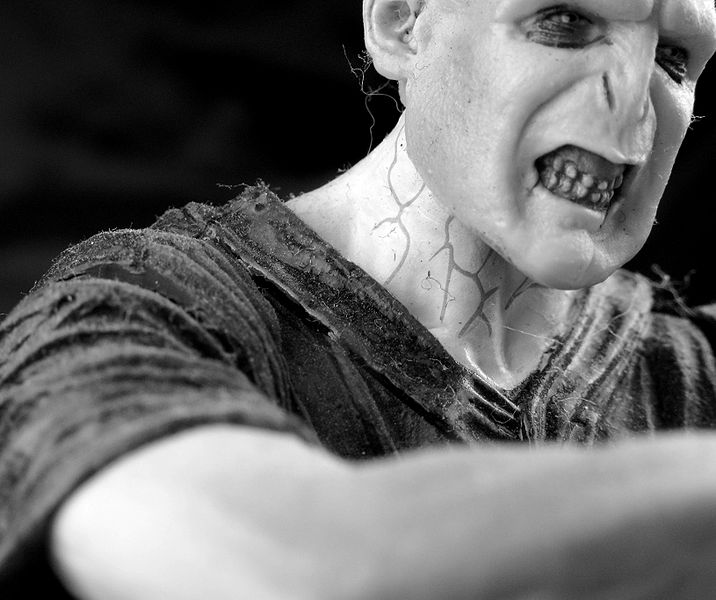
Description
English: A figure of Lord Voldemort made by artist Kevindooley
Español: Figura de Lord Voldemort hecha por el artista Kevindooley
Date 21 August 2008
Source http://www.flickr.com/photos/pagedooley/2783375829/sizes/l/
Author Kevindooley
Permission
Publicado en Flickr con licencia libre
(CC BY 2.0)
Ordinary Time
3 July 2017
The Edge of Elfland
Manchester, New Hampshire
Dearest Readers,
I am, once again, in the midst of my annual read of the Harry Potter series. I’ve reached Harry Potter and the Half-Blood Prince (which I wrote about last year here). Every time I read this book I struck, rather uncomfortably, by certain similarities between myself and boy-Voldemort.
When Dumbledore shows Harry his memory of first meeting ten-year-old Tom Riddle we see not only Voldemort’s nascent secretive and domineering side, but also his desire to be unique. Dumbledore telling him he was a wizard only confirmed what he already knew about himself: that he was special. I am very much afraid that had Dumbledore walked through my door when I was child and told me I was special, I would have believed him in an instant.
I don’t know whether it had to do with being adopted, being raised as an only child (despite having half-siblings and adopted-siblings), but I was always ready to believe there was something different about me. This manifested itself in many ways. For quite some time it manifested itself as hypochondria (not any formal kind). I was always ready to believe that I was ill and with something rare. Maybe it would even kill me and then I’d get to find out what people really thought of me. In Junior High I played the eponymous Tom Sawyer in our production of the musical based on Twain’s famous work. I was always drawn to the funeral scene. I longed to know what people really thought of me; who might be in love with me but unwilling to say it; who regretted being mean to me. Later it led me to contemplate suicide and write about it in notebooks on bus trips. I would leave the notebook open nearby someone, usually a girl, to get her attention and her sympathy. Just as often, this side of my sickness would lead me to rebuff advances to make me feel better. There are images trapped in my brain of the things friends and others (again, mostly girls) would do to try to get my attention, to make me feel better. But these I must leave aside.
The other way this desire to be special manifested itself was through delusions of grandeur (again, not in the formal sense). In elementary school I would imagine a young girl climbing to the top of a jungle-gym–which we, at the height of scatological humor, called The Toilet–she would get stuck or begin to fall and I would courageously run up and catch her. When films like The Lion King came out or when I read certain stories, I would always imagine myself the hero, righting wrongs and wooing women. Later it made me think I was particularly bright, but misunderstood. My stories didn’t win writing competitions in school, but I knew I was a better writer. I always hoped I would get bumped up a grade because I was deemed too smart. The summer between Junior High and High School when the Freshman AP English teacher (Mrs. English) called my house asking me to join her AP class rather than the slightly lower College Entrance had me in a euphoric state for most of the summer. I am sure all of this made me insufferable to both friends and family. Especially since I did, at times anyway excel. Because at times I was, ever so slightly, extraordinary. Thank God Dumbledore never showed up.
And this, I think, is the difference between Harry, Riddle, and myself. Harry needed Hagrid to tell him, not so much that he was special, but that he wasn’t nothing, which is what his Aunt, Uncle, and cousin had essentially taught him. Riddle needed reminding of his commonness. He rejects his birth name both because of its commonality–”There are a lot of Toms” he says at one point–but also because it associates himself with his “common” (albeit rich) muggle father. By having neither Hagrid nor Dumbledore, and by truly failing, I learned the humility Riddle never did and Harry didn’t need to. And so, while like Voldemort I was, and often am, ready to believe that I am different, that I am special, my life has done a decent job of reminding that, thankfully, I am no one particularly special, at least not in comparison to others. All praise be.
Sincerely,
David
Previous Post

June 29, 2017
Root and Twig: Convivium a New Literary Journal

Browse Our Archives
Select a Category A Secular Age Advent Apologetics Atheism Beauty Being a Catholic Evangelical Being Catholic Being Deified: Poetry and Fantasy on the Path to God Blogging Book Reviews C. S. Lewis Catholic Imagination Catholic Social Teaching Catholicism Christmas Church Calendar Church Fathers Church Life Community Conferences Cosmology Creation Curdled Words Deification Distributism Easter Economics Education Epiphany Essay Extracts Eucharist Faerie Faeriean Metaphysics Fatherhood Films Folk Liturgy Food and Drink G. K. Chesterton Harry Potter J. R. R. Tolkien Jove King Arthur Language Lent Life Literature and Poetry Liturgy Medieval Theology Music My Publications Mythology On the Edges of Elfland Ordinary Time Ordination Parenthood Parish Patristic Theology Pentecost Politics Prayer Racism Radical Orthodoxy Restoration Movement Sacramental Ontology Saints Science Sex and Sexuality Sophiology Stories The Inklings The Radical Catholic Reimagination of Everything Theologians in the Church Theopoetics Thesis Research Uncategorized University of Nottingham What I'm Reading Writing
Select a Month December 2019 November 2019 October 2019 September 2019 August 2019 July 2019 June 2019 May 2019 April 2019 March 2019 February 2019 January 2019 December 2018 November 2018 October 2018 September 2018 August 2018 July 2018 June 2018 May 2018 April 2018 March 2018 February 2018 January 2018 December 2017 November 2017 October 2017 August 2017 July 2017 June 2017 May 2017 April 2017 March 2017 February 2017 January 2017 December 2016 November 2016 October 2016 September 2016 August 2016 July 2016 June 2016 May 2016 April 2016 March 2016 February 2016 January 2016 December 2015 November 2015 October 2015 September 2015 August 2015 July 2015 June 2015 May 2015 April 2015 March 2015 February 2015 January 2015 December 2014 November 2014 October 2014 September 2014 August 2014 July 2014 June 2014 May 2014 April 2014 March 2014 February 2014 January 2014 December 2013 November 2013 October 2013 September 2013 August 2013 July 2013 June 2013 May 2013 April 2013 March 2013 February 2013 January 2013 December 2012 November 2012 October 2012 September 2012 July 2012
Follow Us!
TAKE THE
Religious Wisdom Quiz
Who said, "I have been crucified with Christ and I no longer live, but Christ lives in me"?
Select your answer to see how you score.
Paul James Peter John
Related posts from Letters from the Edge of Elfland

Poetry, Podcasts, and More: Some Updates on Other...
Letters from the Edge of Elfland

Working on a Book of Poetry: An Apology...
Letters from the Edge of Elfland

Poetry Shapes the World around Us: Reflecting on...
Letters from the Edge of Elfland
Harry Potter, Demons, and Exorcists: A Follow Up...
Letters from the Edge of Elfland
TRENDING AT PATHEOS Catholic

Rejecting Doom: Christian Hope And Human Action
Christianity is a religion of hope. We are to have hope and...

It’s What Comes From Within Which Matters
One of the most difficult things for us to understand is why...

Why I Choose the Eucharist Over the Sermon
Choose the Eucharist, Not the Sermon What are we supposed to get...

5 Design Elements Found in Spiritually Rooted Homes
Putting Spirituality Into Home Decor Our homes are more than our living...

Credo: A Story of God Told with the...
About 10 years ago, I began to imagine a personal "Credo" that...

The Anatomy of Divine Revelation in Catholic Thought
The claim that God has made Himself known to human beings is...
view all Catholic blogs
Ad-Free & Subscriber Log-In Subscription Support
- About Us
- 2026 Calendar
- Videos
- Podcasts
- Library of World Religions
- Faith In Media Tracker
- Advertise With Us
- Write for Us
- Privacy Policy
- Terms of Service
- Do Not Sell My Data
- Contact Us
- Radiant Digital
- Manage Newsletter Subscriptions
- Unsubscribe From Notifications
- Sitemap
Copyright 2008-2026, Patheos. All rights reserved.
Subscription Support Ad-Free & Subscriber Log-In
Follow Patheos