
BuddhistCatholicContemplativeEvangelicalGeneral ChristianHinduJewishLatter-day SaintMuslimNew VisionsProgressive Christian
Beliefs
- Buddhist
- Catholic
- Contemplative
- Evangelical
- General Christian
- Hindu
- Jewish
- Latter-day Saint
- More Voices
- Muslim
- New Visions
- Pagan
- Progressive Christian
Topics
- Religion News
- Food and Religion
- Sports and Religion
- Religious Art
- Religious Music and Entertainment
- Religious Events
- History and Religion
- Style and Religion
- Politics and Religion
- Women in Religion
- Recreation Outdoors and Religion
- Business Finance and Religion
- Careers Workplace and Religion
- Education and Religion
- Family Parenting and Religion
- Health Fitness and Religion
- Home and Religion
- Relationships and Religion
- Technology and Religion
- Travel and Religion
Columnists
- Buddhist Columnists
- Business Finance and Religion Columnists
- Careers Workplace and Religion Columnists
- Catholic Columnists
- Contemplative Columnists
- Education and Religion Columnists
- Evangelists Columnists
- Family Parenting and Religion Columnists
- General Christian Columnists
- Health Fitness and Religion Columnists
- Hindu Columnists
- History and Religion Columnists
- Home and Religion Columnists
- Jewish Columnists
- More Voices Columnists
- Latter Day Columnists
- Muslim Columnists
- New Visions Columnists
- Nonreligious Columnists
- Pagan Columnists
- Politics and Religion Columnists
- Progressive Columnists
- Recreation Outdoors and Religion Columnists
- Relationships and Religion Columnists
- Religion News Columnists
- Religious Art Columnists
- Religious Events Columnists
- Religious Music and Entertainment Columnists
- Sports and Religion Columnists
- Style and Religion Columnists
- Technology and Religion Columnists
- Travel and Religion Columnists
- Women in Religion Columnists
Resource Library
- 2026 Calendar
- Library of World Religions
- The 100 Most Holy Places on Earth
- Patheos Answers
- Podcasts
- Videos
- Faith Leaders Database
- Anglican Episcopalian
- Bahai
- Baptist
- Buddhism
- Christianity
- Confucianism
- Eastern Orthodoxy
- Hinduism
- Holiness and Pentecostal
- ISKCON
- Islam
- Judaism
- Lutheran
- Methodist
- The Church of Jesus Christ of Latter-day Saints
- New Age
- Paganism
- Presbytarian and Reformed
- Protestantism
- Religion Behind the Scenes
- Roman Catholic
- Scientology
- Shia Islam
- Sikhism
- Sufism
- Sunni Islam
- Taoism
- Zen
- See all religions
Research Tools
 Ad-Free & Subscriber Log-In Subscription Support
Ad-Free & Subscriber Log-In Subscription Support
Follow Patheos 

- Trending:
- Forgiveness
- |
- Marriage
- |
- Consciousness
- |
- Death Penalty
- |
- Election
- |
- Halloween
 Letters from the Edge of Elfland
- Home
- About
- Distributist Resources
- Publications and Presentations
- Support
- Works in Progress
- The Epistolarian Around the Web
- Home
- Catholic
- Trying to Say “God”: After the Conference Part I: Reflections
Trying to Say “God”: After the Conference Part I: Reflections
Last updated on: June 29, 2017 at 2:50 am by David Russell Mosley
Trying to Say “God”: After the Conference Part I: Reflections 2017-06-29T02:50:18-04:00 David Russell Mosley
Patheos Explore the world's faith through different perspectives on religion and spirituality! Patheos has the views of the prevalent religions and spiritualities of the world.
David Russell Mosley
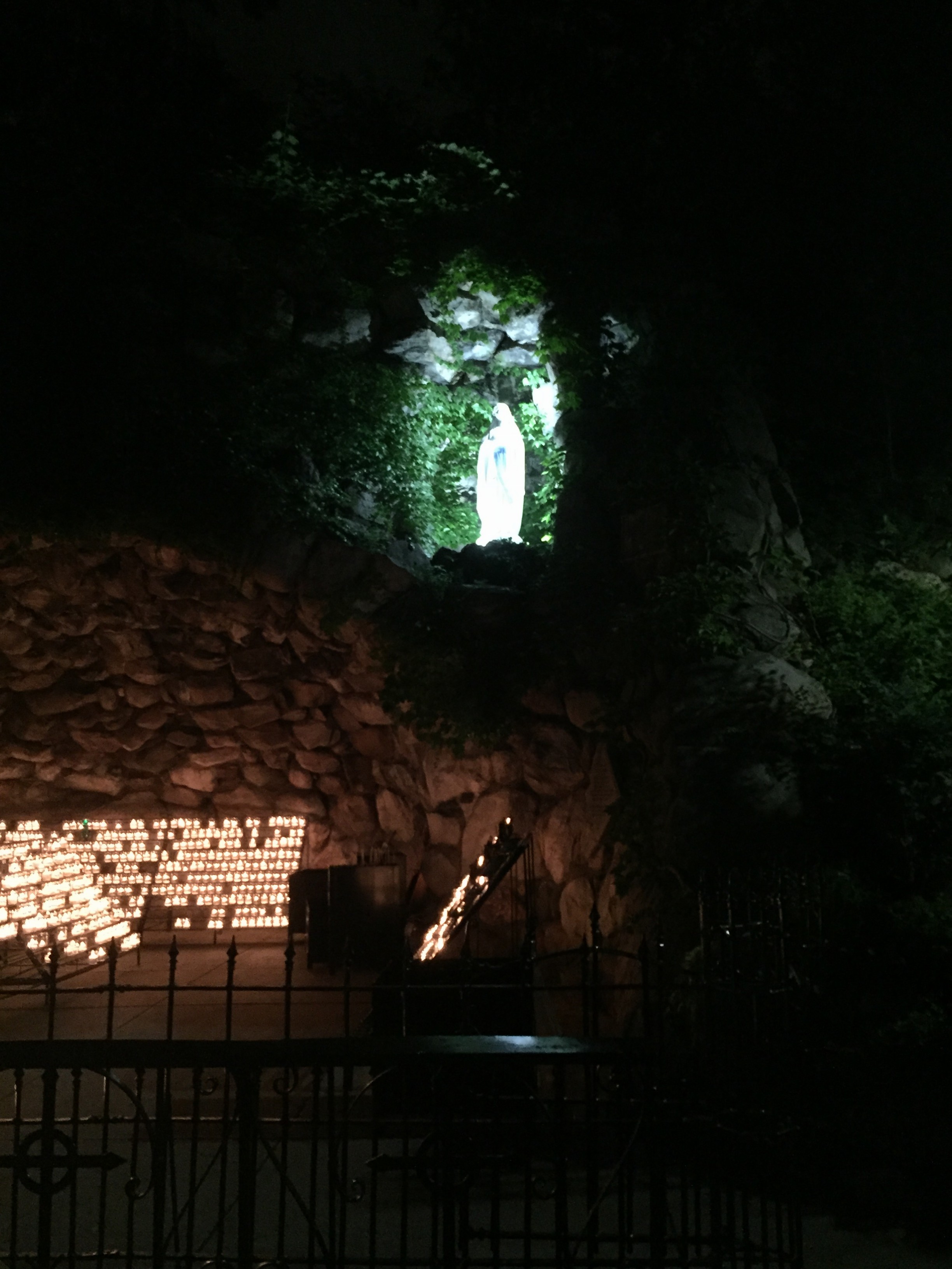
Photo of the Grotto at Notre Dame by David Russell Mosley
Ordinary Time
26 June 2017
The Edge of Elfland
Hudson, New Hampshire
Dear Readers,
I’m not sure I’ve ever stayed up later, laughed more, or generally been happier at a conference than I was at the “Trying to Say ‘God'” conference. This conference was unlike any other I’ve been to. Most of the presentations, including my own, were not papers but true presentations, often by artists. It was not a perfect conference and had its own foibles, especially those attendant to a conference run for and put on by Catholic artists. But still, this conference managed to be both intellectual and practical. It was not simply theologians or philosophers sitting around talking about Catholic literature, but Catholic writers sitting around trying to enact Catholic literature. And this made it worth every penny.
Day 1
On the first day we heard the key note presentation by Bishop Daniel Flores. You can read it (or listen to it) at Sick Pilgrim. The primary point was that the Catholic artist begins in poverty because we write out of our poverty. Words themselves come out of poverty in as much as they participate in the Word who impoverished himself for our sake.
I actually spent most of the first day lost and sweating. But I made it to Mass that evening in the Sacred Heart Basilica at Notre Dame and it was enchanting. I skipped the evening’s plenary, for a number of reasons, but joined everyone at Notre Dame’s grotto for the rosary and to light a candle for private intentions.
Day 2
The next day, for me, was filled with time talking to friends. I’ve learned that conferences need to be customized to, for, and by the individual. If there’s not a panel of special interest to you, it is ok to skip. Still, I heard an interesting paper on how lectio divina can help us learn to read literature more deeply and contemplatively. Later I went to a paper that featured Jonathan Ryan of Sick Pilgrim and Rebecca Bratten Weiss of . They were joined by author John Farrell to talk about vulgarity in religious art. I’ve never heard the f-word so many times in a conference panel. It was glorious. In the afternoon, I listened to Jonathan talk about Weird Fiction, particularly about people such as Andrew Machen and Charles Williams.
That evening I heard Heather King for the first time. I was moved to tears as she talked about being a Catholic artist. Though I will admit I did not always agree with her, since I cannot make her experience my own. After all, I have twin 3 year olds, and they cannot be ignored, not even for the sake of my art. Still, she moved me, and I bought a copy of her book. I even had her sign it as I shamelessly told her about my essay in Convivium since Rebecca had given her a copy. After Heather’s presentation, we heard the sacred music group from Notre Dame. I do not have words to describe how they moved me. That night we had an open mic, to which I added myself late in the game, and read a portion of On the Edges of Elfland with voices to a group of sleepy but attentive artists.
Day 3
The next morning, somehow getting out of bed despite not going to sleep until after 2, I had my continental breakfast and headed to a wonderful panel moderated and brought together by Karl Pearsson and presented by Tim O’Malley, Heather King, Malcom Guite, and Vinita Hampton Wright. They talked about devotional writing “with teeth”. Tim and Malcolm particularly spoke to me as they made sure we understand that not everyone needs a “dark” devotional or loves literary poetry. The others on this panel, however, did an excellent job of reminding us that so many do need something darker. Throughout this panel, I couldn’t help but think, “Saturn gives way to Jove.”
I took a break after that panel and later joined Kevin M. Johnson and Cassidy Hall to hear them talk about the Inner Room and silence. It was a beautiful and practical panel where we actually practised silence (which, we were reminded, is not necessarily the absence of noise but an interior quiet and focus). I needed this panel, for more than I could ever have realized. Later I attended a panel concerned with talking about the body in Catholic writing. The presentations were all different and difficult for me to describe. But the overall message was this: Catholicism is an embodied faith and that must come through in our art.
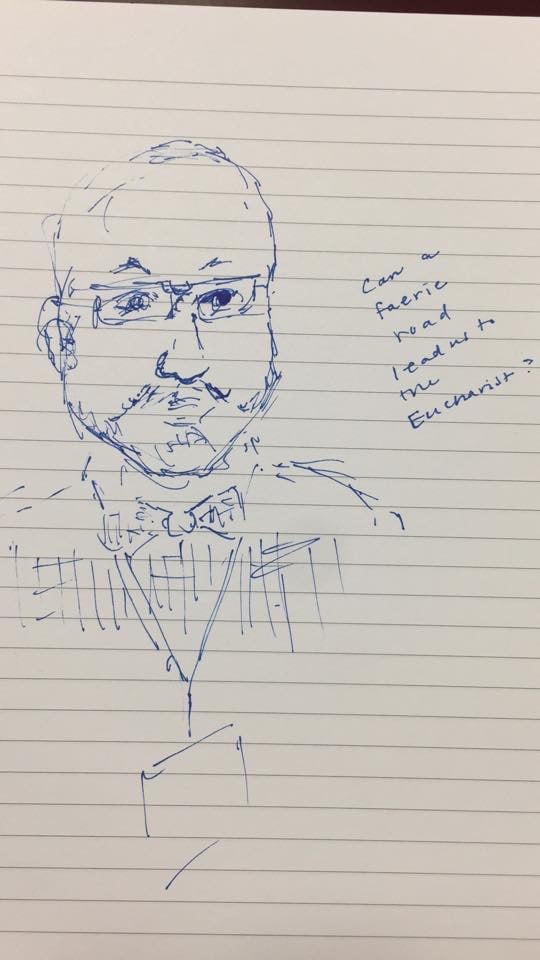
Sketch of me during my presentation by Joanna Penn Cooper
The final set of concurrent sessions was where my panel with Kevin and Jessica Mesman Griffith finally took shape. All of us, I think Jess and I in particular, struggled to prepare for our panel. And yet, something beautiful happened. Perhaps it was simply because we were tired, but we joked and laughed as moved flawlessly from Jess’s personal reflection on looking for magic and rediscovering the Catholic Church, Kevin’s reflections on the epistemological problems of modernity and the need for silence, and my own attempts to talk about sacramental ontology, liturgy, the Eucharist and Faërie. It certainly seems we touched on something important for many in the room that day.
The evening ended for me with Tim Powers and Br. Guy Consolmagno (the director of the Vatican Observatory). I have never laughed so much as I did in Tim Powers’ presentation. Sadly, I didn’t make it to the Sick Pilgrim after party since I had to get up early the next morning for my flight back home.
These short descriptions don’t do justice to this conference. They certainly do no justice to the presentations I heard (or to the ones I didn’t). But more, they cannot convey the spirit of the conference. I cannot convey the laughter I heard as I had drinks and meals with friends I was meeting in person for the first time. They cannot describe the glint I saw in so many eyes as the people at this conference discovered that they are not alone. The hugs, the love, the things extraneous to but made possible by this conference I cannot describe. But I loved it and I cannot wait for the next one in 2019.
Hopefully in the next day or so my panel’s audio will be posted and I’ll share it with you. Until then, make sure you check out the audio from so many of the other panels.
Sincerely,
David
Previous Post
June 21, 2017
Sick Pilgrim and Trying to Say "God": Before the Conference
Browse Our Archives
Select a Category A Secular Age Advent Apologetics Atheism Beauty Being a Catholic Evangelical Being Catholic Being Deified: Poetry and Fantasy on the Path to God Blogging Book Reviews C. S. Lewis Catholic Imagination Catholic Social Teaching Catholicism Christmas Church Calendar Church Fathers Church Life Community Conferences Cosmology Creation Curdled Words Deification Distributism Easter Economics Education Epiphany Essay Extracts Eucharist Faerie Faeriean Metaphysics Fatherhood Films Folk Liturgy Food and Drink G. K. Chesterton Harry Potter J. R. R. Tolkien Jove King Arthur Language Lent Life Literature and Poetry Liturgy Medieval Theology Music My Publications Mythology On the Edges of Elfland Ordinary Time Ordination Parenthood Parish Patristic Theology Pentecost Politics Prayer Racism Radical Orthodoxy Restoration Movement Sacramental Ontology Saints Science Sex and Sexuality Sophiology Stories The Inklings The Radical Catholic Reimagination of Everything Theologians in the Church Theopoetics Thesis Research Uncategorized University of Nottingham What I'm Reading Writing
Select a Month December 2019 November 2019 October 2019 September 2019 August 2019 July 2019 June 2019 May 2019 April 2019 March 2019 February 2019 January 2019 December 2018 November 2018 October 2018 September 2018 August 2018 July 2018 June 2018 May 2018 April 2018 March 2018 February 2018 January 2018 December 2017 November 2017 October 2017 August 2017 July 2017 June 2017 May 2017 April 2017 March 2017 February 2017 January 2017 December 2016 November 2016 October 2016 September 2016 August 2016 July 2016 June 2016 May 2016 April 2016 March 2016 February 2016 January 2016 December 2015 November 2015 October 2015 September 2015 August 2015 July 2015 June 2015 May 2015 April 2015 March 2015 February 2015 January 2015 December 2014 November 2014 October 2014 September 2014 August 2014 July 2014 June 2014 May 2014 April 2014 March 2014 February 2014 January 2014 December 2013 November 2013 October 2013 September 2013 August 2013 July 2013 June 2013 May 2013 April 2013 March 2013 February 2013 January 2013 December 2012 November 2012 October 2012 September 2012 July 2012
Follow Us!
TAKE THE
Religious Wisdom Quiz
Why did Jesus often use parables?
Select your answer to see how you score.
To show off To entertain only To reveal truths to those open to God To confuse listeners
Related posts from Letters from the Edge of Elfland

Poetry, Podcasts, and More: Some Updates on Other...
Letters from the Edge of Elfland

Working on a Book of Poetry: An Apology...
Letters from the Edge of Elfland

Poetry Shapes the World around Us: Reflecting on...
Letters from the Edge of Elfland

William Blake on the Creative Spirit, Beauty, and...
Letters from the Edge of Elfland
TRENDING AT PATHEOS Catholic

The Parable Of The Sower And The Word...
One of Christ’s most famous parables is that of the sower who...

Rejecting Doom: Christian Hope And Human Action
Christianity is a religion of hope. We are to have hope and...

Why I Choose the Eucharist Over the Sermon
Choose the Eucharist, Not the Sermon What are we supposed to get...

5 Design Elements Found in Spiritually Rooted Homes
Putting Spirituality Into Home Decor Our homes are more than our living...

Credo: A Story of God Told with the...
About 10 years ago, I began to imagine a personal "Credo" that...

The Anatomy of Divine Revelation in Catholic Thought
The claim that God has made Himself known to human beings is...
view all Catholic blogs
Ad-Free & Subscriber Log-In Subscription Support
- About Us
- 2026 Calendar
- Videos
- Podcasts
- Library of World Religions
- Faith In Media Tracker
- Advertise With Us
- Write for Us
- Privacy Policy
- Terms of Service
- Do Not Sell My Data
- Contact Us
- Radiant Digital
- Manage Newsletter Subscriptions
- Unsubscribe From Notifications
- Sitemap
Copyright 2008-2026, Patheos. All rights reserved.
Subscription Support Ad-Free & Subscriber Log-In
Follow Patheos