
BuddhistCatholicContemplativeEvangelicalGeneral ChristianHinduJewishLatter-day SaintMuslimNew VisionsProgressive Christian
Beliefs
- Buddhist
- Catholic
- Contemplative
- Evangelical
- General Christian
- Hindu
- Jewish
- Latter-day Saint
- More Voices
- Muslim
- New Visions
- Pagan
- Progressive Christian
Topics
- Religion News
- Food and Religion
- Sports and Religion
- Religious Art
- Religious Music and Entertainment
- Religious Events
- History and Religion
- Style and Religion
- Politics and Religion
- Women in Religion
- Recreation Outdoors and Religion
- Business Finance and Religion
- Careers Workplace and Religion
- Education and Religion
- Family Parenting and Religion
- Health Fitness and Religion
- Home and Religion
- Relationships and Religion
- Technology and Religion
- Travel and Religion
Columnists
- Buddhist Columnists
- Business Finance and Religion Columnists
- Careers Workplace and Religion Columnists
- Catholic Columnists
- Contemplative Columnists
- Education and Religion Columnists
- Evangelists Columnists
- Family Parenting and Religion Columnists
- General Christian Columnists
- Health Fitness and Religion Columnists
- Hindu Columnists
- History and Religion Columnists
- Home and Religion Columnists
- Jewish Columnists
- More Voices Columnists
- Latter Day Columnists
- Muslim Columnists
- New Visions Columnists
- Nonreligious Columnists
- Pagan Columnists
- Politics and Religion Columnists
- Progressive Columnists
- Recreation Outdoors and Religion Columnists
- Relationships and Religion Columnists
- Religion News Columnists
- Religious Art Columnists
- Religious Events Columnists
- Religious Music and Entertainment Columnists
- Sports and Religion Columnists
- Style and Religion Columnists
- Technology and Religion Columnists
- Travel and Religion Columnists
- Women in Religion Columnists
Resource Library
- 2026 Calendar
- Library of World Religions
- The 100 Most Holy Places on Earth
- Patheos Answers
- Podcasts
- Videos
- Faith Leaders Database
- Anglican Episcopalian
- Bahai
- Baptist
- Buddhism
- Christianity
- Confucianism
- Eastern Orthodoxy
- Hinduism
- Holiness and Pentecostal
- ISKCON
- Islam
- Judaism
- Lutheran
- Methodist
- The Church of Jesus Christ of Latter-day Saints
- New Age
- Paganism
- Presbytarian and Reformed
- Protestantism
- Religion Behind the Scenes
- Roman Catholic
- Scientology
- Shia Islam
- Sikhism
- Sufism
- Sunni Islam
- Taoism
- Zen
- See all religions
Research Tools
 Ad-Free & Subscriber Log-In Subscription Support
Ad-Free & Subscriber Log-In Subscription Support
Follow Patheos 

- Trending:
- Forgiveness
- |
- Marriage
- |
- Consciousness
- |
- Death Penalty
- |
- Election
- |
- Halloween
 Letters from the Edge of Elfland
- Home
- About
- Distributist Resources
- Publications and Presentations
- Support
- Works in Progress
- The Epistolarian Around the Web
- Home
- Catholic
- Jove Looking Over My Shoulder: Reflections on the Medieval Cosmos and a Night under the Stars
Jove Looking Over My Shoulder: Reflections on the Medieval Cosmos and a Night under the Stars
Last updated on: June 9, 2017 at 9:00 am by David Russell Mosley
Jove Looking Over My Shoulder: Reflections on the Medieval Cosmos and a Night under the Stars 2017-06-08T13:01:30-04:00 David Russell Mosley
Patheos Explore the world's faith through different perspectives on religion and spirituality! Patheos has the views of the prevalent religions and spiritualities of the world.
David Russell Mosley
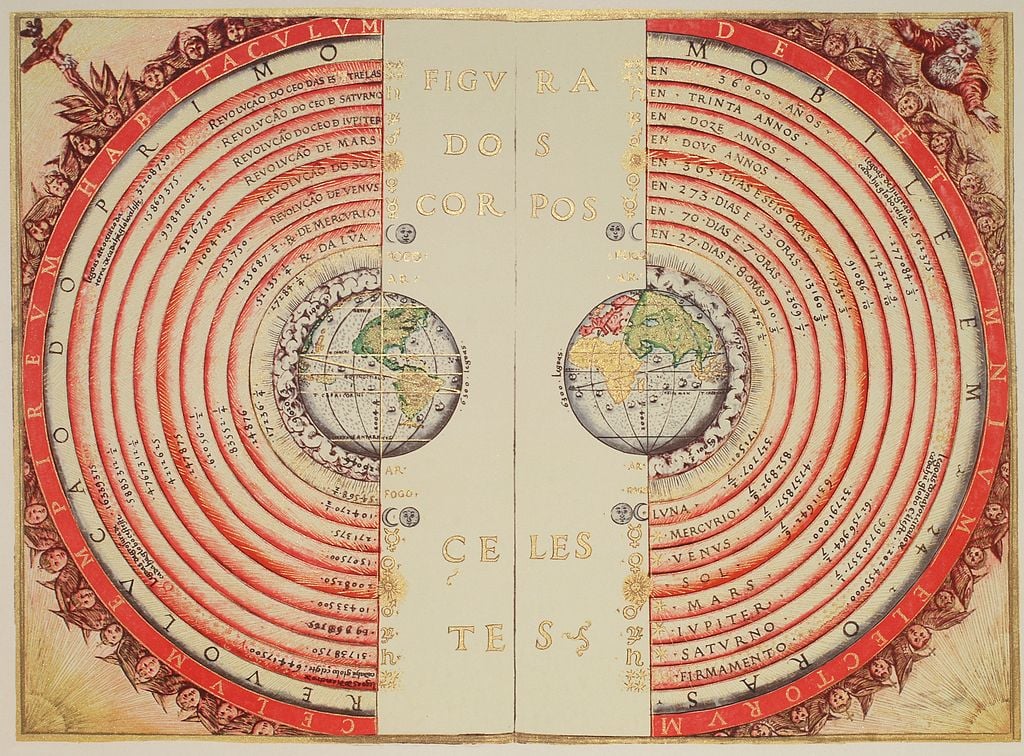
Description
English: Figure of the heavenly bodies – Illuminated illustration of the Ptolemaic geocentric conception of the Universe by Portuguese cosmographer and cartographer Bartolomeu Velho (?-1568). From his work Cosmographia, made in France, 1568 (Bibilotèque nationale de France, Paris). Notice the distances of the bodies to the centre of the Earth (left) and the times of revolution, in years (right). The outermost text says: “The heavenly empire, the dwelling of God and of all of the elect”
Date Original work, 1568. Photo taken in 2008
Source Own work
Author Bartolomeu Velho
Eastertide
9 June 2017
The Edge of Elfland
Hudson, New Hampshire
Dear Readers,
Two nights ago, after a long and hard day, I sat outside with my pipe and my computer under the stars. I’ve been slowly doing some work on Medieval cosmology, which will hopefully pick up if my paper proposal is accepted. Because of this, my night under the stars took on a different flare. Lewis in The Discarded Image recommends that one must take starlit walks in order to truly get inside the mind of our medieval ancestors. He writes:
“You must go out on a starry night and walk about for half an hour trying to see the sky in terms of the old cosmology. Remember that you now have an absolute Up and Down” (DI 98).
Later he writes:
“You must conceive yourself looking up at a world lighted, warmed, and resonant with music” (DI 112).
How different from our modern conceptions of space!
So I sat there, listening to the music of crickets, frogs, and whistlepigs. Suddenly I looked over my shoulder and saw someone looking at me. At first I thought it was Venus. She had been a constant companion in the evenings of the Winter. But a quick check of star charts showed me I was wrong. It was not Venus, but Jove himself, the king. I laughed when I realized my mistake. Luna too was present and nearby. She was full and shone bright. I tried to get pictures of them both, but to little avail.
Then, yesterday, I sat down to read some more Boethius. As I was reading in Book IV, I came across this poem from Lady Philosophy:
‘For I have swift and speedy wings
With which to mount the lofty skies,
And when the mind has put them on
The earth below it will despise:
It mounts the air sublunary
And far behind the clouds it leaves;
It passes through the sphere of fire
Which from the ether heat receives,
Until it rises to the stars,
Where Phoebus there to join its ways,
Or said with cold and ancient Saturn
As soldier of his shining rays.
Wherever night is spangled bright
The orbit of a star it takes,
And when the orbit’s path is done
The outmost pole of heaven forsakes.
It treads beneath the speeding ether
Possessing now the holy light,
For here the King of kings holds sway,
The reins of all things holding tight,
Unmoving moves the chariot fast,
The lord of all things shining bright.
If there the pathway brings you back –
The path you lost and seek anew –
Then, “I remember,” you will say,
“My home, my source, my ending too.”
And if you choose to seek again
The lightless earth which you have left,
Dictators whom the people fear,
Will outcasts seem of home bereft.’
I could perhaps spend many letters unpacking this poem. But for now, I want to focus on one aspect in particular. The poem concerns the soul’s ascent to God. First in passes through the sublunary spheres (that is, everything below the moon) and then passes through the heavenly spheres. Of course, we must remember that for Boethius, everything beyond the moon was perfect, in capable of corruption, though capable of movement. But once you get beyond the spheres, you reach what Dante calls the Empyrion, the final sphere, which is the mind of God. Here, we discover, implicitly in Boethius and explicitly in Dante, that the cosmos is inverted. From our sublunary perspective, it appears that the Earth is the center of things (which, of course, is actually very bad for us since it also means we’re the bottom and capable of corruption). However, as the soul ascends to God we realize, that God is the source of light and thus the true center of the cosmos. It is a kind of exitus and reditus. We exit out from earth and reach God only to discover that rather than having left the center of the universe, we have come into it. As the universe is inverted, and we see the Earth as the lightless planet furthest from the center, we take that light back with us.
Lady Philosophy is helping Boethius understand why it appears that the wicked have so much power and do so well on Earth. It is because our perspective is off. Dictators and other wicked, but seemingly powerful men, do not belong here. Or more, they do, insofar as the Earth stands as that place furthest from God, because they do not recognize that their true home resides in God. It is a matter of perspective, that once righted (by ascending to God and returning to Earth) shines a new light on all that we experience in the sublunary sphere.
And so, I look forward to more nights with Jove looking over my shoulder. He shines brightly to remind me that the true center of the cosmos is the mind of God which both contains all the created spheres as if it were the largest sphere of all and yet is the center from which all the spheres spin out. In the end, the medieval cosmos, and our own, is theocentric.
Sincerely,
David
The Radical Catholic Reimagination of Everything
Previous Post
June 8, 2017
I Am Not a Convert: Reflections on Becoming Catholic
Next Post

June 10, 2017 Celebrating My One Year Anniversary with Patheos Catholic
Browse Our Archives
Select a Category A Secular Age Advent Apologetics Atheism Beauty Being a Catholic Evangelical Being Catholic Being Deified: Poetry and Fantasy on the Path to God Blogging Book Reviews C. S. Lewis Catholic Imagination Catholic Social Teaching Catholicism Christmas Church Calendar Church Fathers Church Life Community Conferences Cosmology Creation Curdled Words Deification Distributism Easter Economics Education Epiphany Essay Extracts Eucharist Faerie Faeriean Metaphysics Fatherhood Films Folk Liturgy Food and Drink G. K. Chesterton Harry Potter J. R. R. Tolkien Jove King Arthur Language Lent Life Literature and Poetry Liturgy Medieval Theology Music My Publications Mythology On the Edges of Elfland Ordinary Time Ordination Parenthood Parish Patristic Theology Pentecost Politics Prayer Racism Radical Orthodoxy Restoration Movement Sacramental Ontology Saints Science Sex and Sexuality Sophiology Stories The Inklings The Radical Catholic Reimagination of Everything Theologians in the Church Theopoetics Thesis Research Uncategorized University of Nottingham What I'm Reading Writing
Select a Month December 2019 November 2019 October 2019 September 2019 August 2019 July 2019 June 2019 May 2019 April 2019 March 2019 February 2019 January 2019 December 2018 November 2018 October 2018 September 2018 August 2018 July 2018 June 2018 May 2018 April 2018 March 2018 February 2018 January 2018 December 2017 November 2017 October 2017 August 2017 July 2017 June 2017 May 2017 April 2017 March 2017 February 2017 January 2017 December 2016 November 2016 October 2016 September 2016 August 2016 July 2016 June 2016 May 2016 April 2016 March 2016 February 2016 January 2016 December 2015 November 2015 October 2015 September 2015 August 2015 July 2015 June 2015 May 2015 April 2015 March 2015 February 2015 January 2015 December 2014 November 2014 October 2014 September 2014 August 2014 July 2014 June 2014 May 2014 April 2014 March 2014 February 2014 January 2014 December 2013 November 2013 October 2013 September 2013 August 2013 July 2013 June 2013 May 2013 April 2013 March 2013 February 2013 January 2013 December 2012 November 2012 October 2012 September 2012 July 2012
Follow Us!
TAKE THE
Religious Wisdom Quiz
True or False: Nehemiah rebuilt the walls of Jerusalem in 52 days.
Select your answer to see how you score.
FALSE TRUE
Related posts from Letters from the Edge of Elfland

William Blake on the Creative Spirit, Beauty, and...
Letters from the Edge of Elfland
The Earth, Our Mother, and the Amazonian Synod
Letters from the Edge of Elfland

“Wherefore stopp’st thou me?” Coleridge’s Creative Message to...
Letters from the Edge of Elfland
C.S. Lewis's Cosmic Turn: Finding Virtue through the...
Letters from the Edge of Elfland
TRENDING AT PATHEOS Catholic

The Parable Of The Sower And The Word...
One of Christ’s most famous parables is that of the sower who...

Rejecting Doom: Christian Hope And Human Action
Christianity is a religion of hope. We are to have hope and...

Why I Choose the Eucharist Over the Sermon
Choose the Eucharist, Not the Sermon What are we supposed to get...

5 Design Elements Found in Spiritually Rooted Homes
Putting Spirituality Into Home Decor Our homes are more than our living...

Credo: A Story of God Told with the...
About 10 years ago, I began to imagine a personal "Credo" that...

The Anatomy of Divine Revelation in Catholic Thought
The claim that God has made Himself known to human beings is...
view all Catholic blogs
Ad-Free & Subscriber Log-In Subscription Support
- About Us
- 2026 Calendar
- Videos
- Podcasts
- Library of World Religions
- Faith In Media Tracker
- Advertise With Us
- Write for Us
- Privacy Policy
- Terms of Service
- Do Not Sell My Data
- Contact Us
- Radiant Digital
- Manage Newsletter Subscriptions
- Unsubscribe From Notifications
- Sitemap
Copyright 2008-2026, Patheos. All rights reserved.
Subscription Support Ad-Free & Subscriber Log-In
Follow Patheos