
BuddhistCatholicContemplativeEvangelicalGeneral ChristianHinduJewishLatter-day SaintMuslimNew VisionsProgressive Christian
Beliefs
- Buddhist
- Catholic
- Contemplative
- Evangelical
- General Christian
- Hindu
- Jewish
- Latter-day Saint
- More Voices
- Muslim
- New Visions
- Pagan
- Progressive Christian
Topics
- Religion News
- Food and Religion
- Sports and Religion
- Religious Art
- Religious Music and Entertainment
- Religious Events
- History and Religion
- Style and Religion
- Politics and Religion
- Women in Religion
- Recreation Outdoors and Religion
- Business Finance and Religion
- Careers Workplace and Religion
- Education and Religion
- Family Parenting and Religion
- Health Fitness and Religion
- Home and Religion
- Relationships and Religion
- Technology and Religion
- Travel and Religion
Columnists
- Buddhist Columnists
- Business Finance and Religion Columnists
- Careers Workplace and Religion Columnists
- Catholic Columnists
- Contemplative Columnists
- Education and Religion Columnists
- Evangelists Columnists
- Family Parenting and Religion Columnists
- General Christian Columnists
- Health Fitness and Religion Columnists
- Hindu Columnists
- History and Religion Columnists
- Home and Religion Columnists
- Jewish Columnists
- More Voices Columnists
- Latter Day Columnists
- Muslim Columnists
- New Visions Columnists
- Nonreligious Columnists
- Pagan Columnists
- Politics and Religion Columnists
- Progressive Columnists
- Recreation Outdoors and Religion Columnists
- Relationships and Religion Columnists
- Religion News Columnists
- Religious Art Columnists
- Religious Events Columnists
- Religious Music and Entertainment Columnists
- Sports and Religion Columnists
- Style and Religion Columnists
- Technology and Religion Columnists
- Travel and Religion Columnists
- Women in Religion Columnists
Resource Library
- 2026 Calendar
- Library of World Religions
- The 100 Most Holy Places on Earth
- Patheos Answers
- Podcasts
- Videos
- Faith Leaders Database
- Anglican Episcopalian
- Bahai
- Baptist
- Buddhism
- Christianity
- Confucianism
- Eastern Orthodoxy
- Hinduism
- Holiness and Pentecostal
- ISKCON
- Islam
- Judaism
- Lutheran
- Methodist
- The Church of Jesus Christ of Latter-day Saints
- New Age
- Paganism
- Presbytarian and Reformed
- Protestantism
- Religion Behind the Scenes
- Roman Catholic
- Scientology
- Shia Islam
- Sikhism
- Sufism
- Sunni Islam
- Taoism
- Zen
- See all religions
Research Tools
 Ad-Free & Subscriber Log-In Subscription Support
Ad-Free & Subscriber Log-In Subscription Support
Follow Patheos 

- Trending:
- Forgiveness
- |
- Marriage
- |
- Consciousness
- |
- Death Penalty
- |
- Election
- |
- Halloween
 Letters from the Edge of Elfland
- Home
- About
- Distributist Resources
- Publications and Presentations
- Support
- Works in Progress
- The Epistolarian Around the Web
- Home
- Catholic
- The World of Patrick’s Breastplate: Seeing through the Eyes of a Medieval Prayer
The World of Patrick’s Breastplate: Seeing through the Eyes of a Medieval Prayer
Last updated on: March 18, 2017 at 11:53 am by David Russell Mosley
The World of Patrick’s Breastplate: Seeing through the Eyes of a Medieval Prayer 2017-03-18T11:53:18-04:00 David Russell Mosley
Patheos Explore the world's faith through different perspectives on religion and spirituality! Patheos has the views of the prevalent religions and spiritualities of the world.
La version en noir & blanc connue est dans Camille Flammarion (1842-1925).- L’atmosphère : météorologie populaire, Hachette, Paris, 1888, p. 163
Author Heikenwaelder Hugo, Austria, Email : [email protected], www.heikenwaelder.at, CC BY-SA 2.5I arise today
Through the strength of heaven;
Light of sun,
Radiance of moon,
Splendour of fire,
Speed of lightning,
Swiftness of wind,
Depth of sea,
Stability of earth,
Firmness of rock.
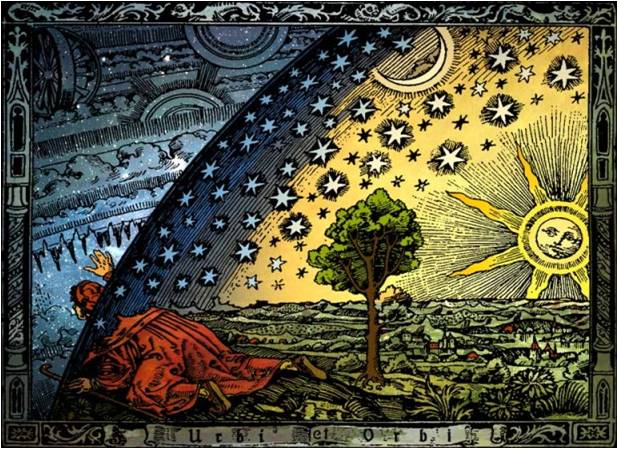
This stanza connects us to the rest of creation. While animals are not mentioned here, we still see that everything from sun to rocks is part of the strength through which we arise today. This is something we normally see as emblematic of “Celtic Christianity” that it is important to stop and remember that this simply good Christian theology. God pervades all of reality; he upholds and sustains it. These things by virtue of their existence (and thus their truth, goodness, and beauty) participate in God who is the source of all existence. Thus can we pray by them or with them and they can contribute (I think actively) to the strength by which we arise today.
I arise today
Through God’s strength to pilot me:
God’s might to uphold me.
God’s wisdom to guide me,
God’s eye to look before me,
God’s ear to hear me,
God’s word to speak to me,
God’s hand to guard me,
God’s way to lie before me,
God’s shield to protect me
From snares of devils,
From temptation of vices,
From everyone who shall wish me ill,
Afar and anear,
Alone and in multitude.
Here we begin a more explicit lorica section. Before we have been arising in the strength of God and creation. Now we are asking for direction and protection. I think it possible to read this section as a reference to the Holy Spirit, but it is not explicit. More important is the belief that both devils (and I think here vices ought to be read as personal beings, as a category of devil) and humans will seek to harm us and that we need God’s protection from them. Even more interesting is the implicit belief that humans can, in some way, cause us harm from which we might need protection from a distance. That is, this prayer is not exclusively concerned with protection from harm of people right in front us, but from far away, implying both physical and spiritual hurts can be dispensed from a distance.
I summon today all these powers between me and those evils,
Against every cruel merciless power that may oppose my body and soul,
Against incantations of false prophets,
Against black laws of pagandom,
Against false laws of heretics,
Against craft of idolatry,
Against spells of women and smiths and wizards,
Against every knowledge that corrupts man’s body and soul.
I take “these powers” to mean all the things in whose (or through whose) strength we have arisen today. Again here we see something of the world this author inhabited. This is a world of “magic,” a world where those who align themselves with the devils (whether implicitly or explicitly) can have real effects on my person. Here we can see something of Taylor’s “porous self.” These people are permeable and may do harm to me body or soul. And so the author of this prayer invokes God and his creation (insofar as it participates in him) to protect us from those who pervert God’s creation. You can see that this conception of evil is that of perversion or privation in the way it inverts many of the categories from the third stanza (interestingly this is the sixth stanza). We prophets in both, I think the pagandom reference ought to refer us back to the patriarchs (those who followed God before the incarnation); heretics to the apostles (those who established, not perverted, the faith; idolatry to the confessors (those who died rather than worship idols); and women, smiths, and wizards to the innocent virgins and righteous men.
Christ to shield me today,
Against poisoning, against burning,
Against drowning, against wounding,
So there come to me abundance of reward.
Christ with me, Christ before me, Christ behind me,
Christ in me, Christ beneath me, Christ above me,
Christ on my right, Christ on my left,
Christ when I lied down, Christ when I sit down,
Christ when I arise, Christ in the heart of every man who thinks of me,
Christ in the mouth of every one who speaks of me,
Christ in the eye of every one who sees me,
Christ in every ear that hears me.
Here we get to the proper shielding. Christ is invoked to pervade our entire life. To protect us from natural hurts inflicted by creation in general or humans in particular (but hurts, it would seem of a rather mundane kind as opposed to those listed in the preceding stanza). Christ is invoked to be where he already is, namely everywhere. I also see something evangelistic in the prayer that Christ be in the mind, eye, mouth, and ear of everyone who encounters the one who prays. While obviously some of this is so that the pray-er is protected, I cannot help but think some of it has to do with the hope of salvation for the one who is being prayed about.
I arise today
Through a mighty strength, the invocation of the Trinity,
Through belief in the threeness,
Through confession of the oneness
Of the Creator of Creation.
And so the prayer ends where it began, with an invocation of the Trinity. Reminding us again that God is the beginning, middle, and end of all things, not least of which is our lives.
The world of “The Lorica” is one, as Gerard Manley Hopkins would say, that is “charged with the grandeur of God.” The Holy Trinity pervades every aspect not only of our lives but of both immaterial and material creation. He can protect us (unless he wills otherwise) from the hurts of those who pervert his creation. He is in and around us everywhere. And he can be met in anyone. I think we ought to take this prayer as a challenge. It ought to challenge us to see the world a little differently. Not as simply divided between natural and supernatural, but as pervaded, as intertwined with God and with immaterial creation. I hope too that it will be effective, that praying this prayer will help protect us as it teaches us too.
Sincerely,
David
The Radical Catholic Reimagination of Everything
Previous Post
March 15, 2017
Michael Martin Discusses the Sophia Option
Next Post
March 22, 2017 Mooreeffoc: Reflections on Words and Worlds while Reading in a Coffeeshop
Browse Our Archives
Select a Category A Secular Age Advent Apologetics Atheism Beauty Being a Catholic Evangelical Being Catholic Being Deified: Poetry and Fantasy on the Path to God Blogging Book Reviews C. S. Lewis Catholic Imagination Catholic Social Teaching Catholicism Christmas Church Calendar Church Fathers Church Life Community Conferences Cosmology Creation Curdled Words Deification Distributism Easter Economics Education Epiphany Essay Extracts Eucharist Faerie Faeriean Metaphysics Fatherhood Films Folk Liturgy Food and Drink G. K. Chesterton Harry Potter J. R. R. Tolkien Jove King Arthur Language Lent Life Literature and Poetry Liturgy Medieval Theology Music My Publications Mythology On the Edges of Elfland Ordinary Time Ordination Parenthood Parish Patristic Theology Pentecost Politics Prayer Racism Radical Orthodoxy Restoration Movement Sacramental Ontology Saints Science Sex and Sexuality Sophiology Stories The Inklings The Radical Catholic Reimagination of Everything Theologians in the Church Theopoetics Thesis Research Uncategorized University of Nottingham What I'm Reading Writing
Select a Month December 2019 November 2019 October 2019 September 2019 August 2019 July 2019 June 2019 May 2019 April 2019 March 2019 February 2019 January 2019 December 2018 November 2018 October 2018 September 2018 August 2018 July 2018 June 2018 May 2018 April 2018 March 2018 February 2018 January 2018 December 2017 November 2017 October 2017 August 2017 July 2017 June 2017 May 2017 April 2017 March 2017 February 2017 January 2017 December 2016 November 2016 October 2016 September 2016 August 2016 July 2016 June 2016 May 2016 April 2016 March 2016 February 2016 January 2016 December 2015 November 2015 October 2015 September 2015 August 2015 July 2015 June 2015 May 2015 April 2015 March 2015 February 2015 January 2015 December 2014 November 2014 October 2014 September 2014 August 2014 July 2014 June 2014 May 2014 April 2014 March 2014 February 2014 January 2014 December 2013 November 2013 October 2013 September 2013 August 2013 July 2013 June 2013 May 2013 April 2013 March 2013 February 2013 January 2013 December 2012 November 2012 October 2012 September 2012 July 2012
Follow Us!
TAKE THE
Religious Wisdom Quiz
I saw the Lord seated on a throne, high and exalted, while six-winged beings called out 'Holy, holy, holy.' What were these creatures?
Select your answer to see how you score.
Cherubim Angels Leviathan Seraphim
Related posts from Letters from the Edge of Elfland

William Blake on the Creative Spirit, Beauty, and...
Letters from the Edge of Elfland

“Wherefore stopp’st thou me?” Coleridge’s Creative Message to...
Letters from the Edge of Elfland
Good Morning, Mr. Magpie: On Folklore and Science
Letters from the Edge of Elfland
Letters from the Edge of Elfland
TRENDING AT PATHEOS Catholic

The Parable Of The Sower And The Word...
One of Christ’s most famous parables is that of the sower who...

Rejecting Doom: Christian Hope And Human Action
Christianity is a religion of hope. We are to have hope and...

Why I Choose the Eucharist Over the Sermon
Choose the Eucharist, Not the Sermon What are we supposed to get...

5 Design Elements Found in Spiritually Rooted Homes
Putting Spirituality Into Home Decor Our homes are more than our living...

Credo: A Story of God Told with the...
About 10 years ago, I began to imagine a personal "Credo" that...

The Anatomy of Divine Revelation in Catholic Thought
The claim that God has made Himself known to human beings is...
view all Catholic blogs
Ad-Free & Subscriber Log-In Subscription Support
- About Us
- 2026 Calendar
- Videos
- Podcasts
- Library of World Religions
- Faith In Media Tracker
- Advertise With Us
- Write for Us
- Privacy Policy
- Terms of Service
- Do Not Sell My Data
- Contact Us
- Radiant Digital
- Manage Newsletter Subscriptions
- Unsubscribe From Notifications
- Sitemap
Copyright 2008-2026, Patheos. All rights reserved.
Subscription Support Ad-Free & Subscriber Log-In
Follow Patheos