
BuddhistCatholicContemplativeEvangelicalGeneral ChristianHinduJewishLatter-day SaintMuslimNew VisionsProgressive Christian
Beliefs
- Buddhist
- Catholic
- Contemplative
- Evangelical
- General Christian
- Hindu
- Jewish
- Latter-day Saint
- More Voices
- Muslim
- New Visions
- Pagan
- Progressive Christian
Topics
- Religion News
- Food and Religion
- Sports and Religion
- Religious Art
- Religious Music and Entertainment
- Religious Events
- History and Religion
- Style and Religion
- Politics and Religion
- Women in Religion
- Recreation Outdoors and Religion
- Business Finance and Religion
- Careers Workplace and Religion
- Education and Religion
- Family Parenting and Religion
- Health Fitness and Religion
- Home and Religion
- Relationships and Religion
- Technology and Religion
- Travel and Religion
Columnists
- Buddhist Columnists
- Business Finance and Religion Columnists
- Careers Workplace and Religion Columnists
- Catholic Columnists
- Contemplative Columnists
- Education and Religion Columnists
- Evangelists Columnists
- Family Parenting and Religion Columnists
- General Christian Columnists
- Health Fitness and Religion Columnists
- Hindu Columnists
- History and Religion Columnists
- Home and Religion Columnists
- Jewish Columnists
- More Voices Columnists
- Latter Day Columnists
- Muslim Columnists
- New Visions Columnists
- Nonreligious Columnists
- Pagan Columnists
- Politics and Religion Columnists
- Progressive Columnists
- Recreation Outdoors and Religion Columnists
- Relationships and Religion Columnists
- Religion News Columnists
- Religious Art Columnists
- Religious Events Columnists
- Religious Music and Entertainment Columnists
- Sports and Religion Columnists
- Style and Religion Columnists
- Technology and Religion Columnists
- Travel and Religion Columnists
- Women in Religion Columnists
Resource Library
- 2026 Calendar
- Library of World Religions
- The 100 Most Holy Places on Earth
- Patheos Answers
- Podcasts
- Videos
- Faith Leaders Database
- Anglican Episcopalian
- Bahai
- Baptist
- Buddhism
- Christianity
- Confucianism
- Eastern Orthodoxy
- Hinduism
- Holiness and Pentecostal
- ISKCON
- Islam
- Judaism
- Lutheran
- Methodist
- The Church of Jesus Christ of Latter-day Saints
- New Age
- Paganism
- Presbytarian and Reformed
- Protestantism
- Religion Behind the Scenes
- Roman Catholic
- Scientology
- Shia Islam
- Sikhism
- Sufism
- Sunni Islam
- Taoism
- Zen
- See all religions
Research Tools
 Ad-Free & Subscriber Log-In Subscription Support
Ad-Free & Subscriber Log-In Subscription Support
Follow Patheos 

- Trending:
- Forgiveness
- |
- Marriage
- |
- Consciousness
- |
- Death Penalty
- |
- Election
- |
- Halloween
 Letters from the Edge of Elfland
- Home
- About
- Distributist Resources
- Publications and Presentations
- Support
- Works in Progress
- The Epistolarian Around the Web
- Home
- Catholic
- The Unity of Truth, Goodness, and Beauty, Or Is Judas the Original Social Justice Warrior?
The Unity of Truth, Goodness, and Beauty, Or Is Judas the Original Social Justice Warrior?
Last updated on: March 14, 2017 at 9:00 am by David Russell Mosley
The Unity of Truth, Goodness, and Beauty, Or Is Judas the Original Social Justice Warrior? 2017-03-13T21:15:10-04:00 David Russell Mosley
Patheos Explore the world's faith through different perspectives on religion and spirituality! Patheos has the views of the prevalent religions and spiritualities of the world.
David Russell Mosley
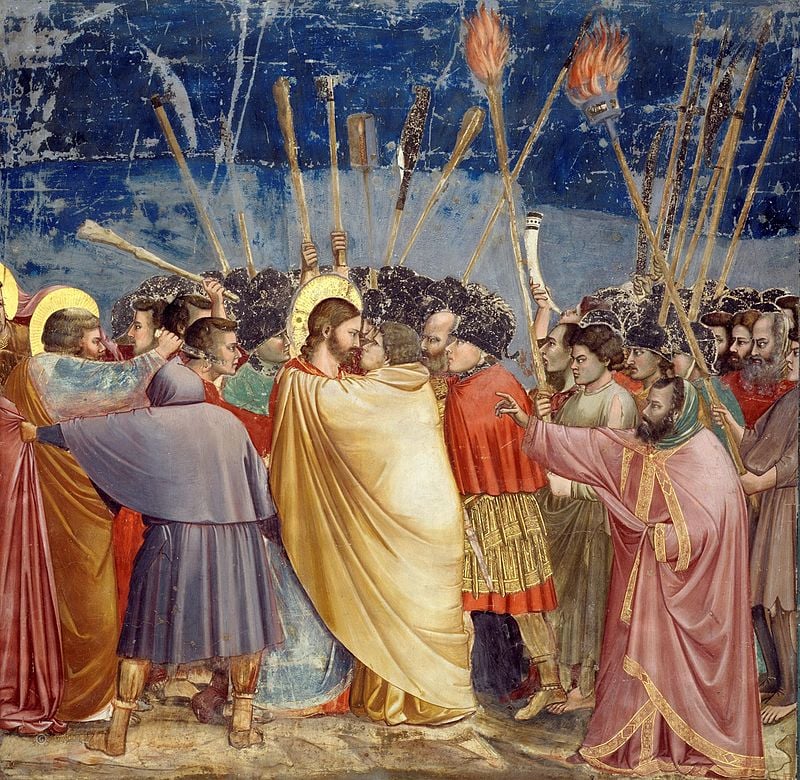
Artist
Giotto (1266–1337)
Title The Arrest of Christ (Kiss of Judas)
Description
English: No. 31 Scenes from the Life of Christ: 15.
The disciple on the left, who wounds a soldier with his knife, is Saint Peter.
Date between 1304 and 1306
(Public Domain)
Ordinary Time
14 March 2017
The Edge of Elfland
Hudson, New Hampshire
Dear Readers,
About a month ago over at the Lepanto Institute Facebook page, a meme was posted. You can see it here. It pictures an almost offensively stereotypically Jewish Judas kissing a rather European looking Jesus. At the top in ominous, red letters it says, Judas Iscariot; at the bottom (oddly in white), Patron Saint of Social Justice. Scot Eric Alt and Mary Pezzulo adequately explained and criticized this: “Lepanto Institute Meme Attempts to Link Social Justice to Judas Iscariot,” “The Lepanto Institute and the Sin of Judas,” and “Lepanto Institute Under Malicious Attack by Evil “Social Justice Warriors”!”
I thought things were done, then I cam across this piece by Steven Skojec over at 1Peter5 (an odd, to me, Catholic site). Skojec describes Pope Francis as wearing some kind of mask (as if, perhaps, he’s really just a front for a demon and the Devil/Antichrist really now is the Pope in Rome as so many of my fundamentalist, dispensationalist Protestant friends used to tell me). Skojec’s article is strange enough. But then I read the comments. Two people, in conjunction with one another, regarded Pope Francis, SJW, as Judas’ pope. One commenter went so far as to suggest there were “excellent parallels” between Pope Francis and Judas, both, the commenter notes, Social Justice Warriors.
Now, I don’t want to beat a dead horse. But let’s do be reminded of the context for this claim. While the anointing of Jesus’ feet with expensive perfume is described in three gospels, it is only in John’s that we are told it was Judas complaining. And also in John are we reminded that Judas did not actually care about the poor, but used shared purse as his personal purse, purloining coins whene’er he could. So, the context makes it clear, Judas’ goals are not social justice, but personal gain. But, what if Judas did really want to help the poor? I mean, let’s remember that two other gospels merely tell us that some of the disciples complained about the woman’s actions suggesting that they could have sold the perfume and aided the poor. On the face of it, we could easily read them as passages about “social justice.”
This is where a video from back in November featuring Dr. Conor Cunningham, of my alma mater the University of Nottingham, comes into play. The video is one in the Theology and Religious Studies’ Why Study series. The question at hand is, Why Study the Transcendentals. Throughout the video Cunningham discusses the importance of the transcendentals, primarily Beauty, Truth, and Goodness. These are considered by Thomas Aquinas as being convertible with Being. What this means is this: Everything that is, by virtue of existing, must at least insofar as it exists is also good, true, and beautiful. Central in all this is the unity of Truth, Goodness, and Beauty. They are not meant, so Cunningham reminds us, to be divided.
Throughout the video, Cunningham gives examples of what too much emphasis on one of the transcendentals, to the exclusion of the others, can look like. Goodness brought to fore can lapse into moralism; Beauty into vanity or aestheticism; Truth into propositions (or theological masturbation as Cunningham calls it). Then Cunningham does something apropos of all these Judas Iscariot, SJW memes and ideas. He uses Judas (I think, in the moment he may have forgotten John’s little explanatory note about Judas the thief) as an example of someone who focuses on Goodness to the exclusion of Beauty. Cunningham notes that there are those who question why we build cathedrals when there are poor people to feed. He reminds us that we build cathedrals (which are beautiful) because of the poor. Beauty, properly received, can lead us to Truth and Goodness. So, even if Judas had truly wanted to feed the poor, his problem would not have been a dedication to the Good, but a forgetfulness of the Beautiful (and in Judas’ case the True as well).
So where does this leave us? Is Judas the “patron saint” of social justice warriors? On the one hand, of course not. That’s ridiculous on a whole host of levels. But Christ’s words (whether to Judas or to all the disciples) still stand. We cannot become so focused on social justice that we forget the Truth or the Beautiful. No more than we ought to become so focused on the Truth so as to lose focus on the Good and the Beautiful; or on the Beautiful so as to lose focus on the Good and the Truth. The three must stand united (just as Father, Son, and Holy Spirit can never be truly divided). So we must feed the poor; we must be social justice warriors. But perhaps, to further a meme suggesting other role-playing classes, we ought also to be or to raise up social justice bards (or poets/artists) and social justice philosophers and theologians. And I don’t simply mean poets and artists who write, paint, and sculpt about explicit social justice issues; or philosophers and theologians who are exclusively ethicists. Rather I mean we must foster poets and artists and philosophers and theologians (and bankers and farmers and housewives and househusbands and students) whose lives are so organized around Truth, Beauty, and Goodness that while they may not always have the ferver of some SJWs they will nevertheless be committed to bringing about social reform just as (or perhaps slightly less than) they are committed to writing beautiful (and good and true) poetry or devising true (and good and beautiful) books about God and the nature of reality. We must be whole. We must also be the body, allowing some to be legs, others eyes, still others mouths and ears. And we must tend to each part of the body to ensure that we move with one fluid motion.
Sincerely,
David
Previous Post

March 8, 2017
On Joy and Renewal: More Reflections on Michael Martin's Sophia Option
Next Post

March 15, 2017 Michael Martin Discusses the Sophia Option
Browse Our Archives
Select a Category A Secular Age Advent Apologetics Atheism Beauty Being a Catholic Evangelical Being Catholic Being Deified: Poetry and Fantasy on the Path to God Blogging Book Reviews C. S. Lewis Catholic Imagination Catholic Social Teaching Catholicism Christmas Church Calendar Church Fathers Church Life Community Conferences Cosmology Creation Curdled Words Deification Distributism Easter Economics Education Epiphany Essay Extracts Eucharist Faerie Faeriean Metaphysics Fatherhood Films Folk Liturgy Food and Drink G. K. Chesterton Harry Potter J. R. R. Tolkien Jove King Arthur Language Lent Life Literature and Poetry Liturgy Medieval Theology Music My Publications Mythology On the Edges of Elfland Ordinary Time Ordination Parenthood Parish Patristic Theology Pentecost Politics Prayer Racism Radical Orthodoxy Restoration Movement Sacramental Ontology Saints Science Sex and Sexuality Sophiology Stories The Inklings The Radical Catholic Reimagination of Everything Theologians in the Church Theopoetics Thesis Research Uncategorized University of Nottingham What I'm Reading Writing
Select a Month December 2019 November 2019 October 2019 September 2019 August 2019 July 2019 June 2019 May 2019 April 2019 March 2019 February 2019 January 2019 December 2018 November 2018 October 2018 September 2018 August 2018 July 2018 June 2018 May 2018 April 2018 March 2018 February 2018 January 2018 December 2017 November 2017 October 2017 August 2017 July 2017 June 2017 May 2017 April 2017 March 2017 February 2017 January 2017 December 2016 November 2016 October 2016 September 2016 August 2016 July 2016 June 2016 May 2016 April 2016 March 2016 February 2016 January 2016 December 2015 November 2015 October 2015 September 2015 August 2015 July 2015 June 2015 May 2015 April 2015 March 2015 February 2015 January 2015 December 2014 November 2014 October 2014 September 2014 August 2014 July 2014 June 2014 May 2014 April 2014 March 2014 February 2014 January 2014 December 2013 November 2013 October 2013 September 2013 August 2013 July 2013 June 2013 May 2013 April 2013 March 2013 February 2013 January 2013 December 2012 November 2012 October 2012 September 2012 July 2012
Follow Us!
TAKE THE
Religious Wisdom Quiz
Who was cast into a pit by his brothers?
Select your answer to see how you score.
Daniel Moses Joseph Jacob
Related posts from Letters from the Edge of Elfland
On Turning 32 During the March for Life...
Letters from the Edge of Elfland

Covington Catholic, Racism, and the March for Life
Letters from the Edge of Elfland

Finding the Light in the Darkness
Letters from the Edge of Elfland
Chesterton, Dragons, and Cancer: A Reflection on this...
Letters from the Edge of Elfland
TRENDING AT PATHEOS Catholic

The Parable Of The Sower And The Word...
One of Christ’s most famous parables is that of the sower who...

Rejecting Doom: Christian Hope And Human Action
Christianity is a religion of hope. We are to have hope and...

Why I Choose the Eucharist Over the Sermon
Choose the Eucharist, Not the Sermon What are we supposed to get...

5 Design Elements Found in Spiritually Rooted Homes
Putting Spirituality Into Home Decor Our homes are more than our living...

Credo: A Story of God Told with the...
About 10 years ago, I began to imagine a personal "Credo" that...

The Anatomy of Divine Revelation in Catholic Thought
The claim that God has made Himself known to human beings is...
view all Catholic blogs
Ad-Free & Subscriber Log-In Subscription Support
- About Us
- 2026 Calendar
- Videos
- Podcasts
- Library of World Religions
- Faith In Media Tracker
- Advertise With Us
- Write for Us
- Privacy Policy
- Terms of Service
- Do Not Sell My Data
- Contact Us
- Radiant Digital
- Manage Newsletter Subscriptions
- Unsubscribe From Notifications
- Sitemap
Copyright 2008-2026, Patheos. All rights reserved.
Subscription Support Ad-Free & Subscriber Log-In
Follow Patheos