
BuddhistCatholicContemplativeEvangelicalGeneral ChristianHinduJewishLatter-day SaintMuslimNew VisionsProgressive Christian
Beliefs
- Buddhist
- Catholic
- Contemplative
- Evangelical
- General Christian
- Hindu
- Jewish
- Latter-day Saint
- More Voices
- Muslim
- New Visions
- Pagan
- Progressive Christian
Topics
- Religion News
- Food and Religion
- Sports and Religion
- Religious Art
- Religious Music and Entertainment
- Religious Events
- History and Religion
- Style and Religion
- Politics and Religion
- Women in Religion
- Recreation Outdoors and Religion
- Business Finance and Religion
- Careers Workplace and Religion
- Education and Religion
- Family Parenting and Religion
- Health Fitness and Religion
- Home and Religion
- Relationships and Religion
- Technology and Religion
- Travel and Religion
Columnists
- Buddhist Columnists
- Business Finance and Religion Columnists
- Careers Workplace and Religion Columnists
- Catholic Columnists
- Contemplative Columnists
- Education and Religion Columnists
- Evangelists Columnists
- Family Parenting and Religion Columnists
- General Christian Columnists
- Health Fitness and Religion Columnists
- Hindu Columnists
- History and Religion Columnists
- Home and Religion Columnists
- Jewish Columnists
- More Voices Columnists
- Latter Day Columnists
- Muslim Columnists
- New Visions Columnists
- Nonreligious Columnists
- Pagan Columnists
- Politics and Religion Columnists
- Progressive Columnists
- Recreation Outdoors and Religion Columnists
- Relationships and Religion Columnists
- Religion News Columnists
- Religious Art Columnists
- Religious Events Columnists
- Religious Music and Entertainment Columnists
- Sports and Religion Columnists
- Style and Religion Columnists
- Technology and Religion Columnists
- Travel and Religion Columnists
- Women in Religion Columnists
Resource Library
- 2026 Calendar
- Library of World Religions
- The 100 Most Holy Places on Earth
- Patheos Answers
- Podcasts
- Videos
- Faith Leaders Database
- Anglican Episcopalian
- Bahai
- Baptist
- Buddhism
- Christianity
- Confucianism
- Eastern Orthodoxy
- Hinduism
- Holiness and Pentecostal
- ISKCON
- Islam
- Judaism
- Lutheran
- Methodist
- The Church of Jesus Christ of Latter-day Saints
- New Age
- Paganism
- Presbytarian and Reformed
- Protestantism
- Religion Behind the Scenes
- Roman Catholic
- Scientology
- Shia Islam
- Sikhism
- Sufism
- Sunni Islam
- Taoism
- Zen
- See all religions
Research Tools
 Ad-Free & Subscriber Log-In Subscription Support
Ad-Free & Subscriber Log-In Subscription Support
Follow Patheos 

- Trending:
- Forgiveness
- |
- Marriage
- |
- Consciousness
- |
- Death Penalty
- |
- Election
- |
- Halloween
 Letters from the Edge of Elfland
- Home
- About
- Distributist Resources
- Publications and Presentations
- Support
- Works in Progress
- The Epistolarian Around the Web
- Home
- Catholic
- On Joy and Renewal: More Reflections on Michael Martin’s Sophia Option
On Joy and Renewal: More Reflections on Michael Martin’s Sophia Option
Last updated on: March 8, 2017 at 1:27 pm by David Russell Mosley
On Joy and Renewal: More Reflections on Michael Martin’s Sophia Option 2017-03-08T13:27:59-04:00 David Russell Mosley
Patheos Explore the world's faith through different perspectives on religion and spirituality! Patheos has the views of the prevalent religions and spiritualities of the world.
David Russell Mosley
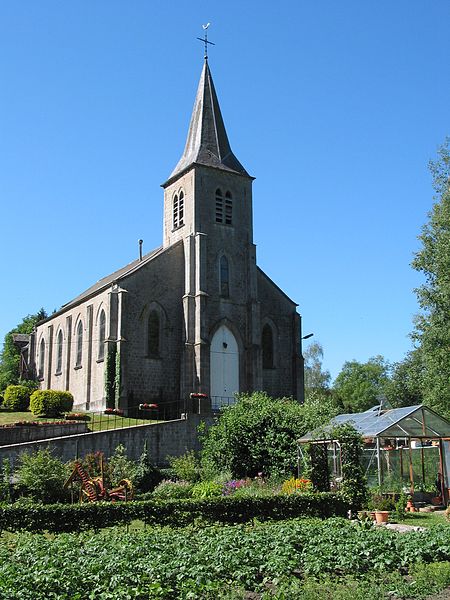
Image by Jean-Pol GRANDAUNT (CC By 3.0)
Lompret, (Belgium), the St Nicolas’ church (1879)
Ordinary Time
8 March 2017
The Edge of Elfland
Hudson, New Hampshire
Dear Readers,
Today I had intended to write about Michael Martin’s The Sophia Option II: A Joyful Noise, but then this morning he went and posted The Sophia Option III: Taking it Back. So, I will respond to both essays (Michael assures me he’s done for now on these).
In these two essays Martin continues to note his dissatisfaction with Rod Dreher’s Benedict Option. In essay two, Martin draws us to the notion of Joy. Martin rejects any implicit or explicit fear and reaction that is present, as he sees it, in Dreher’s Benedict Option. Rather, as Martin writes, “My project starts in joy and ends in joy: the joy of creation, the joy of salvation.” Martin wants us to live joyful lives, lives capable of recognizing the joy inherently knit into creation. He presents two ways of so doing (that I briefly noted in a previous letter): “cosmological awareness and a sacramental sensibility.”
Of the former, Martin writes:
“Cosmological awareness” is a fancy way to say we attend to and interiorize the rhythms of nature and their relationship to the Church year. This would have different applications in the southern hemisphere than in the northern, of course, but, wherever one lives, it should not be all that difficult to connect the two. The Church year and the cycle of saints’ days and feast days enrich the soul in their reciprocity with the progression of the seasons—though I am often mystified and disheartened by the reforms of the calendar in the Latin Church, not to mention horrified by the utilitarian “modernizations” known as Ascension Sunday and translating other Holy Days of Obligation to the nearest convenient Sunday. I think just about everyone can feel how wrong this is, even at a visceral level.
Of the latter:
A sacramental sensibility arises from this understanding of the cosmological structure of our lives. By it we feel the Presence of the Lord as his wisdom shines through the universe and our engagement, for “From the mouth of the Most High [she] came forth, and covered the earth like a mist” (Sirach 24:3). How much richer, then, can be the experience of those of us privileged with access to the Sacraments?
For Martin the liturgy, particularly as expressed in the Church calendar (and somewhat regardless of the, usually, slight differences between East and West) discloses something to us about the nature of reality itself. This is something I have thought for sometime. Liturgy reveals what is already there and then enacts it. And the sacraments play a crucial role in all of this as they are particular reminders that the world, in fact the cosmos, reality itself is a symbol that expresses something about the nature of God.
In his third essay, Martin turns to the subject of renewal. He sees the Benedict Option as primarily preservative or even conservative, in the sense of being concerned with conserving what is past. Martin would rather work on renewal. This, for Martin, requires being mindful of what we have forgotten or left behind, taking it back up, but also transforming it for the present with an eye to the future. In other words, it isn’t enough to try to conserve, say early twentieth century culture or to simply reclaim Medieval culture. Rather, we must take up what has been left behind, along with, to quote Martin quoting Steiner, “the peasant wisdom” (which is also often, not backward looking, but a continuation of former wisdom), and adapting what we find to be good, true, and beautiful for the present.
This, I think, is key. Martin seems to be suggesting what I might call a non-identical repetition. We want to recall what has been in such a way to re-enact in the present, but in a way that is fitting to the present and primed for the future. I am reminded of our present versus older understanding of history. Prior to at least the nineteenth century the majority of people did not view, could not view, the past as a foreign country. When your family lived in a single place for generations, the culture that you grew up in was not starkly transformed. You might be able to look back at what an ancestor did 100 years before and see how it is different from now, but were you to attempt to trace the moment of change you would fail, for the change came imperceptibly, naturally; in the way you could look at a picture of yourself from 10 years ago and today and see the obvious changes but not be able to point to a single moment where 10 years younger you became present day you. This is no longer the case. The past has become a foreign country in which you can only be a tourist. But, could we enact the kind of renewal Martin calls for, we might be able to bring back and move forward some of these older ways of being.
There is much more I could write, and hope to do so in the future. For now, all I can say is this: However this Radical Catholic Reimagination of Everything moves forward, I’m still in. I may have now and will certainly have caveats, differences with Martin and others. But to his call to live intentionally, and intentionally joyfully, I can give total assent. To his call to live cosmologically and sacramentally, I can give total assent. To his call to live in community, I can total assent. We cannot withdraw, we cannot only preserve. We must renew, we must enact culture and community, one founded on Christ.
Sincerely,
David
The Radical Catholic Reimagination of Everything

Browse Our Archives
Select a Category A Secular Age Advent Apologetics Atheism Beauty Being a Catholic Evangelical Being Catholic Being Deified: Poetry and Fantasy on the Path to God Blogging Book Reviews C. S. Lewis Catholic Imagination Catholic Social Teaching Catholicism Christmas Church Calendar Church Fathers Church Life Community Conferences Cosmology Creation Curdled Words Deification Distributism Easter Economics Education Epiphany Essay Extracts Eucharist Faerie Faeriean Metaphysics Fatherhood Films Folk Liturgy Food and Drink G. K. Chesterton Harry Potter J. R. R. Tolkien Jove King Arthur Language Lent Life Literature and Poetry Liturgy Medieval Theology Music My Publications Mythology On the Edges of Elfland Ordinary Time Ordination Parenthood Parish Patristic Theology Pentecost Politics Prayer Racism Radical Orthodoxy Restoration Movement Sacramental Ontology Saints Science Sex and Sexuality Sophiology Stories The Inklings The Radical Catholic Reimagination of Everything Theologians in the Church Theopoetics Thesis Research Uncategorized University of Nottingham What I'm Reading Writing
Select a Month December 2019 November 2019 October 2019 September 2019 August 2019 July 2019 June 2019 May 2019 April 2019 March 2019 February 2019 January 2019 December 2018 November 2018 October 2018 September 2018 August 2018 July 2018 June 2018 May 2018 April 2018 March 2018 February 2018 January 2018 December 2017 November 2017 October 2017 August 2017 July 2017 June 2017 May 2017 April 2017 March 2017 February 2017 January 2017 December 2016 November 2016 October 2016 September 2016 August 2016 July 2016 June 2016 May 2016 April 2016 March 2016 February 2016 January 2016 December 2015 November 2015 October 2015 September 2015 August 2015 July 2015 June 2015 May 2015 April 2015 March 2015 February 2015 January 2015 December 2014 November 2014 October 2014 September 2014 August 2014 July 2014 June 2014 May 2014 April 2014 March 2014 February 2014 January 2014 December 2013 November 2013 October 2013 September 2013 August 2013 July 2013 June 2013 May 2013 April 2013 March 2013 February 2013 January 2013 December 2012 November 2012 October 2012 September 2012 July 2012
Follow Us!
TAKE THE
Religious Wisdom Quiz
True or False: The Israelites crossed the Red Sea by boat.
Select your answer to see how you score.
TRUE FALSE
Related posts from Letters from the Edge of Elfland

William Blake on the Creative Spirit, Beauty, and...
Letters from the Edge of Elfland

“Wherefore stopp’st thou me?” Coleridge’s Creative Message to...
Letters from the Edge of Elfland

Good Morning, Mr. Magpie: On Folklore and Science
Letters from the Edge of Elfland
Letters from the Edge of Elfland
TRENDING AT PATHEOS Catholic

Creation, Preservation, and Teleology in Catholic Theology
As I write this, it is very early Monday morning. Like millions...

The Parable Of The Sower And The Word...
One of Christ’s most famous parables is that of the sower who...

Rejecting Doom: Christian Hope And Human Action
Christianity is a religion of hope. We are to have hope and...

Why I Choose the Eucharist Over the Sermon
Choose the Eucharist, Not the Sermon What are we supposed to get...

5 Design Elements Found in Spiritually Rooted Homes
Putting Spirituality Into Home Decor Our homes are more than our living...

Credo: A Story of God Told with the...
About 10 years ago, I began to imagine a personal "Credo" that...
view all Catholic blogs
Ad-Free & Subscriber Log-In Subscription Support
- About Us
- 2026 Calendar
- Videos
- Podcasts
- Library of World Religions
- Faith In Media Tracker
- Advertise With Us
- Write for Us
- Privacy Policy
- Terms of Service
- Do Not Sell My Data
- Contact Us
- Radiant Digital
- Manage Newsletter Subscriptions
- Unsubscribe From Notifications
- Sitemap
Copyright 2008-2026, Patheos. All rights reserved.
Subscription Support Ad-Free & Subscriber Log-In
Follow Patheos