
BuddhistCatholicContemplativeEvangelicalGeneral ChristianHinduJewishLatter-day SaintMuslimNew VisionsProgressive Christian
Beliefs
- Buddhist
- Catholic
- Contemplative
- Evangelical
- General Christian
- Hindu
- Jewish
- Latter-day Saint
- More Voices
- Muslim
- New Visions
- Pagan
- Progressive Christian
Topics
- Religion News
- Food and Religion
- Sports and Religion
- Religious Art
- Religious Music and Entertainment
- Religious Events
- History and Religion
- Style and Religion
- Politics and Religion
- Women in Religion
- Recreation Outdoors and Religion
- Business Finance and Religion
- Careers Workplace and Religion
- Education and Religion
- Family Parenting and Religion
- Health Fitness and Religion
- Home and Religion
- Relationships and Religion
- Technology and Religion
- Travel and Religion
Columnists
- Buddhist Columnists
- Business Finance and Religion Columnists
- Careers Workplace and Religion Columnists
- Catholic Columnists
- Contemplative Columnists
- Education and Religion Columnists
- Evangelists Columnists
- Family Parenting and Religion Columnists
- General Christian Columnists
- Health Fitness and Religion Columnists
- Hindu Columnists
- History and Religion Columnists
- Home and Religion Columnists
- Jewish Columnists
- More Voices Columnists
- Latter Day Columnists
- Muslim Columnists
- New Visions Columnists
- Nonreligious Columnists
- Pagan Columnists
- Politics and Religion Columnists
- Progressive Columnists
- Recreation Outdoors and Religion Columnists
- Relationships and Religion Columnists
- Religion News Columnists
- Religious Art Columnists
- Religious Events Columnists
- Religious Music and Entertainment Columnists
- Sports and Religion Columnists
- Style and Religion Columnists
- Technology and Religion Columnists
- Travel and Religion Columnists
- Women in Religion Columnists
Resource Library
- 2026 Calendar
- Library of World Religions
- The 100 Most Holy Places on Earth
- Patheos Answers
- Podcasts
- Videos
- Faith Leaders Database
- Anglican Episcopalian
- Bahai
- Baptist
- Buddhism
- Christianity
- Confucianism
- Eastern Orthodoxy
- Hinduism
- Holiness and Pentecostal
- ISKCON
- Islam
- Judaism
- Lutheran
- Methodist
- The Church of Jesus Christ of Latter-day Saints
- New Age
- Paganism
- Presbytarian and Reformed
- Protestantism
- Religion Behind the Scenes
- Roman Catholic
- Scientology
- Shia Islam
- Sikhism
- Sufism
- Sunni Islam
- Taoism
- Zen
- See all religions
Research Tools
 Ad-Free & Subscriber Log-In Subscription Support
Ad-Free & Subscriber Log-In Subscription Support
Follow Patheos 

- Trending:
- Forgiveness
- |
- Marriage
- |
- Consciousness
- |
- Death Penalty
- |
- Election
- |
- Halloween
 Letters from the Edge of Elfland
- Home
- About
- Distributist Resources
- Publications and Presentations
- Support
- Works in Progress
- The Epistolarian Around the Web
- Home
- Catholic
- Entering the Sphere of Jove: Saturn Makes Way for Jupiter in the Works of C. S. Lewis
Entering the Sphere of Jove: Saturn Makes Way for Jupiter in the Works of C. S. Lewis
Last updated on: March 6, 2017 at 3:50 pm by David Russell Mosley
Entering the Sphere of Jove: Saturn Makes Way for Jupiter in the Works of C. S. Lewis 2017-03-06T15:50:21-04:00 David Russell Mosley
Patheos Explore the world's faith through different perspectives on religion and spirituality! Patheos has the views of the prevalent religions and spiritualities of the world.
David Russell Mosley
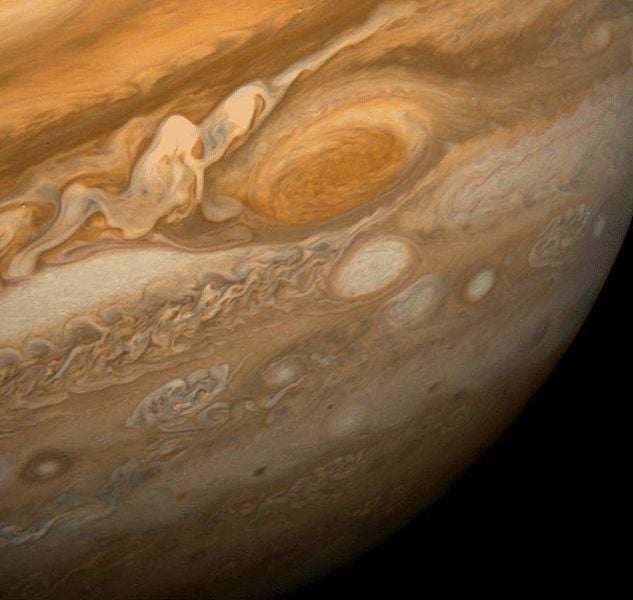
Jupiter
Date 25 February 1979
Source http://photojournal.jpl.nasa.gov/catalog/PIA00014
Author NASA
(Public Domain)
Ordinary Time
6 March 2017
The Edge of Elfland
Hudson, New Hampshire
Dear Readers,
As I was reading Michael Ward’s excellent and convincing Planet Narnia (which argues that the seven Chronicles of Narnia were written with a particular governing planet in mind) I came to his chapter on Saturn and The Last Battle.
Lewis describes Saturn this way in The Discarded Image:
In the earth his influence produces lead; in men the melancholy complexion; in history, disastrous events. In Dante his sphere is the contemplatives. He is connected with sickness and old age. Our traditional picture of Father Time with the scythe is revived from earlier pictures of Saturn. A good account of his activities in promoting fatal accidents, pestilence, treacheries, and ill luck n general occurs in The Knight’s Tale (A 2463 sq). He is the most terrible of the seven and is sometimes called The Greater Infortune, Infortuna Major.
It does take much investigation to see how Saturn might be the governing principle of The Last Battle. One need only look at Chapter 14 to see one instance of the saturnine quality of the book:
But when Aslan had roared yet again, out on their left they saw another black shape. That is, they saw another patch where there were no stars: and the patch rose up higher and higher and became the shape of a man, the hugest of all giants. They all knew Narnia well enough to work out where he must be standing. He must be on the high moorlands that stretches away to the North beyond the River Shribble. Then Jill and Eustace remembered how once long ago, in the deep caves beneath those moors, they had seen a great giant asleep and been told that his name was Father Time, and that he would wake on the day the world ended.

This file comes from Wellcome Images, a website operated by Wellcome Trust, a global charitable foundation based in the United Kingdom. Refer to Wellcome blog post (archive).
(CC BY 4.0)
The Greater Infortune indeed. Father Time, who in an earlier draft of The Silver Chair had actually been called Saturn, now presides over the end Narnia just as the planet Saturn has presided over the entire book up to this point. And yet the world does not end in Saturn’s sphere, rather it makes way for Jove.
This can be easily seen as, after the winnowing, all the friends of Narnia discover that they are in a truer Narnia and as they make their way up Aslan’s mountain, they find their way into truer Narnia still. Joy and laughter dictate most of the following chapters, but, in a way, the turn to Jove is made complete when the last person is met. Up to this point we have been reintroduced to beloved characters throughout the series, Reepicheep, Rillian, Fledge, and others. But the last new person met is Mr. Tumnus, the Faun whose encounter with Lucy sparked the, “… wrath ended/And woes mended, [the] winter passed/And guilt forgiven, and good fortune…” of the Jovial The Lion, the Witch and the Wardrobe. So Saturn makes way for Jove in away that both returns us to the first book of the series and yet moves us beyond it, to have us say, “Farewell to the Shadowlands*.”*
Lewis makes a similar move in That Hideous Strength. Despite the fact that in the Ptolemaic model of the universe Saturn follows Jupiter, when the gods descend on Merlin, Saturn comes first:
Saturn, whose name in the heavens is Lurga, stood in the Blue Room. His spirit lay upon the house, or even on the whole Earth, with a cold pressure such as might flatten the very orb of Tellus to a wafer. Matched against the lead-like burden of his antiquity the other gods themselves perhaps felt young and ephemeral. It was a mountain of centuries sloping up from the highest antiquity we can conceive, up and up like a mountain whose summit never comes into sight, not to eternity where the thought can rest, but into more and still more time, into freezing wastes and silence of unnameable numbers. It was also strong like a mountain; its age was no mere morass of time where imagination can sink in reverie, but a living, self-remembering duration which repelled higher intelligences from its structure as granite flings back the waves, itself unwithered and undecided but able to wither any who approach it unadvised. Ransom and Merlin suffered a sensation of unendurable cold; and all that strength in Lurga became a sorrow as it entered them. Yet Lurga in that room was overmatched.
Lewis was concerned that society was becoming Saturnocentric. And if what this meant was that we became more contemplative, perhaps this would not have been so bad. But Lewis feared the fallen response to Saturn, the turn to melancholy and sorrow without end. And so in his own version of the cosmos, while Jupiter might occupy the sixth sphere, an even greater Jove (namely God himself) presides over the life to come.
And so, as I reflect on this sublunary life, I pray that I too will always find that turn to Jupiter, that even in my darkest, saturnine moments, Saturn will make way for Jove.
Sincerely,
David
The Radical Catholic Reimagination of Everything
Previous Post

March 4, 2017
On the Edges of Elfland Is Now Available on Kindle!
Next Post

March 8, 2017 On Joy and Renewal: More Reflections on Michael Martin's Sophia Option
Browse Our Archives
Select a Category A Secular Age Advent Apologetics Atheism Beauty Being a Catholic Evangelical Being Catholic Being Deified: Poetry and Fantasy on the Path to God Blogging Book Reviews C. S. Lewis Catholic Imagination Catholic Social Teaching Catholicism Christmas Church Calendar Church Fathers Church Life Community Conferences Cosmology Creation Curdled Words Deification Distributism Easter Economics Education Epiphany Essay Extracts Eucharist Faerie Faeriean Metaphysics Fatherhood Films Folk Liturgy Food and Drink G. K. Chesterton Harry Potter J. R. R. Tolkien Jove King Arthur Language Lent Life Literature and Poetry Liturgy Medieval Theology Music My Publications Mythology On the Edges of Elfland Ordinary Time Ordination Parenthood Parish Patristic Theology Pentecost Politics Prayer Racism Radical Orthodoxy Restoration Movement Sacramental Ontology Saints Science Sex and Sexuality Sophiology Stories The Inklings The Radical Catholic Reimagination of Everything Theologians in the Church Theopoetics Thesis Research Uncategorized University of Nottingham What I'm Reading Writing
Select a Month December 2019 November 2019 October 2019 September 2019 August 2019 July 2019 June 2019 May 2019 April 2019 March 2019 February 2019 January 2019 December 2018 November 2018 October 2018 September 2018 August 2018 July 2018 June 2018 May 2018 April 2018 March 2018 February 2018 January 2018 December 2017 November 2017 October 2017 August 2017 July 2017 June 2017 May 2017 April 2017 March 2017 February 2017 January 2017 December 2016 November 2016 October 2016 September 2016 August 2016 July 2016 June 2016 May 2016 April 2016 March 2016 February 2016 January 2016 December 2015 November 2015 October 2015 September 2015 August 2015 July 2015 June 2015 May 2015 April 2015 March 2015 February 2015 January 2015 December 2014 November 2014 October 2014 September 2014 August 2014 July 2014 June 2014 May 2014 April 2014 March 2014 February 2014 January 2014 December 2013 November 2013 October 2013 September 2013 August 2013 July 2013 June 2013 May 2013 April 2013 March 2013 February 2013 January 2013 December 2012 November 2012 October 2012 September 2012 July 2012
Follow Us!
TAKE THE
Religious Wisdom Quiz
In Revelation, what does John eat that is sweet in his mouth but sour in his stomach?
Select your answer to see how you score.
A little scroll The word of God Honey A sealed book
Related posts from Letters from the Edge of Elfland

William Blake on the Creative Spirit, Beauty, and...
Letters from the Edge of Elfland
The Earth, Our Mother, and the Amazonian Synod
Letters from the Edge of Elfland
Can You Imagine? Beginning a Definition of the...
Letters from the Edge of Elfland

“Wherefore stopp’st thou me?” Coleridge’s Creative Message to...
Letters from the Edge of Elfland
TRENDING AT PATHEOS Catholic

Rejecting Doom: Christian Hope And Human Action
Christianity is a religion of hope. We are to have hope and...

It’s What Comes From Within Which Matters
One of the most difficult things for us to understand is why...

Why I Choose the Eucharist Over the Sermon
Choose the Eucharist, Not the Sermon What are we supposed to get...

5 Design Elements Found in Spiritually Rooted Homes
Putting Spirituality Into Home Decor Our homes are more than our living...

Credo: A Story of God Told with the...
About 10 years ago, I began to imagine a personal "Credo" that...

The Anatomy of Divine Revelation in Catholic Thought
The claim that God has made Himself known to human beings is...
view all Catholic blogs
Ad-Free & Subscriber Log-In Subscription Support
- About Us
- 2026 Calendar
- Videos
- Podcasts
- Library of World Religions
- Faith In Media Tracker
- Advertise With Us
- Write for Us
- Privacy Policy
- Terms of Service
- Do Not Sell My Data
- Contact Us
- Radiant Digital
- Manage Newsletter Subscriptions
- Unsubscribe From Notifications
- Sitemap
Copyright 2008-2026, Patheos. All rights reserved.
Subscription Support Ad-Free & Subscriber Log-In
Follow Patheos