
BuddhistCatholicContemplativeEvangelicalGeneral ChristianHinduJewishLatter-day SaintMuslimNew VisionsProgressive Christian
Beliefs
- Buddhist
- Catholic
- Contemplative
- Evangelical
- General Christian
- Hindu
- Jewish
- Latter-day Saint
- More Voices
- Muslim
- New Visions
- Pagan
- Progressive Christian
Topics
- Religion News
- Food and Religion
- Sports and Religion
- Religious Art
- Religious Music and Entertainment
- Religious Events
- History and Religion
- Style and Religion
- Politics and Religion
- Women in Religion
- Recreation Outdoors and Religion
- Business Finance and Religion
- Careers Workplace and Religion
- Education and Religion
- Family Parenting and Religion
- Health Fitness and Religion
- Home and Religion
- Relationships and Religion
- Technology and Religion
- Travel and Religion
Columnists
- Buddhist Columnists
- Business Finance and Religion Columnists
- Careers Workplace and Religion Columnists
- Catholic Columnists
- Contemplative Columnists
- Education and Religion Columnists
- Evangelists Columnists
- Family Parenting and Religion Columnists
- General Christian Columnists
- Health Fitness and Religion Columnists
- Hindu Columnists
- History and Religion Columnists
- Home and Religion Columnists
- Jewish Columnists
- More Voices Columnists
- Latter Day Columnists
- Muslim Columnists
- New Visions Columnists
- Nonreligious Columnists
- Pagan Columnists
- Politics and Religion Columnists
- Progressive Columnists
- Recreation Outdoors and Religion Columnists
- Relationships and Religion Columnists
- Religion News Columnists
- Religious Art Columnists
- Religious Events Columnists
- Religious Music and Entertainment Columnists
- Sports and Religion Columnists
- Style and Religion Columnists
- Technology and Religion Columnists
- Travel and Religion Columnists
- Women in Religion Columnists
Resource Library
- 2026 Calendar
- Library of World Religions
- The 100 Most Holy Places on Earth
- Patheos Answers
- Podcasts
- Videos
- Faith Leaders Database
- Anglican Episcopalian
- Bahai
- Baptist
- Buddhism
- Christianity
- Confucianism
- Eastern Orthodoxy
- Hinduism
- Holiness and Pentecostal
- ISKCON
- Islam
- Judaism
- Lutheran
- Methodist
- The Church of Jesus Christ of Latter-day Saints
- New Age
- Paganism
- Presbytarian and Reformed
- Protestantism
- Religion Behind the Scenes
- Roman Catholic
- Scientology
- Shia Islam
- Sikhism
- Sufism
- Sunni Islam
- Taoism
- Zen
- See all religions
Research Tools
 Ad-Free & Subscriber Log-In Subscription Support
Ad-Free & Subscriber Log-In Subscription Support
Follow Patheos 

- Trending:
- Forgiveness
- |
- Marriage
- |
- Consciousness
- |
- Death Penalty
- |
- Election
- |
- Halloween
 Letters from the Edge of Elfland
- Home
- About
- Distributist Resources
- Publications and Presentations
- Support
- Works in Progress
- The Epistolarian Around the Web
- Home
- Catholic
- Entering the Sphere of Jove: Reflecting on Joy with Lent, C.S. Lewis, and Michael Martin
Entering the Sphere of Jove: Reflecting on Joy with Lent, C.S. Lewis, and Michael Martin
Last updated on: March 2, 2017 at 11:12 am by David Russell Mosley
Entering the Sphere of Jove: Reflecting on Joy with Lent, C.S. Lewis, and Michael Martin 2017-03-02T11:12:19-04:00 David Russell Mosley
Patheos Explore the world's faith through different perspectives on religion and spirituality! Patheos has the views of the prevalent religions and spiritualities of the world.
David Russell Mosley
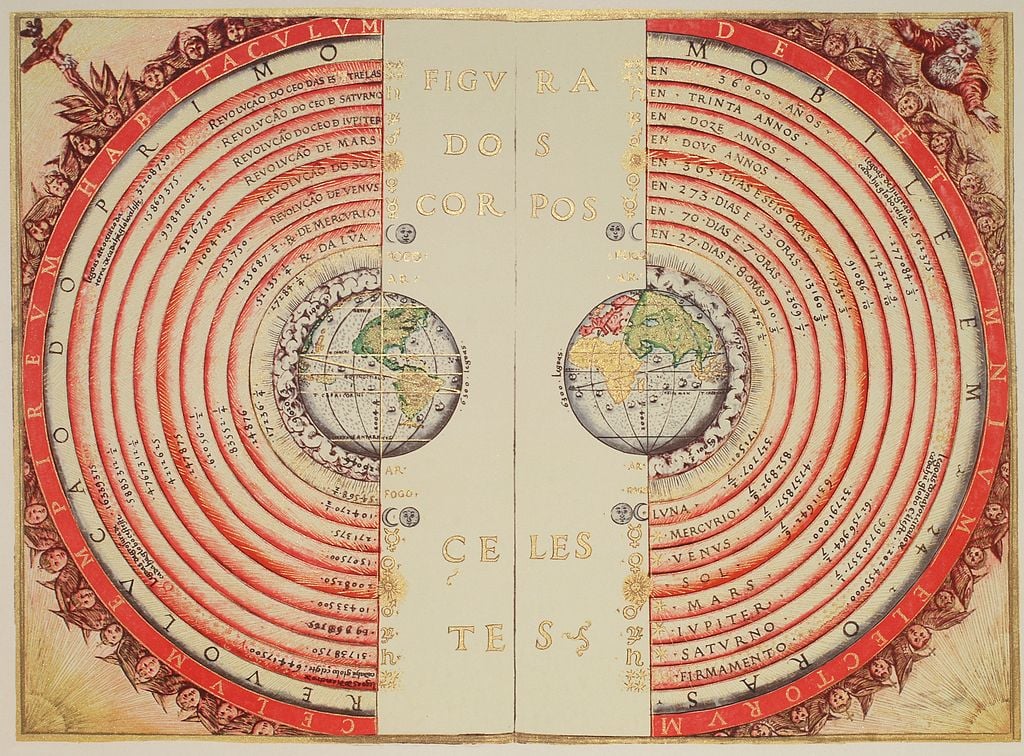
Description
English: Figure of the heavenly bodies – Illuminated illustration of the Ptolemaic geocentric conception of the Universe by Portuguese cosmographer and cartographer Bartolomeu Velho (?-1568). From his work Cosmographia, made in France, 1568 (Bibilotèque nationale de France, Paris). Notice the distances of the bodies to the centre of the Earth (left) and the times of revolution, in years (right). The outermost text says: “The heavenly empire, the dwelling of God and of all of the elect”
Date Original work, 1568. Photo taken in 2008
Source Own work
Author Bartolomeu Velho (Public Domain)
Ordinary Time
2 March 2017
The Edge of Elfland
Hudson, New Hampshire
Dear Readers,
I want to talk to you about Joy. It has been an obsession of mine of late. I began to notice its influence on me most at the tail end of the last liturgical year and the start of this one. I began to describe myself as one formed by and for Joy. I began to realize that, at my core, I am joyful. Even in my darkest moments, of which I have had several lately, Joy has been there prodding me with his great, pudgy finger, trying to get me to laugh.
Joy, or perhaps better Jove, has been an overriding figure for me lately. In fact, there has been something of a perfect storm of joviality. First, I have discovered that many use the greeting “Joyful Lent.” This is a wonderful thing to learn for my first Lent as a Catholic (almost anyway). Perhaps joy and Lent seem at odds. After all, Lent is a time to remember our sins, to fast, to remember that we are but dust and to dust we shall return. And yet, Lent is not an end in itself. It is a means to an end and that end is Easter, Pascha, the resurrection of our Lord and Savior. What more joyful or more jovial event is there in the Christian calendar (Christmas being a very close second)? What is more, there is a jovial character to Easter. By that I mean Easter reminds us not only of the joy of the Gospel, but of the kingliness of Christ. Put to death by the leaders of this world, in part for claiming a kingship higher than theirs, Christ’s sovereignty is legitimized by his resurrection. Christ is Lord, not Caesar.
And this would have been more than enough, except that, thanks in part to my annual re-read of Lewis’ Cosmic Trilogy, I have begun a keen interest in Medieval Cosmology, particularly the spiritual aspects of it. This has led me to purchase and begin reading Michael Ward’s groundbreaking Planet Narnia: The Seven Heavens in the Imagination of C. S. Lewis. If you’re unfamiliar with this work, Ward proposes that Lewis’ Chronicles of Narnia are organized around the seven planets of the Ptolemaic model of the universe: Luna (the Moon), Mercury, Venus, Sol (the Sun), Mars, Jupiter, and Saturn. Each book in the Narniad represents or is represented by one of these seven planets. I’ve only just finished his chapter on The Lion, the Witch and the Wardrobe, which Ward argues is governed by Jupiter. In this chapter, Ward takes us through the place of Jove throughout Lewis’ work, not only in LWW. And I have to say, so far I find his arguments compelling, but then I find myself in a place where I am already inclined to do so. It is not only Joy, but kingliness that reigns in Lewis’ use of Jupiter. Lewis, it seems had a particular fascination with Jupiter, one I hope to explore more later.
And still, these two places of joy would have been enough, but they are not alone. Yesterday, Michael Martin wrote more about his Sophia Option, which as I have said before, is really just a re-branding of his Radical Catholic Reimagination of Everything. “My project,” says Martin, “starts in joy and ends in joy: the joy of creation, the joy of salvation.” Martin wants to bring about a renewal of culture, similar to that of Rod Dreher’s Benedict Option, “But,” says Martin “the renewal of culture, it is my contention, cannot come about without two necessary (and intimately related) things: a cosmological awareness and a sacramental sensibility. Otherwise, we are cut off from the source of life (zöe) and have no life in us (John 6:53).” In one sense, Martin’s cultural, Catholic project is a coming together of the two themes I’ve listed above. His cosmological awareness (which he primarily focuses on the relationship of the seasons of the natural world to the seasons of the liturgical calendar) aligns with my readings in Medieval cosmology. His sacramental sensibility relates to my recognition of a Joyful Lent. This isn’t a perfect analogy, and there’s much more I could say here, but the key is Joy, Joviality, Jocundity.
I believe these outpourings of Joy in various aspects of my life are not coincidental, and so I will be pursuing them. In fact, for the next 6 weeks, I will write you at least one letter dealing with Joy. I hope to follow up more on Lewis and the Medieval cosmology. I hope to follow up more on Martin’s Sophia Option. And above all, I hope to follow up more on how Lent can be Joyful.
I leave you with lines about Jove from C.S. Lewis’ poem “The Planets.”
Sincerely,
David
…. Soft breathes the air
Mild, and meadowy, as we mount further
Where rippled radiance rolls about us
Moved with music – measureless the waves’
Joy and jubilee. It is JOVE’s orbit,
Filled and festal, faster turning
With arc ampler. From the Isles of Tin
Tyrian traders, in trouble steering
Came with his cargoes; the Cornish treasure
That his ray ripens. Of wrath ended
And woes mended, of winter passed
And guilt forgiven, and good fortune
Jove is master; and of jocund revel,
Laughter of ladies. The lion-hearted,
The myriad-minded, men like the gods,
Helps and heroes, helms of nations
Just and gentle, are Jove’s children,
Work his wonders. On his white forehead
Calm and kingly, no care darkens
Nor wrath wrinkles: but righteous power
And leisure and largess their loose splendours
Have wrapped around him – a rich mantle
Of ease and empire….
Previous Post

February 27, 2017
It Reminds Me of Númenor: Melancholic Reflections on a Rainy Day
Next Post

March 4, 2017 On the Edges of Elfland Is Now Available on Kindle!
Browse Our Archives
Select a Category A Secular Age Advent Apologetics Atheism Beauty Being a Catholic Evangelical Being Catholic Being Deified: Poetry and Fantasy on the Path to God Blogging Book Reviews C. S. Lewis Catholic Imagination Catholic Social Teaching Catholicism Christmas Church Calendar Church Fathers Church Life Community Conferences Cosmology Creation Curdled Words Deification Distributism Easter Economics Education Epiphany Essay Extracts Eucharist Faerie Faeriean Metaphysics Fatherhood Films Folk Liturgy Food and Drink G. K. Chesterton Harry Potter J. R. R. Tolkien Jove King Arthur Language Lent Life Literature and Poetry Liturgy Medieval Theology Music My Publications Mythology On the Edges of Elfland Ordinary Time Ordination Parenthood Parish Patristic Theology Pentecost Politics Prayer Racism Radical Orthodoxy Restoration Movement Sacramental Ontology Saints Science Sex and Sexuality Sophiology Stories The Inklings The Radical Catholic Reimagination of Everything Theologians in the Church Theopoetics Thesis Research Uncategorized University of Nottingham What I'm Reading Writing
Select a Month December 2019 November 2019 October 2019 September 2019 August 2019 July 2019 June 2019 May 2019 April 2019 March 2019 February 2019 January 2019 December 2018 November 2018 October 2018 September 2018 August 2018 July 2018 June 2018 May 2018 April 2018 March 2018 February 2018 January 2018 December 2017 November 2017 October 2017 August 2017 July 2017 June 2017 May 2017 April 2017 March 2017 February 2017 January 2017 December 2016 November 2016 October 2016 September 2016 August 2016 July 2016 June 2016 May 2016 April 2016 March 2016 February 2016 January 2016 December 2015 November 2015 October 2015 September 2015 August 2015 July 2015 June 2015 May 2015 April 2015 March 2015 February 2015 January 2015 December 2014 November 2014 October 2014 September 2014 August 2014 July 2014 June 2014 May 2014 April 2014 March 2014 February 2014 January 2014 December 2013 November 2013 October 2013 September 2013 August 2013 July 2013 June 2013 May 2013 April 2013 March 2013 February 2013 January 2013 December 2012 November 2012 October 2012 September 2012 July 2012
Follow Us!
TAKE THE
Religious Wisdom Quiz
What did Stephen see as he was being stoned?
Select your answer to see how you score.
Angels descending The face of God A bright light from heaven Heaven opened and Jesus standing at the right hand of God
Related posts from Letters from the Edge of Elfland

William Blake on the Creative Spirit, Beauty, and...
Letters from the Edge of Elfland
Can You Imagine? Beginning a Definition of the...
Letters from the Edge of Elfland

“Wherefore stopp’st thou me?” Coleridge’s Creative Message to...
Letters from the Edge of Elfland
C.S. Lewis's Cosmic Turn: Finding Virtue through the...
Letters from the Edge of Elfland
TRENDING AT PATHEOS Catholic

Rejecting Doom: Christian Hope And Human Action
Christianity is a religion of hope. We are to have hope and...

It’s What Comes From Within Which Matters
One of the most difficult things for us to understand is why...

Why I Choose the Eucharist Over the Sermon
Choose the Eucharist, Not the Sermon What are we supposed to get...

5 Design Elements Found in Spiritually Rooted Homes
Putting Spirituality Into Home Decor Our homes are more than our living...

Credo: A Story of God Told with the...
About 10 years ago, I began to imagine a personal "Credo" that...

The Anatomy of Divine Revelation in Catholic Thought
The claim that God has made Himself known to human beings is...
view all Catholic blogs
Ad-Free & Subscriber Log-In Subscription Support
- About Us
- 2026 Calendar
- Videos
- Podcasts
- Library of World Religions
- Faith In Media Tracker
- Advertise With Us
- Write for Us
- Privacy Policy
- Terms of Service
- Do Not Sell My Data
- Contact Us
- Radiant Digital
- Manage Newsletter Subscriptions
- Unsubscribe From Notifications
- Sitemap
Copyright 2008-2026, Patheos. All rights reserved.
Subscription Support Ad-Free & Subscriber Log-In
Follow Patheos