
BuddhistCatholicContemplativeEvangelicalGeneral ChristianHinduJewishLatter-day SaintMuslimNew VisionsProgressive Christian
Beliefs
- Buddhist
- Catholic
- Contemplative
- Evangelical
- General Christian
- Hindu
- Jewish
- Latter-day Saint
- More Voices
- Muslim
- New Visions
- Pagan
- Progressive Christian
Topics
- Religion News
- Food and Religion
- Sports and Religion
- Religious Art
- Religious Music and Entertainment
- Religious Events
- History and Religion
- Style and Religion
- Politics and Religion
- Women in Religion
- Recreation Outdoors and Religion
- Business Finance and Religion
- Careers Workplace and Religion
- Education and Religion
- Family Parenting and Religion
- Health Fitness and Religion
- Home and Religion
- Relationships and Religion
- Technology and Religion
- Travel and Religion
Columnists
- Buddhist Columnists
- Business Finance and Religion Columnists
- Careers Workplace and Religion Columnists
- Catholic Columnists
- Contemplative Columnists
- Education and Religion Columnists
- Evangelists Columnists
- Family Parenting and Religion Columnists
- General Christian Columnists
- Health Fitness and Religion Columnists
- Hindu Columnists
- History and Religion Columnists
- Home and Religion Columnists
- Jewish Columnists
- More Voices Columnists
- Latter Day Columnists
- Muslim Columnists
- New Visions Columnists
- Nonreligious Columnists
- Pagan Columnists
- Politics and Religion Columnists
- Progressive Columnists
- Recreation Outdoors and Religion Columnists
- Relationships and Religion Columnists
- Religion News Columnists
- Religious Art Columnists
- Religious Events Columnists
- Religious Music and Entertainment Columnists
- Sports and Religion Columnists
- Style and Religion Columnists
- Technology and Religion Columnists
- Travel and Religion Columnists
- Women in Religion Columnists
Resource Library
- 2026 Calendar
- Library of World Religions
- The 100 Most Holy Places on Earth
- Patheos Answers
- Podcasts
- Videos
- Faith Leaders Database
- Anglican Episcopalian
- Bahai
- Baptist
- Buddhism
- Christianity
- Confucianism
- Eastern Orthodoxy
- Hinduism
- Holiness and Pentecostal
- ISKCON
- Islam
- Judaism
- Lutheran
- Methodist
- The Church of Jesus Christ of Latter-day Saints
- New Age
- Paganism
- Presbytarian and Reformed
- Protestantism
- Religion Behind the Scenes
- Roman Catholic
- Scientology
- Shia Islam
- Sikhism
- Sufism
- Sunni Islam
- Taoism
- Zen
- See all religions
Research Tools
 Ad-Free & Subscriber Log-In Subscription Support
Ad-Free & Subscriber Log-In Subscription Support
Follow Patheos 

- Trending:
- Forgiveness
- |
- Marriage
- |
- Consciousness
- |
- Death Penalty
- |
- Election
- |
- Halloween
 Letters from the Edge of Elfland
- Home
- About
- Distributist Resources
- Publications and Presentations
- Support
- Works in Progress
- The Epistolarian Around the Web
- Home
- Catholic
- Suffering from Beatitude: A Reflection on Mysticism from James Martin’s Account of St. Bernadette
Suffering from Beatitude: A Reflection on Mysticism from James Martin’s Account of St. Bernadette
Last updated on: January 10, 2017 at 1:49 pm by David Russell Mosley
Suffering from Beatitude: A Reflection on Mysticism from James Martin’s Account of St. Bernadette 2017-01-10T13:49:04-04:00 David Russell Mosley
Patheos Explore the world's faith through different perspectives on religion and spirituality! Patheos has the views of the prevalent religions and spiritualities of the world.
David Russell Mosley
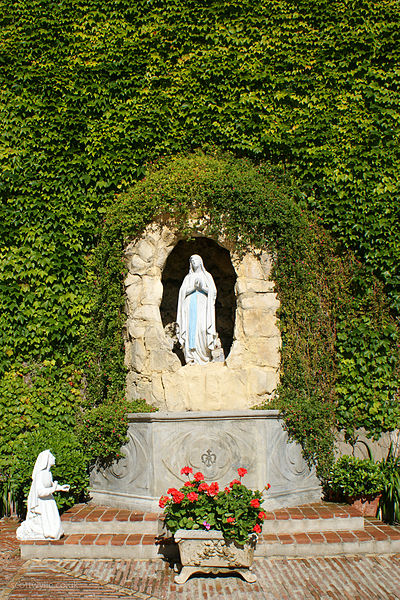
Description
Gibraltar St Bernadette shrine
Date 19 May 2008, 05:12:10
Source Flickr: Gibraltar
Author Scott Wylie
Scott Wylie
Ordinary Time
10 January 2017
The Edge of Elfland
Hudson, New Hampshire
Dear Readers,
I’m in the midst of reading James Martin’s My Life with the Saints for the Patheos bookclub. Through some miscommunication I got my book rather late in the game. So, rather than provide a proper review, I thought I would make sure to get a post up. It helps that I was just moved very much by one of the chapters.
The chapter in question, entitled “In the Grotto of Massabielle,” is about St. Bernadette Soubirous. While I had heard of Lourdes and knew that the grotto at Notre Dame University was made in imitation of the grotto at Lourdes I knew nothing else. Reading not only about the story of St. Bernadette, but of Martin’s time there with the Knights of Malta, I was nearly moved to tears (reading the account in a local coffeeshop helped keep my tears in check).
If you don’t know the story of St. Bernadette I recommend it. Even if you find yourself disinclined to believe it, I recommend it. What I noticed about Bernadette’s story, however, was the suffering that came along with her visions. Not, from what little I now know, that the visions themselves were a source of suffering, but the reactions she received from her family and from others. Institutional suffering often comes with being a mystic. After all, one is saying that one receives visions, even a kind of revelation, and this reminds us that God is not bound to work within the order of the institution, but may work in the lowest and weakest of us.
And yet, while the stories don’t mention it, I cannot help but wonder about the physical or emotional effect such mystical experiences have on the mystic. I have in my nearly 30 years had at least three mystical experiences. They were never of the nature of St. Bernadette’s, for I am not nearly holy enough to receive such visions. However, what I can say is that these events took a tole on me physically and emotionally when they have happened. My heart begins to race. It feels as though it will beat its way outside of my chest. I often feel a great pressure on my shoulders. Usually, I begin with my eyes closed, but open them––which has concluded the experience––because of a kind of intense brightness that fills my closed eyes. I remember before one such experience I had been praying to have one and afterwards feeling as though I should never ask for one again because the experience felt unbearable.
I am reminded too of Jacob and Moses. When Jacob wrestles the angel and the angel dislocates his hip, Jacob ends up walking with a limp. When Moses descends from the mountain he face shines so brightly that he has to cover it with a veil. While in Moses’ case, the experience caused him no pain the holiness he imbibed was painful to others. And this, I think, is part of the point.
We are still sinful. Even those of us washed in the waters of baptism are not yet deified. We have not yet been resurrected and so have not attained the end for which God made us. Therefore, we can only stand so long in his presence. After Moses asks to see God’s glory, God allows him to “see” him in some sense, but tells him that no one can see God and live. We are not yet ready to abide in God’s holiness and so the sheer blessedness the mystic experiences, I think, must come with complications. Perhaps I find the experiences so painful (although pain doesn’t really get at what I’m trying to describe) precisely because I am not holy enough even for the shadows I have been shown. Perhaps as I become holier whatever God chooses to bless me with will not be so difficult to bear. After all, many saints who seemed to have almost lived in heaven while on earth are said to have been particularly hale despite their scant diets and poor self-care. Still, that too must be a special grace, for fallen humanity is not yet ready for the fullness of God’s glory.
So, I will continue to pray that God show me things, but I will also pray to be made better capable of bearing them. Whatever the case, however, I will continue to ask for God to make his presence known to me. After all, it is far better to suffer from beatitude than it is never to have experienced even the smallest measure of it.
Sincerely,
David

Browse Our Archives
Select a Category A Secular Age Advent Apologetics Atheism Beauty Being a Catholic Evangelical Being Catholic Being Deified: Poetry and Fantasy on the Path to God Blogging Book Reviews C. S. Lewis Catholic Imagination Catholic Social Teaching Catholicism Christmas Church Calendar Church Fathers Church Life Community Conferences Cosmology Creation Curdled Words Deification Distributism Easter Economics Education Epiphany Essay Extracts Eucharist Faerie Faeriean Metaphysics Fatherhood Films Folk Liturgy Food and Drink G. K. Chesterton Harry Potter J. R. R. Tolkien Jove King Arthur Language Lent Life Literature and Poetry Liturgy Medieval Theology Music My Publications Mythology On the Edges of Elfland Ordinary Time Ordination Parenthood Parish Patristic Theology Pentecost Politics Prayer Racism Radical Orthodoxy Restoration Movement Sacramental Ontology Saints Science Sex and Sexuality Sophiology Stories The Inklings The Radical Catholic Reimagination of Everything Theologians in the Church Theopoetics Thesis Research Uncategorized University of Nottingham What I'm Reading Writing
Select a Month December 2019 November 2019 October 2019 September 2019 August 2019 July 2019 June 2019 May 2019 April 2019 March 2019 February 2019 January 2019 December 2018 November 2018 October 2018 September 2018 August 2018 July 2018 June 2018 May 2018 April 2018 March 2018 February 2018 January 2018 December 2017 November 2017 October 2017 August 2017 July 2017 June 2017 May 2017 April 2017 March 2017 February 2017 January 2017 December 2016 November 2016 October 2016 September 2016 August 2016 July 2016 June 2016 May 2016 April 2016 March 2016 February 2016 January 2016 December 2015 November 2015 October 2015 September 2015 August 2015 July 2015 June 2015 May 2015 April 2015 March 2015 February 2015 January 2015 December 2014 November 2014 October 2014 September 2014 August 2014 July 2014 June 2014 May 2014 April 2014 March 2014 February 2014 January 2014 December 2013 November 2013 October 2013 September 2013 August 2013 July 2013 June 2013 May 2013 April 2013 March 2013 February 2013 January 2013 December 2012 November 2012 October 2012 September 2012 July 2012
Follow Us!
TAKE THE
Religious Wisdom Quiz
What did the people do when Ezra read from the Book of the Law?
Select your answer to see how you score.
Wept and repented Destroyed idols Ran away Laughed
Related posts from Letters from the Edge of Elfland
Enduring the Valleys of Life: My Struggle with...
Letters from the Edge of Elfland
Hope and Death in Advent: Reflecting on Adventual...
Letters from the Edge of Elfland

Poetry, Podcasts, and More: Some Updates on Other...
Letters from the Edge of Elfland

Working on a Book of Poetry: An Apology...
Letters from the Edge of Elfland
TRENDING AT PATHEOS Catholic

Creation, Preservation, and Teleology in Catholic Theology
As I write this, it is very early Monday morning. Like millions...

The Parable Of The Sower And The Word...
One of Christ’s most famous parables is that of the sower who...

Rejecting Doom: Christian Hope And Human Action
Christianity is a religion of hope. We are to have hope and...

Why I Choose the Eucharist Over the Sermon
Choose the Eucharist, Not the Sermon What are we supposed to get...

5 Design Elements Found in Spiritually Rooted Homes
Putting Spirituality Into Home Decor Our homes are more than our living...

Credo: A Story of God Told with the...
About 10 years ago, I began to imagine a personal "Credo" that...
view all Catholic blogs
Ad-Free & Subscriber Log-In Subscription Support
- About Us
- 2026 Calendar
- Videos
- Podcasts
- Library of World Religions
- Faith In Media Tracker
- Advertise With Us
- Write for Us
- Privacy Policy
- Terms of Service
- Do Not Sell My Data
- Contact Us
- Radiant Digital
- Manage Newsletter Subscriptions
- Unsubscribe From Notifications
- Sitemap
Copyright 2008-2026, Patheos. All rights reserved.
Subscription Support Ad-Free & Subscriber Log-In
Follow Patheos