
BuddhistCatholicContemplativeEvangelicalGeneral ChristianHinduJewishLatter-day SaintMuslimNew VisionsProgressive Christian
Beliefs
- Buddhist
- Catholic
- Contemplative
- Evangelical
- General Christian
- Hindu
- Jewish
- Latter-day Saint
- More Voices
- Muslim
- New Visions
- Pagan
- Progressive Christian
Topics
- Religion News
- Food and Religion
- Sports and Religion
- Religious Art
- Religious Music and Entertainment
- Religious Events
- History and Religion
- Style and Religion
- Politics and Religion
- Women in Religion
- Recreation Outdoors and Religion
- Business Finance and Religion
- Careers Workplace and Religion
- Education and Religion
- Family Parenting and Religion
- Health Fitness and Religion
- Home and Religion
- Relationships and Religion
- Technology and Religion
- Travel and Religion
Columnists
- Buddhist Columnists
- Business Finance and Religion Columnists
- Careers Workplace and Religion Columnists
- Catholic Columnists
- Contemplative Columnists
- Education and Religion Columnists
- Evangelists Columnists
- Family Parenting and Religion Columnists
- General Christian Columnists
- Health Fitness and Religion Columnists
- Hindu Columnists
- History and Religion Columnists
- Home and Religion Columnists
- Jewish Columnists
- More Voices Columnists
- Latter Day Columnists
- Muslim Columnists
- New Visions Columnists
- Nonreligious Columnists
- Pagan Columnists
- Politics and Religion Columnists
- Progressive Columnists
- Recreation Outdoors and Religion Columnists
- Relationships and Religion Columnists
- Religion News Columnists
- Religious Art Columnists
- Religious Events Columnists
- Religious Music and Entertainment Columnists
- Sports and Religion Columnists
- Style and Religion Columnists
- Technology and Religion Columnists
- Travel and Religion Columnists
- Women in Religion Columnists
Resource Library
- 2026 Calendar
- Library of World Religions
- The 100 Most Holy Places on Earth
- Patheos Answers
- Podcasts
- Videos
- Faith Leaders Database
- Anglican Episcopalian
- Bahai
- Baptist
- Buddhism
- Christianity
- Confucianism
- Eastern Orthodoxy
- Hinduism
- Holiness and Pentecostal
- ISKCON
- Islam
- Judaism
- Lutheran
- Methodist
- The Church of Jesus Christ of Latter-day Saints
- New Age
- Paganism
- Presbytarian and Reformed
- Protestantism
- Religion Behind the Scenes
- Roman Catholic
- Scientology
- Shia Islam
- Sikhism
- Sufism
- Sunni Islam
- Taoism
- Zen
- See all religions
Research Tools
 Ad-Free & Subscriber Log-In Subscription Support
Ad-Free & Subscriber Log-In Subscription Support
Follow Patheos 

- Trending:
- Forgiveness
- |
- Marriage
- |
- Consciousness
- |
- Death Penalty
- |
- Election
- |
- Halloween
 Letters from the Edge of Elfland
- Home
- About
- Distributist Resources
- Publications and Presentations
- Support
- Works in Progress
- The Epistolarian Around the Web
- Home
- Catholic
- Beginning Work on a Curriculum for My Toddlers
Beginning Work on a Curriculum for My Toddlers
Last updated on: December 16, 2016 at 11:38 am by David Russell Mosley
Beginning Work on a Curriculum for My Toddlers 2016-12-16T11:38:18-04:00 David Russell Mosley
Patheos Explore the world's faith through different perspectives on religion and spirituality! Patheos has the views of the prevalent religions and spiritualities of the world.
David Russell Mosley
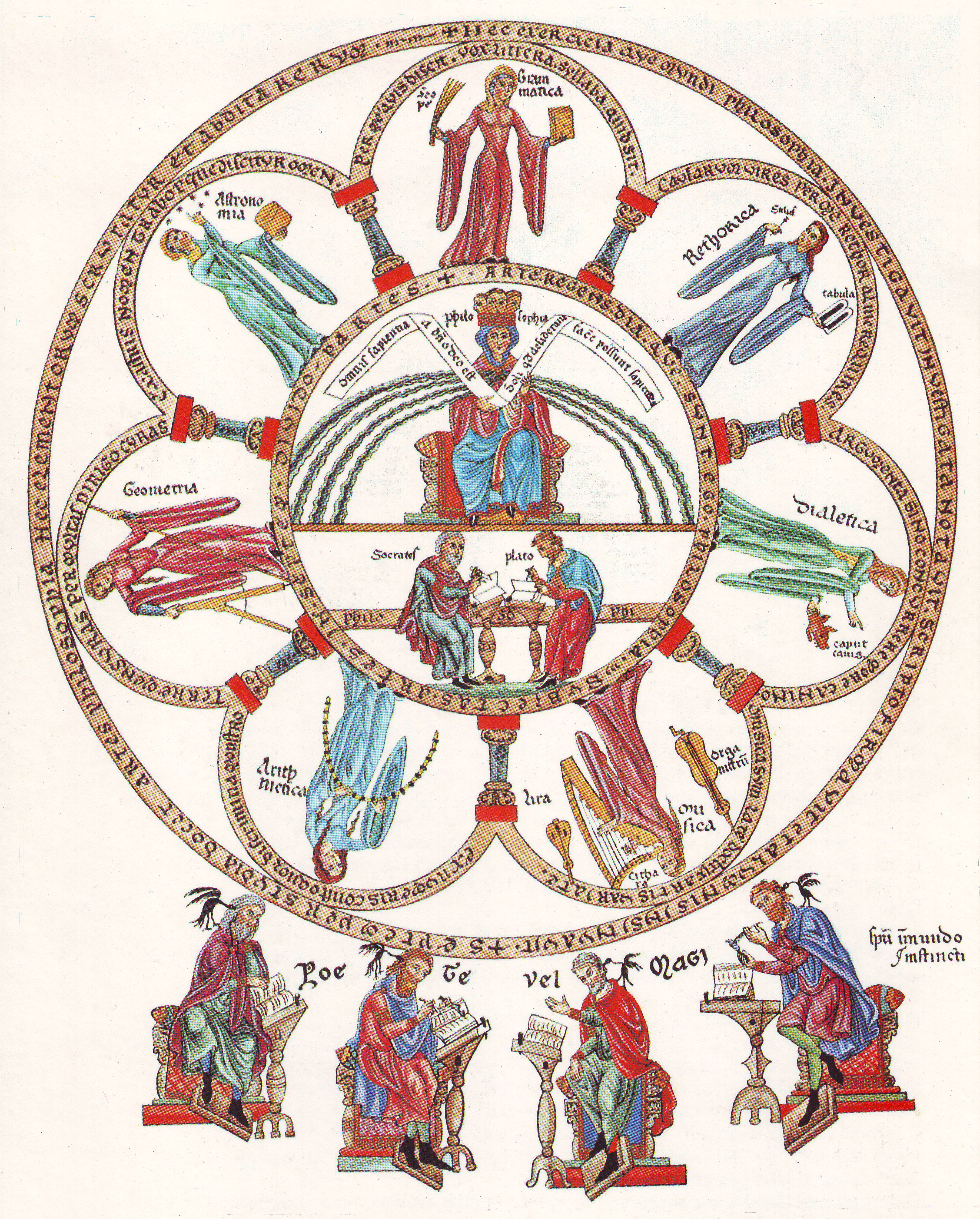
The Liberal Arts
(Public Domain)
Advent
16 December 2016
The Edge of Elfland
Hudson, New Hampshire
Dear Readers,
Having twins, working from home, trying to read, write, research, teach, etc. It can all be rather a lot. And sometimes, things get left behind. They must. One man (or woman) cannot do it all. Unfortunately, this has sometimes meant intentional time with my children while I try to write these letters, grade papers, do research and so on. But, I’m trying to turn that around. I want to be intentional in how I teach and engage with my children. So, to that end, I have begun to work on and implement a curriculum for my children. I’m sure it has gaps, and that reading things from Steiner and other educational theorists would likely be helpful. But for the time being this is what I have and I would love your comments on it.
The key, as I see it, is to engage my children in various things as is fitting for their age. So, what I am about to lay out is my rough curriculum, based, in part on the seven liberal arts: the trivium grammar, logic, and rhetoric; and the quadrivium arithmetic, geometry, music, and astronomy. We will also dabble in philosophy, theology, biology and other various branches of knowledge as well as art. Here’s how it “works”.
For the trivium, the key is introducing my children to words, stories, and poetry. These don’t, necessarily map onto the three branches of the trivium exactly. But the idea is to introduce my children not only to language in the abstract, but language through story and poetry. I want to engage my children’s imagination, help form and shape it. But I also want to introduce them to poetry, that height of human language. We do this through reading stories and children’s poetry. Sure, not all of it is of the highest quality. That can be difficult to find in works for the two year old’s attention span, but not all is lost. My children, for instance, love The Gruffalo and all thing Julia Donaldson. They’re starting to like Dr. Seuss and the old Curious George stories, etc.
For the quadrivium things are actually even easier. We work on counting, recognizing numbers, shapes, colors. They’re perhaps too young to understand the finer points of arithmetic, or geometry, but we can introduce the ideas to them. Besides, the ability to recognize a shape is the first step in learning how it works with its angles, lines, points, etc. What’s more, we sing! Every night we sing a couple of songs and I am trying now to both have times of singing during the day as well as engage in some singing (or praying) as I go about my daily duties (washing dishes, doing the laundry, etc.).
For other arts and sciences we do things like play. We build with blocks, or work train tracks (which are lessons in physics). We learn to recognize animals and the sounds they make. We color or play with differently. My kids are wild for shows like Wild Kratts which are really helpful here, as of course, are stories.
For philosophy and theology again most of it comes through story and song. Other than ethics, it is perhaps a bit much to suggest that I’m teaching my children philosophy. Unless you want to count, and I think you should, that the way I am trying to engage their imaginations will affect how they view and understand reality, which is ultimately a lesson in metaphysics.
Theology is a bit easier. This we engage in chiefly through ritual. Every night we pray. One of the most amazing things about this has been how are children decide to pray. While most of Lauren and I’s prayers for and with them have to do with having a good night’s sleep. But Theodore, when he prays, just starts a litany of the people for whom he’d like to pray. This is usually a list of his cousins, Mémère and Pépère, Laure and I, etc. We didn’t teach him that. He came up with that on his own. Advent is a wonderful time to work on this as well as we say a prayer together and light candles. These are moments to show our children who God is and what he is like, through the rituals of our daily life and the Church Calendar.
Now, this is the ideal. We certainly don’t engage in each of these activities everyday. Also, Lauren and I have different things at which we’re good (I’m not great at the arts and crafts stuff, for instance). So each day looks a little different, but we’re trying, as parents, to be more intentional in how we educate and raise our children. We do and often will fail, but we’re trying.
So, what about you? Do you homeschool? When did you start? What curricula do/did you use? Does this plan sound tenable? Let me know.
Sincerely,
David
Browse Our Archives
Select a Category A Secular Age Advent Apologetics Atheism Beauty Being a Catholic Evangelical Being Catholic Being Deified: Poetry and Fantasy on the Path to God Blogging Book Reviews C. S. Lewis Catholic Imagination Catholic Social Teaching Catholicism Christmas Church Calendar Church Fathers Church Life Community Conferences Cosmology Creation Curdled Words Deification Distributism Easter Economics Education Epiphany Essay Extracts Eucharist Faerie Faeriean Metaphysics Fatherhood Films Folk Liturgy Food and Drink G. K. Chesterton Harry Potter J. R. R. Tolkien Jove King Arthur Language Lent Life Literature and Poetry Liturgy Medieval Theology Music My Publications Mythology On the Edges of Elfland Ordinary Time Ordination Parenthood Parish Patristic Theology Pentecost Politics Prayer Racism Radical Orthodoxy Restoration Movement Sacramental Ontology Saints Science Sex and Sexuality Sophiology Stories The Inklings The Radical Catholic Reimagination of Everything Theologians in the Church Theopoetics Thesis Research Uncategorized University of Nottingham What I'm Reading Writing
Select a Month December 2019 November 2019 October 2019 September 2019 August 2019 July 2019 June 2019 May 2019 April 2019 March 2019 February 2019 January 2019 December 2018 November 2018 October 2018 September 2018 August 2018 July 2018 June 2018 May 2018 April 2018 March 2018 February 2018 January 2018 December 2017 November 2017 October 2017 August 2017 July 2017 June 2017 May 2017 April 2017 March 2017 February 2017 January 2017 December 2016 November 2016 October 2016 September 2016 August 2016 July 2016 June 2016 May 2016 April 2016 March 2016 February 2016 January 2016 December 2015 November 2015 October 2015 September 2015 August 2015 July 2015 June 2015 May 2015 April 2015 March 2015 February 2015 January 2015 December 2014 November 2014 October 2014 September 2014 August 2014 July 2014 June 2014 May 2014 April 2014 March 2014 February 2014 January 2014 December 2013 November 2013 October 2013 September 2013 August 2013 July 2013 June 2013 May 2013 April 2013 March 2013 February 2013 January 2013 December 2012 November 2012 October 2012 September 2012 July 2012
Follow Us!
TAKE THE
Religious Wisdom Quiz
In Revelation, what color is the horse ridden by Death?
Select your answer to see how you score.
Black Pale (or green) White Red
Related posts from Letters from the Edge of Elfland

William Blake on the Creative Spirit, Beauty, and...
Letters from the Edge of Elfland

“Wherefore stopp’st thou me?” Coleridge’s Creative Message to...
Letters from the Edge of Elfland
Good Morning, Mr. Magpie: On Folklore and Science
Letters from the Edge of Elfland
Letters from the Edge of Elfland
TRENDING AT PATHEOS Catholic

Rejecting Doom: Christian Hope And Human Action
Christianity is a religion of hope. We are to have hope and...

It’s What Comes From Within Which Matters
One of the most difficult things for us to understand is why...

Why I Choose the Eucharist Over the Sermon
Choose the Eucharist, Not the Sermon What are we supposed to get...

5 Design Elements Found in Spiritually Rooted Homes
Putting Spirituality Into Home Decor Our homes are more than our living...

Credo: A Story of God Told with the...
About 10 years ago, I began to imagine a personal "Credo" that...

The Anatomy of Divine Revelation in Catholic Thought
The claim that God has made Himself known to human beings is...
view all Catholic blogs
Ad-Free & Subscriber Log-In Subscription Support
- About Us
- 2026 Calendar
- Videos
- Podcasts
- Library of World Religions
- Faith In Media Tracker
- Advertise With Us
- Write for Us
- Privacy Policy
- Terms of Service
- Do Not Sell My Data
- Contact Us
- Radiant Digital
- Manage Newsletter Subscriptions
- Unsubscribe From Notifications
- Sitemap
Copyright 2008-2026, Patheos. All rights reserved.
Subscription Support Ad-Free & Subscriber Log-In
Follow Patheos