
BuddhistCatholicContemplativeEvangelicalGeneral ChristianHinduJewishLatter-day SaintMuslimNew VisionsProgressive Christian
Beliefs
- Buddhist
- Catholic
- Contemplative
- Evangelical
- General Christian
- Hindu
- Jewish
- Latter-day Saint
- More Voices
- Muslim
- New Visions
- Pagan
- Progressive Christian
Topics
- Religion News
- Food and Religion
- Sports and Religion
- Religious Art
- Religious Music and Entertainment
- Religious Events
- History and Religion
- Style and Religion
- Politics and Religion
- Women in Religion
- Recreation Outdoors and Religion
- Business Finance and Religion
- Careers Workplace and Religion
- Education and Religion
- Family Parenting and Religion
- Health Fitness and Religion
- Home and Religion
- Relationships and Religion
- Technology and Religion
- Travel and Religion
Columnists
- Buddhist Columnists
- Business Finance and Religion Columnists
- Careers Workplace and Religion Columnists
- Catholic Columnists
- Contemplative Columnists
- Education and Religion Columnists
- Evangelists Columnists
- Family Parenting and Religion Columnists
- General Christian Columnists
- Health Fitness and Religion Columnists
- Hindu Columnists
- History and Religion Columnists
- Home and Religion Columnists
- Jewish Columnists
- More Voices Columnists
- Latter Day Columnists
- Muslim Columnists
- New Visions Columnists
- Nonreligious Columnists
- Pagan Columnists
- Politics and Religion Columnists
- Progressive Columnists
- Recreation Outdoors and Religion Columnists
- Relationships and Religion Columnists
- Religion News Columnists
- Religious Art Columnists
- Religious Events Columnists
- Religious Music and Entertainment Columnists
- Sports and Religion Columnists
- Style and Religion Columnists
- Technology and Religion Columnists
- Travel and Religion Columnists
- Women in Religion Columnists
Resource Library
- 2026 Calendar
- Library of World Religions
- The 100 Most Holy Places on Earth
- Patheos Answers
- Podcasts
- Videos
- Faith Leaders Database
- Anglican Episcopalian
- Bahai
- Baptist
- Buddhism
- Christianity
- Confucianism
- Eastern Orthodoxy
- Hinduism
- Holiness and Pentecostal
- ISKCON
- Islam
- Judaism
- Lutheran
- Methodist
- The Church of Jesus Christ of Latter-day Saints
- New Age
- Paganism
- Presbytarian and Reformed
- Protestantism
- Religion Behind the Scenes
- Roman Catholic
- Scientology
- Shia Islam
- Sikhism
- Sufism
- Sunni Islam
- Taoism
- Zen
- See all religions
Research Tools
 Ad-Free & Subscriber Log-In Subscription Support
Ad-Free & Subscriber Log-In Subscription Support
Follow Patheos 

- Trending:
- Forgiveness
- |
- Marriage
- |
- Consciousness
- |
- Death Penalty
- |
- Election
- |
- Halloween
 Letters from the Edge of Elfland
- Home
- About
- Distributist Resources
- Publications and Presentations
- Support
- Works in Progress
- The Epistolarian Around the Web
- Home
- Catholic
- Adventual Reflections on Silence, Whisky, Nick Offerman, and Pipe Smoking
Adventual Reflections on Silence, Whisky, Nick Offerman, and Pipe Smoking
Last updated on: December 12, 2016 at 12:12 pm by David Russell Mosley
Adventual Reflections on Silence, Whisky, Nick Offerman, and Pipe Smoking 2016-12-12T12:12:50-04:00 David Russell Mosley
Patheos Explore the world's faith through different perspectives on religion and spirituality! Patheos has the views of the prevalent religions and spiritualities of the world.
David Russell Mosley
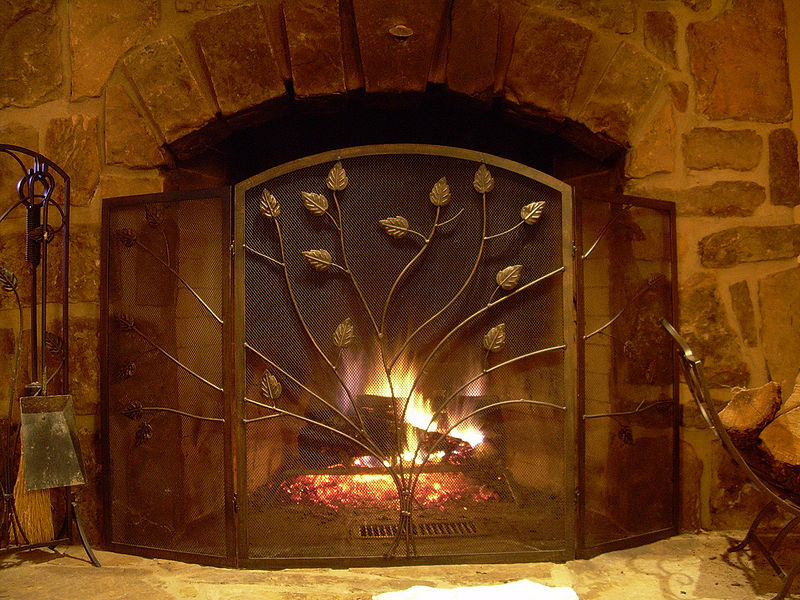
Description
English: Photo of a stone fireplace.
Date 10 December 2007
Source Own work
Author ErgoSum88
Public Domain
Advent
12 December 2016
The Edge of Elfland
Hudson, New Hampshire
Dear Readers,
Today, Nick Offerman’s YouTube channel, My Tales of Whisky, released a few new videos. These videos, in many ways, serve as a continuation of Offerman’s character Ron Swanson (in attitude if not in name) from the popular television series Parks and Recreation. These videos can swerve drastically into the ridiculous, since Offerman is a comedian, but all center on one topic, the drinking and making of whisky.
Last year, Offerman’s channel produced an unexpectedly popular video, “Nick Offerman’s ‘Yule Log’.” You can watch it below, but it is very easy to describe. Nick Offerman sits in a room with a fire burning and drinks Lagavulin single-malt Scottish whisky, for forty-five minutes. Later they developed a looped version which lasts for 10 hours. This year, My Tales of Whisky, put out a similar version for New Year’s Eve. Offerman sits alone in a chair just outside the Lagavulin Distillery as the people behind him celebrate the coming New Year. The video lasts just over an hour and while you can hear music and people celebrating in the background, the foregrounded image of Offerman sitting in silence, drinking whisky is the enduring image. But why is this so attractive to us? And what, if anything, does this have to do with Advent?
I want to suggest that silence is the key here. I think the temptation to noise has been present in every age of human history. But there is no denying that it is in so many ways easier to indulge in noise today. Right now, as I write this, I have both the video of the Yule Log going and my children are watching the kids program Octonauts. And of course so many of us have phones capable of playing music, not to mention texting, phone calls, Facebook and more. Radios, TV, computers, smart phones, muzak at coffeeshops, we’re surrounded by sound. What attracts us, then, or at least me, about these videos is the opportunity for real silence. Sure, in both videos there is sound. Offerman is not in a sensory deprivation chamber, but, particularly in the first video, the sound is a pleasing one, one that isn’t a distraction in itself, one that lends itself to contemplation. Which brings me to my next point: Silence leads to contemplation.
What I find so idyllic about Offerman sitting quietly, sipping his whisky, as the fire burns next to him, is the opportunity such an event would provide for contemplation. I’m actually quite bad at silence and contemplation. I learned this very quickly when I spent a weekend with Benedictine monks in England. And yet, to truly contemplate (which Pieper would say is the “point” of leisure) requires silence of a particular kind. Certain sounds, certain noises or activities can be allowed insofar as they are aids to contemplation. I think the drinking of whisky and the smoking of pipe tobacco can be two such aids. Whisky is, I think, the most contemplative of drinks. Beer is the most common and thus the most communal, wine is the most convivial, but whisky is the most contemplative. Whether one is attempting to ascertain the various notes on the nose or on the tongue; or whether the liquors subtle effects, when drunk none too quickly nor too slowly, leads one to think deeply. In any case, when treated rightly, whisky can be an aid to the contemplative life (beer and wine as well, but I think they’re better suited to community).
Pipe smoking too can be this kind of aid. Pipe smoking cannot be done in a trice. First one must prepare one’s pipe. In some cases this means preparing the tobacco itself, but at the very least one must carefully pack one’s pipe. Packed too tight it will be difficult to get a good draw. Packed too loose and it will burn to hot and sting your tongue. Then there is the light. Lighting a pipe is not like lighting a cigarette. You often need to light it at least twice in order to get it going. Then you smoke, but not too quickly or you’ll burn yourself and not too slowly so your pipe goes out. These activities, whisky drinking and pipe smoking, can be real aids in getting us to slow down, to listen to the silence, and to contemplate.
All this leads me to Advent. For us in the Northern Hemisphere, Advent takes place in the late Autumn and early Winter. The days continue to get shorter and colder, our Advent candles increasingly burn lower, especially the candle from the first week, and the light slowly goes out of the world as we wait for the Light to come into the world. It is so easy to get lost in the noise of shopping, commercialism, and individualism that run rampant during the Advent season as it leads up to the commercial celebration of Christmas. And yet, this is, I think the perfect time to practice the virtues of silence and contemplation. The darker days, and in some places snow, can provide us with more opportunities for staying home and thinking. The approach of the feast of the Nativity of Our Lord (also known as Christmas), can remind us to get our minds straight, to remember––if you allow me this rather cliché aphorism––the reason for the season. Christ is coming and we would do well to think about that, to consider it, to contemplate it as a past, a present, and future reality. For those places, like my home here in New Hampshire, where it does get cold, the warming effects of whisky and pipe tobacco are fitting. Thus, they can help us prepare for the coming feast, for the coming celebration of our Lord, and can help us prepare for his return.
Now, whisky and pipe tobacco are tools, useful in the art of contemplation and silence, but not necessary. If you’re a teetotaler, a recovering alcoholic, an asthmatic, or for any other reason cannot, do not, or will not partake of either, you can still engage in silence and contemplation. I only recommend these tools for two reasons. First, they are, on their own, quite enjoyable, regardless of whether or not they lead you into deeper contemplations about reality, Christ, or your personal holiness. Second, they can be useful in putting us into situations where we can be quiet and contemplate. But of course, going to church can, or ought to, provide those same opportunities. And you likely can find them at home with the right amount effort. So, whether you do so with whisky and tobacco or not, let me recommend to you silence and contemplation this Advent.
Slàinte!
David
Previous Post
December 7, 2016
Beginning Work on a Christmas Ghost Story Including a Short Excerpt
Browse Our Archives
Select a Category A Secular Age Advent Apologetics Atheism Beauty Being a Catholic Evangelical Being Catholic Being Deified: Poetry and Fantasy on the Path to God Blogging Book Reviews C. S. Lewis Catholic Imagination Catholic Social Teaching Catholicism Christmas Church Calendar Church Fathers Church Life Community Conferences Cosmology Creation Curdled Words Deification Distributism Easter Economics Education Epiphany Essay Extracts Eucharist Faerie Faeriean Metaphysics Fatherhood Films Folk Liturgy Food and Drink G. K. Chesterton Harry Potter J. R. R. Tolkien Jove King Arthur Language Lent Life Literature and Poetry Liturgy Medieval Theology Music My Publications Mythology On the Edges of Elfland Ordinary Time Ordination Parenthood Parish Patristic Theology Pentecost Politics Prayer Racism Radical Orthodoxy Restoration Movement Sacramental Ontology Saints Science Sex and Sexuality Sophiology Stories The Inklings The Radical Catholic Reimagination of Everything Theologians in the Church Theopoetics Thesis Research Uncategorized University of Nottingham What I'm Reading Writing
Select a Month December 2019 November 2019 October 2019 September 2019 August 2019 July 2019 June 2019 May 2019 April 2019 March 2019 February 2019 January 2019 December 2018 November 2018 October 2018 September 2018 August 2018 July 2018 June 2018 May 2018 April 2018 March 2018 February 2018 January 2018 December 2017 November 2017 October 2017 August 2017 July 2017 June 2017 May 2017 April 2017 March 2017 February 2017 January 2017 December 2016 November 2016 October 2016 September 2016 August 2016 July 2016 June 2016 May 2016 April 2016 March 2016 February 2016 January 2016 December 2015 November 2015 October 2015 September 2015 August 2015 July 2015 June 2015 May 2015 April 2015 March 2015 February 2015 January 2015 December 2014 November 2014 October 2014 September 2014 August 2014 July 2014 June 2014 May 2014 April 2014 March 2014 February 2014 January 2014 December 2013 November 2013 October 2013 September 2013 August 2013 July 2013 June 2013 May 2013 April 2013 March 2013 February 2013 January 2013 December 2012 November 2012 October 2012 September 2012 July 2012
Follow Us!
TAKE THE
Religious Wisdom Quiz
I am confidence in what is hoped for and assurance about what is not seen. Without me, it's impossible to please God. What am I?
Select your answer to see how you score.
Hope Belief Faith Trust
Related posts from Letters from the Edge of Elfland
Enduring the Valleys of Life: My Struggle with...
Letters from the Edge of Elfland
Letters from the Edge of Elfland
Letters from the Edge of Elfland
On the First Day of Advent: Taking Twin...
Letters from the Edge of Elfland
TRENDING AT PATHEOS Catholic

Rejecting Doom: Christian Hope And Human Action
Christianity is a religion of hope. We are to have hope and...

It’s What Comes From Within Which Matters
One of the most difficult things for us to understand is why...

Why I Choose the Eucharist Over the Sermon
Choose the Eucharist, Not the Sermon What are we supposed to get...

5 Design Elements Found in Spiritually Rooted Homes
Putting Spirituality Into Home Decor Our homes are more than our living...

Credo: A Story of God Told with the...
About 10 years ago, I began to imagine a personal "Credo" that...

The Anatomy of Divine Revelation in Catholic Thought
The claim that God has made Himself known to human beings is...
view all Catholic blogs
Ad-Free & Subscriber Log-In Subscription Support
- About Us
- 2026 Calendar
- Videos
- Podcasts
- Library of World Religions
- Faith In Media Tracker
- Advertise With Us
- Write for Us
- Privacy Policy
- Terms of Service
- Do Not Sell My Data
- Contact Us
- Radiant Digital
- Manage Newsletter Subscriptions
- Unsubscribe From Notifications
- Sitemap
Copyright 2008-2026, Patheos. All rights reserved.
Subscription Support Ad-Free & Subscriber Log-In
Follow Patheos