
BuddhistCatholicContemplativeEvangelicalGeneral ChristianHinduJewishLatter-day SaintMuslimNew VisionsProgressive Christian
Beliefs
- Buddhist
- Catholic
- Contemplative
- Evangelical
- General Christian
- Hindu
- Jewish
- Latter-day Saint
- More Voices
- Muslim
- New Visions
- Pagan
- Progressive Christian
Topics
- Religion News
- Food and Religion
- Sports and Religion
- Religious Art
- Religious Music and Entertainment
- Religious Events
- History and Religion
- Style and Religion
- Politics and Religion
- Women in Religion
- Recreation Outdoors and Religion
- Business Finance and Religion
- Careers Workplace and Religion
- Education and Religion
- Family Parenting and Religion
- Health Fitness and Religion
- Home and Religion
- Relationships and Religion
- Technology and Religion
- Travel and Religion
Columnists
- Buddhist Columnists
- Business Finance and Religion Columnists
- Careers Workplace and Religion Columnists
- Catholic Columnists
- Contemplative Columnists
- Education and Religion Columnists
- Evangelists Columnists
- Family Parenting and Religion Columnists
- General Christian Columnists
- Health Fitness and Religion Columnists
- Hindu Columnists
- History and Religion Columnists
- Home and Religion Columnists
- Jewish Columnists
- More Voices Columnists
- Latter Day Columnists
- Muslim Columnists
- New Visions Columnists
- Nonreligious Columnists
- Pagan Columnists
- Politics and Religion Columnists
- Progressive Columnists
- Recreation Outdoors and Religion Columnists
- Relationships and Religion Columnists
- Religion News Columnists
- Religious Art Columnists
- Religious Events Columnists
- Religious Music and Entertainment Columnists
- Sports and Religion Columnists
- Style and Religion Columnists
- Technology and Religion Columnists
- Travel and Religion Columnists
- Women in Religion Columnists
Resource Library
- 2026 Calendar
- Library of World Religions
- The 100 Most Holy Places on Earth
- Patheos Answers
- Podcasts
- Videos
- Faith Leaders Database
- Anglican Episcopalian
- Bahai
- Baptist
- Buddhism
- Christianity
- Confucianism
- Eastern Orthodoxy
- Hinduism
- Holiness and Pentecostal
- ISKCON
- Islam
- Judaism
- Lutheran
- Methodist
- The Church of Jesus Christ of Latter-day Saints
- New Age
- Paganism
- Presbytarian and Reformed
- Protestantism
- Religion Behind the Scenes
- Roman Catholic
- Scientology
- Shia Islam
- Sikhism
- Sufism
- Sunni Islam
- Taoism
- Zen
- See all religions
Research Tools
 Ad-Free & Subscriber Log-In Subscription Support
Ad-Free & Subscriber Log-In Subscription Support
Follow Patheos 

- Trending:
- Forgiveness
- |
- Marriage
- |
- Consciousness
- |
- Death Penalty
- |
- Election
- |
- Halloween
 Letters from the Edge of Elfland
- Home
- About
- Distributist Resources
- Publications and Presentations
- Support
- Works in Progress
- The Epistolarian Around the Web
- Home
- Catholic
- Handling the “Race” of Santa Claus: Exercises in Imagination and Gratuity
Handling the “Race” of Santa Claus: Exercises in Imagination and Gratuity
Last updated on: December 5, 2016 at 10:12 am by David Russell Mosley
Handling the “Race” of Santa Claus: Exercises in Imagination and Gratuity 2016-12-05T10:12:15-04:00 David Russell Mosley
Patheos Explore the world's faith through different perspectives on religion and spirituality! Patheos has the views of the prevalent religions and spiritualities of the world.
David Russell Mosley
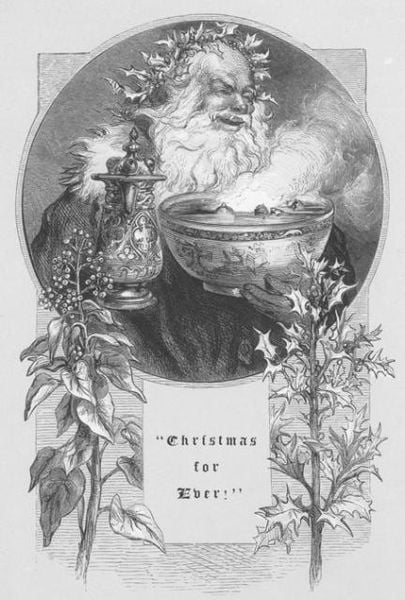
Date 1864
Source http://www.reusableart.com/d/1194-2/santa-08.jpg
Gallery page http://www.reusableart.com/v/christmas/santa/santa-08.jpg.html
Author Sir John Gilbert (1817-1897)
(Public Domain)
Advent
5 December 2016
The Edge of Elfland
Hudson, New Hampshire
Dear Readers,
It seems that every year I encounter something that makes feel the need to give a defense of Father Christmas, often known here in the States as Santa Claus. This year is no different. A few days ago, the Mall of America hired its first black Santa. Apparently this is a big deal. Actually, in some ways I can understand why it is. After all a few years ago, Megan Kelly lost it at the idea that, in order to be racially inclusive, some people were considering representing Santa as a penguin. Now, I must admit, I find this equally ridiculous. For starters, penguins are antarctic creatures, not arctic creatures. A polar bear would make infinitely more sense. Or a reindeer. Still, I do think it rather important that he remain a man. But how are we to handle his race? Or ought we to? Ought we to abandon Santa altogether? Well, let me attempt a few answers.
One possible way to answer this question is to get historical. St. Nicholas of Myra was from modern day Turkey. So, he certainly wouldn’t look like me or the red-haired version in the Rankin-Bass Santa Claus is Coming to Town. The problem with this, of course, is that St. Nicholas is dead. We celebrate that fact tomorrow (December 6th). Now, this could certainly add an interesting element to the story of Santa: zombie Santa! But that seems to miss the point of Santa (to which I will return). So, if you still want to tell your kids that someone comes to their house one night a year and gives them presents, it might be best not to tell them that it’s a dead guy.
Instead, I think we need to allow Santa to be culturally adaptable. Now, this is actually quite difficult in many ways. After all, a black family can tell stories about a black Santa, but if they let their kids watch TV Christmas specials, or go to most malls, they’re likely to see a white Santa. After all, blacks are still a minority in the United States, and when that’s combined with aspects of institutional racism, black children are going to be far more likely to encounter white Santas. But in a sense, this is why we need characters like Santa, we need them to transcend these issues of race.
This is one of many reasons I prefer Father Christmas to Santa Claus. Santa Claus embroils us in issues of an undead historical figure sneaking into our houses at night. That’s Dracula’s territory. Father Christmas, can be totally adaptable, and yet still relatable to Santa Claus. But whether we go with Father Christmas, Santa Claus, Kris Kringle, he can become within reason, whatever we need him to be. Think about all the depictions of Christ, the Virgin Mary, or any of the saints. Depending on who’s doing the painting, they can appear white, black, Asian, or more like their actual ethnicities. The key is that these figures, while historical, have also transcended their historicity. They have come to mean more than just the brute facts of where and when they were born. Not that they have left these behind. Christ is still a first-century Jew, Nicholas of Myra is still a Greek-Turk, and yet they are not just those things. One is the Son of God, the second person of the Trinity. The other is a saint, one who can intercede on our behalf. They are both so much bigger than their historical circumstances that they are their historical circumstances as well (this is similar to how it is precisely God’s transcendence that allows his immanence). It is precisely, now anyway, because St. Nicholas is St. Nicholas that allows him also to be Nicholas of Myra, the man who punched Arius, the man who left bags of gold for three young women about to be sold into slavery. And yet, of course, it is these things that show him to be saint, just as it is Christ’s life that showed him to be the Son of God, or that it is God’s immanence that allows us to understand the he is transcendent.
So, back to Santa Claus. I, of course, have no problem with the Mall of America hiring a black Santa (though I might take issue with the whole notion of malls, which sell toys, hiring Santas to help sell those toys). Father Christmas transcends race and ethnicity and therefore can be represented by any race or ethnicity. The more important thing to remember here is what Father Christmas represents. He represents generosity and gratuity. As G. K. Chesterton writes in Orthodoxy, “Children are grateful when Santa Claus puts in their stockings gifts of toys or sweets. Could I not be grateful to Santa Claus when he put in my stockings the gift of two miraculous legs? We thank people for birthday presents of cigars and slippers. Can I thank no one for the birthday present of birth?” Santa, like all the saints, is actually a representation of Christ, of God. He is an embodiment of our need to be thankful to someone for the gift of our being. Of course, God is the one to whom we ought to be thankful, and that is precisely what we are doing when we are thankful to Father Christmas for gifts, especially for the gift of being.
So be thankful, be grateful. And stop complaining about the “race” of Santa Claus.
Sincerely,
David



Next Post

December 7, 2016 Beginning Work on a Christmas Ghost Story Including a Short Excerpt
Browse Our Archives
Select a Category A Secular Age Advent Apologetics Atheism Beauty Being a Catholic Evangelical Being Catholic Being Deified: Poetry and Fantasy on the Path to God Blogging Book Reviews C. S. Lewis Catholic Imagination Catholic Social Teaching Catholicism Christmas Church Calendar Church Fathers Church Life Community Conferences Cosmology Creation Curdled Words Deification Distributism Easter Economics Education Epiphany Essay Extracts Eucharist Faerie Faeriean Metaphysics Fatherhood Films Folk Liturgy Food and Drink G. K. Chesterton Harry Potter J. R. R. Tolkien Jove King Arthur Language Lent Life Literature and Poetry Liturgy Medieval Theology Music My Publications Mythology On the Edges of Elfland Ordinary Time Ordination Parenthood Parish Patristic Theology Pentecost Politics Prayer Racism Radical Orthodoxy Restoration Movement Sacramental Ontology Saints Science Sex and Sexuality Sophiology Stories The Inklings The Radical Catholic Reimagination of Everything Theologians in the Church Theopoetics Thesis Research Uncategorized University of Nottingham What I'm Reading Writing
Select a Month December 2019 November 2019 October 2019 September 2019 August 2019 July 2019 June 2019 May 2019 April 2019 March 2019 February 2019 January 2019 December 2018 November 2018 October 2018 September 2018 August 2018 July 2018 June 2018 May 2018 April 2018 March 2018 February 2018 January 2018 December 2017 November 2017 October 2017 August 2017 July 2017 June 2017 May 2017 April 2017 March 2017 February 2017 January 2017 December 2016 November 2016 October 2016 September 2016 August 2016 July 2016 June 2016 May 2016 April 2016 March 2016 February 2016 January 2016 December 2015 November 2015 October 2015 September 2015 August 2015 July 2015 June 2015 May 2015 April 2015 March 2015 February 2015 January 2015 December 2014 November 2014 October 2014 September 2014 August 2014 July 2014 June 2014 May 2014 April 2014 March 2014 February 2014 January 2014 December 2013 November 2013 October 2013 September 2013 August 2013 July 2013 June 2013 May 2013 April 2013 March 2013 February 2013 January 2013 December 2012 November 2012 October 2012 September 2012 July 2012
Follow Us!
TAKE THE
Religious Wisdom Quiz
Which book of the Bible contains the Ten Commandments?
Select your answer to see how you score.
Leviticus Genesis Numbers Exodus
Related posts from Letters from the Edge of Elfland

William Blake on the Creative Spirit, Beauty, and...
Letters from the Edge of Elfland

“Wherefore stopp’st thou me?” Coleridge’s Creative Message to...
Letters from the Edge of Elfland

Good Morning, Mr. Magpie: On Folklore and Science
Letters from the Edge of Elfland
Letters from the Edge of Elfland
TRENDING AT PATHEOS Catholic

Creation, Preservation, and Teleology in Catholic Theology
As I write this, it is very early Monday morning. Like millions...

The Parable Of The Sower And The Word...
One of Christ’s most famous parables is that of the sower who...

Rejecting Doom: Christian Hope And Human Action
Christianity is a religion of hope. We are to have hope and...

Why I Choose the Eucharist Over the Sermon
Choose the Eucharist, Not the Sermon What are we supposed to get...

5 Design Elements Found in Spiritually Rooted Homes
Putting Spirituality Into Home Decor Our homes are more than our living...

Credo: A Story of God Told with the...
About 10 years ago, I began to imagine a personal "Credo" that...
view all Catholic blogs
Ad-Free & Subscriber Log-In Subscription Support
- About Us
- 2026 Calendar
- Videos
- Podcasts
- Library of World Religions
- Faith In Media Tracker
- Advertise With Us
- Write for Us
- Privacy Policy
- Terms of Service
- Do Not Sell My Data
- Contact Us
- Radiant Digital
- Manage Newsletter Subscriptions
- Unsubscribe From Notifications
- Sitemap
Copyright 2008-2026, Patheos. All rights reserved.
Subscription Support Ad-Free & Subscriber Log-In
Follow Patheos