
BuddhistCatholicContemplativeEvangelicalGeneral ChristianHinduJewishLatter-day SaintMuslimNew VisionsProgressive Christian
Beliefs
- Buddhist
- Catholic
- Contemplative
- Evangelical
- General Christian
- Hindu
- Jewish
- Latter-day Saint
- More Voices
- Muslim
- New Visions
- Pagan
- Progressive Christian
Topics
- Religion News
- Food and Religion
- Sports and Religion
- Religious Art
- Religious Music and Entertainment
- Religious Events
- History and Religion
- Style and Religion
- Politics and Religion
- Women in Religion
- Recreation Outdoors and Religion
- Business Finance and Religion
- Careers Workplace and Religion
- Education and Religion
- Family Parenting and Religion
- Health Fitness and Religion
- Home and Religion
- Relationships and Religion
- Technology and Religion
- Travel and Religion
Columnists
- Buddhist Columnists
- Business Finance and Religion Columnists
- Careers Workplace and Religion Columnists
- Catholic Columnists
- Contemplative Columnists
- Education and Religion Columnists
- Evangelists Columnists
- Family Parenting and Religion Columnists
- General Christian Columnists
- Health Fitness and Religion Columnists
- Hindu Columnists
- History and Religion Columnists
- Home and Religion Columnists
- Jewish Columnists
- More Voices Columnists
- Latter Day Columnists
- Muslim Columnists
- New Visions Columnists
- Nonreligious Columnists
- Pagan Columnists
- Politics and Religion Columnists
- Progressive Columnists
- Recreation Outdoors and Religion Columnists
- Relationships and Religion Columnists
- Religion News Columnists
- Religious Art Columnists
- Religious Events Columnists
- Religious Music and Entertainment Columnists
- Sports and Religion Columnists
- Style and Religion Columnists
- Technology and Religion Columnists
- Travel and Religion Columnists
- Women in Religion Columnists
Resource Library
- 2026 Calendar
- Library of World Religions
- The 100 Most Holy Places on Earth
- Patheos Answers
- Podcasts
- Videos
- Faith Leaders Database
- Anglican Episcopalian
- Bahai
- Baptist
- Buddhism
- Christianity
- Confucianism
- Eastern Orthodoxy
- Hinduism
- Holiness and Pentecostal
- ISKCON
- Islam
- Judaism
- Lutheran
- Methodist
- The Church of Jesus Christ of Latter-day Saints
- New Age
- Paganism
- Presbytarian and Reformed
- Protestantism
- Religion Behind the Scenes
- Roman Catholic
- Scientology
- Shia Islam
- Sikhism
- Sufism
- Sunni Islam
- Taoism
- Zen
- See all religions
Research Tools
 Ad-Free & Subscriber Log-In Subscription Support
Ad-Free & Subscriber Log-In Subscription Support
Follow Patheos 

- Trending:
- Forgiveness
- |
- Marriage
- |
- Consciousness
- |
- Death Penalty
- |
- Election
- |
- Halloween
 Letters from the Edge of Elfland
- Home
- About
- Distributist Resources
- Publications and Presentations
- Support
- Works in Progress
- The Epistolarian Around the Web
- Home
- Catholic
- The Society of Trees: What the Trees Can Teach Us
The Society of Trees: What the Trees Can Teach Us
Last updated on: September 26, 2016 at 2:54 pm by David Russell Mosley
The Society of Trees: What the Trees Can Teach Us 2016-09-26T14:54:38-04:00 David Russell Mosley
Patheos Explore the world's faith through different perspectives on religion and spirituality! Patheos has the views of the prevalent religions and spiritualities of the world.
David Russell Mosley
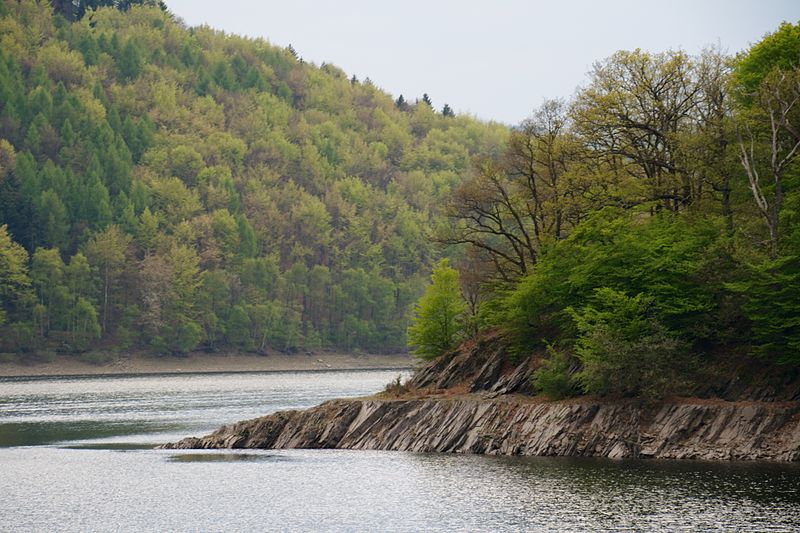
Description
Deutsch: Nationalpark Eifel, Rursee
Date 22 May 2014, 23:14:09
Source Own work
Author Sjokolade
(CC BY-SA 3.0)
Ordinary Time
23 September 2016
The Edge of Elfland
Hudson, New Hampshire
Dear Readers,
Today thanks to Addison Hodges Hart (older brother to David Bentley Hart) and Kevin Johnson (ringleader at The Inner Room), I read the article at Brain Pickings entitled, “The Secret Life of Trees: The Astonishing Science of What Trees Feel and How They Communicate.” The article is essentially a review of Peter Wohlleben’s book The Hidden Life of Trees: What They Feel, How They Communicate. Wohlleben is a forester in the Eifel Forest in Germany. And this book, it would seem, is a combination of Wohlleben’s experiences working in the forest, especially as he began to see it in a new and fresh light while taking tourists through it, and scientific research into how trees act, react, and even think. I highly recommend the article to you and hope to get my hands on a copy of the book, eventually.
The essence of the article is very similar to that of the article “The Secrets of the Wood Wide Web,” which follows the work of Merlin Sheldrake in noting how fungi create networks in forests and which I wrote about here. Wohllenben even notes this, according to the author of the article, but also sees the trees as in direct communication with one another. They share nutrients by their roots, restrict their growth around friends and only slightly compete with some of their neighbors for resources. The most beautiful example given of this is when Wohlleben encounters moss covered stones:
“The stones were an unusual shape: they were gently curved with hollowed-out areas. Carefully, I lifted the moss on one of the stones. What I found underneath was tree bark. So, these were not stones, after all, but old wood. I was surprised at how hard the “stone” was, because it usually takes only a few years for beechwood lying on damp ground to decompose. But what surprised me most was that I couldn’t lift the wood. It was obviously attached to the ground in some way. I took out my pocketknife and carefully scraped away some of the bark until I got down to a greenish layer. Green? This color is found only in chlorophyll, which makes new leaves green; reserves of chlorophyll are also stored in the trunks of living trees. That could mean only one thing: this piece of wood was still alive! I suddenly noticed that the remaining “stones” formed a distinct pattern: they were arranged in a circle with a diameter of about 5 feet. What I had stumbled upon were the gnarled remains of an enormous ancient tree stump. All that was left were vestiges of the outermost edge. The interior had completely rotted into humus long ago — a clear indication that the tree must have been felled at least four or five hundred years earlier” (presumably a quotation from the book in the article).
These stones turned out to be rather old vestiges of a once enormous tree. They were being kept alive by their own power as well as that of the surrounding trees. For reasons beyond our current comprehension, the forest wanted to keep this tree alive.
It is hard to read an article such as this and not to think of Tolkien. Tolkien was a renowned lover of trees. One of his two most enigmatic characters is so identified with trees that he appears treeish himself, but, it would seem, is not tree. I am, of course, talking about Treebeard, Fangorn, the Ent, perhaps the first of the Onordrim. Tolkien’s invention of the Ents is a curious tale in and of itself. It happened when he encountered the word ent in Anglo-Saxon as a word for giants, which differed from another word for giants eoten. As Tolkien often did when he encountered an interesting or new word in another language, he wrote stories surrounding it and that is how we got the Ents. And yet, it is obvious that the Ents are not giants, not like the ones we meet in The Hobbit anyway. Their own closest cousins, or second closest, are the trolls who are made of stone in mockery of the Ents. The Ents themselves, Treebeard tells us, can become too treeish to the point of practically being trees just as there are trees that can and do become entish to the point of being able to move and wander and attack as we see in the huorns. In any event, Tolkien seemed at least capable of imagining what we are now learning to be true; trees can and do communicate with each other, and likely with other plants and, more subtely, with animals, in their forests. Trees exist in society not just in Tolkien’s Legendarium, but in reality.
Trees have always been fascinating to me. From the large copses far off in the distance that I saw from the road as child, to the actual forests in which I have walked, to the old gnarled trees on totally or semi-forsaken farms. When I was an undergraduate student taking homiletics, one of my professors took the students in my homiletics class on a retreat. We went to a local camp, stayed in a large cabin and spent the weekend practicing various spiritual disciplines. Key among these was silence. We could wander wherever we wanted and simply had to come back at a set time. I took to the woods. Here is a small sample of what I wrote after that walk, forgive the failings of my 20 year old self:
“Have you ever heard someone say that they ‘couldn’t see the forest for the trees?’ well the reverse happened to me, I hadn’t seen the trees for the forest. Then, as I walked out of the wood I noticed a tree and I began to truly see it. I don’t mean that I could not make out what it looked like until that point, but I began to see it for what it truly was, a creature of God’s that did a much better job at being a creature of God than I did.
I began to see how trees do what I do not, they do what God tells them. They stand firm, rooting themselves deep in their community. They provide for their community; homes for some animals, and sources of food for others. They stay where God has called them, through both good times and bad, dry seasons and wet ones. They put up with their neighbors, and are even willing to lay down their lives so that others may live. And if God says it is time for them to die they do not struggle or fight or weep but go as God has called them. Trees embody what we should be, servants, joyful, willing servants.”
As it turns out, trees do fight when attacked and they also provide for more than just their animal neighbors but for each other as well. Still, there is something about the longstanding nature of trees that strikes me. We have much to learn, and the long-viewed nature of trees is something we can learn from them. They do not measure their lives by years, not naturally anyway, but by decades, centuries, even beyond their evident death, as the tree-stones Wohlleben encountered teach us. It would not be a wasted life to sit in a forest and to contemplate the trees. Having a family means I cannot spend all my time so doing, but I am glad of the reminder that I ought to spend more time so doing. I am certain I will learn much.
Sincerely,
David
The Radical Catholic Reimagination of Everything
Previous Post

September 23, 2016
To Autumn: Feasts, Angels, and Joy

Browse Our Archives
Select a Category A Secular Age Advent Apologetics Atheism Beauty Being a Catholic Evangelical Being Catholic Being Deified: Poetry and Fantasy on the Path to God Blogging Book Reviews C. S. Lewis Catholic Imagination Catholic Social Teaching Catholicism Christmas Church Calendar Church Fathers Church Life Community Conferences Cosmology Creation Curdled Words Deification Distributism Easter Economics Education Epiphany Essay Extracts Eucharist Faerie Faeriean Metaphysics Fatherhood Films Folk Liturgy Food and Drink G. K. Chesterton Harry Potter J. R. R. Tolkien Jove King Arthur Language Lent Life Literature and Poetry Liturgy Medieval Theology Music My Publications Mythology On the Edges of Elfland Ordinary Time Ordination Parenthood Parish Patristic Theology Pentecost Politics Prayer Racism Radical Orthodoxy Restoration Movement Sacramental Ontology Saints Science Sex and Sexuality Sophiology Stories The Inklings The Radical Catholic Reimagination of Everything Theologians in the Church Theopoetics Thesis Research Uncategorized University of Nottingham What I'm Reading Writing
Select a Month December 2019 November 2019 October 2019 September 2019 August 2019 July 2019 June 2019 May 2019 April 2019 March 2019 February 2019 January 2019 December 2018 November 2018 October 2018 September 2018 August 2018 July 2018 June 2018 May 2018 April 2018 March 2018 February 2018 January 2018 December 2017 November 2017 October 2017 August 2017 July 2017 June 2017 May 2017 April 2017 March 2017 February 2017 January 2017 December 2016 November 2016 October 2016 September 2016 August 2016 July 2016 June 2016 May 2016 April 2016 March 2016 February 2016 January 2016 December 2015 November 2015 October 2015 September 2015 August 2015 July 2015 June 2015 May 2015 April 2015 March 2015 February 2015 January 2015 December 2014 November 2014 October 2014 September 2014 August 2014 July 2014 June 2014 May 2014 April 2014 March 2014 February 2014 January 2014 December 2013 November 2013 October 2013 September 2013 August 2013 July 2013 June 2013 May 2013 April 2013 March 2013 February 2013 January 2013 December 2012 November 2012 October 2012 September 2012 July 2012
Follow Us!
TAKE THE
Religious Wisdom Quiz
Who warned "the tongue is a fire"?
Select your answer to see how you score.
Peter John James Paul
Related posts from Letters from the Edge of Elfland

William Blake on the Creative Spirit, Beauty, and...
Letters from the Edge of Elfland
Friendship, Love, and the Arts: A Belated Review...
Letters from the Edge of Elfland
The Earth, Our Mother, and the Amazonian Synod
Letters from the Edge of Elfland
Can You Imagine? Beginning a Definition of the...
Letters from the Edge of Elfland
TRENDING AT PATHEOS Catholic

Creation, Preservation, and Teleology in Catholic Theology
As I write this, it is very early Monday morning. Like millions...

The Parable Of The Sower And The Word...
One of Christ’s most famous parables is that of the sower who...

Rejecting Doom: Christian Hope And Human Action
Christianity is a religion of hope. We are to have hope and...

Why I Choose the Eucharist Over the Sermon
Choose the Eucharist, Not the Sermon What are we supposed to get...

5 Design Elements Found in Spiritually Rooted Homes
Putting Spirituality Into Home Decor Our homes are more than our living...

Credo: A Story of God Told with the...
About 10 years ago, I began to imagine a personal "Credo" that...
view all Catholic blogs
Ad-Free & Subscriber Log-In Subscription Support
- About Us
- 2026 Calendar
- Videos
- Podcasts
- Library of World Religions
- Faith In Media Tracker
- Advertise With Us
- Write for Us
- Privacy Policy
- Terms of Service
- Do Not Sell My Data
- Contact Us
- Radiant Digital
- Manage Newsletter Subscriptions
- Unsubscribe From Notifications
- Sitemap
Copyright 2008-2026, Patheos. All rights reserved.
Subscription Support Ad-Free & Subscriber Log-In
Follow Patheos