
BuddhistCatholicContemplativeEvangelicalGeneral ChristianHinduJewishLatter-day SaintMuslimNew VisionsProgressive Christian
Beliefs
- Buddhist
- Catholic
- Contemplative
- Evangelical
- General Christian
- Hindu
- Jewish
- Latter-day Saint
- More Voices
- Muslim
- New Visions
- Pagan
- Progressive Christian
Topics
- Religion News
- Food and Religion
- Sports and Religion
- Religious Art
- Religious Music and Entertainment
- Religious Events
- History and Religion
- Style and Religion
- Politics and Religion
- Women in Religion
- Recreation Outdoors and Religion
- Business Finance and Religion
- Careers Workplace and Religion
- Education and Religion
- Family Parenting and Religion
- Health Fitness and Religion
- Home and Religion
- Relationships and Religion
- Technology and Religion
- Travel and Religion
Columnists
- Buddhist Columnists
- Business Finance and Religion Columnists
- Careers Workplace and Religion Columnists
- Catholic Columnists
- Contemplative Columnists
- Education and Religion Columnists
- Evangelists Columnists
- Family Parenting and Religion Columnists
- General Christian Columnists
- Health Fitness and Religion Columnists
- Hindu Columnists
- History and Religion Columnists
- Home and Religion Columnists
- Jewish Columnists
- More Voices Columnists
- Latter Day Columnists
- Muslim Columnists
- New Visions Columnists
- Nonreligious Columnists
- Pagan Columnists
- Politics and Religion Columnists
- Progressive Columnists
- Recreation Outdoors and Religion Columnists
- Relationships and Religion Columnists
- Religion News Columnists
- Religious Art Columnists
- Religious Events Columnists
- Religious Music and Entertainment Columnists
- Sports and Religion Columnists
- Style and Religion Columnists
- Technology and Religion Columnists
- Travel and Religion Columnists
- Women in Religion Columnists
Resource Library
- 2026 Calendar
- Library of World Religions
- The 100 Most Holy Places on Earth
- Patheos Answers
- Podcasts
- Videos
- Faith Leaders Database
- Anglican Episcopalian
- Bahai
- Baptist
- Buddhism
- Christianity
- Confucianism
- Eastern Orthodoxy
- Hinduism
- Holiness and Pentecostal
- ISKCON
- Islam
- Judaism
- Lutheran
- Methodist
- The Church of Jesus Christ of Latter-day Saints
- New Age
- Paganism
- Presbytarian and Reformed
- Protestantism
- Religion Behind the Scenes
- Roman Catholic
- Scientology
- Shia Islam
- Sikhism
- Sufism
- Sunni Islam
- Taoism
- Zen
- See all religions
Research Tools
 Ad-Free & Subscriber Log-In Subscription Support
Ad-Free & Subscriber Log-In Subscription Support
Follow Patheos 

- Trending:
- Forgiveness
- |
- Marriage
- |
- Consciousness
- |
- Death Penalty
- |
- Election
- |
- Halloween
 Letters from the Edge of Elfland
- Home
- About
- Distributist Resources
- Publications and Presentations
- Support
- Works in Progress
- The Epistolarian Around the Web
- Home
- Catholic
- Dining at Sophia’s Banquet: Wisdom, the Eucharist, and Life
Dining at Sophia’s Banquet: Wisdom, the Eucharist, and Life
Last updated on: September 21, 2016 at 12:59 pm by David Russell Mosley
Dining at Sophia’s Banquet: Wisdom, the Eucharist, and Life 2016-09-21T12:59:53-04:00 David Russell Mosley
Patheos Explore the world's faith through different perspectives on religion and spirituality! Patheos has the views of the prevalent religions and spiritualities of the world.
David Russell Mosley
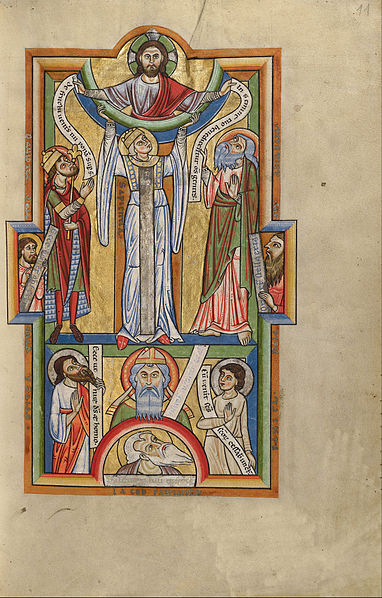
Artist Unknown – illuminator
Title Wisdom
Object type Folio
Date probably 1170s
(Public Domain)
Ordinary Time
St. Matthew
The Edge of Elfland
Hudson, New Hampshire
Dear Readers,
Yesterday, I wrote to you about food, quoting somewhat from Angel F. Méndez-Montoya’s excellent book, The Theology of Food: Eating and the Eucharist. Today I want to interact a bit more with his section on Sophia and food.
In Proverbs 9.1-6, Wisdom, who is depicted as a woman (and I simply refuse to believe that this is merely because the word is feminine in Hebrew––as well as in Greek and Latin and likely other languages as well), has prepared a palace for her abode and a feast for her lovers. Here is the passage in full:
Wisdom has built her house,
she has hewn her seven pillars.
She has slaughtered her animals, she has mixed her wine,
she has also set her table.
She has sent out her servant-girls, she calls
from the highest places in the town,
‘You that are simple, turn in here!’
To those without sense she says,
‘Come, eat of my bread
and drink of the wine I have mixed.
Lay aside immaturity, and live,
and walk in the way of insight.’
Méndez, whose Sophiology, it would seem comes almost entirely from Bulgakov’s Philosophy of Economy: The World as Household, comments on this passage as related by Bulgakov writes:
“Bulgakov echoes Proverbs 9:1-6, where Sophia shares a banquet, and alludes to her metaphorical identification with meat, bread, and wine. Food points to the root of being as ultimately relational – the very character of Sophia. Sophia is, for Bulgakov, the true expression of the metaphysical, social, and economic life. A similar analogy could be drawn with regard to food. At the metaphysical level, being is the food/substance offered as a gift from God, and thus intimately related to or participatory in the divine.”1
Sophia is the divine sharing of God-self to his creatures. This happens now, if not exclusively, primarily through the food of the Eucharist, bread and wine, which have prominent place at Sophia’s feast in Proverbs 9. Méndez further highlights this when he writes:
“Sophia is God’s own sharing that gifts creation with a food and drink that is God-self, God’s love: “God’s love for what he creates implies that the creation is generated within a harmonious order intrinsic to God’s own being” (Theology and Social Theory, 429). God offered as food and drink is further radicalized in the eucharistic sharing where the elements of bread and wine become a source of that same divine-sophianic sharing. This is the most physical and material aspect of deification. Therefore, rather than merely constructing an ontology intrinsically intensifies the materiality, corporeality, and contingency of Being, and displays a complex, metaxological – to use Desmond’s account – realm. For divinity reaches beyond humanity, into the realms of the material (bread and wine), only to reconstitute the mystery of materiality as eucharistic: an expression of thanksgiving, that is, a reception and return of God’s gift.”2
Méndez’s use of Sophia here is that of bridge. She bridges the divide between Creator and creature that was first, or perhaps simultaneously, bridged by Christ. This makes me think of the two kinds of participation one can find in the writings of Thomas Aquinas. For Aquinas, all existent things participate in God since God is the source of all being. Therefore created things (everything that isn’t God) participate in God’s being since, in a sense, God is the only existent being and he shares his existence with his creatures. This extends to all created reality, from the lowest, basest form of matter (and the microscopic and atomic realities that make it up) to the highest of the Seraphim. However, humans in general and Christians in particular have a special share in God. Because humanity has been united to divinity in a new way in the Incarnation, humanity now has a special share in God’s divinity. Sophia, then, in many ways symbolizes both of these realities. Before Christ she was still the Wisdom of God toward which all things are ordered (as the divine nature); after Christ, it is still God’s Divine Wisdom that, as Méndez says, “reaches beyond humanity, into the realms of the material (bread and wine).” Thus it is not so much, or not even primarily, Wisdom that we meet at Wisdom’s banquet but Christ, made present in the bread and wine by the transformative power of the Holy Spirit at the invocation of God the Father. Thus, as the whole Trinity is present in this moment, Sophia is present in this moment.
Sophia remains an enigmatic figure for me. She is not, quite clearly, a fourth hypostasis. The Trinity is not, in reality, a Quadrinity. And yet it is not, it would seem, totally wrong to think of her as a person, to assign pronouns to her. I did not go looking for her when I read Méndez’s book. In fact, the book was recommended to me by a friend who is very skeptical of Sophiology in general. And yet, as I read this excellent book, there she was. Whatever we may think of the “person” of Sophia, there is no denying the reality of God’s Wisdom. There is no denying the inherent relationship between Wisdom and the Son as well as Wisdom and the Spirit, thus solidifying that God is Wisdom. There is no denying that when we come to the Eucharist that table-altar it is just as much the banquet of Wisdom that we are attending as it is the Wedding Feast of the Lamb. There is, therefore, also no denying the change in our relationship to food because of this feast. Rather than see eating as related to cycles of death, Méndez encourages us to see food as participating in cycles of ultimate Life:
“An alternative Catholic reading of eating affirms that, through eating in the Eucharist, unity with God is restored, and a promise of resurrected life is opened up. From this eucharistic perspective eating is not a condition of lack, but a foretaste of divine plenitude: a physical and spiritual tasting that kindles a desire for more, for that beautiful excess wherein there is yet more to savor.”3
“From these sophianic and eucharistic perspectives, food is not severance, nor does it bring about ultimate destruction and final death. Instead, what Sophia and the Eucharist convey is food as a material – as much as it is also a divine – sign of relationality, interdependence, and sharing of life eternal.”4
When we meet Christ at the table we meet Life Himself. We meet the one who is vita ex morte, Life from death. This is our hope.
Sincerely,
David
1 Angel F.Mendez-Montoya, The Theology of Food: Eating and the Eucharist (Chichester: Wiley-Blackwell, 2012), 89.
2 Angel F.Mendez-Montoya, The Theology of Food: Eating and the Eucharist (Chichester: Wiley-Blackwell, 2012), 111.
3 Angel F.Mendez-Montoya, The Theology of Food: Eating and the Eucharist (Chichester: Wiley-Blackwell, 2012), 109.
4 Angel F.Mendez-Montoya, The Theology of Food: Eating and the Eucharist (Chichester: Wiley-Blackwell, 2012), 114.
The Radical Catholic Reimagination of Everything
Next Post

September 22, 2016 On Bilbo and Frodo's Birthday: A Reflection on Food and Feasting
Browse Our Archives
Select a Category A Secular Age Advent Apologetics Atheism Beauty Being a Catholic Evangelical Being Catholic Being Deified: Poetry and Fantasy on the Path to God Blogging Book Reviews C. S. Lewis Catholic Imagination Catholic Social Teaching Catholicism Christmas Church Calendar Church Fathers Church Life Community Conferences Cosmology Creation Curdled Words Deification Distributism Easter Economics Education Epiphany Essay Extracts Eucharist Faerie Faeriean Metaphysics Fatherhood Films Folk Liturgy Food and Drink G. K. Chesterton Harry Potter J. R. R. Tolkien Jove King Arthur Language Lent Life Literature and Poetry Liturgy Medieval Theology Music My Publications Mythology On the Edges of Elfland Ordinary Time Ordination Parenthood Parish Patristic Theology Pentecost Politics Prayer Racism Radical Orthodoxy Restoration Movement Sacramental Ontology Saints Science Sex and Sexuality Sophiology Stories The Inklings The Radical Catholic Reimagination of Everything Theologians in the Church Theopoetics Thesis Research Uncategorized University of Nottingham What I'm Reading Writing
Select a Month December 2019 November 2019 October 2019 September 2019 August 2019 July 2019 June 2019 May 2019 April 2019 March 2019 February 2019 January 2019 December 2018 November 2018 October 2018 September 2018 August 2018 July 2018 June 2018 May 2018 April 2018 March 2018 February 2018 January 2018 December 2017 November 2017 October 2017 August 2017 July 2017 June 2017 May 2017 April 2017 March 2017 February 2017 January 2017 December 2016 November 2016 October 2016 September 2016 August 2016 July 2016 June 2016 May 2016 April 2016 March 2016 February 2016 January 2016 December 2015 November 2015 October 2015 September 2015 August 2015 July 2015 June 2015 May 2015 April 2015 March 2015 February 2015 January 2015 December 2014 November 2014 October 2014 September 2014 August 2014 July 2014 June 2014 May 2014 April 2014 March 2014 February 2014 January 2014 December 2013 November 2013 October 2013 September 2013 August 2013 July 2013 June 2013 May 2013 April 2013 March 2013 February 2013 January 2013 December 2012 November 2012 October 2012 September 2012 July 2012
Follow Us!
TAKE THE
Religious Wisdom Quiz
What does "Satan" mean in Hebrew?
Select your answer to see how you score.
Adversary Deceiver Destroyer Murderer
Related posts from Letters from the Edge of Elfland

William Blake on the Creative Spirit, Beauty, and...
Letters from the Edge of Elfland
The Earth, Our Mother, and the Amazonian Synod
Letters from the Edge of Elfland

“Wherefore stopp’st thou me?” Coleridge’s Creative Message to...
Letters from the Edge of Elfland
Good Morning, Mr. Magpie: On Folklore and Science
Letters from the Edge of Elfland
TRENDING AT PATHEOS Catholic

Creation, Preservation, and Teleology in Catholic Theology
As I write this, it is very early Monday morning. Like millions...

The Parable Of The Sower And The Word...
One of Christ’s most famous parables is that of the sower who...

Rejecting Doom: Christian Hope And Human Action
Christianity is a religion of hope. We are to have hope and...

Why I Choose the Eucharist Over the Sermon
Choose the Eucharist, Not the Sermon What are we supposed to get...

5 Design Elements Found in Spiritually Rooted Homes
Putting Spirituality Into Home Decor Our homes are more than our living...

Credo: A Story of God Told with the...
About 10 years ago, I began to imagine a personal "Credo" that...
view all Catholic blogs
Ad-Free & Subscriber Log-In Subscription Support
- About Us
- 2026 Calendar
- Videos
- Podcasts
- Library of World Religions
- Faith In Media Tracker
- Advertise With Us
- Write for Us
- Privacy Policy
- Terms of Service
- Do Not Sell My Data
- Contact Us
- Radiant Digital
- Manage Newsletter Subscriptions
- Unsubscribe From Notifications
- Sitemap
Copyright 2008-2026, Patheos. All rights reserved.
Subscription Support Ad-Free & Subscriber Log-In
Follow Patheos