
BuddhistCatholicContemplativeEvangelicalGeneral ChristianHinduJewishLatter-day SaintMuslimNew VisionsProgressive Christian
Beliefs
- Buddhist
- Catholic
- Contemplative
- Evangelical
- General Christian
- Hindu
- Jewish
- Latter-day Saint
- More Voices
- Muslim
- New Visions
- Pagan
- Progressive Christian
Topics
- Religion News
- Food and Religion
- Sports and Religion
- Religious Art
- Religious Music and Entertainment
- Religious Events
- History and Religion
- Style and Religion
- Politics and Religion
- Women in Religion
- Recreation Outdoors and Religion
- Business Finance and Religion
- Careers Workplace and Religion
- Education and Religion
- Family Parenting and Religion
- Health Fitness and Religion
- Home and Religion
- Relationships and Religion
- Technology and Religion
- Travel and Religion
Columnists
- Buddhist Columnists
- Business Finance and Religion Columnists
- Careers Workplace and Religion Columnists
- Catholic Columnists
- Contemplative Columnists
- Education and Religion Columnists
- Evangelists Columnists
- Family Parenting and Religion Columnists
- General Christian Columnists
- Health Fitness and Religion Columnists
- Hindu Columnists
- History and Religion Columnists
- Home and Religion Columnists
- Jewish Columnists
- More Voices Columnists
- Latter Day Columnists
- Muslim Columnists
- New Visions Columnists
- Nonreligious Columnists
- Pagan Columnists
- Politics and Religion Columnists
- Progressive Columnists
- Recreation Outdoors and Religion Columnists
- Relationships and Religion Columnists
- Religion News Columnists
- Religious Art Columnists
- Religious Events Columnists
- Religious Music and Entertainment Columnists
- Sports and Religion Columnists
- Style and Religion Columnists
- Technology and Religion Columnists
- Travel and Religion Columnists
- Women in Religion Columnists
Resource Library
- 2026 Calendar
- Library of World Religions
- The 100 Most Holy Places on Earth
- Patheos Answers
- Podcasts
- Videos
- Faith Leaders Database
- Anglican Episcopalian
- Bahai
- Baptist
- Buddhism
- Christianity
- Confucianism
- Eastern Orthodoxy
- Hinduism
- Holiness and Pentecostal
- ISKCON
- Islam
- Judaism
- Lutheran
- Methodist
- The Church of Jesus Christ of Latter-day Saints
- New Age
- Paganism
- Presbytarian and Reformed
- Protestantism
- Religion Behind the Scenes
- Roman Catholic
- Scientology
- Shia Islam
- Sikhism
- Sufism
- Sunni Islam
- Taoism
- Zen
- See all religions
Research Tools
 Ad-Free & Subscriber Log-In Subscription Support
Ad-Free & Subscriber Log-In Subscription Support
Follow Patheos 

- Trending:
- Forgiveness
- |
- Marriage
- |
- Consciousness
- |
- Death Penalty
- |
- Election
- |
- Halloween
 Letters from the Edge of Elfland
- Home
- About
- Distributist Resources
- Publications and Presentations
- Support
- Works in Progress
- The Epistolarian Around the Web
- Home
- Catholic
- Private Property and Common Use in Thomas Aquinas
Private Property and Common Use in Thomas Aquinas
Last updated on: September 17, 2016 at 10:32 am by David Russell Mosley
Private Property and Common Use in Thomas Aquinas 2016-09-17T10:32:59-04:00 David Russell Mosley
Patheos Explore the world's faith through different perspectives on religion and spirituality! Patheos has the views of the prevalent religions and spiritualities of the world.
David Russell Mosley
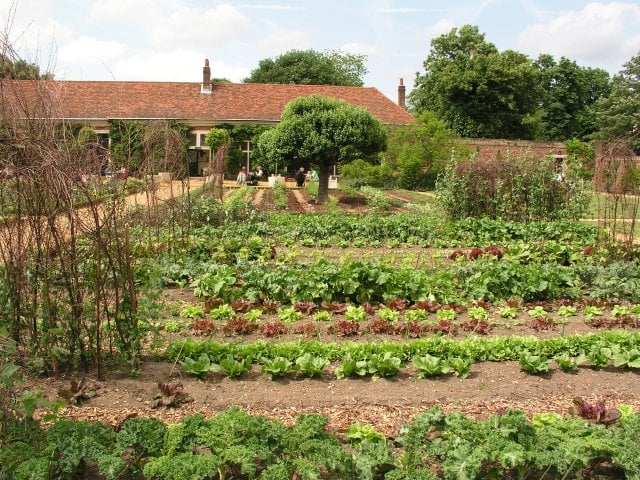
Description
English: Vegetable garden at Ham House Estate. In the top left corner of TQ1772.
Date 7 June 2003
Source From geograph.org.uk
Author mym
(CC BY-SA 2.0)
Ordinary Time
St. Hildegaard
The Edge of Elfland
Hudson, New Hampshire
Dear Readers,
The other day a friend of mine posted on his Facebook page about desiring to liberate apples from a neighbor’s neglected orchard. The idea caused him to consider writing a little something about Aquinas on theft in times of need. I’m hoping to convince him to work with me on a project to that effect for a new journal coming out. In the mean time, I wanted to bring to your attention a fascinating passage from the Summa on ownership.
Aquinas writes in Summa Theologiae Question 66 Article 2 about “Whether it is lawful for a man to possess a thing as his own?” According to Aquinas it is lawful for a person to own stuff. Aquinas sees this as good because people are more likely to work for themselves than for others. That is, I’m more willing to do work if it benefits me and my family first rather than doing work for a common pot shared by all. Aquinas also thinks it good if everyone is “charged with taking care of some particular thing himself, whereas there would be confusion if everyone had to look after any one thing indeterminately.” In other words, I’m more likely to care for my home (for instance) since it is mine than I am to care for a common home where everyone is equally responsible but no one is in charge. Finally, Aquinas says its good because it is more peaceful if everyone is responsible for themselves first. He says fighting is more likely “where there is no division of the things possessed.”
Now, you might disagree with Aquinas on these points as to why it is good for a man to own possessions. After all, most monastic orders actually require that no one own anything. Although in these instances, even if no one owns anything in particular (or very little) certain people are set in charge of certain duties. This obviates many of the issues Aquinas says would arise if people didn’t own things in general. Whether or not you agree with the reasons Aquinas gives for private ownership, we probably should agree with him that it is a good thing that people can and should own things. However, Aquinas doesn’t end the conversation here. He starts this whole section by saying, “Two things are competent to man in respect of exterior things.” The above is just the first thing. The second is as follows:
The second thing that is competent to man with regard to external things is their use. In this respect man ought to possess external things, not as his own, but as common, so that, to wit, he is ready to communicate them to others in their need. Hence the Apostle says (1 Tim. 6:17,18): “Charge the rich of this world . . . to give easily, to communicate to others,” etc.
Aquinas nearly subverts everything he has previously said. It is good, he tells us, for men to own personal possessions. Private property is a good, but private use is not. In the answers to the objections Aquinas reiterates this point. The first reminds us that all goods are ultimately common, and that private property is a human addition to natural law. In other words, naturally no one owns anything, or everyone owns everything in common, but in order to maintain peace humanity developed the notion of private property. This however, is not the end of the conversation. In the next two replies Aquinas makes it clear that privately owned goods ought to be of common use. We ought to think of the laws in the Old Testament about leaving some of the grains behind so the widows, orphans, and aliens (i.e. the poor) can gather them for food. The field belongs to the one who owns it, but he does not command the total use of it. He must retain part of it for common use.
This way of thinking flies in the face of much of what we see today. It also explains why American Christians (really all Christians, but I want to focus on my own society), particularly those who take seriously Catholic Social Teaching, can never––if they take these teachings seriously––really fit into any of our political parties. We think it good to own possessions, but it is evil to retain their use solely to yourself. Aquinas even takes it a step further in Question 66 Article 7 by stating that theft is not always sinful, “Nevertheless, if the need be so manifest and urgent, that it is evident that the present need must be remedied by whatever means be at hand (for instance when a person is in some imminent danger, and there is no other possible remedy), then it is lawful for a man to succor his own need by means of another’s property, by taking it either openly or secretly: nor is this properly speaking theft or robbery.” The one who owns anything must help the one who owns nothing. Ultimately this is why it is good for individuals to own possessions privately, in order to help those who have nothing (or little). Private property, but common use.
Sincerely,
David
The Radical Catholic Reimagination of Everything
Previous Post

September 16, 2016
On the Edges of Elfland Is Available for Purchase!
Next Post

September 19, 2016 Autumn Sweaters
Browse Our Archives
Select a Category A Secular Age Advent Apologetics Atheism Beauty Being a Catholic Evangelical Being Catholic Being Deified: Poetry and Fantasy on the Path to God Blogging Book Reviews C. S. Lewis Catholic Imagination Catholic Social Teaching Catholicism Christmas Church Calendar Church Fathers Church Life Community Conferences Cosmology Creation Curdled Words Deification Distributism Easter Economics Education Epiphany Essay Extracts Eucharist Faerie Faeriean Metaphysics Fatherhood Films Folk Liturgy Food and Drink G. K. Chesterton Harry Potter J. R. R. Tolkien Jove King Arthur Language Lent Life Literature and Poetry Liturgy Medieval Theology Music My Publications Mythology On the Edges of Elfland Ordinary Time Ordination Parenthood Parish Patristic Theology Pentecost Politics Prayer Racism Radical Orthodoxy Restoration Movement Sacramental Ontology Saints Science Sex and Sexuality Sophiology Stories The Inklings The Radical Catholic Reimagination of Everything Theologians in the Church Theopoetics Thesis Research Uncategorized University of Nottingham What I'm Reading Writing
Select a Month December 2019 November 2019 October 2019 September 2019 August 2019 July 2019 June 2019 May 2019 April 2019 March 2019 February 2019 January 2019 December 2018 November 2018 October 2018 September 2018 August 2018 July 2018 June 2018 May 2018 April 2018 March 2018 February 2018 January 2018 December 2017 November 2017 October 2017 August 2017 July 2017 June 2017 May 2017 April 2017 March 2017 February 2017 January 2017 December 2016 November 2016 October 2016 September 2016 August 2016 July 2016 June 2016 May 2016 April 2016 March 2016 February 2016 January 2016 December 2015 November 2015 October 2015 September 2015 August 2015 July 2015 June 2015 May 2015 April 2015 March 2015 February 2015 January 2015 December 2014 November 2014 October 2014 September 2014 August 2014 July 2014 June 2014 May 2014 April 2014 March 2014 February 2014 January 2014 December 2013 November 2013 October 2013 September 2013 August 2013 July 2013 June 2013 May 2013 April 2013 March 2013 February 2013 January 2013 December 2012 November 2012 October 2012 September 2012 July 2012
Follow Us!
TAKE THE
Religious Wisdom Quiz
What did the Israelites do when Moses was gone too long on the mountain?
Select your answer to see how you score.
Left Egypt again Made a golden calf Built a city Hid in fear
Related posts from Letters from the Edge of Elfland

William Blake on the Creative Spirit, Beauty, and...
Letters from the Edge of Elfland
The Earth, Our Mother, and the Amazonian Synod
Letters from the Edge of Elfland

“Wherefore stopp’st thou me?” Coleridge’s Creative Message to...
Letters from the Edge of Elfland

Good Morning, Mr. Magpie: On Folklore and Science
Letters from the Edge of Elfland
TRENDING AT PATHEOS Catholic

The Parable Of The Sower And The Word...
One of Christ’s most famous parables is that of the sower who...

Rejecting Doom: Christian Hope And Human Action
Christianity is a religion of hope. We are to have hope and...

Why I Choose the Eucharist Over the Sermon
Choose the Eucharist, Not the Sermon What are we supposed to get...

5 Design Elements Found in Spiritually Rooted Homes
Putting Spirituality Into Home Decor Our homes are more than our living...

Credo: A Story of God Told with the...
About 10 years ago, I began to imagine a personal "Credo" that...

The Anatomy of Divine Revelation in Catholic Thought
The claim that God has made Himself known to human beings is...
view all Catholic blogs
Ad-Free & Subscriber Log-In Subscription Support
- About Us
- 2026 Calendar
- Videos
- Podcasts
- Library of World Religions
- Faith In Media Tracker
- Advertise With Us
- Write for Us
- Privacy Policy
- Terms of Service
- Do Not Sell My Data
- Contact Us
- Radiant Digital
- Manage Newsletter Subscriptions
- Unsubscribe From Notifications
- Sitemap
Copyright 2008-2026, Patheos. All rights reserved.
Subscription Support Ad-Free & Subscriber Log-In
Follow Patheos