
BuddhistCatholicContemplativeEvangelicalGeneral ChristianHinduJewishLatter-day SaintMuslimNew VisionsProgressive Christian
Beliefs
- Buddhist
- Catholic
- Contemplative
- Evangelical
- General Christian
- Hindu
- Jewish
- Latter-day Saint
- More Voices
- Muslim
- New Visions
- Pagan
- Progressive Christian
Topics
- Religion News
- Food and Religion
- Sports and Religion
- Religious Art
- Religious Music and Entertainment
- Religious Events
- History and Religion
- Style and Religion
- Politics and Religion
- Women in Religion
- Recreation Outdoors and Religion
- Business Finance and Religion
- Careers Workplace and Religion
- Education and Religion
- Family Parenting and Religion
- Health Fitness and Religion
- Home and Religion
- Relationships and Religion
- Technology and Religion
- Travel and Religion
Columnists
- Buddhist Columnists
- Business Finance and Religion Columnists
- Careers Workplace and Religion Columnists
- Catholic Columnists
- Contemplative Columnists
- Education and Religion Columnists
- Evangelists Columnists
- Family Parenting and Religion Columnists
- General Christian Columnists
- Health Fitness and Religion Columnists
- Hindu Columnists
- History and Religion Columnists
- Home and Religion Columnists
- Jewish Columnists
- More Voices Columnists
- Latter Day Columnists
- Muslim Columnists
- New Visions Columnists
- Nonreligious Columnists
- Pagan Columnists
- Politics and Religion Columnists
- Progressive Columnists
- Recreation Outdoors and Religion Columnists
- Relationships and Religion Columnists
- Religion News Columnists
- Religious Art Columnists
- Religious Events Columnists
- Religious Music and Entertainment Columnists
- Sports and Religion Columnists
- Style and Religion Columnists
- Technology and Religion Columnists
- Travel and Religion Columnists
- Women in Religion Columnists
Resource Library
- 2026 Calendar
- Library of World Religions
- The 100 Most Holy Places on Earth
- Patheos Answers
- Podcasts
- Videos
- Faith Leaders Database
- Anglican Episcopalian
- Bahai
- Baptist
- Buddhism
- Christianity
- Confucianism
- Eastern Orthodoxy
- Hinduism
- Holiness and Pentecostal
- ISKCON
- Islam
- Judaism
- Lutheran
- Methodist
- The Church of Jesus Christ of Latter-day Saints
- New Age
- Paganism
- Presbytarian and Reformed
- Protestantism
- Religion Behind the Scenes
- Roman Catholic
- Scientology
- Shia Islam
- Sikhism
- Sufism
- Sunni Islam
- Taoism
- Zen
- See all religions
Research Tools
 Ad-Free & Subscriber Log-In Subscription Support
Ad-Free & Subscriber Log-In Subscription Support
Follow Patheos 

- Trending:
- Forgiveness
- |
- Marriage
- |
- Consciousness
- |
- Death Penalty
- |
- Election
- |
- Halloween
 Letters from the Edge of Elfland
- Home
- About
- Distributist Resources
- Publications and Presentations
- Support
- Works in Progress
- The Epistolarian Around the Web
- Home
- Catholic
- Sex, Marriage, and the Incarnation: Interpreting Scripture with John Cassian
Sex, Marriage, and the Incarnation: Interpreting Scripture with John Cassian
Last updated on: September 13, 2016 at 9:39 am by David Russell Mosley
Sex, Marriage, and the Incarnation: Interpreting Scripture with John Cassian 2016-09-13T09:39:39-04:00 David Russell Mosley
Patheos Explore the world's faith through different perspectives on religion and spirituality! Patheos has the views of the prevalent religions and spiritualities of the world.
David Russell Mosley
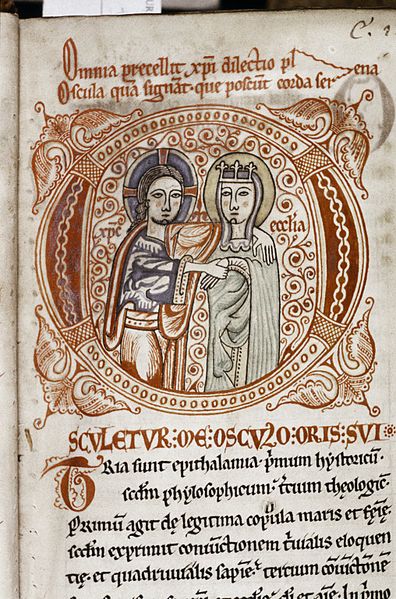
Description
Deutsch: Buchmalerei aus dem Kloster Eberbach, Rheingau. Das vom Mönch Thomas gemalte Bild zeigt “Christus und Ecclesia” und ziert einen Kommentar zum Hohenlied.
Date
English: 12th century, second half
Source Digitalisiert http://bodley30.bodley.ox.ac.uk:8180/luna/servlet/detail/ODLodl~1~1~46686~113586:Commentary-on-the-Song-of-Songs-?sort=Shelfmark%2CFolio_Page#
Author Mönch Thomas (Kloster Eberbach)
Public Domain
Ordinary Time
St. John Chrysostom
The Edge of Elfland
Hudson, New Hampshire
Dear Readers,
Yesterday’s letter about sex, the early church, and allegory, put me in mind of something written by John Cassian. Cassian is an enigmatic figure, as I’ve told you before, but I think many today would be surprised to know he wrote anything more than The Institutes and The Conferences. However, Cassian wrote an entire work on the nature of the Incarnation against Nestorianism. He was actually commissioned to write this work by Leo who was at the time Archdeacon of Rome and later became Pope Leo I (also known as Pope Leo the Great). Many have derided Cassian’s work on the Incarnation primarily because they claim he little understood the position put forward by Nestorius. I don’t want to get too technical here, but ultimately this comes down to Cassian couching Nestorianism with, to a certain extent, Pelagianism. Whether Cassian rightly or wrongly understood Nestorius is, ultimately inconsequential, at least for my purposes today. Today, I want to look at one particular passage.
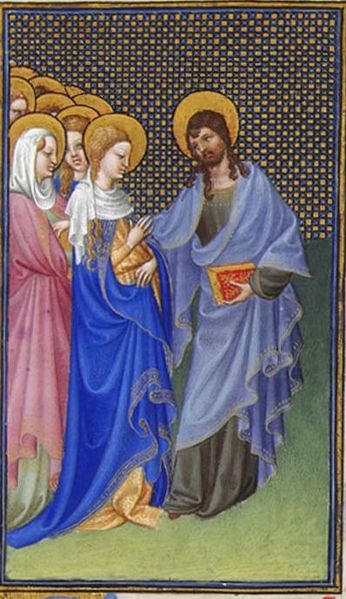
Les Très Riches Heures du duc de Berry, Folio 31r – David Foresees the Mystic Marriage of Christ and the Church the Musée Condé, Chantilly.
Public Domain
In Chapter 11 of Book 5, Cassian begins to discuss the coming together of the divine and the human in Jesus Christ. Cassian understood Nestorius as teaching that the human nature of Jesus lived for some time before being joined to the divine nature (whether this happened at birth or at baptism). And so Cassian wants to ensure that we understand that in the person of Jesus Christ there has always been the co-incidence of the divine and the human. He writes:
“And so to every man who breaks out into this mad blasphemy, the Lord Jesus in the gospel Himself repeats what He said to the Pharisees, and declares: “What God hath joined together, let not man put asunder.” For although where it was originally spoken by God it seems to be in answer to another matter, yet the deep wisdom of God which was speaking not more of carnal than of spiritual things, would have this to be taken of that subject indeed, but even more of this: for when the Jews of that day believed with you that Jesus was only a man without Divinity, and the Lord was asked a question about the union in marriage, in His teaching He not only referred to it, but to this also: though consulted about matters of less importance His answer applied to greater and deeper matters, when he said, “What God hath joined together, let not man put asunder,” i.e., Do not sever what God hath joined together in My Person. Let not human wickedness sever that which the Divine Glory hath united in Me.”
Cassian cites Christ’s words in Matthew 19.6, which he recognizes as being, on the surface, a reference to marriage and divorce, as also a reference to the unification of divine and human in Christ. Now perhaps some could read this passage and say that Cassian wants us to put away the “carnal” reading. But ultimately this would be difficult to maintain. Yes, Cassian believed the higher meaning, about the two natures of Christ was more important. And of course it is. The reality of who Christ is is more important than our understanding of marriage and divorce. Nevertheless, this passage is only comprehensible if we understand the literal meaning. That is, only if we understand what marriage is, what divorce is, what the union of man and woman is (in sex and in marriage) can we begin to understand the union of the two natures of Christ. It is only because we recognize men and women as different, and as remaining individual even while being united that we can begin to understand that Christ is both divine and human. Only when we have at least a functional knowledge of the intimacies of sex can we understand not only the intimate relationship between Christ’s divinity and humanity but between Christ and the Church.

Description
name lost in internet. Seems to be Mystic Marriage of Christ and the Church
Date 17th century
Source http://www.cattolicesimo.eu/forum/viewtopic.php?t=923&postdays=0&postorder=asc&start=15
Author name lost, Italy or Spain
Public Domain
Cassian goes on to talk about that very relationship as he turns to Paul in Ephesians 5.25-30. Here Cassian sees the reference to husbands and wives as being about Christ and the Church, which makes sense since the Apostle makes the comparison himself. Now Cassian does say that Paul, “cuts off and gets rid of any carnal interpretation, by saying that it is a Divine mystery.” However, this is in reference to the passage Christ quotes from Genesis, “‘For this cause shall a man leave his father and his mother, and shall cleave unto his wife, and they twain shall be one flesh.'” When Cassian says Paul cuts off any carnal interpretation, what he means is that this passage is a reference to the coming together of divine and human in Christ, but that, should those who cannot understand this, read this passage, they will still understand it as being about Christ and the Church. Cassian is a monk, and so he is not going to be prone to extolling marriage. Nevertheless, his allegorical interpretations of these passages only work if the literal interpretation remains. Paul may very well not be talking to us about marriage primarily (that is on the literal level), but his allegory only works because we know what marriage is, what sex is.
Did Cassian think that celibacy was a higher calling that marriage? Yes. But again, Paul seems to agree with him. What’s most important here, however, is that only an understanding of the lower thing can the higher be understood. Only because some, perhaps even the majority, of us participate in marriage can we begin to understand how marriage and sex relate not only to Christ’s relationship to the Church, but how Christ’s divinity relates to his humanity. This in no way suggests that our physicality is inherently bad. Rather it says something rather tremendous: our physicality, our marriages, our sex lives, are shadows, intimations, of the deeper reality that upholds them and gives them meaning. We do not understand marriage through the lens of Christ and the Church, rather, Christ and the Church is the source for our understanding of marriage. Sex too is informed by the Incarnation, that intimate cleaving together of divinity and humanity informs the cleaving together of man and wife in the marital bed. Even if Cassian leans perhaps a bit too far away from the “carnal” interpretations, what he has written still gives them life, shape, and meaning by sourcing them in the person of Jesus Christ.
Sincerely,
David
Previous Post
September 12, 2016
Sex and the Early Church: A Response to Daniel D. Lee
Next Post

September 16, 2016 On the Edges of Elfland Is Available for Purchase!
Browse Our Archives
Select a Category A Secular Age Advent Apologetics Atheism Beauty Being a Catholic Evangelical Being Catholic Being Deified: Poetry and Fantasy on the Path to God Blogging Book Reviews C. S. Lewis Catholic Imagination Catholic Social Teaching Catholicism Christmas Church Calendar Church Fathers Church Life Community Conferences Cosmology Creation Curdled Words Deification Distributism Easter Economics Education Epiphany Essay Extracts Eucharist Faerie Faeriean Metaphysics Fatherhood Films Folk Liturgy Food and Drink G. K. Chesterton Harry Potter J. R. R. Tolkien Jove King Arthur Language Lent Life Literature and Poetry Liturgy Medieval Theology Music My Publications Mythology On the Edges of Elfland Ordinary Time Ordination Parenthood Parish Patristic Theology Pentecost Politics Prayer Racism Radical Orthodoxy Restoration Movement Sacramental Ontology Saints Science Sex and Sexuality Sophiology Stories The Inklings The Radical Catholic Reimagination of Everything Theologians in the Church Theopoetics Thesis Research Uncategorized University of Nottingham What I'm Reading Writing
Select a Month December 2019 November 2019 October 2019 September 2019 August 2019 July 2019 June 2019 May 2019 April 2019 March 2019 February 2019 January 2019 December 2018 November 2018 October 2018 September 2018 August 2018 July 2018 June 2018 May 2018 April 2018 March 2018 February 2018 January 2018 December 2017 November 2017 October 2017 August 2017 July 2017 June 2017 May 2017 April 2017 March 2017 February 2017 January 2017 December 2016 November 2016 October 2016 September 2016 August 2016 July 2016 June 2016 May 2016 April 2016 March 2016 February 2016 January 2016 December 2015 November 2015 October 2015 September 2015 August 2015 July 2015 June 2015 May 2015 April 2015 March 2015 February 2015 January 2015 December 2014 November 2014 October 2014 September 2014 August 2014 July 2014 June 2014 May 2014 April 2014 March 2014 February 2014 January 2014 December 2013 November 2013 October 2013 September 2013 August 2013 July 2013 June 2013 May 2013 April 2013 March 2013 February 2013 January 2013 December 2012 November 2012 October 2012 September 2012 July 2012
Follow Us!
TAKE THE
Religious Wisdom Quiz
Which Christian group believes in "baptism of the Holy Spirit" with evidence of speaking in tongues?
Select your answer to see how you score.
Lutherans Presbyterians Methodists Pentecostals
Related posts from Letters from the Edge of Elfland
Chesterton, Dragons, and Cancer: A Reflection on this...
Letters from the Edge of Elfland
Ethnicity, DNA, White Supremacy, and the Pro-Life Movement
Letters from the Edge of Elfland
Saint-Haunted: How St. Cuthbert Found Me
Letters from the Edge of Elfland
Speaking on the Catholic Imagination for Spirited Theology
Letters from the Edge of Elfland
TRENDING AT PATHEOS Catholic

Rejecting Doom: Christian Hope And Human Action
Christianity is a religion of hope. We are to have hope and...

It’s What Comes From Within Which Matters
One of the most difficult things for us to understand is why...

Why I Choose the Eucharist Over the Sermon
Choose the Eucharist, Not the Sermon What are we supposed to get...

5 Design Elements Found in Spiritually Rooted Homes
Putting Spirituality Into Home Decor Our homes are more than our living...

Credo: A Story of God Told with the...
About 10 years ago, I began to imagine a personal "Credo" that...

The Anatomy of Divine Revelation in Catholic Thought
The claim that God has made Himself known to human beings is...
view all Catholic blogs
Ad-Free & Subscriber Log-In Subscription Support
- About Us
- 2026 Calendar
- Videos
- Podcasts
- Library of World Religions
- Faith In Media Tracker
- Advertise With Us
- Write for Us
- Privacy Policy
- Terms of Service
- Do Not Sell My Data
- Contact Us
- Radiant Digital
- Manage Newsletter Subscriptions
- Unsubscribe From Notifications
- Sitemap
Copyright 2008-2026, Patheos. All rights reserved.
Subscription Support Ad-Free & Subscriber Log-In
Follow Patheos