
BuddhistCatholicContemplativeEvangelicalGeneral ChristianHinduJewishLatter-day SaintMuslimNew VisionsProgressive Christian
Beliefs
- Buddhist
- Catholic
- Contemplative
- Evangelical
- General Christian
- Hindu
- Jewish
- Latter-day Saint
- More Voices
- Muslim
- New Visions
- Pagan
- Progressive Christian
Topics
- Religion News
- Food and Religion
- Sports and Religion
- Religious Art
- Religious Music and Entertainment
- Religious Events
- History and Religion
- Style and Religion
- Politics and Religion
- Women in Religion
- Recreation Outdoors and Religion
- Business Finance and Religion
- Careers Workplace and Religion
- Education and Religion
- Family Parenting and Religion
- Health Fitness and Religion
- Home and Religion
- Relationships and Religion
- Technology and Religion
- Travel and Religion
Columnists
- Buddhist Columnists
- Business Finance and Religion Columnists
- Careers Workplace and Religion Columnists
- Catholic Columnists
- Contemplative Columnists
- Education and Religion Columnists
- Evangelists Columnists
- Family Parenting and Religion Columnists
- General Christian Columnists
- Health Fitness and Religion Columnists
- Hindu Columnists
- History and Religion Columnists
- Home and Religion Columnists
- Jewish Columnists
- More Voices Columnists
- Latter Day Columnists
- Muslim Columnists
- New Visions Columnists
- Nonreligious Columnists
- Pagan Columnists
- Politics and Religion Columnists
- Progressive Columnists
- Recreation Outdoors and Religion Columnists
- Relationships and Religion Columnists
- Religion News Columnists
- Religious Art Columnists
- Religious Events Columnists
- Religious Music and Entertainment Columnists
- Sports and Religion Columnists
- Style and Religion Columnists
- Technology and Religion Columnists
- Travel and Religion Columnists
- Women in Religion Columnists
Resource Library
- 2026 Calendar
- Library of World Religions
- The 100 Most Holy Places on Earth
- Patheos Answers
- Podcasts
- Videos
- Faith Leaders Database
- Anglican Episcopalian
- Bahai
- Baptist
- Buddhism
- Christianity
- Confucianism
- Eastern Orthodoxy
- Hinduism
- Holiness and Pentecostal
- ISKCON
- Islam
- Judaism
- Lutheran
- Methodist
- The Church of Jesus Christ of Latter-day Saints
- New Age
- Paganism
- Presbytarian and Reformed
- Protestantism
- Religion Behind the Scenes
- Roman Catholic
- Scientology
- Shia Islam
- Sikhism
- Sufism
- Sunni Islam
- Taoism
- Zen
- See all religions
Research Tools
 Ad-Free & Subscriber Log-In Subscription Support
Ad-Free & Subscriber Log-In Subscription Support
Follow Patheos 

- Trending:
- Forgiveness
- |
- Marriage
- |
- Consciousness
- |
- Death Penalty
- |
- Election
- |
- Halloween
 Letters from the Edge of Elfland
- Home
- About
- Distributist Resources
- Publications and Presentations
- Support
- Works in Progress
- The Epistolarian Around the Web
- Home
- Catholic
- Seeing the Invisible: Reflecting on Elves in Iceland and Native Americans in the US
Seeing the Invisible: Reflecting on Elves in Iceland and Native Americans in the US
Last updated on: September 9, 2016 at 8:06 pm by David Russell Mosley
Seeing the Invisible: Reflecting on Elves in Iceland and Native Americans in the US 2016-09-09T20:06:47-04:00 David Russell Mosley
Patheos Explore the world's faith through different perspectives on religion and spirituality! Patheos has the views of the prevalent religions and spiritualities of the world.
David Russell Mosley
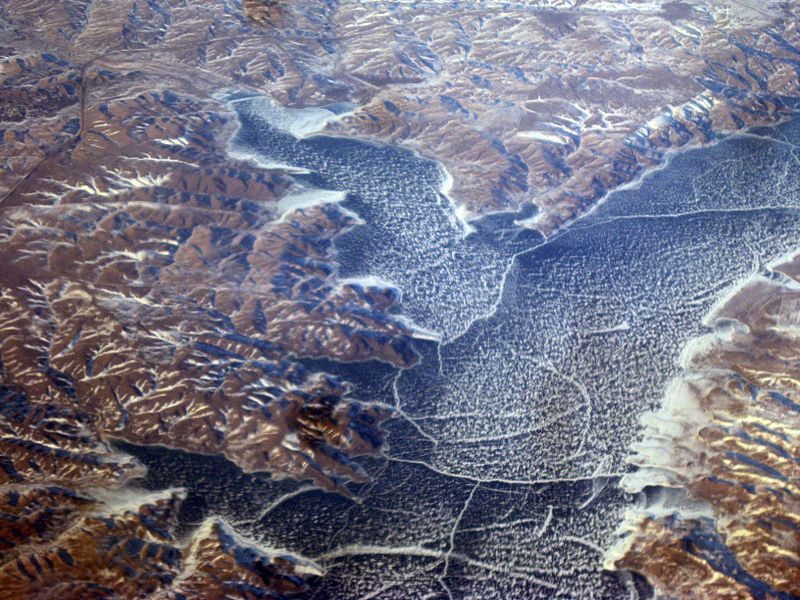
Description
Lake Oahe, in the dammed Missouri River, in the heart of South Dakota. Dolphee’s Island is here, under water. It is mentioned in Lewis & Clark’s journal. They passed through here in their explorations. Stove Creek Bay is on the upper left
Date 27 January 2009, 17:18
Source 2009_01_27_bos-sfo_506
Uploaded by PDTillman
Author Doc Searls from Santa Barbara, USA
(CC BY-SA 2.0)
Ordinary Time
9 September 2016
The Edge of Elfland
Hudson, New Hampshire
Dear Readers,
About a week a ago, a fellow Patheos Catholic blogger (Michael Pezzulo of Steel Magnificat fame) brought the article, “Iceland unearths rock to appease angry elves,” to my attention. And I’m quite glad he did. The story is essentially this: A road is being constructed in Iceland, but construction has had to cease. It appears that several mishaps have been happening ever since the construction words covered over an “enchanted elfin rock.” Work on the road has had to cease, at least in part due to the mishaps, and so that the rock could be uncovered in order to appease the angry elves. Truth be told, I’d be none too happy if someone covered over my home, the bakery where my wife works (where I do my grading, reading, and writing from time to time) or my church (in other words, I’m not sure of the significance of the rock to the elves but I assume to be something similar to a place of rest, worship, or leisure).
As I initially read this article two things sprang to mind. The first is C. S. Lewis’ Perelandra. The second is Pope Francis’ Encyclical Laudato Si’. I will, of course, turn to both of these. However, as I sit here to write this letter to you another thing has come to mind and I will share it in due course.
Toward the end of Perelandra, after Ransom has disposed of the Unman, he finds himself lost in the subterranean world of Venus. Ransom finds a tunnel after having first found two overly large rock carven thrones:
“There was a dark tunnel in which a wind from heaven knows where was blowing and drove sand in his face. There was also a place where he himself walked in darkness and looked down through fathom below fathom of shafts and natural arches and winding gulfs on to a smooth floor lit with a cold green light. And as he stood and looked it seemed to him that four of the great earth-beetles, dwarfed by distance to the size of gates, and crawling two by two, came slowly into sight. And they were drawing behind them a flat car, and on the car, upright, unshaken, stood a mantled form, huge and still and slender. And driving its strange team it passed on with insufferable majesty and went out of sight. Assuredly the inside of this world was not for man. But it was for something. And it appeared to Ransom that there might, if a man could find it, be some way to renew the old Pagan practice of propitiating the local gods of unknown places in such a fashion that it was no offence to God Himself but only a prudent courteous apology for trespass. That thing, that swathed form in its chariot, was no doubt his fellow creature. It did not follow that they were equals or had an equal right in the under-land” (P. 157-158).
I hope you’ll forgive me quoting the passage at length, but it is so very similar to what is going on in Iceland. They are seeking to propitiate not even local gods but elves, creatures of lower stature than a god. In fact this story was not at all unusual for me for one often reads such stories about the Icelanders. They have a real, at least on a practical level (and of course as David Bentley Hart would say, a rational), belief in elves. One that causes them as a society to take them into account. There is much more I could draw from Lewis’ passage but the key, as it connects to Iceland is this: this elf whom Ransom meets belongs to the under-lands, and they to him. There is an inherent association. So to the elves belong to the woods and the woods to the elves. Belief in elves here drives the Icelanders to consider how properly to care for the woods.
This of course returns me to themes I took in my two letters on Pope Francis in Elfland. Pope Francis reminds us:
“As Christians, we are also called ‘to accept the world as a sacrament of communion, as a way of sharing with God and our neighbors on a global scale. It is our humble conviction that the divine and the human meet in the slightest detail in the seamless garment of God’s creation, in the least speck of dust on our planet.'”1
So whether there are elves in the woods as well against whom we may be trespassing, it is certainly true that the woods themselves (as do our very selves) ultimately belong to God and so must be treated with proper care and respect. One might say with proper propitiation.
I intended originally to go much further down this line, but I cannot, this evening. For as I sit here and think about how Iceland seeks to propitiate its elves for covering up a stone sacred to them, we here in the US are doing far worse. It may be true that there are no elves in Iceland (though I think it rather sensible to hedge one’s bets in that corner). It is, however, unequivocally true that the Standing Rock Sioux Tribe have been egregiously violated by the Dakota Access pipeline. Here are real people, already so mistreated by our government, by our ancestors (both United States citizens and our European ancestors), who have had a burial ground destroyed. In Iceland, accidentally covering over an “enchanted elfin stone” has caused the cessation of work on road for creatures in which, lamentably, most of the world disbelieves. Yet here, we cannot get justice for people we can see, hear, and touch. People who perhaps have been made as invisible to us as the elves so often are because we have forgotten how to see them. We must, we Christians especially must, open our eyes and stop these atrocities (it is true that the Justice Department has stepped in, saving an important lake to the tribe; it has requested Dakota Access voluntarily stop construction 20 miles away from Lake Oahe).
We must open our eyes and see what is right before us. Failure to do so is not only sinful in and of itself, but will lead to no good for us in the long run. If the people of Iceland can stop road construction for the sake of elves, surely there is something we can do to aid our brothers and sisters, the native peoples of this land, in Dakota. Even if that something simply be to open our eyes and call evil evil publicly.
Sincerely,
David
1 Praef. 9. Global Responsibility and Ecological Sustainability closing Remarks, Halki Summit I, Istanbul (20 June 2012).
The Radical Catholic Reimagination of Everything

Next Post
September 12, 2016 Sex and the Early Church: A Response to Daniel D. Lee
Browse Our Archives
Select a Category A Secular Age Advent Apologetics Atheism Beauty Being a Catholic Evangelical Being Catholic Being Deified: Poetry and Fantasy on the Path to God Blogging Book Reviews C. S. Lewis Catholic Imagination Catholic Social Teaching Catholicism Christmas Church Calendar Church Fathers Church Life Community Conferences Cosmology Creation Curdled Words Deification Distributism Easter Economics Education Epiphany Essay Extracts Eucharist Faerie Faeriean Metaphysics Fatherhood Films Folk Liturgy Food and Drink G. K. Chesterton Harry Potter J. R. R. Tolkien Jove King Arthur Language Lent Life Literature and Poetry Liturgy Medieval Theology Music My Publications Mythology On the Edges of Elfland Ordinary Time Ordination Parenthood Parish Patristic Theology Pentecost Politics Prayer Racism Radical Orthodoxy Restoration Movement Sacramental Ontology Saints Science Sex and Sexuality Sophiology Stories The Inklings The Radical Catholic Reimagination of Everything Theologians in the Church Theopoetics Thesis Research Uncategorized University of Nottingham What I'm Reading Writing
Select a Month December 2019 November 2019 October 2019 September 2019 August 2019 July 2019 June 2019 May 2019 April 2019 March 2019 February 2019 January 2019 December 2018 November 2018 October 2018 September 2018 August 2018 July 2018 June 2018 May 2018 April 2018 March 2018 February 2018 January 2018 December 2017 November 2017 October 2017 August 2017 July 2017 June 2017 May 2017 April 2017 March 2017 February 2017 January 2017 December 2016 November 2016 October 2016 September 2016 August 2016 July 2016 June 2016 May 2016 April 2016 March 2016 February 2016 January 2016 December 2015 November 2015 October 2015 September 2015 August 2015 July 2015 June 2015 May 2015 April 2015 March 2015 February 2015 January 2015 December 2014 November 2014 October 2014 September 2014 August 2014 July 2014 June 2014 May 2014 April 2014 March 2014 February 2014 January 2014 December 2013 November 2013 October 2013 September 2013 August 2013 July 2013 June 2013 May 2013 April 2013 March 2013 February 2013 January 2013 December 2012 November 2012 October 2012 September 2012 July 2012
Follow Us!
TAKE THE
Religious Wisdom Quiz
Who was lowered through a roof to be healed by Jesus?
Select your answer to see how you score.
A paralyzed man Jairus' daughter A blind man A leper
Related posts from Letters from the Edge of Elfland

William Blake on the Creative Spirit, Beauty, and...
Letters from the Edge of Elfland
The Earth, Our Mother, and the Amazonian Synod
Letters from the Edge of Elfland
Can You Imagine? Beginning a Definition of the...
Letters from the Edge of Elfland

“Wherefore stopp’st thou me?” Coleridge’s Creative Message to...
Letters from the Edge of Elfland
TRENDING AT PATHEOS Catholic

Creation, Preservation, and Teleology in Catholic Theology
As I write this, it is very early Monday morning. Like millions...

The Parable Of The Sower And The Word...
One of Christ’s most famous parables is that of the sower who...

Rejecting Doom: Christian Hope And Human Action
Christianity is a religion of hope. We are to have hope and...

Why I Choose the Eucharist Over the Sermon
Choose the Eucharist, Not the Sermon What are we supposed to get...

5 Design Elements Found in Spiritually Rooted Homes
Putting Spirituality Into Home Decor Our homes are more than our living...

Credo: A Story of God Told with the...
About 10 years ago, I began to imagine a personal "Credo" that...
view all Catholic blogs
Ad-Free & Subscriber Log-In Subscription Support
- About Us
- 2026 Calendar
- Videos
- Podcasts
- Library of World Religions
- Faith In Media Tracker
- Advertise With Us
- Write for Us
- Privacy Policy
- Terms of Service
- Do Not Sell My Data
- Contact Us
- Radiant Digital
- Manage Newsletter Subscriptions
- Unsubscribe From Notifications
- Sitemap
Copyright 2008-2026, Patheos. All rights reserved.
Subscription Support Ad-Free & Subscriber Log-In
Follow Patheos