
BuddhistCatholicContemplativeEvangelicalGeneral ChristianHinduJewishLatter-day SaintMuslimNew VisionsProgressive Christian
Beliefs
- Buddhist
- Catholic
- Contemplative
- Evangelical
- General Christian
- Hindu
- Jewish
- Latter-day Saint
- More Voices
- Muslim
- New Visions
- Pagan
- Progressive Christian
Topics
- Religion News
- Food and Religion
- Sports and Religion
- Religious Art
- Religious Music and Entertainment
- Religious Events
- History and Religion
- Style and Religion
- Politics and Religion
- Women in Religion
- Recreation Outdoors and Religion
- Business Finance and Religion
- Careers Workplace and Religion
- Education and Religion
- Family Parenting and Religion
- Health Fitness and Religion
- Home and Religion
- Relationships and Religion
- Technology and Religion
- Travel and Religion
Columnists
- Buddhist Columnists
- Business Finance and Religion Columnists
- Careers Workplace and Religion Columnists
- Catholic Columnists
- Contemplative Columnists
- Education and Religion Columnists
- Evangelists Columnists
- Family Parenting and Religion Columnists
- General Christian Columnists
- Health Fitness and Religion Columnists
- Hindu Columnists
- History and Religion Columnists
- Home and Religion Columnists
- Jewish Columnists
- More Voices Columnists
- Latter Day Columnists
- Muslim Columnists
- New Visions Columnists
- Nonreligious Columnists
- Pagan Columnists
- Politics and Religion Columnists
- Progressive Columnists
- Recreation Outdoors and Religion Columnists
- Relationships and Religion Columnists
- Religion News Columnists
- Religious Art Columnists
- Religious Events Columnists
- Religious Music and Entertainment Columnists
- Sports and Religion Columnists
- Style and Religion Columnists
- Technology and Religion Columnists
- Travel and Religion Columnists
- Women in Religion Columnists
Resource Library
- 2026 Calendar
- Library of World Religions
- The 100 Most Holy Places on Earth
- Patheos Answers
- Podcasts
- Videos
- Faith Leaders Database
- Anglican Episcopalian
- Bahai
- Baptist
- Buddhism
- Christianity
- Confucianism
- Eastern Orthodoxy
- Hinduism
- Holiness and Pentecostal
- ISKCON
- Islam
- Judaism
- Lutheran
- Methodist
- The Church of Jesus Christ of Latter-day Saints
- New Age
- Paganism
- Presbytarian and Reformed
- Protestantism
- Religion Behind the Scenes
- Roman Catholic
- Scientology
- Shia Islam
- Sikhism
- Sufism
- Sunni Islam
- Taoism
- Zen
- See all religions
Research Tools
 Ad-Free & Subscriber Log-In Subscription Support
Ad-Free & Subscriber Log-In Subscription Support
Follow Patheos 

- Trending:
- Forgiveness
- |
- Marriage
- |
- Consciousness
- |
- Death Penalty
- |
- Election
- |
- Halloween
 Letters from the Edge of Elfland
- Home
- About
- Distributist Resources
- Publications and Presentations
- Support
- Works in Progress
- The Epistolarian Around the Web
- Home
- Catholic
- The Eucharist the Basis of Leisure: Some Reflections on Josef Pieper, Fr. Jacques Hamel, and C. S. Lewis
The Eucharist the Basis of Leisure: Some Reflections on Josef Pieper, Fr. Jacques Hamel, and C. S. Lewis
Last updated on: September 6, 2016 at 8:22 am by David Russell Mosley
The Eucharist the Basis of Leisure: Some Reflections on Josef Pieper, Fr. Jacques Hamel, and C. S. Lewis 2016-09-06T08:22:57-04:00 David Russell Mosley
Patheos Explore the world's faith through different perspectives on religion and spirituality! Patheos has the views of the prevalent religions and spiritualities of the world.
David Russell Mosley
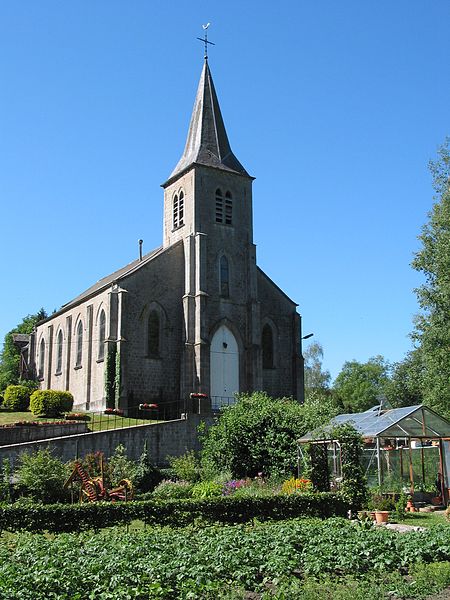
Image by Jean-Pol GRANDAUNT (CC By 3.0)
Lompret, (Belgium), the St Nicolas’ church (1879)
Ordinary Time
5 September 2016
The Edge of Elfland
Hudson, New Hampshire
Dear Readers,
As part of my research for my upcoming paper on Thomas Aquinas and the Eucharist, I have been re-reading Josef Pieper’s book Leisure the Basis of Culture. It was actually this book that first gave me the idea for my paper about the relationship between the meals we eat and the Eucharist being similar to that of we ourselves as human beings and the incarnation of God in the person of Jesus Christ. Many things have stood out to me on this reading of Pieper’s excellent text and I wanted to share one of them with you.
Pieper writes:
The sphere of leisure, it has already been said, is no less than the sphere of culture in so far as that word means everything that lies beyond the utilitarian world. Culture lives on religion through divine worship. And when culture itself is endangered, and leisure is called in question, there is only one thing to be done: to go back to the first and original source (71).
For Pieper one of the key ways, if not the key way of returning to a right relationship between leisure and work is to create space for leisure. One of the key ways to do this, as I read Pieper, is to return to a true sense of celebration through divine worship. Throughout his book, Pieper makes this central argument: leisure is the basis of culture (anything that is done for its own sake and not for some utilitarian end); celebration is the basis of leisure; divine worship is the basis of celebration; and the Eucharist is the basis of divine worship. So, in a sense, what Pieper is saying is that to go back to the first and original source is to return to the Eucharist.
Pieper goes on to write:
Leisure cannot be achieved at all when it is sought as a means to an end, even though that end be “the salvation of Western civilization”. Celebration of God in worship cannot be done unless it is done for its own sake. That most sublime form of affirmation of the world as a whole is the fountainhead of leisure (72).
In essence the only way to return to the right relationship between leisure and work cannot to be done through work. We cannot make efforts to reinstitute practice A in order to result in B. These things must be done because we believe them to be true and worth doing whatever the results may be. This makes me think of three things I’d like to share with you.
The first is the witness of Fr. Jacques Hamel. I wrote to you about him not long after he was martyred, his blood being poured out when he was preparing to pour out the blood of Christ for the forgiveness of many (including those who killed him). Here we see the possible results of our return to a right way of seeing the world, death. The world, when we use this word to mean the illegitimate kingdom of Satan, does not want us to return to a right way of seeing. So doing would overturn so much that is presently taken for granted. And so we must remember the witness of Fr. Jacques Hamel that this too could be our end for desiring the Good, the True, and the Beautiful.
The second and third things go together. A friend on his Facebook page commented on the nature of the work set before us in order to return to a right a vision of the world. He wrote something along the lines of, we’ve got our work cut out for us; I’m going to go plant some onions (or some other such delicious food). His point was to draw a direct connection between the work cut out for us and the growing of food. It is true that Pieper would not view, I think, self-subsistent farming as part of leisure. Few if any people grow vegetables just for the sake of growing vegetables. Rather they grow them for eating. Still, there is something about re-connecting our selves to the sources of our food that can incline us more to celebration (and besides, David Jones would certainly see farming as an art even if it is also work).
This leads me to a section I frequently mention from C.S. Lewis’ That Hideous Strength. At this point in the story evil has been defeated and yet the source of its defeat could be difficult to suss out. Most of the people “involved” really did very little to bring it about. One character, the resident skeptic, gives voice to this, after another talks about how the story of these events will include no mention of them or Merlin:
“‘Aye,’ said MacPhee, ‘and it could be right good history without mentioning you and me or most of those present. I’d be greatly obliged if any one would tell me what we have done––always apart from feeding the pigs and raising some very decent vegetables'” (THS 368).
He is told that this group has “‘done what is required of them'” and the lion’s share of that has been to be in community with one another. Even this very conversation takes place toward the end of a feast. This, I think, is what Pieper is getting at. These men and women did not return to a right view of the cosmos in order to defeat evil, but because it is right. This involved for most of them simply living life as one ought to live it, in close connection with the earth, each other, and God. It had the effect of so equipping them when there was action to take on their part and this helped them in the defeat of that Hideous Strength, but they did not come to this view of reality with only that in mind. Even if the group formally disbanded after Ransom’s ascension (as in they ceased living together), they would not, or should not, cease to believe in Maleldil and the eldila.
In many ways this has been my project for some time now, to help us reclaim this kind of vision. I often talk about it in terms of enchantment or elfland or sacramental ontology; sometimes as liturgy and the Church Calendar. Whatever we call it, however, we need to return to it, we need to be faithful. This may cost us dearly, as it did Fr. Hamel. It may, in the mean time cost us little more than effort. It may even cause us to win great victories for the soul of the world over against Satan’s rebellion. But this matters very little. What matters is our faithfulness, our recognition that leisure is the basis of culture, celebration the basis of leisure, divine worship the basis of celebration, and the Eucharist the basis of divine worship. Christ must be at the heart of all things. Everything else spins out from him. This is the way of seeing reality I would see reclaimed.
Sincerely,
David
The Radical Catholic Reimagination of Everything


Browse Our Archives
Select a Category A Secular Age Advent Apologetics Atheism Beauty Being a Catholic Evangelical Being Catholic Being Deified: Poetry and Fantasy on the Path to God Blogging Book Reviews C. S. Lewis Catholic Imagination Catholic Social Teaching Catholicism Christmas Church Calendar Church Fathers Church Life Community Conferences Cosmology Creation Curdled Words Deification Distributism Easter Economics Education Epiphany Essay Extracts Eucharist Faerie Faeriean Metaphysics Fatherhood Films Folk Liturgy Food and Drink G. K. Chesterton Harry Potter J. R. R. Tolkien Jove King Arthur Language Lent Life Literature and Poetry Liturgy Medieval Theology Music My Publications Mythology On the Edges of Elfland Ordinary Time Ordination Parenthood Parish Patristic Theology Pentecost Politics Prayer Racism Radical Orthodoxy Restoration Movement Sacramental Ontology Saints Science Sex and Sexuality Sophiology Stories The Inklings The Radical Catholic Reimagination of Everything Theologians in the Church Theopoetics Thesis Research Uncategorized University of Nottingham What I'm Reading Writing
Select a Month December 2019 November 2019 October 2019 September 2019 August 2019 July 2019 June 2019 May 2019 April 2019 March 2019 February 2019 January 2019 December 2018 November 2018 October 2018 September 2018 August 2018 July 2018 June 2018 May 2018 April 2018 March 2018 February 2018 January 2018 December 2017 November 2017 October 2017 August 2017 July 2017 June 2017 May 2017 April 2017 March 2017 February 2017 January 2017 December 2016 November 2016 October 2016 September 2016 August 2016 July 2016 June 2016 May 2016 April 2016 March 2016 February 2016 January 2016 December 2015 November 2015 October 2015 September 2015 August 2015 July 2015 June 2015 May 2015 April 2015 March 2015 February 2015 January 2015 December 2014 November 2014 October 2014 September 2014 August 2014 July 2014 June 2014 May 2014 April 2014 March 2014 February 2014 January 2014 December 2013 November 2013 October 2013 September 2013 August 2013 July 2013 June 2013 May 2013 April 2013 March 2013 February 2013 January 2013 December 2012 November 2012 October 2012 September 2012 July 2012
Follow Us!
TAKE THE
Religious Wisdom Quiz
Who warned "the tongue is a fire"?
Select your answer to see how you score.
Peter John James Paul
Related posts from Letters from the Edge of Elfland

William Blake on the Creative Spirit, Beauty, and...
Letters from the Edge of Elfland
The Earth, Our Mother, and the Amazonian Synod
Letters from the Edge of Elfland
Can You Imagine? Beginning a Definition of the...
Letters from the Edge of Elfland

“Wherefore stopp’st thou me?” Coleridge’s Creative Message to...
Letters from the Edge of Elfland
TRENDING AT PATHEOS Catholic

Creation, Preservation, and Teleology in Catholic Theology
As I write this, it is very early Monday morning. Like millions...

The Parable Of The Sower And The Word...
One of Christ’s most famous parables is that of the sower who...

Rejecting Doom: Christian Hope And Human Action
Christianity is a religion of hope. We are to have hope and...

Why I Choose the Eucharist Over the Sermon
Choose the Eucharist, Not the Sermon What are we supposed to get...

5 Design Elements Found in Spiritually Rooted Homes
Putting Spirituality Into Home Decor Our homes are more than our living...

Credo: A Story of God Told with the...
About 10 years ago, I began to imagine a personal "Credo" that...
view all Catholic blogs
Ad-Free & Subscriber Log-In Subscription Support
- About Us
- 2026 Calendar
- Videos
- Podcasts
- Library of World Religions
- Faith In Media Tracker
- Advertise With Us
- Write for Us
- Privacy Policy
- Terms of Service
- Do Not Sell My Data
- Contact Us
- Radiant Digital
- Manage Newsletter Subscriptions
- Unsubscribe From Notifications
- Sitemap
Copyright 2008-2026, Patheos. All rights reserved.
Subscription Support Ad-Free & Subscriber Log-In
Follow Patheos