
BuddhistCatholicContemplativeEvangelicalGeneral ChristianHinduJewishLatter-day SaintMuslimNew VisionsProgressive Christian
Beliefs
- Buddhist
- Catholic
- Contemplative
- Evangelical
- General Christian
- Hindu
- Jewish
- Latter-day Saint
- More Voices
- Muslim
- New Visions
- Pagan
- Progressive Christian
Topics
- Religion News
- Food and Religion
- Sports and Religion
- Religious Art
- Religious Music and Entertainment
- Religious Events
- History and Religion
- Style and Religion
- Politics and Religion
- Women in Religion
- Recreation Outdoors and Religion
- Business Finance and Religion
- Careers Workplace and Religion
- Education and Religion
- Family Parenting and Religion
- Health Fitness and Religion
- Home and Religion
- Relationships and Religion
- Technology and Religion
- Travel and Religion
Columnists
- Buddhist Columnists
- Business Finance and Religion Columnists
- Careers Workplace and Religion Columnists
- Catholic Columnists
- Contemplative Columnists
- Education and Religion Columnists
- Evangelists Columnists
- Family Parenting and Religion Columnists
- General Christian Columnists
- Health Fitness and Religion Columnists
- Hindu Columnists
- History and Religion Columnists
- Home and Religion Columnists
- Jewish Columnists
- More Voices Columnists
- Latter Day Columnists
- Muslim Columnists
- New Visions Columnists
- Nonreligious Columnists
- Pagan Columnists
- Politics and Religion Columnists
- Progressive Columnists
- Recreation Outdoors and Religion Columnists
- Relationships and Religion Columnists
- Religion News Columnists
- Religious Art Columnists
- Religious Events Columnists
- Religious Music and Entertainment Columnists
- Sports and Religion Columnists
- Style and Religion Columnists
- Technology and Religion Columnists
- Travel and Religion Columnists
- Women in Religion Columnists
Resource Library
- 2026 Calendar
- Library of World Religions
- The 100 Most Holy Places on Earth
- Patheos Answers
- Podcasts
- Videos
- Faith Leaders Database
- Anglican Episcopalian
- Bahai
- Baptist
- Buddhism
- Christianity
- Confucianism
- Eastern Orthodoxy
- Hinduism
- Holiness and Pentecostal
- ISKCON
- Islam
- Judaism
- Lutheran
- Methodist
- The Church of Jesus Christ of Latter-day Saints
- New Age
- Paganism
- Presbytarian and Reformed
- Protestantism
- Religion Behind the Scenes
- Roman Catholic
- Scientology
- Shia Islam
- Sikhism
- Sufism
- Sunni Islam
- Taoism
- Zen
- See all religions
Research Tools
 Ad-Free & Subscriber Log-In Subscription Support
Follow Patheos 

- Trending:
- Advent
- |
- Forgiveness
- |
- Thanksgiving
- |
- Election
- |
- Seasonal Holidays
- |
- Marriage
 Letters from the Edge of Elfland
- Home
- About
- Distributist Resources
- Publications and Presentations
- Support
- Works in Progress
- The Epistolarian Around the Web
- Home
- Catholic
- The Atlantis Theory: The Numenorean Connection Between the Works of Lewis and Tolkien
The Atlantis Theory: The Numenorean Connection Between the Works of Lewis and Tolkien
Last updated on: September 2, 2016 at 10:00 am by David Russell Mosley
The Atlantis Theory: The Numenorean Connection Between the Works of Lewis and Tolkien 2016-09-01T15:30:34-04:00 David Russell Mosley
Patheos Explore the world's faith through different perspectives on religion and spirituality! Patheos has the views of the prevalent religions and spiritualities of the world.
David Russell Mosley

Description
English: Picture of The Eagle and Child pub logo, in Oxford (England).
Date 17 July 2006, 21:10
Source Self-photographed
Author Gunnar Bach Pedersen
Public Domain
Ordinary Time
2 September 2016
The Edge of Elfland
Hudson, New Hampshire
Dear Readers,
Today is the anniversary of the death of J. R. R. Tolkien. To commemorate this event, I thought it would be good to revisit a theory I’ve posited before: namely, that the works of C. S. Lewis and J. R. R. Tolkien are largely (though not entirely) connected to one another. This connection is put forth almost entirely on Lewis’s side, so it is more as though Lewis, seeing the great works of Tolkien, decided to stitch his own fiction into Tolkien’s. That this works is because Tolkien’s Legendarium ends long before the modern age.
Before I dive in, I should tip my hat to Brenton Dickieson, whose scholarly work made this amateur’s speculations possible. It was Dickieson who first discovered that in an original preface to The Screwtape Letters, the letters we the readers encounter were translated by none other than Dr. Elwin Ransom, the protagonist of Out of the Silent Planet, Perelandra, and a key figure in That Hideous Strength. This combined with my own amateurish searches into elves in the works of C. S. Lewis has resulted in these findings, whatever they might be.
The first thing we have to establish for my theory to work is that Tolkien was interested in Atlantis. This is actually rather easy to do. One simply has to follow the index entry for Atlantis in the one volume Collected Letters.
In a letter to Stanley Unwin dated 14 September 1950, Tolkien writes:
“The Men of the Three Houses were rewarded for their valour and faithful alliance, by being allowed to dwell ‘westernmost of all mortals’, in the great ‘Atlantis’ isle of Númenóre” (Letter 130).
This is followed by a footnote in the letter where Tolkien writes:
“A name that Lewis derives from me and cannot be restrained from using, and mis-spelling as Numinor. Númenóre means in ‘Elvish’ simply Westernness or Land in the West, and is not related to numen numinous, or νοὐμενον!” (Letter 139).
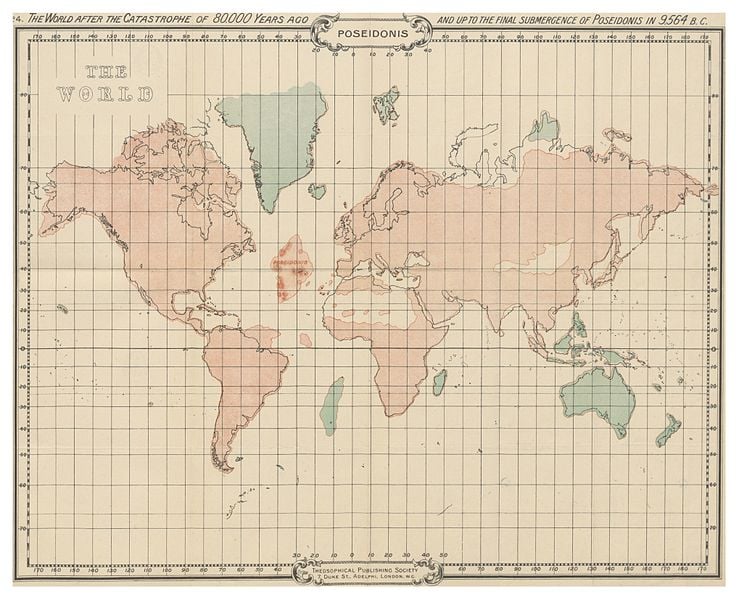
Date 1896 Accession number British Library HMNTS 10007.dd.2.
Image extracted from page 91 of The Story of Atlantis. A geographical, historical, and ethnological sketch. Illustrated by four maps of the world’s configuration at different periods …, by ELLIOT, William Scott. Original held and digitised by the British Library. Copied from Flickr.
(Public Domain)
Here already we see a connection between Númenóre and Atlantis as well as connection between Númenóre and Lewis. However, I would venture to say that this is not quite enough. First, we need to more firmly connect Númenóre to Atlantis and both to Lewis. In Letter 154, Tolkien calls Númenóre “a variety of the Atlantis tradition.” This might seem to disconnect Atlantis from Númenóre. The latter is merely a type of the former.
However, we see the connection more firmly made in Letter 227. Here again, Tolkien is writing concerning the etymology behind Númenor, as it appeared in The Lord of the Rings and noting that it is not related to numen, and that Lewis has misspelled it. Tolkien writes, however, concerning these legends and words:
“They are my own use for my own purposes of the Atlantis legend, but not based on a special knowledge, but on a special personal concern with this tradition of the culture-bearing men of the Sea, which so profoundly affected the imagination of peoples of Europe with westward-shores” (Letter 227).
Tolkien continues concerning Lewis’s trilogy (meaning his Cosmic Trilogy):
His Numinor was derived, by ear, from Númenor, and was indeed intended to refer to my work and other legends (not published) of mine, which he had heard (Letter 227).
One final piece of evidence from the Tolkien side before I move to Lewis should suffice. We learn from various letters by Tolkien that not only did Lewis hear all these stories about Númenor, but he and Tolkien had made plans to write stories about the origins of our myths. Lewis was to write about it from the perspective of space travel, Tolkien from time travel. Lewis’ Cosmic Trilogy is the result of his work on this. Tolkien never published his story, but Númenor/Atlantis was to feature. While Tolkien makes clear that Lewis had no hand in creating Númenor *(*Letter 257), it is certainly sensible that Lewis chose to connect his trilogy to Tolkien’s work on the hopes that Tolkien’s work would eventually be published. (Do read Letter 257 for some fascinating aspects of what Tolkien had hoped to do with Atlantis). In any event, Tolkien at the least saw what Lewis was doing as an attempt to graft his own trilogy onto Tolkien’s Legendarium. Letters 276 and 294 both suggest that Lewis latched onto various ideas from Tolkien’s work and knit them into his own.
So, what is the use Lewis makes of Numinor (as he spells it). One key place that Lewis uses it is in That Hideous Strength. He even writes in the preface, “Those who would like to learn further about Numinor and the True West must (alas!) await the publication of much that still exists only in the MSS. of my friend, Professor J. R. R. Tolkien” (THS, 8). But it is not limited to the veiled reference. We later learn that Merlin as a magician (I use that word quite intentionally) was related to Numinor/Atlantis. Lewis explicitly uses both terms. Lewis writes:
“He [Ransom] thought that Merlin’s art was the last survival of something older and different––something brought to Western Europe after the fall of Numinor and going back to an era in which the general relations of mind and matter on this planet had been other than those we know” (THS 198).
On the same page, Lewis writes:
“But if the only possible attraction of Bragdon lay in its association with the last vestiges of Atlantean magic, this told the Company something else. It told them that the N.I.C.E., at its core, was not concerned solely with modern or materialistic forms of power. It told the Director [Ransom], in fact, that there was ildilic energy and ildilic knowledge behind it” (THS 198).
Now, if Tolkien is correct, eldila comes from Tolkien’s Eldar, elves. If we consider that Tolkien at one point considered having his elves actually diminish (that is change in size), in early drafts of The Silmarillion, it is not too far fetched to believe that Lewis took this as an opportunity to make almost non-physical at all. This is actually made more clear when we discover that Tolkien had intended to have characters named Eadwine and Ælfwine who had later decedents, a father and son called Edwin and Elwin. Edwin was to mean “‘one loyal to the Valar, content with the bliss and prosperity within the limits described,'” and Elwin was to mean “‘one loyal to friendship with the High-elves'” (Letter 257). Lewis’s protagonist is, of course, named Elwin and we are in another book told it means friend of the eldila. The connection is not exact, and Lewis’ eldila function more like the Valar and Maiar than like the elves in Tolkien, but still the connection is clear.
This, I think, clearly connects the Cosmic Trilogy to Tolkien’s Middle-earth. What’s more, it connects The Screwtape Letters to Tolkien since they were originally conceived as being translated by Elwin Ransom. So there is only one link more to be forged in this chain I have been constructing. We need, now, to get from the Cosmic Trilogy to the Chronicles of Narnia, and for that, we need look no further than The Magician’s Nephew.
I’ve already written about how Diggory’s Uncle Andrew had a (part) fairy-godmother. Well, she bequeaths to him a box and tells him to destroy it. Uncle Andrew decides not to do as she asks and does research into it. He tells Diggory:
“‘My first task was of course to study the box itself. It was very ancient. And I knew enough even then to know that it wasn’t Greek, or Old Egyptian, or Babylonian, or Hittite, or Chinese. It was older than any of those nations. Ah––that was a great day when I at last found out the truth. The box was Atlantean; it came from the lost island of Atlantis. That meant it was centuries older than any of the stone-age things they dig up in Europe. And it wasn’t a rough, crude thing like them either. For in the very dawn of time Atlantis was already a great city with palaces and temples and learned men'” (TMN, 22).
So there we have it. While it is true that Lewis’ description of Atlantis could refer to any version of the Atlantis myth, the fact that he had already engaged that myth via Tolkien in the Cosmic Trilogy, suggests, at the very least that this is not a simple invocation of the ancient island. Rather, it is an invocation to the Atlantis story as told by Tolkien. Now, it is true that the notion of other worlds Lewis goes on to discuss via Uncle Andrew does not precisely jive with Tolkien’s work. However, even the connection between the different worlds is odd in Lewis’ work since Jadis comes from Charn (another world) but is said, in The Lion, the Witch and the Wardrobe to be descended from Lilith, Adam’s first wife. Still, I think we can safely say that this invocation of Atlantis here should make us think of the same invocation in That Hideous Strength thus connecting The Chronicles of Narnia, the Cosmic Trilogy, and The Screwtape Letters to Tolkien’s Middle-earth.
So, it is not, perhaps, as tidy as I would like it to be, but then Lewis, whom I love, was not as tidy a writer, or perhaps not as tidy an editor, as Tolkien was. I have had to conduct this “research” without access to Lewis’s letters or any of his MSS. which might either confirm or deny my theory. But, in light of the research I have been able to do, I think we can safely say that eleven of Lewis’s books and possibly some of his poetry (cf. Tolkien, Letter 294) are not only indebted to Tolkien’s Middle-earth but are actually meant to exist within the same universe (in fact on the same earth) as it. This was totally, it seems, Lewis’ intention and not Tolkien’s. Still, this reading can add some possible further depth in reading Lewis and Tolkien together.
Sincerely,
David
Previous Post

September 1, 2016
Pope Francis in Elfland: Reflections on Laudato Si' Part II
Browse Our Archives
Select a Category A Secular Age Advent Apologetics Atheism Beauty Being a Catholic Evangelical Being Catholic Being Deified: Poetry and Fantasy on the Path to God Blogging Book Reviews C. S. Lewis Catholic Imagination Catholic Social Teaching Catholicism Christmas Church Calendar Church Fathers Church Life Community Conferences Cosmology Creation Curdled Words Deification Distributism Easter Economics Education Epiphany Essay Extracts Eucharist Faerie Faeriean Metaphysics Fatherhood Films Folk Liturgy Food and Drink G. K. Chesterton Harry Potter J. R. R. Tolkien Jove King Arthur Language Lent Life Literature and Poetry Liturgy Medieval Theology Music My Publications Mythology On the Edges of Elfland Ordinary Time Ordination Parenthood Parish Patristic Theology Pentecost Politics Prayer Racism Radical Orthodoxy Restoration Movement Sacramental Ontology Saints Science Sex and Sexuality Sophiology Stories The Inklings The Radical Catholic Reimagination of Everything Theologians in the Church Theopoetics Thesis Research Uncategorized University of Nottingham What I'm Reading Writing
Select a Month December 2019 November 2019 October 2019 September 2019 August 2019 July 2019 June 2019 May 2019 April 2019 March 2019 February 2019 January 2019 December 2018 November 2018 October 2018 September 2018 August 2018 July 2018 June 2018 May 2018 April 2018 March 2018 February 2018 January 2018 December 2017 November 2017 October 2017 August 2017 July 2017 June 2017 May 2017 April 2017 March 2017 February 2017 January 2017 December 2016 November 2016 October 2016 September 2016 August 2016 July 2016 June 2016 May 2016 April 2016 March 2016 February 2016 January 2016 December 2015 November 2015 October 2015 September 2015 August 2015 July 2015 June 2015 May 2015 April 2015 March 2015 February 2015 January 2015 December 2014 November 2014 October 2014 September 2014 August 2014 July 2014 June 2014 May 2014 April 2014 March 2014 February 2014 January 2014 December 2013 November 2013 October 2013 September 2013 August 2013 July 2013 June 2013 May 2013 April 2013 March 2013 February 2013 January 2013 December 2012 November 2012 October 2012 September 2012 July 2012
Follow Us!
TAKE THE
Religious Wisdom Quiz
What Christian group refers to their leaders as "General Superintendents"?
Select your answer to see how you score.
Catholic Methodist Nazarene Orthodox
Related posts from Letters from the Edge of Elfland

Poetry, Podcasts, and More: Some Updates on Other...
Letters from the Edge of Elfland
Working on a Book of Poetry: An Apology...
Letters from the Edge of Elfland
Poetry Shapes the World around Us: Reflecting on...
Letters from the Edge of Elfland
William Blake on the Creative Spirit, Beauty, and...
Letters from the Edge of Elfland
TRENDING AT PATHEOS Catholic

How Discretion Guides Us Away From Extremes
Prudence is an important virtue for all of us. While we should...

Bad Survey Questions Distort Eucharistic Theology
It seems to be the newest thing: someone conducts a bad survey...

If Baptism Washes Away Sin, Why Do Catholics...
The seven sacraments stand as the foundation of Catholic ecclesial life. The...

The Power of Setting a Good Example
Remember last August when the Chicago White Sox hosted a "Pope Hat...

A Catholic Critique of Biblical Unitarianism
If the statistics are to be believed, Unitarianism is rising worldwide. Although...

How Grandma Tourism Helps Grandparents Live Their Vocation
Grandma, The New Travel Influencer What started as a nostalgia-inspired social media...
view all Catholic blogs
Ad-Free & Subscriber Log-In Subscription Support
- About Us
- 2026 Calendar
- Videos
- Podcasts
- Library of World Religions
- Faith In Media Tracker
- Advertise With Us
- Write for Us
- Privacy Policy
- Terms of Service
- Do Not Sell My Data
- Contact Us
- Radiant Digital
- Manage Newsletter Subscriptions
- Unsubscribe From Notifications
- Sitemap
Copyright 2008-2026, Patheos, part of the Radiant Digital network of media brands. All rights reserved.
Subscription Support Ad-Free & Subscriber Log-In
Follow Patheos